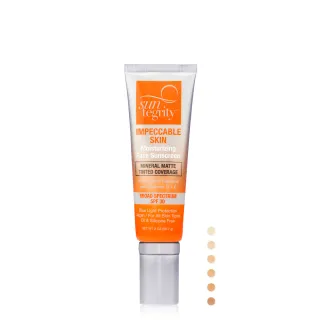
Suntegrity Impeccable Skin, Broad Spectrum SPF 30
Works for
3 of 3 advertised claims delivered
Sun protectionSPF 30 · 2 UV filtersBroad spectrum
This product offers a good level of protection against both UVB and UVA rays.
It is a mineral sunscreen. In other words, it contains non-organic UV filters. It will probably not sting your eyes but might leave a white cast.
This product can be considered "reef safe" because it does not contain the UV filters (oxybenzone and octinoxate) that can be harmful to coral reefs when present in the water in high concentrations.
Evens skin tone2 ingredients credited for this claimStrong support
“Formulated without oils or silicones, this vitamin and peptide rich technology helps to reduce the appearance of fine lines, while non-nano zinc oxide and melanin provide Broad Spectrum SPF 30 and blue light protection to help reduce future damage.”
This product offers broad spectrum sun protection. It means that it can prevent hyperpigmentation and help keep the skin tone even (sun damage is the main factor causing age spots, darkening of post-acne marks and other discolorations).
Anti-aging6 ingredients credited for this claimStrong support
“Formulated without oils or silicones, this vitamin and peptide rich technology helps to reduce the appearance of fine lines, while non-nano zinc oxide and melanin provide Broad Spectrum SPF 30 and blue light protection to help reduce future damage.”
This product can help prevent early signs of skin aging because it offers a good level of broad spectrum sun protection. Sun damage is the main cause of premature skin aging, and protecting your skin from the sun is the best anti-aging strategy.
MoisturizingNot advertised by the brand · 12 ingredients credited for this claimGood support
This product can help improve hydration of the skin with the two types of ingredients.
The first type is called “humectants”:
these ingredients help attract water.
When humectants are on the surface of the skin, they “pull in” the moisture from the outside environment, or from
within deeper layers of the skin. The following ingredients in this product do the job:
glycerin, hyaluronic acid.
This product also contains ingredients called “occlusives”. They help reduce the speed with which our skin loses moisture to the outside environment. These ingredients also help soften the upper layer of the skin, so it feels less tight and nicer to the touch. The following ingredients in this product do the job: caprylic/capric triglyceride, c12-15 alkyl benzoate.
Can it cause trouble?
Irritancy7 flagged ingredientsLow risk
ComedogenicClean of flagged comedogenic ingredientsNone flagged
User reviews
Ingredients
Filter by role to see what each ingredient is doing.
Zinc oxide15%
- Irritation risk
- Low
A broad spectrum sunblock (protects from both UVA and UVB rays). Is suitable for most sensitive skins. In small concentrations, can be used as a colorant
More about Zinc oxideAloe barbadensis leaf juice~23–35%
- Irritation risk
- Medium
Traditionally used to treat sunburns, dermatitis and inflammation, but evidence for its effectiveness is lacking. The extract can contain humectants that help attract water into the skin
More about Aloe barbadensis leaf juiceWater~8.4–12.6%
Caprylic/capric triglyceride~3.9–5.9%
- Irritation risk
- Medium
A good mix of fatty acids that forms a protective layer on the skin. Improves the shelf life of products. Derived from coconut and glycerin
More about Caprylic/capric triglycerideC13-15 alkane~3–4.5%
Glycerin~2.5–3.7%
- Irritation risk
- Low
One of the best moisturizing ingredients. Naturally present in skin. It attracts water to the upper layer of the skin working as a humectant
More about GlycerinLauroyl lysine~2–2.9%
- Irritation risk
- Low
Helps soften the upper layer of the skin and creates a nice product texture
More about Lauroyl lysinePolyglyceryl-2 oleate~1.7–2.5%
Polyhydroxystearic acid~1.4–2.1%
- Irritation risk
- Medium
Used to create a thicker product consistency and stabilize the formulation
More about Polyhydroxystearic acidC12-15 alkyl benzoate~1.1–1.7%
- Irritation risk
- Low
Enhances the product texture and makes it more spreadable. Helps reduce water loss from the outer layer of skin. Extands the shelf life by preventing bacteria growth
More about C12-15 alkyl benzoateStearalkonium hectorite~0.9–1.35%
Leuconostoc/radish root ferment filtrate~0.55–1.3%
- Irritation risk
- Medium
A preservative that comes from radishes fermented by a bacteria. New research suggests that the preservation properties in the ingredient come from an ammonium salt that is not present naturally in radish root but used in its cultivation. Is problematic because the exact amount of the preservative agents is difficult to determine
More about Leuconostoc/radish root ferment filtrateDipalmitoyl hydroxyproline~0.45–1.1%
- Irritation risk
- Low
Is claimed to stimulate collagen and elastin production, as well as work as an anti-oxidant. There is however not enough evidence for its effectiveness
More about Dipalmitoyl hydroxyprolineTetrahexyldecyl ascorbate~0.45–1.05%
- Irritation risk
- Medium
Being a lipid soluble form of vitamin C, it is more stable than ascorbic acid, but still degrades quickly and needs to be stabilized in a formulation with another ingredient. It is claimed to penetrate skin better than pure vitamin C and have the the similar benefits, but solid studies of its effectiveness are lacking. Is likely to require a higher concentration in a product than pure vitamin C to be effective. It might be able to help reduce pore clogging.
More about Tetrahexyldecyl ascorbateTocopherol~0.35–0.85%
- Irritation risk
- Low
Pure form of vitamin E. Can help moisturise and protect the skin from free radicals. Often used to help stabilise other ingredients or the formula itself
More about TocopherolKappaphycus alvarezii extract~0.35–0.75%
- Irritation risk
- Low
A red algae extract that can help attract water to the upper layer of the skin and might have some antioxidant properties
More about Kappaphycus alvarezii extractCaesalpinia spinosa fruit extract~0.35–0.8%
- Irritation risk
- Low
Melanin~0.3–0.75%
- Irritation risk
- Low
Bisabolol~0.2–0.75%
- Irritation risk
- Low
An active component of chamomile plant that historically has been used to calm down irritated skin. A recent study shows that bisabolol indeed can have some anti-inflammatory effect on skin, even though conclusive data is lacking. Bisabolol has a sweet floral scent and can be added to products for its aromatic properties
More about BisabololHyaluronic acid~0.15–0.7%
- Irritation risk
- Low
One of the best moisturizing ingredients. Attracts water into the upper layer of the skin. Naturally present in skin. Typically has large molecule size unless advertised otherwise on the product label. Helps support skin's barrier function and may help to reduce inflammation
More about Hyaluronic acidCamellia sinensis leaf extract~0.15–0.55%
- Irritation risk
- Low
Can contain potent anti-oxidant compounds (abbreviated ECG, GCG, EGC, and EGCG) that might help protect the skin from free radicals. Can help calm down inflammation and has some anti-bacterial properties. Unfortunately, these antioxidants are unstable and lose their effectiveness very quickly in products. The concentration of the antioxidant compounds in the extract also tends to be low to be effective in topical formulation
More about Camellia sinensis leaf extractPhospholipids~0.1–0.5%
- Irritation risk
- Low
Emollients that are naturaly present in skin. In addition, they help water and oil mix together in the product
More about PhospholipidsPolyglyceryl-2 stearate~0.1–0.5%
- Irritation risk
- Medium
Helps water and oil mix together
More about Polyglyceryl-2 stearateSodium chloride~0.1–0.4%
- Irritation risk
- Low
Used to stabilize mixtures of oil and water, and create thicker, gel-like product textures
More about Sodium chloridePropylene carbonate~0.1–0.4%
- Irritation risk
- Low
Is used to dissolve other ingredients and create nice product texture
More about Propylene carbonateIsopropyl titanium triisostearate~0.1–0.4%
- Irritation risk
- Medium
Helps water and oil mix together
More about Isopropyl titanium triisostearateTitanium dioxide~0.1–0.4%
- Irritation risk
- Low
Works as a UV filter when used in high concentrations. It is photostable and is effective mostly against the UVB light, with some protection in the UVA range. In small concentrations, used for its ability to improve the color of cosmetic products. Is usually well tolerated by the skin
More about Titanium dioxideIron oxides~0.05–0.15%
- Irritation risk
- Low
An umbrella term for the following three colorants: CI 77491, CI 77492, CI 77499. They might be able to offer some protection against visible light, but the degree of the protection is not clear
More about Iron oxidesIngredient list view
Zinc oxide, Aloe barbadensis leaf juice, Water, Caprylic/capric triglyceride, C13-15 alkane, Glycerin, Lauroyl lysine, Polyglyceryl-2 oleate, Polyhydroxystearic acid, C12-15 alkyl benzoate, Stearalkonium hectorite, Leuconostoc/radish root ferment filtrate, Dipalmitoyl hydroxyproline, Tetrahexyldecyl ascorbate, Tocopherol, Kappaphycus alvarezii extract, Caesalpinia spinosa fruit extract, Melanin, Bisabolol, Hyaluronic acid, Camellia sinensis leaf extract, Phospholipids, Polyglyceryl-2 stearate, Sodium chloride, Propylene carbonate, Isopropyl titanium triisostearate, Titanium dioxide, Iron oxides
Compare prices
Retailers ranked by price — lowest first.


Product summary
Based on the ingredient list, we assess that "Suntegrity - Impeccable Skin, Broad Spectrum SPF 30" can provide reliable sun protection. We love that it can protect from both UVA and UVB rays (not all sunscreens with SPF ratings give UVA protection. UVA rays do not cause sunburn, but still damage our skin and lead to early aging).
It also works as a moisturizer, so you do not have to use an additional hydrating product. Like all broad-spectrum sunscreens, this product helps prevent early signs of aging.
Sunscreen filters
This sunscreen is a mineral sunscreen. It uses titanium dioxide and zinc oxide for sun protection. Both titanium dioxide and zinc oxide almost never irritate even the most sensitive skin and eyes, but can leave a white cast.
Irritation risk
This product does not contain known common irritants and is suitable for sensitive skin. We assess the overall irritancy of this sunscreen to be low. For a detailed overview of all potential irritants: click here
You can see the detailed formula review with the breakdown of all actives in the product and the full ingredient list with estimated concentrations in the tables below.
About the brand
According to Cruelty-Free Kitty "Suntegrity" is cruelty free and so is its parent company.
Price
The product retails for 55.00$ in the United States.
For a detailed price comparison: click here.
Sources cited in this review
Every concentration estimate and effectiveness label is anchored to one of these 14 studies and safety reviews.
- 1A review of inorganic UV filters zinc oxide and titanium dioxideonlinelibrary.wiley.com
- 2
- 3
- 4
- 5
- 6

Affiliate links · As an Amazon Associate, WIMJ earns from qualifying purchases.