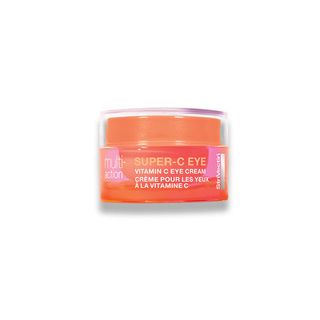
StriVectin Super-C Eye Vitamin C Eye Cream
Works for
1 of 2 advertised claims delivered
Moisturizing19 ingredients credited for this claimStrong support
“90% agreed eye area felt instantly moisturized and nourished***”
This product can help improve hydration of the skin with the two types of ingredients.
The first type is called “humectants”:
these ingredients help attract water.
When humectants are on the surface of the skin, they “pull in” the moisture from the outside environment, or from
within deeper layers of the skin. The following ingredients in this product do the job:
glycerin, hydrolyzed hyaluronic acid.
This product also contains ingredients called “occlusives”. They help reduce the speed with which our skin loses moisture to the outside environment. These ingredients also help soften the upper layer of the skin, so it feels less tight and nicer to the touch. The following ingredients in this product do the job: caprylic/capric triglyceride, dimethicone.
The following ingredients in this product are especially good for supporting the skin barrier and helping with the hydration level: panthenol
Anti-aging2 ingredients credited for this claimLimited support
“• Clinically proven to improve the look of fine lines and wrinkles, crow's feet, dark circles, and undereye puffiness.*”
This product does not contain ingredients that are able to reduce fine lines and wrinkles or help with skin elasticity, but it can improve the look of the skin temporarily through moisturization. Well-moisturized skin might also be able to repair the sun damage better.
Can it cause trouble?
Irritancy14 flagged ingredientsMedium risk
Comedogenic3 ingredients rated 2 or more on the 0–5 pore-clogging scale3 flagged


User reviews
Be the first — your take helps the next person decide.
Ingredients
Filter by role to see what each ingredient is doing.
Water~45–55%
Dimethicone~5.5–6.7%
- Irritation risk
- Low
A silicone that helps to reduce water loss from the surface of the skin. Can temporarily "fill in" lines and wrinkles, absorb oil, and create a nice product finish
More about DimethiconeCaprylic/capric triglyceride~4.4–5.4%
- Irritation risk
- Medium
A good mix of fatty acids that forms a protective layer on the skin. Improves the shelf life of products. Derived from coconut and glycerin
More about Caprylic/capric triglycerideGlycerin~3.2–3.9%
- Irritation risk
- Low
One of the best moisturizing ingredients. Naturally present in skin. It attracts water to the upper layer of the skin working as a humectant
More about GlycerinC12-15 alkyl benzoate~2.5–3%
- Irritation risk
- Low
Enhances the product texture and makes it more spreadable. Helps reduce water loss from the outer layer of skin. Extands the shelf life by preventing bacteria growth
More about C12-15 alkyl benzoatePropanediol~2–2.5%
- Irritation risk
- Low
Acts as a solvent for other ingredients. Speeds up the absorption of other ingredients into the skin
More about PropanediolGlyceryl stearate~1.7–2.1%
- Irritation risk
- Low
An emollient that softens the skin and forms a protective layer on its surface. Helps water and oil mix together
More about Glyceryl stearatePeg-100 stearate~1.5–1.9%
- Irritation risk
- Low
Helps oil and water mix togehter and creates a nice product texture
More about Peg-100 stearateMyristyl nicotinate~1.2–1.4%
- Irritation risk
- Low
Stearyl alcohol~1.1–1.3%
- Irritation risk
- Low
An emollient that helps soften the skin
More about Stearyl alcoholMyristyl myristate~0.75–1.15%
- Irritation risk
- Medium
- Comedogenicity
- 3/5
An emollient. Is not recommended for acne-prone skin as it can be comedogenic
More about Myristyl myristateIsocetyl stearate~0.6–0.9%
- Irritation risk
- Low
An emollient that helps soften the skin
More about Isocetyl stearatePentylene glycol~0.55–0.85%
- Irritation risk
- Medium
Used to preserve products, dissolve other ingredients and create a nice product texture
More about Pentylene glycolHydrogenated ethylhexyl olivate~0.5–0.75%
- Irritation risk
- Low
Helps soften the upper layer of the skin
More about Hydrogenated ethylhexyl olivateArachidyl alcohol~0.45–0.7%
- Irritation risk
- Low
Used to soften the upper layer of the skin and create a thicker product consistency
More about Arachidyl alcoholBis-stearyl dimethicone~0.45–0.7%
- Irritation risk
- Low
Tetrahexyldecyl ascorbate~0.4–0.6%
- Irritation risk
- Medium
Being a lipid soluble form of vitamin C, it is more stable than ascorbic acid, but still degrades quickly and needs to be stabilized in a formulation with another ingredient. It is claimed to penetrate skin better than pure vitamin C and have the the similar benefits, but solid studies of its effectiveness are lacking. Is likely to require a higher concentration in a product than pure vitamin C to be effective. It might be able to help reduce pore clogging.
More about Tetrahexyldecyl ascorbateIpomoea batatas root extract~0.3–0.6%
- Irritation risk
- Low
Rosa canina fruit oil~0.35–0.6%
- Irritation risk
- Medium
A great emollient. Contains vitamin E (tocopherol) which may give it some anti-oxidant properties. Can contain volatile compounds and can be irritating
More about Rosa canina fruit oilFucus vesiculosus extract~0.25–0.5%
- Irritation risk
- Low
- Comedogenicity
- 3/5
Arachidyl glucoside~0.25–0.5%
1,2-hexanediol~0.25–0.45%
Methylpropanediol~0.2–0.4%
Behenyl alcohol~0.25–0.5%
- Irritation risk
- Low
Non-drying alcohol that helps water and oil mix together. Also serves as an emollient
More about Behenyl alcoholXanthan gum~0.25–0.4%
- Irritation risk
- Low
Used to create a thicker product consistency
More about Xanthan gumAcrylamide/sodium acryloyldimethyltaurate copolymer~0.2–0.4%
- Irritation risk
- Low
Helps water and oil mix together and create gel-like textures
More about Acrylamide/sodium acryloyldimethyltaurate copolymerPanthenol~0.2–0.4%
- Irritation risk
- Low
Helps attract water to the upper layer of the skin and can help improve skin barrier function
More about PanthenolPolysilicone-11~0.25–0.45%
- Irritation risk
- Low
A silicone that forms a light film on the skin surface helping to bind water and temporarily absorb oils creating a matt and powdery feel
More about Polysilicone-11Isohexadecane~0.3–0.55%
- Irritation risk
- Low
Improves the texture of the product and helps soften the skin. Helps oil and water mix together and can be used as a cleansing agent
More about IsohexadecaneCaprylhydroxamic acid~0.2–0.4%
Synthetic fluorphlogopite~0.25–0.4%
- Irritation risk
- Low
A mineral that is used as an optical filter (makes the skin looks nicer through light reflection) and to improve the texture of cosmetic products
More about Synthetic fluorphlogopiteHydrogenated olive oil unsaponifiables~0.25–0.45%
- Irritation risk
- Low
Help soften the upper layer of the skin
More about Hydrogenated olive oil unsaponifiablesTitanium dioxide~0.3–0.55%
- Irritation risk
- Low
Works as a UV filter when used in high concentrations. It is photostable and is effective mostly against the UVB light, with some protection in the UVA range. In small concentrations, used for its ability to improve the color of cosmetic products. Is usually well tolerated by the skin
More about Titanium dioxideDisodium edta~0.2–0.4%
Hydrolyzed hyaluronic acid~0.2–0.4%
- Irritation risk
- Low
One of the best moisturizing ingredients. Attracts water into the upper layer of the skin. A version of it is naturally present in skin
More about Hydrolyzed hyaluronic acidMica~0.25–0.45%
- Irritation risk
- Low
Creates an illusion of smoother and more radiant skin tone. Adds shimmer to the skin by reflecting light
More about MicaPolysorbate 80~0.25–0.4%
Ci 77492~0.2–0.35%
Ascorbyl methylsilanol pectinate~0.2–0.35%
- Irritation risk
- Medium
A stable derivative of pectin and vitamin C. It might help neutralize free radicals in skin, but evidence of effectiveness is lacking. Helps create a thicker product consistency and stabilize the product formulation
More about Ascorbyl methylsilanol pectinateSorbitan oleate~0.2–0.35%
- Irritation risk
- Medium
- Comedogenicity
- 2/5
Helps oil and water mix together
More about Sorbitan oleateHexylene glycol~0.15–0.3%
- Irritation risk
- Medium
Helps create a more spreadable product texture
More about Hexylene glycolCaprylyl glycol~0.2–0.35%
- Irritation risk
- Medium
Helps preserve products and creates a nice product texture
More about Caprylyl glycolSodium sulfate~0.15–0.3%
- Irritation risk
- Medium
Used to improve the product consistency and stabilize formulations
More about Sodium sulfateTin oxide~0.2–0.35%
- Irritation risk
- Low
A colorant that can add a pearl-like appearance to the formulation
More about Tin oxideTocopherol~0.1–0.2%
- Irritation risk
- Low
Pure form of vitamin E. Can help moisturise and protect the skin from free radicals. Often used to help stabilise other ingredients or the formula itself
More about TocopherolIngredient list view
Water, Dimethicone, Caprylic/capric triglyceride, Glycerin, C12-15 alkyl benzoate, Propanediol, Glyceryl stearate, Peg-100 stearate, Myristyl nicotinate, Stearyl alcohol, Myristyl myristate, Isocetyl stearate, Pentylene glycol, Hydrogenated ethylhexyl olivate, Arachidyl alcohol, Bis-stearyl dimethicone, Tetrahexyldecyl ascorbate, Ipomoea batatas root extract, Rosa canina fruit oil, Fucus vesiculosus extract, Arachidyl glucoside, 1,2-hexanediol, Methylpropanediol, Behenyl alcohol, Xanthan gum, Acrylamide/sodium acryloyldimethyltaurate copolymer, Panthenol, Polysilicone-11, Isohexadecane, Caprylhydroxamic acid, Synthetic fluorphlogopite, Hydrogenated olive oil unsaponifiables, Titanium dioxide, Disodium edta, Hydrolyzed hyaluronic acid, Mica, Polysorbate 80, Ci 77492, Ascorbyl methylsilanol pectinate, Sorbitan oleate, Hexylene glycol, Caprylyl glycol, Unknown, Sodium sulfate, Tin oxide, Tocopherol
Compare prices
Retailers ranked by price — lowest first.

Worth comparing, line by line.
Match % combines shared ingredients, the first five ingredients, shared actives and hero ingredients, irritancy (lower counts in the alternative's favour), texture and body area. Only products in the same routine step are compared.
| StriVectinSuper-C Eye Vitamin C Eye CreamYOUR PRODUCT | OARS + ALPSFace + Eye Cream | Beyou CosmeticsCaffeine Eye Cream | BaleaQ10 Anti-Age Eye Cream | |
|---|---|---|---|---|
| Match | — | 61% | 60% | 60% |
| Price | $65.00 | $2.00−$63.00 | $18.99−$46.01 | $4.89−$60.11 |
| Shared key ingredients | — | 4 of 10 | 4 of 10 | 4 of 10 |
| Key difference | — | Carthamus Tinctorius Seed Oil | Niacinamide | Carthamus Tinctorius Seed Oil |
| Irritancy | Medium | Low | Low | Low |
| Drying alcohol | — | — | — | — |
| View product | Shop | Shop | Shop |


Sources cited in this review
Every concentration estimate and effectiveness label is anchored to one of these 15 studies and safety reviews.
- 1
- 2Final Report on the Safety Assessment of Dimethicone Copolyoljournals.sagepub.com
- 3
- 4
- 5
- 6

Affiliate links · As an Amazon Associate, WIMJ earns from qualifying purchases.