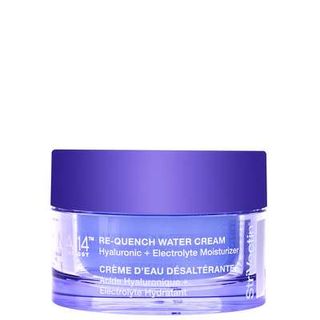
StriVectin Advanced Hydration Re-Quench Water Cream
Works for
1 of 1 advertised claim delivered
Moisturizing20 ingredients credited for this claimStrong support
“Advanced Hydration Re-Quench Water Cream”
This product can help improve hydration of the skin with the two types of ingredients.
The first type is called “humectants”:
these ingredients help attract water.
When humectants are on the surface of the skin, they “pull in” the moisture from the outside environment, or from
within deeper layers of the skin. The following ingredients in this product do the job:
betaine, fructooligosaccharides.
This product also contains ingredients called “occlusives”. They help reduce the speed with which our skin loses moisture to the outside environment. These ingredients also help soften the upper layer of the skin, so it feels less tight and nicer to the touch. The following ingredients in this product do the job: dimethicone, caprylyl glycol.
The following ingredients in this product are especially good for supporting the skin barrier and helping with the hydration level: isosorbide dicaprylate
Can it cause trouble?
Irritancy7 strong irritants: Citrus aurantium dulcis fruit water, Parfum + 5 more — patch-test recommendedHigh risk
ComedogenicClean of flagged comedogenic ingredientsNone flagged
User reviews
Be the first — your take helps the next person decide.
Ingredients
Filter by role to see what each ingredient is doing.
Water~45–55%
Dimethicone~5.3–6.5%
- Irritation risk
- Low
A silicone that helps to reduce water loss from the surface of the skin. Can temporarily "fill in" lines and wrinkles, absorb oil, and create a nice product finish
More about DimethiconePropanediol~4.2–5.1%
- Irritation risk
- Low
Acts as a solvent for other ingredients. Speeds up the absorption of other ingredients into the skin
More about PropanediolGlycerin~3.1–3.8%
- Irritation risk
- Low
One of the best moisturizing ingredients. Naturally present in skin. It attracts water to the upper layer of the skin working as a humectant
More about GlycerinHydroxyethyl acrylate/sodium acryloyldimethyl taurate copolymer~2.3–2.9%
- Irritation risk
- Medium
A gelling agent that thickens the product consistency and leaves the skin with a velvety finish
More about Hydroxyethyl acrylate/sodium acryloyldimethyl taurate copolymerHydrolyzed vegetable protein~1.9–2.3%
Polymethylsilsesquioxane/silica crosspolymer~1.7–2%
- Irritation risk
- Low
A type of silicone that helps add a "soft focus" effect on the surface of the skin and create a nice product texture
More about Polymethylsilsesquioxane/silica crosspolymerFructooligosaccharides~1.4–1.7%
- Irritation risk
- Low
Help attract water to the upper layer of the skin
More about FructooligosaccharidesIsosorbide dicaprylate~1.2–1.5%
- Irritation risk
- Low
Helps soften the upper layer of the skin. Early studies suggest that it can help strengthen the skin barrier
More about Isosorbide dicaprylatePolysilicone-11~1–1.3%
- Irritation risk
- Low
A silicone that forms a light film on the skin surface helping to bind water and temporarily absorb oils creating a matt and powdery feel
More about Polysilicone-11Betaine~0.7–1%
- Irritation risk
- Low
Helps attract water to the upper layer of the skin and improves the product texture
More about BetaineMyristyl nicotinate~0.6–0.85%
- Irritation risk
- Low
Beta vulgaris~0.55–0.8%
- Irritation risk
- Low
Beta vulgaris root extract~0.5–0.7%
- Irritation risk
- Medium
A plant extract that might have some antioxidant properties, but mostly used in cosmetics for its color
More about Beta vulgaris root extractBeta vulgaris~0.45–0.7%
- Irritation risk
- Low
Nelumbo nucifera root water~0.45–0.65%
- Irritation risk
- Low
Citrus aurantium dulcis fruit water~0.45–0.65%
- Irritation risk
- High
Leuconostoc ferment filtrate~0.4–0.6%
Hydrolyzed hyaluronic acid~0.3–0.6%
- Irritation risk
- Low
One of the best moisturizing ingredients. Attracts water into the upper layer of the skin. A version of it is naturally present in skin
More about Hydrolyzed hyaluronic acid1,2-hexanediol~0.3–0.6%
Trehalose~0.3–0.55%
- Irritation risk
- Low
A sugar that attracts water to the upper layer of the skin
More about TrehaloseHexylene glycol~0.3–0.55%
- Irritation risk
- Medium
Helps create a more spreadable product texture
More about Hexylene glycolSaccharide isomerate~0.25–0.5%
- Irritation risk
- Low
Helps attract water to the upper layer of the skin
More about Saccharide isomerateCetearyl olivate~0.3–0.55%
Isononyl isononanoate~0.3–0.55%
- Irritation risk
- Low
Forms a protective film on the surface of the skin to prevent moisture loss. Gives a velvety feel to products while reducing tackiness
More about Isononyl isononanoateButylene glycol~0.3–0.5%
- Irritation risk
- Low
Used to create a nice product texture and help delivery of other ingredients. Might be somewhat helpful in attracting water to the upper layer of the skin
More about Butylene glycolEthylhexyl isononanoate~0.3–0.6%
- Irritation risk
- Low
Helps soften the upper layer of the skin and improve the product consistency
More about Ethylhexyl isononanoateSorbitan olivate~0.3–0.55%
Trisodium ethylenediamine disuccinate~0.25–0.5%
- Irritation risk
- Medium
Used to improve stability of the formulation
More about Trisodium ethylenediamine disuccinateSorbitan isostearate~0.3–0.55%
- Irritation risk
- Low
Helps oil and water mix together
More about Sorbitan isostearateDecyl glucoside~0.4–0.6%
- Irritation risk
- High
Helps oil and water mix together. Can be irritating
More about Decyl glucosideCaprylyl glycol~0.3–0.55%
- Irritation risk
- Medium
Helps preserve products and creates a nice product texture
More about Caprylyl glycolMagnesium aspartate~0.25–0.5%
- Irritation risk
- Low
Might be helpful in restoring skin barrier function and calm down inflammation in skin
More about Magnesium aspartateZinc gluconate~0.25–0.5%
- Irritation risk
- Medium
Typically used to stabilize the product formulations. It is a salt of a polyhydroxy acid (PHA) and in larger concentrations, can help shed the dead cells from the skin surface revealing smoother skin. It can help attract water to the upper layer of the skin. Might to be helpful against acne and clogged pores. Could be helpful in neutralizing free radicals, but solid research is missing. Due to the zinc content, might help calm down inflammation in skin
More about Zinc gluconateCopper gluconate~0.25–0.5%
- Irritation risk
- Medium
Typically used to stabilize the product formulations. It is a salt of polyhydroxy acid (PHA) and in larger concentrations, can help shed the dead cells from the skin surface revealing smoother skin. It can help attract water to the upper layer of the skin. Might to be helpful against acne and clogged pores. Could be helpful in neutralizing free radicals, but solid research is missing
More about Copper gluconatePolyisobutene~0.3–0.55%
Polysorbate 60~0.3–0.55%
Aloe barbadensis leaf juice powder~0.25–0.5%
- Irritation risk
- Medium
Traditionally used to treat sunburns, dermatitis and inflammation, but evidence for its effectiveness is lacking. The extract can contain humectants that help attract water into the skin
More about Aloe barbadensis leaf juice powderPeg-7 trimethylolpropane coconut ether~0.3–0.55%
Caprylhydroxamic acid~0.25–0.5%
Potassium lactate~0.25–0.5%
- Irritation risk
- Low
Lactic acid~0.25–0.5%
- Irritation risk
- Medium
An exfoliating and moisturizing alpha-hydroxy acid (AHA). Typically causes less irritation than other AHAs, for example, glycolic acid. At high concentrations (about 15%), lactic acid can help reduce lines and wrinkles. Recent studies show that lactic acid can support the "good" bacteria living on skin's surface (healthy skin microbiome)
More about Lactic acidParfum~0.25–0.45%
- Irritation risk
- High
An aromatic blend of unspecified and possibly irritating ingredients
More about ParfumBenzyl benzoate~0.25–0.45%
- Irritation risk
- High
Fragrance with sweet balsamic smell. Help to preserve products and dissolve other ingredients. Could trigger allergic reactions and be irritating
More about Benzyl benzoateLimonene~0.2–0.4%
- Irritation risk
- High
A common frangrance that can easily irritate skin, especially if exposed to air, light or heat
More about LimoneneLinalool~0.2–0.4%
Citral~0.2–0.35%
Citronellol~0.2–0.35%
Phenoxyethanol~0.2–0.35%
- Irritation risk
- Low
A preservative. It helps prevent bacterial growth in cosmetic products
More about PhenoxyethanolCitric acid~0.15–0.3%
- Irritation risk
- Medium
Can work as an exfoliant but is typically used to adjust the product pH
More about Citric acidSodium citrate~0.15–0.3%
- Irritation risk
- Medium
Helps to control the skin's pH level. Maintains the skin's natural film of amino-lactic acids and oils. Helps to preserve products
More about Sodium citrateCi 17200~0.15–0.3%
Ci 42090~0.1–0.2%
Ingredient list view
Water, Dimethicone, Propanediol, Glycerin, Hydroxyethyl acrylate/sodium acryloyldimethyl taurate copolymer, Hydrolyzed vegetable protein, Polymethylsilsesquioxane/silica crosspolymer, Fructooligosaccharides, Isosorbide dicaprylate, Polysilicone-11, Betaine, Myristyl nicotinate, Beta vulgaris, Beta vulgaris root extract, Beta vulgaris, Nelumbo nucifera root water, Citrus aurantium dulcis fruit water, Leuconostoc ferment filtrate, Hydrolyzed hyaluronic acid, 1,2-hexanediol, Trehalose, Hexylene glycol, Saccharide isomerate, Cetearyl olivate, Isononyl isononanoate, Butylene glycol, Ethylhexyl isononanoate, Sorbitan olivate, Trisodium ethylenediamine disuccinate, Sorbitan isostearate, Decyl glucoside, Caprylyl glycol, Magnesium aspartate, Zinc gluconate, Copper gluconate, Polyisobutene, Polysorbate 60, Aloe barbadensis leaf juice powder, Peg-7 trimethylolpropane coconut ether, Caprylhydroxamic acid, Potassium lactate, Lactic acid, Parfum, Benzyl benzoate, Limonene, Linalool, Citral, Citronellol, Phenoxyethanol, Citric acid, Sodium citrate, Ci 17200, Ci 42090
Compare prices
Retailers ranked by price — lowest first.
Affiliate links · prices updated regularly · As an Amazon Associate, WIMJ earns from qualifying purchases.
Product summary
"StriVectin - Advanced Hydration Re-Quench Water Cream" has a good moisturizing formula. To work well, any moisturizer needs to include a combination of water-binding and emollient ingredients. StriVectin - Advanced Hydration Re-Quench Water Cream ticks this box. Humectants in this product (betaine, fructooligosaccharides, glycerin, hydrolyzed hyaluronic acid and saccharide isomerate) help to increase the water content in the upper layer of the skin. (These ingredients do so by "capturing" water molecules from the outside air or from within the deeper layers of the skin). Emollients in this formulation (isosorbide dicaprylate, dimethicone, caprylyl glycol and ethylhexyl isononanoate) help to reduce the moisture loss from the skin. They also soften the skin surface and relieve the feeling of dryness and tightness.
Irritation risk
There are quite a few common irritants in this product, including ingredients without particular skin benefits. We would not recommend it for sensitive skin. We assess the overall irritancy of this moisturizer to be high. For a detailed overview of all potential irritants: click here
You can see the detailed formula review with the breakdown of all actives in the product and the full ingredient list with estimated concentrations in the tables below.
Price
The product retails for 27.20£ in the United Kingdom and for 59.00$ in the United States.
For a detailed price comparison: click here.
Sources cited in this review
Every concentration estimate and effectiveness label is anchored to one of these 20 studies and safety reviews.
- 1
- 2Final Report on the Safety Assessment of Dimethicone Copolyoljournals.sagepub.com
- 3
- 4
- 5
- 6Efficacy of a New Topical Nano-hyaluronic Acid in Humansncbi.nlm.nih.gov

Affiliate links · As an Amazon Associate, WIMJ earns from qualifying purchases.