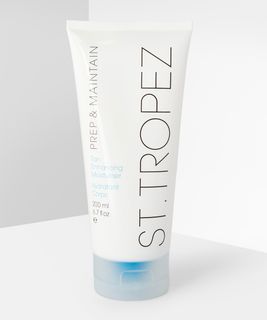
St. Tropez Prep And Maintain Tan Enhancing Moisturiser
Works for
1 of 1 advertised claim delivered
Moisturizing21 ingredients credited for this claimStrong support
“A nourishing moisturiser to prolong tan.”
This product can help improve hydration of the skin with the two types of ingredients.
The first type is called “humectants”:
these ingredients help attract water.
When humectants are on the surface of the skin, they “pull in” the moisture from the outside environment, or from
within deeper layers of the skin. The following ingredients in this product do the job:
glycerin, glucose.
This product also contains ingredients called “occlusives”. They help reduce the speed with which our skin loses moisture to the outside environment. These ingredients also help soften the upper layer of the skin, so it feels less tight and nicer to the touch. The following ingredients in this product do the job: butyrospermum parkii butter, dimethicone.
The following ingredients in this product are especially good for supporting the skin barrier and helping with the hydration level: panthenol
Anti-oxidationNot advertised by the brand · 12 ingredients credited for this claimModerate support
This product contains antioxidants (tocopheryl linoleate) that might be able to help neutralize free radicals in skin to lessen the damage it gets from the UV light (sun). There is not enough evidence to confirm their effectiveness in skin though.
Can it cause trouble?
Irritancy17 strong irritants: Orchis mascula flower extract, Rosmarinus officinalis leaf extract + 15 more — patch-test recommendedHigh risk
Comedogenic3 ingredients rated 2 or more on the 0–5 pore-clogging scale3 flagged


User reviews
Be the first — your take helps the next person decide.
Ingredients
Filter by role to see what each ingredient is doing.
Water~45–55%
Prunus armeniaca kernel oil~3.8–4.7%
- Irritation risk
- Medium
An emollient that helps soften the skin
More about Prunus armeniaca kernel oilStearic acid~4.1–5.1%
- Irritation risk
- Low
Helps oil and water mix together and works as an emollient
More about Stearic acidGlycerin~2.9–3.6%
- Irritation risk
- Low
One of the best moisturizing ingredients. Naturally present in skin. It attracts water to the upper layer of the skin working as a humectant
More about GlycerinButyrospermum parkii butter~2.3–2.9%
- Irritation risk
- Low
- Comedogenicity
- 3/5
A great moisturising ingredient that softens the skin and reduces water loss from its upper layer. It also can be helpful in protecting skin from free radicals
More about Butyrospermum parkii butterJojoba esters~1.9–2.3%
- Irritation risk
- Medium
An emollient made of jojoba oil. Helps soften the skin and support its barrier function
More about Jojoba estersGlyceryl stearate~1.6–1.9%
- Irritation risk
- Low
An emollient that softens the skin and forms a protective layer on its surface. Helps water and oil mix together
More about Glyceryl stearateDimethicone~1.5–1.8%
- Irritation risk
- Low
A silicone that helps to reduce water loss from the surface of the skin. Can temporarily "fill in" lines and wrinkles, absorb oil, and create a nice product finish
More about DimethiconeAloe barbadensis leaf juice powder~1.1–1.3%
- Irritation risk
- Medium
Traditionally used to treat sunburns, dermatitis and inflammation, but evidence for its effectiveness is lacking. The extract can contain humectants that help attract water into the skin
More about Aloe barbadensis leaf juice powderAloe barbadensis leaf extract~1–1.2%
- Irritation risk
- Medium
Traditionally used to treat sunburns, dermatitis and inflammation, but evidence for its effectiveness is lacking. The extract can contain humectants that help attract water into the skin
More about Aloe barbadensis leaf extractSimmondsia chinensis seed oil~0.75–1.1%
- Irritation risk
- Medium
Softens the upper layer of skin and helps restore the healthy skin barrier. Has shown to help calm down inflammation in skin. It is a stable oil, meaning that it retains its properties even when exposed to air.
More about Simmondsia chinensis seed oilOrchis mascula flower extract~0.5–0.8%
Aleurites moluccanus seed oil~0.5–0.75%
- Irritation risk
- Low
Helps soften the upper layer of the skin
More about Aleurites moluccanus seed oilTyrosine~0.45–0.7%
Panthenol~0.45–0.65%
- Irritation risk
- Low
Helps attract water to the upper layer of the skin and can help improve skin barrier function
More about PanthenolRosmarinus officinalis leaf extract~0.4–0.6%
- Irritation risk
- High
Can be helpful in reducing inflammation in skin, including inflamed acne. It can be irritating
More about Rosmarinus officinalis leaf extractChamomilla recutita flower extract~0.4–0.6%
- Irritation risk
- High
Plant extract that can have healing and anti-inflammatory properties. It is a potential allergen and can be irritating
More about Chamomilla recutita flower extractCucumis sativus fruit extract~0.35–0.65%
- Irritation risk
- Medium
Might be somewhat helpful in reducing hyperpigmentation and neutralizing free radicals but its typical concentration in a product is too low for having an effect
More about Cucumis sativus fruit extractHypericum perforatum extract~0.3–0.6%
- Irritation risk
- Low
Aesculus hippocastanum seed extract~0.3–0.5%
- Irritation risk
- High
Plant extract. Might have some anti-oxidant properties. Can be irritating
More about Aesculus hippocastanum seed extractHumulus lupulus extract~0.25–0.5%
- Irritation risk
- High
Hops extract. Can contain common irritants and allergens geraniol, limonene, linalool
More about Humulus lupulus extractEquisetum hyemale extract~0.25–0.5%
- Irritation risk
- Low
Arnica montana flower extract~0.2–0.4%
- Irritation risk
- High
A plant extract that can be irritating. It can have some anti-bacterial properties, but there are no evidence of a beneficial effect for skin
More about Arnica montana flower extractCitrus grandis fruit extract~0.2–0.4%
- Irritation risk
- High
Sambucus nigra flower extract~0.25–0.45%
- Irritation risk
- High
A plant extract that might help neutralize free radicals in skin
More about Sambucus nigra flower extractValeriana officinalis root extract~0.25–0.45%
- Irritation risk
- Low
Calendula officinalis flower extract~0.2–0.4%
- Irritation risk
- High
A plant extract that has some anti-oxidant and anti-bacterial properties. Can be irritating
More about Calendula officinalis flower extractTriticum vulgare germ oil~0.3–0.55%
- Irritation risk
- Low
- Comedogenicity
- 3/5
A good emoillient. Contains vitamin E which can help neutralise free radicals, however the oil is unstable. Avoid if you have gluten or wheat sensitivity (including food allergies).
More about Triticum vulgare germ oilGlucose~0.25–0.45%
- Irritation risk
- Low
Helps attract water to the upper layer of the skin. Could be helpful in restoring the skin barrier function
More about GlucoseTocopheryl acetate~0.25–0.5%
- Irritation risk
- Medium
A more stable but less bio-available form of vitamin E compared to Tocopherol. Might help moisturize and protect the skin from free radicals, but mostly used in low concentrations to stabilize other ingredients.
More about Tocopheryl acetateRetinyl palmitate~0.25–0.45%
- Irritation risk
- High
Three steps removed from the active form of vitamin A - retinoic acid. To have an effect in the skin, it first needs to be converted twice to become the retinoic acid. This means it is less potent than retinol, but could also be less irritating. Once converted to the retinoic acid in the skin, it helps against all signs of aging, improves skin cell turnover and helps fight blemishes and clogged pores. However, in many cosmetic formulations, it is used in a concentration that is too low to have the full effect
More about Retinyl palmitateAscorbic acid~0.25–0.45%
- Irritation risk
- High
The most well-researched antioxidant that works in skin. Helps neutralize free radicals supporting collagen production, helping to even out the skin tone and preventing early signs of aging
More about Ascorbic acidTocopheryl linoleate~0.25–0.45%
- Irritation risk
- Medium
A relative of vitamin E (Tocopherol). It can have an anti-oxidant effect in skin and/or to stabilize the product fromulation. It could be irritating but most of the reported allergy and irritation cases appeared in one geographic location (Switzerland) in 1992, and might be due to the quality issues in manufacturing of a particular batch of the ingredient
More about Tocopheryl linoleateCarthamus tinctorius seed oil~0.3–0.55%
- Irritation risk
- Low
An emollient that helps soften the skin and might help calm down inflammation
More about Carthamus tinctorius seed oilMyristyl myristate~0.25–0.5%
- Irritation risk
- Medium
- Comedogenicity
- 3/5
An emollient. Is not recommended for acne-prone skin as it can be comedogenic
More about Myristyl myristateMyristyl laurate~0.25–0.45%
Butylene glycol~0.25–0.45%
- Irritation risk
- Low
Used to create a nice product texture and help delivery of other ingredients. Might be somewhat helpful in attracting water to the upper layer of the skin
More about Butylene glycolCorn starch modified~0.25–0.5%
Propylene glycol~0.25–0.45%
- Irritation risk
- High
Helps oil and water mix together and can enhance the penetration of other ingredients into the skin. It can be irritating
More about Propylene glycolTriethanolamine~0.25–0.5%
- Irritation risk
- Medium
Used to adjust pH of the product and can help improve the product's smell
More about TriethanolamineCarbomer~0.25–0.45%
- Irritation risk
- Low
Helps create a thicker or gel-like product texture. It is not a surfactant but can be used in gentle cleansing formulations
More about CarbomerPhenoxyethanol~0.25–0.5%
- Irritation risk
- Low
A preservative. It helps prevent bacterial growth in cosmetic products
More about PhenoxyethanolEthylhexylglycerin~0.25–0.45%
Glyceryl undecylenate~0.3–0.5%
- Irritation risk
- Medium
Helps oil and water mix together and helps preserve the product formulation
More about Glyceryl undecylenateDisodium edta~0.2–0.4%
Parfum~0.2–0.35%
- Irritation risk
- High
An aromatic blend of unspecified and possibly irritating ingredients
More about ParfumCinnamal~0.15–0.3%
- Irritation risk
- High
Coumarin~0.15–0.25%
Limonene~0.15–0.25%
- Irritation risk
- High
A common frangrance that can easily irritate skin, especially if exposed to air, light or heat
More about LimoneneEugenol~0.1–0.2%
Alpha-isomethyl ionone~0.1–0.2%
- Irritation risk
- High
A fragrance. Potential allergen and can be irritating
More about Alpha-isomethyl iononeGeraniol~0.1–0.2%
Hexyl cinnamal~0.1–0.2%
Isoeugenol~0.05–0.1%
- Irritation risk
- High
Linalool~0.05–0.1%
Ingredient list view
Water, Prunus armeniaca kernel oil, Stearic acid, Glycerin, Butyrospermum parkii butter, Jojoba esters, Glyceryl stearate, Dimethicone, Aloe barbadensis leaf juice powder, Aloe barbadensis leaf extract, Simmondsia chinensis seed oil, Orchis mascula flower extract, Aleurites moluccanus seed oil, Tyrosine, Panthenol, Rosmarinus officinalis leaf extract, Chamomilla recutita flower extract, Cucumis sativus fruit extract, Hypericum perforatum extract, Aesculus hippocastanum seed extract, Humulus lupulus extract, Equisetum hyemale extract, Arnica montana flower extract, Citrus grandis fruit extract, Sambucus nigra flower extract, Valeriana officinalis root extract, Calendula officinalis flower extract, Triticum vulgare germ oil, Glucose, Tocopheryl acetate, Retinyl palmitate, Ascorbic acid, Tocopheryl linoleate, Carthamus tinctorius seed oil, Myristyl myristate, Myristyl laurate, Butylene glycol, Corn starch modified, Propylene glycol, Triethanolamine, Carbomer, Phenoxyethanol, Ethylhexylglycerin, Glyceryl undecylenate, Disodium edta, Parfum, Cinnamal, Coumarin, Limonene, Eugenol, Alpha-isomethyl ionone, Geraniol, Hexyl cinnamal, Isoeugenol, Linalool
Compare prices
Retailers ranked by price — lowest first.

Worth comparing, line by line.
Match % combines shared ingredients, the first five ingredients, shared actives and hero ingredients, irritancy (lower counts in the alternative's favour), texture and body area. Only products in the same routine step are compared.
| St. TropezPrep And Maintain Tan Enhancing MoisturiserYOUR PRODUCT | NaturiumBio-Lipid Restoring Body Lotion | The Body ShopAlmond Milk Body Butter | Gold BondMen's Essentials Everyday Moisture Lotion | |
|---|---|---|---|---|
| Match | — | 56% | 56% | 55% |
| Price | $14.48 | $14.88 | $11.50−$2.98 | $12.49−$1.99 |
| Shared key ingredients | — | 5 of 16 | 4 of 16 | 4 of 16 |
| Key difference | — | Niacinamide | Sunflower Seed Oil | Niacinamide |
| Irritancy | High | Medium | Medium | Medium |
| Drying alcohol | — | — | — | — |
| View product | Shop | Shop | Shop |


Product summary
Based on the ingredient list, "St. Tropez - Prep And Maintain Tan Enhancing Moisturiser" can work well for skin moisturization. As we expect from a proper moisturizer, the formula includes a combo of effective humectants and emollients. These are the two different types of ingredients that are essential for improving the skin hydration and supporting a healthy skin barrier. Humectants in this product (panthenol, glycerin, glucose, aloe barbadensis leaf extract and butylene glycol) help to increase the water content in the upper layer of the skin. (These ingredients do so by "capturing" water molecules from the outside air or from within the deeper layers of the skin). Emollients in this formulation (carthamus tinctorius seed oil, jojoba esters, prunus armeniaca kernel oil, triticum vulgare germ oil and butyrospermum parkii butter) help to reduce the moisture loss from the skin. They also soften the skin surface and relieve the feeling of dryness and tightness.
Ingredient callouts
- This product also contains Vitamin C (Ascorbic Acid). It can be an effective active for anti-aging and evening out the skin tone, but in this moisturizer it is used for stabilizing other ingredients in the formulation. In this concentration (0.25% - 0.45%) it cannot have a noticeable benefit for the skin.
- This moisturizer includes a form of Retinoids (vitamin A) - retinyl palmitate 0.25% - 0.45%, but this type of vitamin A is not very effective. It could in theory help with fine lines and wrinkles, but the effect is most likely minimal.
Irritation risk
This moisturizer contains a bunch of common irritants, including ingredients that do not provide any known benefit for the skin. It might not be the best choice if your skin is sensitive. We assess the overall irritancy of this moisturizer to be high. For a detailed overview of all potential irritants: click here
You can see the detailed formula review with the breakdown of all actives in the product and the full ingredient list with estimated concentrations in the tables below.
About the brand
According to Cruelty-Free Kitty "St. Tropez" is cruelty free and so is its parent company.
Price
The product retails for 10.00£ in the United Kingdom and for 10.95£ in the United Kingdom.
For a detailed price comparison: click here.
Sources cited in this review
Every concentration estimate and effectiveness label is anchored to one of these 25 studies and safety reviews.
- 1
- 2
- 3Final Report on the Safety Assessment of Dimethicone Copolyoljournals.sagepub.com
- 4Skin moisturizing effects of panthenol-based formulationspdfs.semanticscholar.org
- 5
- 6Allergic contact dermatitis induced by rosemary leaf extract in a cleansing gelpubmed.ncbi.nlm.nih.gov

Affiliate links · As an Amazon Associate, WIMJ earns from qualifying purchases.