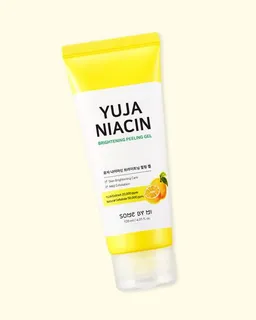
Some By Mi Yuja Niacin Brightening Peeling Gel
Works for
MoisturizingNiacinamide, Panthenol + 8 moreWorks well
“Provides hydration to skin to create a brighter skin radiance”
This product contains good ingredients to attract water to the upper layer of the skin. These ingredients are called "humectants": glycerin, butylene glycol.
When humectants are on the surface of the skin, they “pull in” the moisture from the outside environment, or from within deeper layers of the skin. If the air is dry, humectants can speed up the moisture loss from the skin. This is why it is a good idea to use another product on top of this one to help "seal in" the moisture (look for ingredients like dimethicone, squalane, oils and butters).
The following ingredients in this product are especially good for supporting the skin barrier and helping with the hydration level: lactobionic acid, niacinamide, panthenol
Evens skin toneNiacinamide, Arbutin + 4 moreWorks well
“Yuja Niacin Brightening Peeling Gel”
This product can help reduce hypepigmentation and even out the skin tone because it contains the following effective ingredients: glutathione, lactobionic acid, niacinamide
The following ingredient (ingredients) in this product might be helpful, but there is no evidence to confirm that it actually can help even out the skin tone: arbutin, ascorbyl glucoside.
Keep in mind that you would need to apply any topical skincare targetted at hypigmentation consistently for a couple of months to get a result. No topical skincare product can help get rid of hyperpigmentation (including post-acne marks and age spots) instantly.
ExfoliationLactobionic acidWorks well
“Yuja Niacin Brightening Peeling Gel”
This product can help exfoliate the skin. In other words, it helps break down the bonds between dead cells on the surface of the skin and speed up the skin turnover. Skin often appears softer and brighter after exfoliation, but overdoing it can result in disrupted skin barrier. The following ingredient is doing the exfoliating job in this product: lactobionic acid.
Anti-agingNot advertised by the brand · Niacinamide, Ascorbyl glucoside + 3 moreWorks well
This product can help reduce and prevent fine lines and wrinkles, improve skin elasticity and firmness because it contains lactobionic acid, niacinamide.
These ingredients in the product can also be helpful, even though there is less evidence for their effectiveness: ascorbyl glucoside.
Keep in mind that it typically takes at least 6 weeks to notice any results because the changes that are needed to improve fine lines and elasticity happen in the deeper layers of the skin. No topical anti-aging product can “erase” wrinkles or fully reverse signs of aging.
Anti-blemishNot advertised by the brand · Niacinamide, Lactobionic acidWorks well
This product can help reduce breakouts and clogged pores because it contains the following ingredient: niacinamide. This ingredient is used for treating acne and can have a noticeable effect.
The following ingredient (ingredients) in this product might be helpful, but there is no evidence to confirm that it actually works: lactobionic acid
Anti-oxidationNot advertised by the brand · Arbutin, Glutathione + 5 moreWorks well
This product contains antioxidants (glutathione, lactobionic acid) that can help neutralize free radicals in skin. By doing so, they can lessen the damage the skin gets from the UV light (sun).
The following ingredients - arbutin, ascorbyl glucoside also can have an antioxidant effect, but there is less evidence to confirm their effectiveness in skin.
Can it cause trouble?
Irritancy2 strong irritants: Linalool, LimoneneMedium risk
ComedogenicClean of flagged comedogenic ingredientsNone flagged


User reviews
Be the first — your take helps the next person decide.
Ingredients
Filter by role to see what each ingredient is doing.
Water~40–60%
Quaternium-60~4.5–6.7%
- Irritation risk
- Low
Propylene glycol~3.4–5.2%
- Irritation risk
- High
Helps oil and water mix together and can enhance the penetration of other ingredients into the skin. It can be irritating
More about Propylene glycolBambusa arundinacea stem powder~2.7–4.1%
- Irritation risk
- Medium
Abrasive ingredient used for physical exfoliation (scrubing)
More about Bambusa arundinacea stem powderCellulose~2.1–3.1%
- Irritation risk
- Low
Can be used to help absorb oil as well as add volume and imporve texture of products.
More about CelluloseDipropylene glycol~1.6–2.4%
- Irritation risk
- Low
Helps to dissolve other ingredients in a formulation. Slows down the rate of product drying
More about Dipropylene glycolWater~1.4–2.2%
Nelumbium speciosum flower extract~1.3–1.9%
- Irritation risk
- Low
Niacinamide~1–1.6%
- Irritation risk
- Low
Is proven to be effective in reducing blemishes, evening out skin tone and helping to improve lines and wrinkles. It helps the skin to repair sun damage, calm down inflammation and keep maintain good levels of moisture. The concentration of about 2% is effective for supporting the skin barrier and evening out the skin tone. Concentration of 4-6% is better for helping with acne and balancing the sebum production
More about NiacinamidePanthenol~0.85–1.3%
- Irritation risk
- Low
Helps attract water to the upper layer of the skin and can help improve skin barrier function
More about PanthenolArbutin~0.5–1.2%
- Irritation risk
- Medium
Beta-arbutin. Can help to reduce hyperpigmentation and has an anti-oxidant effect when used in high enough concentration. Is less effective compared to alpha-arbutin
More about ArbutinAscorbyl glucoside~0.45–1.05%
- Irritation risk
- Medium
A vitamin C derivative that is more stable but less potent than pure form of vitamin C. Has a potential to boost collagen production, nutralise free radicals and reduce hyperpigmentation, but the required concentration is likely to be much higher than for the pure form of vitamin C, limiting the ingredient's effectiveness in products
More about Ascorbyl glucosideGlutathione~0.4–0.95%
- Irritation risk
- Medium
A peptide that can help neutralize free radicals in skin and reduce melanin production resulting in skin lightening effect and reduction in hyperpigmentation. It can also help attract moisture to the upper layer of the skin
More about GlutathioneBisabolol~0.35–0.85%
- Irritation risk
- Low
An active component of chamomile plant that historically has been used to calm down irritated skin. A recent study shows that bisabolol indeed can have some anti-inflammatory effect on skin, even though conclusive data is lacking. Bisabolol has a sweet floral scent and can be added to products for its aromatic properties
More about BisabololTocopherol~0.35–0.8%
- Irritation risk
- Low
Pure form of vitamin E. Can help moisturise and protect the skin from free radicals. Often used to help stabilise other ingredients or the formula itself
More about TocopherolAscorbyl glucoside~0.35–0.8%
- Irritation risk
- Medium
A vitamin C derivative that is more stable but less potent than pure form of vitamin C. Has a potential to boost collagen production, nutralise free radicals and reduce hyperpigmentation, but the required concentration is likely to be much higher than for the pure form of vitamin C, limiting the ingredient's effectiveness in products
More about Ascorbyl glucosideBiotin~0.3–0.75%
- Irritation risk
- Low
Might have some moisturising properties. Is not effective when applied topically beyond some moisturizing effect
More about BiotinAscorbyl tetraisopalmitate~0.2–0.75%
- Irritation risk
- Medium
A vitamin C derivative. Studies show that is might be effective in reducing hyperpigmentation, but there are no studies confirming that it is effectively converted into the bioavailable form of Vitamin C in skin. It is not clear how this derivative compares in effectiveness to the topical application of bioavailable form of vitamin C (L-ascorbic acid)
More about Ascorbyl tetraisopalmitateButylene glycol~0.15–0.55%
- Irritation risk
- Low
Used to create a nice product texture and help delivery of other ingredients. Might be somewhat helpful in attracting water to the upper layer of the skin
More about Butylene glycolLactobionic acid~0.1–0.5%
- Irritation risk
- Medium
A polyhydroxy acid (PHA) that helps shed dead cells from the surface of the skin revealing a smoother, more even skin. PHAs tend to be gentler on the skin compared to AHAs (for example, glycolic acid). It also has hydrating properties and helps attract water to the upper layer of the skin. It can help calm down inflammation in skin and support restoration of the barrier function. It has an anti-oxidant effect as well. It can help reduce fine line, wrinkles and improve skin elasticity
More about Lactobionic acid1,2-hexanediol~0.1–0.35%
Benzyl glycol~0.1–0.35%
- Irritation risk
- Medium
Helps dissolve other ingredients and preserve products
More about Benzyl glycolGlycerin~0.1–0.4%
- Irritation risk
- Low
One of the best moisturizing ingredients. Naturally present in skin. It attracts water to the upper layer of the skin working as a humectant
More about GlycerinRaspberry ketone~0.05–0.25%
- Irritation risk
- High
Used as a fragrance. It can reduce skin pigmentation, but it is not safe to use for these purposes in high concentrations as use of raspberry ketone and its derivative is linked to causing loss of skin pigmentation in people (leukoderma)
More about Raspberry ketonePalladium~0.05–0.2%
- Irritation risk
- Low
Linalool~0.05–0.15%
Limonene~0.01–0.1%
- Irritation risk
- High
A common frangrance that can easily irritate skin, especially if exposed to air, light or heat
More about LimoneneIngredient list view
Water, Quaternium-60, Propylene glycol, Bambusa arundinacea stem powder, Cellulose, Unknown, Unknown, Dipropylene glycol, Water, Nelumbium speciosum flower extract, Unknown, Niacinamide, Panthenol, Arbutin, Ascorbyl glucoside, Glutathione, Bisabolol, Tocopherol, Ascorbyl glucoside, Biotin, Ascorbyl tetraisopalmitate, Butylene glycol, Lactobionic acid, 1,2-hexanediol, Benzyl glycol, Glycerin, Raspberry ketone, Palladium, Linalool, Limonene
Compare prices
Retailers ranked by price — lowest first.

Affiliate links
Worth comparing, line by line.
Match % combines shared ingredients, the first five ingredients, shared actives and hero ingredients, irritancy (lower counts in the alternative's favour), texture and body area. Only products in the same routine step are compared.
| Some By MiYuja Niacin Brightening Peeling GelYOUR PRODUCT | Dr.GBrightening Vita Peeling Pad (70pcs) | Vital beautySake Dewy Skin Facial Masks | Vital Beauty | SKIN 1004.Madagascar Centella Spot Cream | |
|---|---|---|---|---|
| Match | — | 78% | 75% | 74% |
| Price | — | $19.31 | $10.30 | $14.09 |
| Shared key ingredients | — | 4 of 9 | 3 of 9 | 3 of 9 |
| Key difference | — | Gluconolactone | Allantoin | Madecassic Acid |
| Irritancy | Medium | Medium | Low | Low |
| Drying alcohol | — | — | — | — |
| View product | Shop | Shop | Shop |


More alternatives: Creamy Tônico clareadorBenton Snail Bee High Content Skin
Product summary
"Some By Mi - Yuja Niacin Brightening Peeling Gel" is effective for: Anti-inflammatory, Anti-aging, Exfoliation and Evens skin tone
Ingredient callouts
- Exfoliating acids (). In this concentration, they will have a noticeable exfoliating effect. They can also have an anti-aging effect and stimulate collagen production in a long-run. PHAs (lactobionic acid 0.15% - 0.65% and lactobionic acid 3.90% - 5.90%) in this product also work for improving skin hydration. They might be even able to stimulate the production of skin's natural humectants and support the healthy skin microbiome.
- This product also contains Vitamin C (Ascorbic Acid). It can be an effective active for anti-aging and evening out the skin tone, but in this product it is used for stabilizing other ingredients in the formulation. In this concentration (0.15% - 0.65%) it cannot have a noticeable benefit for the skin.
Price
The product retails from 16.95A$ up to 23.77A$ in Australia and from 12.16$ up to 18.70$ in the United States.
For a detailed price comparison: click here.
Sources cited in this review
Every concentration estimate and effectiveness label is anchored to one of these 28 studies and safety reviews.
- 1Surfactants and experimental irritant contact dermatitisncbi.nlm.nih.gov
- 2Propylene Glycolpubmed.ncbi.nlm.nih.gov
- 3Skin-sensitizing and irritant properties of propylene glycolonlinelibrary.wiley.com
- 4
- 5
- 6Skin moisturizing effects of panthenol-based formulationspdfs.semanticscholar.org

Affiliate links · As an Amazon Associate, WIMJ earns from qualifying purchases.