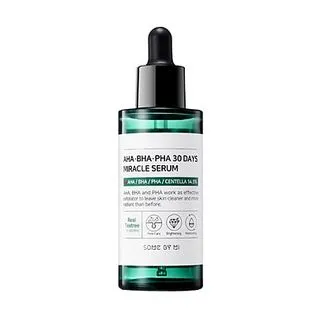
Some By Mi AHA, BHA, PHA 30 Days Miracle Serum

Some By Mi AHA, BHA, PHA 30 Days Miracle Serum

Efficacy87/100IrritancyHigh·0% recommend (2 reviews)

Works for

Anti-aging
Centella asiatica extract, Lactobionic acid + 8 more
Works well
What the product description says
“This lightweight serum doesn’t leave a greasy feel and helps to promote skin renewal, moisture retention, collagen production, and ease inflammation.”
Source: Feelunique

This product can help reduce and prevent fine lines and wrinkles, improve skin elasticity and firmness because it contains glycolic acid, lactobionic acid.

These ingredients in the product can also be helpful, even though there is less evidence for their effectiveness: centella asiatica extract, madecassoside.

Keep in mind that it typically takes at least 6 weeks to notice any results because the changes that are needed to improve fine lines and elasticity happen in the deeper layers of the skin. No topical anti-aging product can “erase” wrinkles or fully reverse signs of aging.

Centella asiatica extractKey activeEffect: MediumA plant extract that has been shown to be able to reduce inflammation in skin, support restoration of skin barrier function, as well as support collagen production. Contains active compounds called centelloids: asiaticoside, madecasosside, asiatic acid and madecassic acid. Might be helpful in preventing stretch marks. It can be itself be irritating though.~6.9–8.4%
Lactobionic acidKey activeEffect: HighA polyhydroxy acid (PHA) that helps shed dead cells from the surface of the skin revealing a smoother, more even skin. PHAs tend to be gentler on the skin compared to AHAs (for example, glycolic acid). It also has hydrating properties and helps attract water to the upper layer of the skin. It can help calm down inflammation in skin and support restoration of the barrier function. It has an anti-oxidant effect as well. It can help reduce fine line, wrinkles and improve skin elasticity~0.25–0.45%
Glycolic acidKey activeEffect: HighAn alpha-hydroxy acid (AHA) that helps to remove the dead skin cells on the surface of the skin reveling a more even, smoother complexation. It is also able to stimulate collagen production with long-term use. Could help to reduce pore congestion. It can be irritating to the skin. Apply sunscreen daily if using products with glycolic acid~0.25–0.45%
MadecassosideKey activeEffect: MediumAn antioxidant that is typically derived from plant Centella Asiatica. It can help neutralize free radicals in skin and support skin barrier function. It could, however, itself be irritating. It is often unstable in formulations~0.25–0.45%
Camellia sinensis leaf extractEffect: LowCan contain potent anti-oxidant compounds (abbreviated ECG, GCG, EGC, and EGCG) that might help protect the skin from free radicals. Can help calm down inflammation and has some anti-bacterial properties. Unfortunately, these antioxidants are unstable and lose their effectiveness very quickly in products. The concentration of the antioxidant compounds in the extract also tends to be low to be effective in topical formulation~0.5–0.75%
Limnanthes alba seed oilEffect: LowThis oil's cmposition is closest to rapeseed oil. It is a very stable oil and serves as an emoillient~0.3–0.5%
Prunus amygdalus dulcis oilEffect: LowAn emollient that softens the skin~0.25–0.5%
Camellia sinensis seed oilEffect: Low, below effective doseA plant oil that helps to soften the upper layer of the skin and can help restore the skin barrier. Might have some anti-oxidant effect~0.25–0.45%
NiacinamideUnder-dosedIs proven to be effective in reducing blemishes, evening out skin tone and helping to improve lines and wrinkles. It helps the skin to repair sun damage, calm down inflammation and keep maintain good levels of moisture. The concentration of about 2% is effective for supporting the skin barrier and evening out the skin tone. Concentration of 4-6% is better for helping with acne and balancing the sebum production~0.65–0.95%
Lactic acidUnder-dosedAn exfoliating and moisturizing alpha-hydroxy acid (AHA). Typically causes less irritation than other AHAs, for example, glycolic acid. At high concentrations (about 15%), lactic acid can help reduce lines and wrinkles. Recent studies show that lactic acid can support the "good" bacteria living on skin's surface (healthy skin microbiome)~0.25–0.45%
Exfoliation
Glycolic acid, Lactobionic acid + 2 more
Works well
What the product description says
“Beyond exfoliation, this serum is a multitasker, offering soothing, hydrating, and barrier-strengthening benefits.”
Source: Soko Glam

This product can help exfoliate the skin. In other words, it helps break down the bonds between dead cells on the surface of the skin and speed up the skin turnover. Skin often appears softer and brighter after exfoliation, but overdoing it can result in disrupted skin barrier. The following ingredient is doing the exfoliating job in this product: glycolic acid, lactobionic acid.

Glycolic acidKey activeEffect: HighAn alpha-hydroxy acid (AHA) that helps to remove the dead skin cells on the surface of the skin reveling a more even, smoother complexation. It is also able to stimulate collagen production with long-term use. Could help to reduce pore congestion. It can be irritating to the skin. Apply sunscreen daily if using products with glycolic acid~0.25–0.45%
Lactobionic acidKey activeEffect: HighA polyhydroxy acid (PHA) that helps shed dead cells from the surface of the skin revealing a smoother, more even skin. PHAs tend to be gentler on the skin compared to AHAs (for example, glycolic acid). It also has hydrating properties and helps attract water to the upper layer of the skin. It can help calm down inflammation in skin and support restoration of the barrier function. It has an anti-oxidant effect as well. It can help reduce fine line, wrinkles and improve skin elasticity~0.25–0.45%
Tartaric acidKey activeEffect: MediumAn AHA (alpha-hydroxy acid). It oxidizes quickly which makes it less effective in skincare formulations. It can support skin's barrier and moisture levels~0.25–0.45%
Lactic acidUnder-dosedAn exfoliating and moisturizing alpha-hydroxy acid (AHA). Typically causes less irritation than other AHAs, for example, glycolic acid. At high concentrations (about 15%), lactic acid can help reduce lines and wrinkles. Recent studies show that lactic acid can support the "good" bacteria living on skin's surface (healthy skin microbiome)~0.25–0.45%
Moisturizing
Lactobionic acid, Madecassoside + 24 more
Works well
What the product description says
“Beyond exfoliation, this serum is a multitasker, offering soothing, hydrating, and barrier-strengthening benefits.”
Source: Soko Glam

This product can help improve hydration of the skin with the two types of ingredients.

The first type is called “humectants”:
these ingredients help attract water. When humectants are on the surface of the skin, they “pull in” the moisture from the outside environment, or from within deeper layers of the skin. The following ingredients in this product do the job: glycerin, sodium lactate.

This product also contains ingredients called “occlusives”. They help reduce the speed with which our skin loses moisture to the outside environment. These ingredients also help soften the upper layer of the skin, so it feels less tight and nicer to the touch. The following ingredients in this product do the job: caprylic/capric triglyceride, limnanthes alba seed oil.

The following ingredients in this product are especially good for supporting the skin barrier and helping with the hydration level: lactobionic acid, madecassoside

Lactobionic acidHeroEffect: HighA polyhydroxy acid (PHA) that helps shed dead cells from the surface of the skin revealing a smoother, more even skin. PHAs tend to be gentler on the skin compared to AHAs (for example, glycolic acid). It also has hydrating properties and helps attract water to the upper layer of the skin. It can help calm down inflammation in skin and support restoration of the barrier function. It has an anti-oxidant effect as well. It can help reduce fine line, wrinkles and improve skin elasticity~0.25–0.45%
MadecassosideHeroEffect: HighAn antioxidant that is typically derived from plant Centella Asiatica. It can help neutralize free radicals in skin and support skin barrier function. It could, however, itself be irritating. It is often unstable in formulations~0.25–0.45%
Centella asiatica extractKey activeEffect: HighA plant extract that has been shown to be able to reduce inflammation in skin, support restoration of skin barrier function, as well as support collagen production. Contains active compounds called centelloids: asiaticoside, madecasosside, asiatic acid and madecassic acid. Might be helpful in preventing stretch marks. It can be itself be irritating though.~6.9–8.4%
Caprylic/capric triglycerideKey active· Emollient, OcclusiveEffect: HighA good mix of fatty acids that forms a protective layer on the skin. Improves the shelf life of products. Derived from coconut and glycerin~3.2–3.9%
GlycerinKey active· HumectantEffect: HighOne of the best moisturizing ingredients. Naturally present in skin. It attracts water to the upper layer of the skin working as a humectant~2.4–2.9%
Olea europaea fruit oilKey active· EmollientEffect: MediumAn emollient that helps soften the skin but is not effective for restoring its barrier function. Might be helpful to calm down inflammation~1.9–2.3%
Limnanthes alba seed oilKey active· EmollientEffect: HighThis oil's cmposition is closest to rapeseed oil. It is a very stable oil and serves as an emoillient~0.3–0.5%
Sodium lactateKey active· HumectantEffect: HighHelps attract water to the upper layer of the skin. Is often used to adjust the pH level of the product~0.3–0.55%
Sodium pcaKey active· HumectantEffect: HighNaturally present in skin and helps to attract water to its upper layer~0.3–0.5%
Althaea officinalis root extractKey activeEffect: HighA plant extract that can help attract water to the upper layer of the skin and might help to reduce inflammation~0.25–0.45%
Oryza sativa bran oilKey active· EmollientEffect: HighHelps soften the upper layer of the skin and might have some anti-oxidant properties~0.25–0.5%
Prunus amygdalus dulcis oilKey active· EmollientEffect: MediumAn emollient that softens the skin~0.25–0.5%
Tartaric acidKey activeEffect: MediumAn AHA (alpha-hydroxy acid). It oxidizes quickly which makes it less effective in skincare formulations. It can support skin's barrier and moisture levels~0.25–0.45%
Cetyl ethylhexanoate· EmollientEffect: LowAn emollient that helps soften the skin and creates a thicker product texture~4.3–5.3%
Butylene glycol· HumectantEffect: LowUsed to create a nice product texture and help delivery of other ingredients. Might be somewhat helpful in attracting water to the upper layer of the skin~1.1–1.4%
Camellia sinensis leaf extractEffect: LowCan contain potent anti-oxidant compounds (abbreviated ECG, GCG, EGC, and EGCG) that might help protect the skin from free radicals. Can help calm down inflammation and has some anti-bacterial properties. Unfortunately, these antioxidants are unstable and lose their effectiveness very quickly in products. The concentration of the antioxidant compounds in the extract also tends to be low to be effective in topical formulation~0.5–0.75%
Scutellaria baicalensis root extract· HumectantEffect: LowA plant extract that might contain a compound baicalin that could be helpful in neutralizing free radicals and reducing inflammation in skin. The baicalin concentration in skincare products is often too low for an effective action. Can be used for its fragrant properties~0.45–0.65%
Pentylene glycol· EmollientEffect: LowUsed to preserve products, dissolve other ingredients and create a nice product texture~0.3–0.55%
Moringa oleifera seed oil· EmollientEffect: LowA plant oil that helps soften the upper layer of the skin. Is unlikely to be helpful in restoring skin barrier function due to the low content of linoleic acid~0.2–0.4%
Pearl powderEffect: LowConsists of 95% calcium carbonate that does not have any effect on the skin. The remaining 5% can include compounds that can help neutralize free radicals and support skin barrier function~0.2–0.4%
Caprylyl glycol· Humectant, EmollientEffect: LowHelps preserve products and creates a nice product texture~0.15–0.25%
NiacinamideUnder-dosedIs proven to be effective in reducing blemishes, evening out skin tone and helping to improve lines and wrinkles. It helps the skin to repair sun damage, calm down inflammation and keep maintain good levels of moisture. The concentration of about 2% is effective for supporting the skin barrier and evening out the skin tone. Concentration of 4-6% is better for helping with acne and balancing the sebum production~0.65–0.95%
Camellia oleifera seed oilUnder-dosedAn emollient that does not leave a greasy finish~0.3–0.5%
Camellia sinensis seed oilUnder-dosedA plant oil that helps to soften the upper layer of the skin and can help restore the skin barrier. Might have some anti-oxidant effect~0.25–0.45%
Rosa canina fruit oilUnder-dosedA great emollient. Contains vitamin E (tocopherol) which may give it some anti-oxidant properties. Can contain volatile compounds and can be irritating~0.25–0.5%
Lactic acidUnder-dosedAn exfoliating and moisturizing alpha-hydroxy acid (AHA). Typically causes less irritation than other AHAs, for example, glycolic acid. At high concentrations (about 15%), lactic acid can help reduce lines and wrinkles. Recent studies show that lactic acid can support the "good" bacteria living on skin's surface (healthy skin microbiome)~0.25–0.45%
Anti-blemish
Lactobionic acid, Glycolic acid + 5 more
Not delivered
What the product description says
“Diminish the appearance of blemishes.”
Source: Glowsecret

This product contains ingredients (glycolic acid, lactobionic acid) that could help reduce blemishes and clogged pores in theory, but there is not enough evidence that they actually work.

Lactobionic acidEffect: MediumA polyhydroxy acid (PHA) that helps shed dead cells from the surface of the skin revealing a smoother, more even skin. PHAs tend to be gentler on the skin compared to AHAs (for example, glycolic acid). It also has hydrating properties and helps attract water to the upper layer of the skin. It can help calm down inflammation in skin and support restoration of the barrier function. It has an anti-oxidant effect as well. It can help reduce fine line, wrinkles and improve skin elasticity~0.25–0.45%
Glycolic acidEffect: MediumAn alpha-hydroxy acid (AHA) that helps to remove the dead skin cells on the surface of the skin reveling a more even, smoother complexation. It is also able to stimulate collagen production with long-term use. Could help to reduce pore congestion. It can be irritating to the skin. Apply sunscreen daily if using products with glycolic acid~0.25–0.45%
Centella asiatica extractEffect: LowA plant extract that has been shown to be able to reduce inflammation in skin, support restoration of skin barrier function, as well as support collagen production. Contains active compounds called centelloids: asiaticoside, madecasosside, asiatic acid and madecassic acid. Might be helpful in preventing stretch marks. It can be itself be irritating though.~6.9–8.4%
Camellia sinensis leaf extractEffect: LowCan contain potent anti-oxidant compounds (abbreviated ECG, GCG, EGC, and EGCG) that might help protect the skin from free radicals. Can help calm down inflammation and has some anti-bacterial properties. Unfortunately, these antioxidants are unstable and lose their effectiveness very quickly in products. The concentration of the antioxidant compounds in the extract also tends to be low to be effective in topical formulation~0.5–0.75%
Melia azadirachta leaf extractEffect: LowA plant extract that has anti-bacterial properties. Can be used to preserve the product. Can be irritating~0.25–0.45%
NiacinamideUnder-dosedIs proven to be effective in reducing blemishes, evening out skin tone and helping to improve lines and wrinkles. It helps the skin to repair sun damage, calm down inflammation and keep maintain good levels of moisture. The concentration of about 2% is effective for supporting the skin barrier and evening out the skin tone. Concentration of 4-6% is better for helping with acne and balancing the sebum production~0.65–0.95%
Rosmarinus officinalis leaf extractUnder-dosedCan be helpful in reducing inflammation in skin, including inflamed acne. It can be irritating~0.3–0.55%
Anti-oxidation
Side benefit · Centella asiatica extract, Camellia sinensis leaf extract + 18 more
Works well

This product contains antioxidants (lactobionic acid, madecassoside) that can help neutralize free radicals in skin. By doing so, they can lessen the damage the skin gets from the UV light (sun).

The following ingredients - camellia sinensis leaf extract, centella asiatica extract, tartaric acid also can have an antioxidant effect, but there is less evidence to confirm their effectiveness in skin.

Centella asiatica extractKey activeEffect: MediumA plant extract that has been shown to be able to reduce inflammation in skin, support restoration of skin barrier function, as well as support collagen production. Contains active compounds called centelloids: asiaticoside, madecasosside, asiatic acid and madecassic acid. Might be helpful in preventing stretch marks. It can be itself be irritating though.~6.9–8.4%
Camellia sinensis leaf extractKey activeEffect: MediumCan contain potent anti-oxidant compounds (abbreviated ECG, GCG, EGC, and EGCG) that might help protect the skin from free radicals. Can help calm down inflammation and has some anti-bacterial properties. Unfortunately, these antioxidants are unstable and lose their effectiveness very quickly in products. The concentration of the antioxidant compounds in the extract also tends to be low to be effective in topical formulation~0.5–0.75%
MadecassosideKey activeEffect: HighAn antioxidant that is typically derived from plant Centella Asiatica. It can help neutralize free radicals in skin and support skin barrier function. It could, however, itself be irritating. It is often unstable in formulations~0.25–0.45%
Lactobionic acidKey activeEffect: HighA polyhydroxy acid (PHA) that helps shed dead cells from the surface of the skin revealing a smoother, more even skin. PHAs tend to be gentler on the skin compared to AHAs (for example, glycolic acid). It also has hydrating properties and helps attract water to the upper layer of the skin. It can help calm down inflammation in skin and support restoration of the barrier function. It has an anti-oxidant effect as well. It can help reduce fine line, wrinkles and improve skin elasticity~0.25–0.45%
Tartaric acidKey activeEffect: MediumAn AHA (alpha-hydroxy acid). It oxidizes quickly which makes it less effective in skincare formulations. It can support skin's barrier and moisture levels~0.25–0.45%
Scutellaria baicalensis root extractEffect: LowA plant extract that might contain a compound baicalin that could be helpful in neutralizing free radicals and reducing inflammation in skin. The baicalin concentration in skincare products is often too low for an effective action. Can be used for its fragrant properties~0.45–0.65%
Glycyrrhiza glabra root extractEffect: LowA plant extract that can help lighten the skin and calm down inflammation. Might be helpful in neutralizing free radicals~0.35–0.65%
Limnanthes alba seed oilEffect: LowThis oil's cmposition is closest to rapeseed oil. It is a very stable oil and serves as an emoillient~0.3–0.5%
Althaea officinalis root extractEffect: LowA plant extract that can help attract water to the upper layer of the skin and might help to reduce inflammation~0.25–0.45%
Prunus amygdalus dulcis oilEffect: LowAn emollient that softens the skin~0.25–0.5%
Pelargonium graveolens flower oilEffect: LowAn essential oil. Can be irritating. Can become an allergen with oxidation~0.25–0.45%
Vaccinium macrocarpon fruit extractEffect: LowA berry extract. Might have some anti-oxidant properties~0.25–0.45%
Pearl powderEffect: LowConsists of 95% calcium carbonate that does not have any effect on the skin. The remaining 5% can include compounds that can help neutralize free radicals and support skin barrier function~0.2–0.4%
Melia azadirachta flower extractEffect: LowA plant extract that might be helpful to neutralize free radicals in skin~0.2–0.4%
Ocimum sanctum leaf extractEffect: LowA plant extract that is rich in a fragrance compound eugenol that is a frequent allergen and can be irritating. It might also contain anti-oxidants to help neutralize free radicals~0.15–0.3%
Polygonum cuspidatum root extractEffect: Low, below effective doseA plant extract that can contain resveratrol, an antioxidant that can help neutralize free radicals in skin. The effectiveness depends on the extract quality and concentration in the product~0.45–0.65%
Rosmarinus officinalis leaf extractEffect: Low, below effective doseCan be helpful in reducing inflammation in skin, including inflamed acne. It can be irritating~0.3–0.55%
Camellia oleifera seed oilEffect: Low, below effective doseAn emollient that does not leave a greasy finish~0.3–0.5%
Rosa canina fruit oilEffect: Low, below effective doseA great emollient. Contains vitamin E (tocopherol) which may give it some anti-oxidant properties. Can contain volatile compounds and can be irritating~0.25–0.5%
Camellia sinensis seed oilEffect: Low, below effective doseA plant oil that helps to soften the upper layer of the skin and can help restore the skin barrier. Might have some anti-oxidant effect~0.25–0.45%
Evens skin tone
Side benefit the brand mentions · Glycolic acid, Lactobionic acid + 5 more
Works well
What the product description says
“Shrinks pore size for a smooth complexion”
Source: Glowsecret

This product can help reduce hypepigmentation and even out the skin tone because it contains the following effective ingredients: glycolic acid, lactobionic acid

The following ingredient (ingredients) in this product might be helpful, but there is no evidence to confirm that it actually can help even out the skin tone: glycyrrhiza glabra root extract, madecassoside.

Keep in mind that you would need to apply any topical skincare targetted at hypigmentation consistently for a couple of months to get a result. No topical skincare product can help get rid of hyperpigmentation (including post-acne marks and age spots) instantly.

Glycolic acidKey activeEffect: HighAn alpha-hydroxy acid (AHA) that helps to remove the dead skin cells on the surface of the skin reveling a more even, smoother complexation. It is also able to stimulate collagen production with long-term use. Could help to reduce pore congestion. It can be irritating to the skin. Apply sunscreen daily if using products with glycolic acid~0.25–0.45%
Lactobionic acidKey activeEffect: HighA polyhydroxy acid (PHA) that helps shed dead cells from the surface of the skin revealing a smoother, more even skin. PHAs tend to be gentler on the skin compared to AHAs (for example, glycolic acid). It also has hydrating properties and helps attract water to the upper layer of the skin. It can help calm down inflammation in skin and support restoration of the barrier function. It has an anti-oxidant effect as well. It can help reduce fine line, wrinkles and improve skin elasticity~0.25–0.45%
Camellia sinensis leaf extractEffect: LowCan contain potent anti-oxidant compounds (abbreviated ECG, GCG, EGC, and EGCG) that might help protect the skin from free radicals. Can help calm down inflammation and has some anti-bacterial properties. Unfortunately, these antioxidants are unstable and lose their effectiveness very quickly in products. The concentration of the antioxidant compounds in the extract also tends to be low to be effective in topical formulation~0.5–0.75%
Glycyrrhiza glabra root extractEffect: LowA plant extract that can help lighten the skin and calm down inflammation. Might be helpful in neutralizing free radicals~0.35–0.65%
MadecassosideEffect: LowAn antioxidant that is typically derived from plant Centella Asiatica. It can help neutralize free radicals in skin and support skin barrier function. It could, however, itself be irritating. It is often unstable in formulations~0.25–0.45%
NiacinamideUnder-dosedIs proven to be effective in reducing blemishes, evening out skin tone and helping to improve lines and wrinkles. It helps the skin to repair sun damage, calm down inflammation and keep maintain good levels of moisture. The concentration of about 2% is effective for supporting the skin barrier and evening out the skin tone. Concentration of 4-6% is better for helping with acne and balancing the sebum production~0.65–0.95%
Lactic acidUnder-dosedAn exfoliating and moisturizing alpha-hydroxy acid (AHA). Typically causes less irritation than other AHAs, for example, glycolic acid. At high concentrations (about 15%), lactic acid can help reduce lines and wrinkles. Recent studies show that lactic acid can support the "good" bacteria living on skin's surface (healthy skin microbiome)~0.25–0.45%

Can it cause trouble?

Irritancy
13 strong irritants: Alcohol, Melaleuca alternifolia leaf water + 11 more — patch-test recommended
High risk
We flagged 41 ingredients with irritancy potential. Severity depends on your sensitivity threshold; the table lists the worst offenders first.
IngredientFunctionIrritationEst. amount
AlcoholCan be drying and contribute to skin irritation. Used in formulars to dissolve other ingredients, create a thinner product consistency or for its antibacterial propertiesHigh~1.4–1.7%est.
Melaleuca alternifolia leaf water—High~0.5–0.8%est.
Scutellaria baicalensis root extractA plant extract that might contain a compound baicalin that could be helpful in neutralizing free radicals and reducing inflammation in skin. The baicalin concentration in skincare products is often too low for an effective action. Can be used for its fragrant propertiesHigh~0.45–0.65%est.
Chamomilla recutita flower extractPlant extract that can have healing and anti-inflammatory properties. It is a potential allergen and can be irritatingHigh~0.35–0.6%est.
Rosmarinus officinalis leaf extractCan be helpful in reducing inflammation in skin, including inflamed acne. It can be irritatingHigh~0.3–0.55%est.
Glycolic acidAn alpha-hydroxy acid (AHA) that helps to remove the dead skin cells on the surface of the skin reveling a more even, smoother complexation. It is also able to stimulate collagen production with long-term use. Could help to reduce pore congestion. It can be irritating to the skin. Apply sunscreen daily if using products with glycolic acidHigh~0.25–0.45%est.
Gaultheria procumbens leaf extract—High~0.2–0.35%est.
Vaccinium macrocarpon fruit extractA berry extract. Might have some anti-oxidant propertiesHigh~0.25–0.45%est.
Lavandula angustifolia extractUsed for fragrance and contains volatile compounds that can irritate the skinHigh~0.25–0.45%est.
Ocimum basilicum leaf extractUsed as a frangrance. Can be irritating. Might have some anti-bacterial propertiesHigh~0.25–0.45%est.
Althaea officinalis root extractA plant extract that can help attract water to the upper layer of the skin and might help to reduce inflammationHigh~0.25–0.45%est.
Rosmarinus officinalis extract—High~0.25–0.4%est.
Citrus paradisi peel oilUsed as a fragrance. Can be irritatingHigh~0.2–0.4%est.
Citrus aurantium dulcis peel oilAn essentil oil from orange peel. Potential allergen and can be irritatingHigh~0.25–0.45%est.
Curcuma longa root extractA plant extract that can contain an active compound curcumin, that may have some anti-inflammatory properties when applied to the skin, but solid research is lacking and the typical concentration used in skincare products is too low. Can be an irritantHigh~0.2–0.4%est.
Melia azadirachta leaf extractA plant extract that has anti-bacterial properties. Can be used to preserve the product. Can be irritatingHigh~0.25–0.45%est.
Pelargonium graveolens flower oilAn essential oil. Can be irritating. Can become an allergen with oxidationHigh~0.25–0.45%est.
Boswellia carterii oilUsed as a fragrance. Can be irritatingHigh~0.2–0.4%est.
Ocimum sanctum leaf extractA plant extract that is rich in a fragrance compound eugenol that is a frequent allergen and can be irritating. It might also contain anti-oxidants to help neutralize free radicalsHigh~0.15–0.3%est.
Ocimum basilicum flower/leaf extractUsed as a fragrance. Canbe irritatingHigh~0.15–0.3%est.
Centella asiatica extractA plant extract that has been shown to be able to reduce inflammation in skin, support restoration of skin barrier function, as well as support collagen production. Contains active compounds called centelloids: asiaticoside, madecasosside, asiatic acid and madecassic acid. Might be helpful in preventing stretch marks. It can be itself be irritating though.Medium~6.9–8.4%est.
Cetyl ethylhexanoateAn emollient that helps soften the skin and creates a thicker product textureMedium~4.3–5.3%est.
Caprylic/capric triglycerideA good mix of fatty acids that forms a protective layer on the skin. Improves the shelf life of products. Derived from coconut and glycerinMedium~3.2–3.9%est.
Olea europaea fruit oilAn emollient that helps soften the skin but is not effective for restoring its barrier function. Might be helpful to calm down inflammationMedium~1.9–2.3%est.
1,2-hexanediolA preservativeMedium~0.65–0.95%est.
Polygonum cuspidatum root extractA plant extract that can contain resveratrol, an antioxidant that can help neutralize free radicals in skin. The effectiveness depends on the extract quality and concentration in the productMedium~0.45–0.65%est.
Glycyrrhiza glabra root extractA plant extract that can help lighten the skin and calm down inflammation. Might be helpful in neutralizing free radicalsMedium~0.35–0.65%est.
Sodium lactateHelps attract water to the upper layer of the skin. Is often used to adjust the pH level of the productMedium~0.3–0.55%est.
Citric acidCan work as an exfoliant but is typically used to adjust the product pHMedium~0.25–0.5%est.
Lactic acidAn exfoliating and moisturizing alpha-hydroxy acid (AHA). Typically causes less irritation than other AHAs, for example, glycolic acid. At high concentrations (about 15%), lactic acid can help reduce lines and wrinkles. Recent studies show that lactic acid can support the "good" bacteria living on skin's surface (healthy skin microbiome)Medium~0.25–0.45%est.
Tartaric acidAn AHA (alpha-hydroxy acid). It oxidizes quickly which makes it less effective in skincare formulations. It can support skin's barrier and moisture levelsMedium~0.25–0.45%est.
Lactobionic acidA polyhydroxy acid (PHA) that helps shed dead cells from the surface of the skin revealing a smoother, more even skin. PHAs tend to be gentler on the skin compared to AHAs (for example, glycolic acid). It also has hydrating properties and helps attract water to the upper layer of the skin. It can help calm down inflammation in skin and support restoration of the barrier function. It has an anti-oxidant effect as well. It can help reduce fine line, wrinkles and improve skin elasticityMedium~0.25–0.45%est.
Pentylene glycolUsed to preserve products, dissolve other ingredients and create a nice product textureMedium~0.3–0.55%est.
MadecassosideAn antioxidant that is typically derived from plant Centella Asiatica. It can help neutralize free radicals in skin and support skin barrier function. It could, however, itself be irritating. It is often unstable in formulationsMedium~0.25–0.45%est.
Camellia oleifera seed oilAn emollient that does not leave a greasy finishMedium~0.3–0.5%est.
Rosa canina fruit oilA great emollient. Contains vitamin E (tocopherol) which may give it some anti-oxidant properties. Can contain volatile compounds and can be irritatingMedium~0.25–0.5%est.
Melia azadirachta flower extractA plant extract that might be helpful to neutralize free radicals in skinMedium~0.2–0.4%est.
Moringa oleifera seed oilA plant oil that helps soften the upper layer of the skin. Is unlikely to be helpful in restoring skin barrier function due to the low content of linoleic acidMedium~0.2–0.4%est.
Disodium edtaStabilizes the product formulationMedium~0.15–0.25%est.
Caprylyl glycolHelps preserve products and creates a nice product textureMedium~0.15–0.25%est.
EthylhexylglycerinA preservativeMedium~0.1–0.2%est.
Comedogenic
Clean of flagged comedogenic ingredients
None flagged

User reviews

Would you recommend?
0%·yes

0 of 2 community members would buy it again.

0% would100% wouldn't
  • sofi_· Dec 2024Doesn't recommend

    not good

What reviewers noticed
Marker shows the average response

Ingredients

Filter by role to see what each ingredient is doing.

Water~45–55%
Formula
Irritation risk
Low

Plain old water

More about Water
Centella asiatica extract~6.9–8.4%
Key activeIrritant · medium
Irritation risk
Medium
Works for
Reduces rednessReduces irritationMoisturizingAnti-inflammatoryAnti-agingAnti-oxidationAnti-blemish

A plant extract that has been shown to be able to reduce inflammation in skin, support restoration of skin barrier function, as well as support collagen production. Contains active compounds called centelloids: asiaticoside, madecasosside, asiatic acid and madecassic acid. Might be helpful in preventing stretch marks. It can be itself be irritating though.

More about Centella asiatica extract
Cetyl ethylhexanoate~4.3–5.3%
Irritant · medium
Irritation risk
Medium
Works for
Moisturizing

An emollient that helps soften the skin and creates a thicker product texture

More about Cetyl ethylhexanoate
Caprylic/capric triglyceride~3.2–3.9%
Key activeIrritant · medium
Irritation risk
Medium
Works for
Moisturizing

A good mix of fatty acids that forms a protective layer on the skin. Improves the shelf life of products. Derived from coconut and glycerin

More about Caprylic/capric triglyceride
Glycerin~2.4–2.9%
Key active
Irritation risk
Low
Works for
Moisturizing

One of the best moisturizing ingredients. Naturally present in skin. It attracts water to the upper layer of the skin working as a humectant

More about Glycerin
Olea europaea fruit oil~1.9–2.3%
Key activeIrritant · medium
Irritation risk
Medium
Works for
Moisturizing

An emollient that helps soften the skin but is not effective for restoring its barrier function. Might be helpful to calm down inflammation

More about Olea europaea fruit oil
Propanediol~1.6–2%
Formula
Irritation risk
Low

Acts as a solvent for other ingredients. Speeds up the absorption of other ingredients into the skin

More about Propanediol
Alcohol~1.4–1.7%
Irritant · high
Irritation risk
High
Works for
Antibacterial

Can be drying and contribute to skin irritation. Used in formulars to dissolve other ingredients, create a thinner product consistency or for its antibacterial properties

More about Alcohol
Butylene glycol~1.1–1.4%
Formula
Irritation risk
Low
Works for
Moisturizing

Used to create a nice product texture and help delivery of other ingredients. Might be somewhat helpful in attracting water to the upper layer of the skin

More about Butylene glycol
1,2-hexanediol~0.65–0.95%
Irritant · medium
Irritation risk
Medium

A preservative

More about 1,2-hexanediol
Niacinamide~0.65–0.95%
Under-dosed
Irritation risk
Low
Works for
Anti-agingEvens skin toneMoisturizingAnti-blemishReduces irritationAntibacterialReduces rednessAnti-inflammatory

Is proven to be effective in reducing blemishes, evening out skin tone and helping to improve lines and wrinkles. It helps the skin to repair sun damage, calm down inflammation and keep maintain good levels of moisture. The concentration of about 2% is effective for supporting the skin barrier and evening out the skin tone. Concentration of 4-6% is better for helping with acne and balancing the sebum production

More about Niacinamide
Melaleuca alternifolia leaf water~0.5–0.8%
Irritant · high
Camellia sinensis leaf extract~0.5–0.75%
Key active
Irritation risk
Low
Works for
Anti-oxidationAntibacterialAnti-agingAnti-blemishEvens skin toneMoisturizing

Can contain potent anti-oxidant compounds (abbreviated ECG, GCG, EGC, and EGCG) that might help protect the skin from free radicals. Can help calm down inflammation and has some anti-bacterial properties. Unfortunately, these antioxidants are unstable and lose their effectiveness very quickly in products. The concentration of the antioxidant compounds in the extract also tends to be low to be effective in topical formulation

More about Camellia sinensis leaf extract
Scutellaria baicalensis root extract~0.45–0.65%
Irritant · high
Irritation risk
High
Works for
Anti-oxidationMoisturizingReduces irritationAnti-inflammatoryAntibacterial

A plant extract that might contain a compound baicalin that could be helpful in neutralizing free radicals and reducing inflammation in skin. The baicalin concentration in skincare products is often too low for an effective action. Can be used for its fragrant properties

More about Scutellaria baicalensis root extract
Polygonum cuspidatum root extract~0.45–0.65%
Irritant · medium
Irritation risk
Medium
Works for
Anti-oxidation

A plant extract that can contain resveratrol, an antioxidant that can help neutralize free radicals in skin. The effectiveness depends on the extract quality and concentration in the product

More about Polygonum cuspidatum root extract
Glycyrrhiza glabra root extract~0.35–0.65%
Irritant · medium
Irritation risk
Medium
Works for
Anti-inflammatoryReduces rednessEvens skin toneAnti-oxidationAntibacterial

A plant extract that can help lighten the skin and calm down inflammation. Might be helpful in neutralizing free radicals

More about Glycyrrhiza glabra root extract
Chamomilla recutita flower extract~0.35–0.6%
Irritant · high
Irritation risk
High
Works for
Anti-inflammatory

Plant extract that can have healing and anti-inflammatory properties. It is a potential allergen and can be irritating

More about Chamomilla recutita flower extract
Rosmarinus officinalis leaf extract~0.3–0.55%
Under-dosedIrritant · high
Irritation risk
High
Works for
Anti-blemishAntibacterialAnti-oxidation

Can be helpful in reducing inflammation in skin, including inflamed acne. It can be irritating

More about Rosmarinus officinalis leaf extract
Sodium lactate~0.3–0.55%
Key activeIrritant · medium
Irritation risk
Medium
Works for
Moisturizing

Helps attract water to the upper layer of the skin. Is often used to adjust the pH level of the product

More about Sodium lactate
Sodium pca~0.3–0.5%
Key active
Irritation risk
Low
Works for
Moisturizing

Naturally present in skin and helps to attract water to its upper layer

More about Sodium pca
Citric acid~0.25–0.5%
Irritant · medium
Irritation risk
Medium

Can work as an exfoliant but is typically used to adjust the product pH

More about Citric acid
Lactic acid~0.25–0.45%
Under-dosedIrritant · medium
Irritation risk
Medium
Works for
Evens skin toneMoisturizingExfoliationAnti-aging

An exfoliating and moisturizing alpha-hydroxy acid (AHA). Typically causes less irritation than other AHAs, for example, glycolic acid. At high concentrations (about 15%), lactic acid can help reduce lines and wrinkles. Recent studies show that lactic acid can support the "good" bacteria living on skin's surface (healthy skin microbiome)

More about Lactic acid
Malic acid~0.25–0.45%
Formula
Irritation risk
Low

Helps adjust the product pH

More about Malic acid
Glycolic acid~0.25–0.45%
Key activeIrritant · high
Irritation risk
High
Works for
Evens skin toneAnti-agingExfoliationAnti-blemish

An alpha-hydroxy acid (AHA) that helps to remove the dead skin cells on the surface of the skin reveling a more even, smoother complexation. It is also able to stimulate collagen production with long-term use. Could help to reduce pore congestion. It can be irritating to the skin. Apply sunscreen daily if using products with glycolic acid

More about Glycolic acid
Pyruvic acid~0.25–0.45%
Formula
Irritation risk
Low
More about Pyruvic acid
Tartaric acid~0.25–0.45%
Key activeIrritant · medium
Irritation risk
Medium
Works for
ExfoliationAnti-oxidationMoisturizing

An AHA (alpha-hydroxy acid). It oxidizes quickly which makes it less effective in skincare formulations. It can support skin's barrier and moisture levels

More about Tartaric acid
Gaultheria procumbens leaf extract~0.2–0.35%
Irritant · high
Lactobionic acid~0.25–0.45%
Hero · MoisturizingIrritant · medium
Irritation risk
Medium
Works for
Evens skin toneExfoliationAnti-agingMoisturizingAnti-oxidationAnti-blemishAnti-inflammatory

A polyhydroxy acid (PHA) that helps shed dead cells from the surface of the skin revealing a smoother, more even skin. PHAs tend to be gentler on the skin compared to AHAs (for example, glycolic acid). It also has hydrating properties and helps attract water to the upper layer of the skin. It can help calm down inflammation in skin and support restoration of the barrier function. It has an anti-oxidant effect as well. It can help reduce fine line, wrinkles and improve skin elasticity

More about Lactobionic acid
Pentylene glycol~0.3–0.55%
Irritant · medium
Irritation risk
Medium
Works for
Moisturizing

Used to preserve products, dissolve other ingredients and create a nice product texture

More about Pentylene glycol
Vaccinium macrocarpon fruit extract~0.25–0.45%
Irritant · high
Irritation risk
High
Works for
Anti-oxidation

A berry extract. Might have some anti-oxidant properties

More about Vaccinium macrocarpon fruit extract
Lavandula angustifolia extract~0.25–0.45%
Irritant · high
Irritation risk
High

Used for fragrance and contains volatile compounds that can irritate the skin

More about Lavandula angustifolia extract
Ocimum basilicum leaf extract~0.25–0.45%
Irritant · high
Irritation risk
High
Works for
Antibacterial

Used as a frangrance. Can be irritating. Might have some anti-bacterial properties

More about Ocimum basilicum leaf extract
Syringa vulgaris extract~0.2–0.4%
Formula
Houttuynia cordata extract~0.25–0.45%
Formula
Angelica keiskei extract~0.25–0.5%
Formula
Althaea officinalis root extract~0.25–0.45%
Key activeIrritant · high
Irritation risk
High
Works for
MoisturizingAnti-oxidation

A plant extract that can help attract water to the upper layer of the skin and might help to reduce inflammation

More about Althaea officinalis root extract
Rosmarinus officinalis extract~0.25–0.4%
Irritant · high
Madecassoside~0.25–0.45%
Hero · MoisturizingIrritant · medium
Irritation risk
Medium
Works for
Anti-oxidationMoisturizingAnti-agingEvens skin tone

An antioxidant that is typically derived from plant Centella Asiatica. It can help neutralize free radicals in skin and support skin barrier function. It could, however, itself be irritating. It is often unstable in formulations

More about Madecassoside
Camellia oleifera seed oil~0.3–0.5%
Under-dosedIrritant · medium
Irritation risk
Medium
Works for
MoisturizingAnti-oxidation

An emollient that does not leave a greasy finish

More about Camellia oleifera seed oil
Oryza sativa bran oil~0.25–0.5%
Key active
Irritation risk
Low
Works for
Moisturizing

Helps soften the upper layer of the skin and might have some anti-oxidant properties

More about Oryza sativa bran oil
Camellia sinensis seed oil~0.25–0.45%
Under-dosed
Irritation risk
Low
Works for
MoisturizingAnti-agingAnti-oxidation

A plant oil that helps to soften the upper layer of the skin and can help restore the skin barrier. Might have some anti-oxidant effect

More about Camellia sinensis seed oil
Rosa canina fruit oil~0.25–0.5%
Under-dosedIrritant · medium
Irritation risk
Medium
Works for
MoisturizingAnti-oxidation

A great emollient. Contains vitamin E (tocopherol) which may give it some anti-oxidant properties. Can contain volatile compounds and can be irritating

More about Rosa canina fruit oil
Prunus amygdalus dulcis oil~0.25–0.5%
Key active
Irritation risk
Low
Works for
MoisturizingAnti-oxidationAnti-aging

An emollient that softens the skin

More about Prunus amygdalus dulcis oil
Limnanthes alba seed oil~0.3–0.5%
Key active
Irritation risk
Low
Works for
MoisturizingAnti-oxidationAnti-aging

This oil's cmposition is closest to rapeseed oil. It is a very stable oil and serves as an emoillient

More about Limnanthes alba seed oil
Sodium chloride~0.25–0.5%
Formula
Irritation risk
Low

Used to stabilize mixtures of oil and water, and create thicker, gel-like product textures

More about Sodium chloride
Citrus paradisi peel oil~0.2–0.4%
Irritant · high
Irritation risk
High

Used as a fragrance. Can be irritating

More about Citrus paradisi peel oil
Citrus aurantium dulcis peel oil~0.25–0.45%
Irritant · high
Irritation risk
High

An essentil oil from orange peel. Potential allergen and can be irritating

More about Citrus aurantium dulcis peel oil
Curcuma longa root extract~0.2–0.4%
Irritant · high
Irritation risk
High
Works for
Anti-inflammatory

A plant extract that can contain an active compound curcumin, that may have some anti-inflammatory properties when applied to the skin, but solid research is lacking and the typical concentration used in skincare products is too low. Can be an irritant

More about Curcuma longa root extract
Melia azadirachta leaf extract~0.25–0.45%
Irritant · high
Irritation risk
High
Works for
AntibacterialAnti-blemish

A plant extract that has anti-bacterial properties. Can be used to preserve the product. Can be irritating

More about Melia azadirachta leaf extract
Melia azadirachta flower extract~0.2–0.4%
Irritant · medium
Irritation risk
Medium
Works for
Anti-oxidation

A plant extract that might be helpful to neutralize free radicals in skin

More about Melia azadirachta flower extract
Xanthan gum~0.25–0.45%
Formula
Irritation risk
Low
Works for
Cleansing

Used to create a thicker product consistency

More about Xanthan gum
Pelargonium graveolens flower oil~0.25–0.45%
Irritant · high
Irritation risk
High
Works for
Anti-oxidation

An essential oil. Can be irritating. Can become an allergen with oxidation

More about Pelargonium graveolens flower oil
Boswellia carterii oil~0.2–0.4%
Irritant · high
Irritation risk
High

Used as a fragrance. Can be irritating

More about Boswellia carterii oil
Melia azadirachta bark extract~0.2–0.4%
Formula
Pearl powder~0.2–0.4%
Formula
Irritation risk
Low
Works for
Anti-oxidationMoisturizing

Consists of 95% calcium carbonate that does not have any effect on the skin. The remaining 5% can include compounds that can help neutralize free radicals and support skin barrier function

More about Pearl powder
Amyris balsamifera bark oil~0.15–0.3%
Formula
Moringa oleifera seed oil~0.2–0.4%
Irritant · medium
Irritation risk
Medium
Works for
Moisturizing

A plant oil that helps soften the upper layer of the skin. Is unlikely to be helpful in restoring skin barrier function due to the low content of linoleic acid

More about Moringa oleifera seed oil
Ocimum sanctum leaf extract~0.15–0.3%
Irritant · high
Irritation risk
High
Works for
Anti-oxidation

A plant extract that is rich in a fragrance compound eugenol that is a frequent allergen and can be irritating. It might also contain anti-oxidants to help neutralize free radicals

More about Ocimum sanctum leaf extract
Ocimum basilicum flower/leaf extract~0.15–0.3%
Irritant · high
Irritation risk
High

Used as a fragrance. Canbe irritating

More about Ocimum basilicum flower/leaf extract
Disodium edta~0.15–0.25%
Irritant · medium
Irritation risk
Medium

Stabilizes the product formulation

More about Disodium edta
Caprylyl glycol~0.15–0.25%
Irritant · medium
Irritation risk
Medium
Works for
Moisturizing

Helps preserve products and creates a nice product texture

More about Caprylyl glycol
Ethylhexylglycerin~0.1–0.2%
Irritant · medium
Irritation risk
Medium

A preservative

More about Ethylhexylglycerin
Ingredient list view

Water, Centella asiatica extract, Cetyl ethylhexanoate, Caprylic/capric triglyceride, Glycerin, Olea europaea fruit oil, Propanediol, Alcohol, Butylene glycol, 1,2-hexanediol, Niacinamide, Melaleuca alternifolia leaf water, Camellia sinensis leaf extract, Scutellaria baicalensis root extract, Polygonum cuspidatum root extract, Glycyrrhiza glabra root extract, Chamomilla recutita flower extract, Rosmarinus officinalis leaf extract, Sodium lactate, Sodium pca, Citric acid, Lactic acid, Malic acid, Glycolic acid, Pyruvic acid, Tartaric acid, Gaultheria procumbens leaf extract, Lactobionic acid, Pentylene glycol, Vaccinium macrocarpon fruit extract, Lavandula angustifolia extract, Ocimum basilicum leaf extract, Syringa vulgaris extract, Houttuynia cordata extract, Angelica keiskei extract, Althaea officinalis root extract, Rosmarinus officinalis extract, Madecassoside, Camellia oleifera seed oil, Oryza sativa bran oil, Camellia sinensis seed oil, Rosa canina fruit oil, Prunus amygdalus dulcis oil, Limnanthes alba seed oil, Sodium chloride, Citrus paradisi peel oil, Citrus aurantium dulcis peel oil, Curcuma longa root extract, Melia azadirachta leaf extract, Melia azadirachta flower extract, Xanthan gum, Pelargonium graveolens flower oil, Boswellia carterii oil, Melia azadirachta bark extract, Pearl powder, Amyris balsamifera bark oil, Moringa oleifera seed oil, Ocimum sanctum leaf extract, Ocimum basilicum flower/leaf extract, Disodium edta, Caprylyl glycol, Ethylhexylglycerin

Worth comparing, line by line.

Match % combines shared ingredients, the first five ingredients, shared actives and hero ingredients, irritancy (lower counts in the alternative's favour), texture and body area. Only products in the same routine step are compared.

Side-by-side comparison of this product against its closest alternatives
Some By MiAHA, BHA, PHA 30 Days Miracle SerumYOUR PRODUCTMeditherapyRetinal Skin Booster SerumConsonantMaximum Glycolic Meta SerumMedicubeZero Pore One-day Serum
Match—79%78%76%
Price$19.67$19.59—$19.98
Shared key ingredients—6 of 207 of 205 of 20
Key difference—Acetyl Hexapeptide-1Salicylic AcidAcetyl Hexapeptide-1
Irritancy High Medium Medium Medium
Drying alcohol Contains drying alcohol ———
View product Shop Shop Shop

More alternatives: Cyrène Skincare Diamond Retinal 1MEDI-PEEL AHA BHA Alpha Arbutin Ampoule

Cheaper alternatives? See how this stacks up against similar formulas.
We compare ingredient profiles across our catalog — pick the closest match for your budget.
Open dupe finder

Product summary

"Some By Mi - AHA, BHA, PHA 30 Days Miracle Serum" is effective for: Anti-aging, Moisturizing, Exfoliation and Evens skin tone

Ingredient callouts

  • This product contains acids (lactobionic acid 0.25% - 0.45%, lactic acid 0.25% - 0.45% and glycolic acid 0.25% - 0.45%). Their concentration is low, and they will not have a strong exfoliating effect. Instead, they work to support the skin natural acid mantle and to attract water (as humectants). PHAs (lactobionic acid) especially are great for improving skin hydration. They might be even able to stimulate the production of skin's natural humectants and support the healthy skin microbiome.
  • Actives derived from an extract of the Centella Asiatica plant (also known as Gotu Kola) - madecassoside 0.25% - 0.45% The Centella Asiatica Actives, even in low concentration, can help reduce inflammation in skin, strengthen the skin barrier and reduce photodamage. They can also help to decrease scarring.
  • Humectants (sodium pca 0.25% - 0.45%, sodium lactate 0.30% - 0.50% and glycerin 3.00% - 3.70%). These ingredients help attract water to the upper layer of the skin and improve the skin hydration.

What our users say

Based on 2 reviews 0% recommend this product
  • When it comes to comedogenicity, two out of two reviewers believe that this product clogs pores.
  • When it comes to using this sunscreen under makeup, the user found that it pills under a foundation.
They find the product's texture to be heavy - light and In terms of the smell, our users report that light fragrance - strong fragrance.

Price

The product retails from 16.67£ up to 24.00£ in the United Kingdom, for 3299.99KSH in Kenya, from 30.10A$ up to 34.40A$ in Australia and from 17.50$ up to 19.67$ in the United States.

For a detailed price comparison: click here.

Sources cited in this review

Every concentration estimate and effectiveness label is anchored to one of these 49 studies and safety reviews.

  1. 1
  2. 2
  3. 3
  4. 4
  5. 5
  6. 6
Some By Mi AHA, BHA, PHA 30 Days Miracle Serum
Some By MiAHA, BHA, PHA 30 Days Miracle Serum