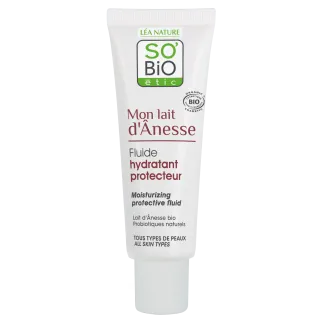
SO'BiO étic Protective moisturizing fluid
Works for
MoisturizingGlycerin, Caprylic/capric triglyceride + 10 moreWorks
“Enriched with Fragments of natural probiotics, the Protective Moisturizing Fluid instantly hydrates(1), helps stimulate the skin's natural defenses and strengthens the skin barrier.”
This product can help improve hydration of the skin with the two types of ingredients.
The first type is called “humectants”:
these ingredients help attract water.
When humectants are on the surface of the skin, they “pull in” the moisture from the outside environment, or from
within deeper layers of the skin. The following ingredients in this product do the job:
glycerin, sodium hyaluronate.
This product also contains ingredients called “occlusives”. They help reduce the speed with which our skin loses moisture to the outside environment. These ingredients also help soften the upper layer of the skin, so it feels less tight and nicer to the touch. The following ingredients in this product do the job: caprylic/capric triglyceride, glycine soja oil.
Can it cause trouble?
Irritancy2 strong irritants: Parfum, LinaloolMedium risk
Comedogenic1 ingredient rated 2 or more on the 0–5 pore-clogging scale1 flagged
User reviews
Be the first — your take helps the next person decide.
Ingredients
Filter by role to see what each ingredient is doing.
Water~40–60%
Anthemis nobilis flower water~5.3–7.9%
- Irritation risk
- Low
Dicaprylyl carbonate~3.7–5.5%
- Irritation risk
- Low
Helps products spread more easily and works as an emollient to soften skin
More about Dicaprylyl carbonateGlycerin~2.8–4.2%
- Irritation risk
- Low
One of the best moisturizing ingredients. Naturally present in skin. It attracts water to the upper layer of the skin working as a humectant
More about GlycerinCaprylic/capric triglyceride~2.2–3.3%
- Irritation risk
- Medium
A good mix of fatty acids that forms a protective layer on the skin. Improves the shelf life of products. Derived from coconut and glycerin
More about Caprylic/capric triglycerideDonkey milk~1.7–2.6%
- Irritation risk
- Low
Octyldodecanol~1.4–2.1%
- Irritation risk
- Low
An emollient that helps to soften the skin and create a pleasant product texture and stabilize the formulation
More about OctyldodecanolLauryl laurate~1.2–1.9%
- Irritation risk
- Medium
Helps soften the upper layer of the skin
More about Lauryl laurateGlyceryl stearate citrate~1.1–1.6%
- Irritation risk
- Low
Helps oil and water mix together while softening the upper layer of the skin
More about Glyceryl stearate citratePolyglyceryl-3 stearate~0.85–1.25%
- Irritation risk
- Low
Helps oil and water mix together
More about Polyglyceryl-3 stearateBentonite~0.55–1.25%
Hydrogenated lecithin~0.4–0.95%
- Irritation risk
- Low
Helps to retain moisture by creating a protective barrier on the skin. Rich in fatty acids. Improves product texture and helps with the penetration of other ingredients.
More about Hydrogenated lecithinSodium levulinate~0.35–0.8%
Benzyl alcohol~0.2–0.75%
- Irritation risk
- High
A preservative. Can be used to mask unpleasant smell. Can be irritating
More about Benzyl alcoholParfum~0.2–0.75%
- Irritation risk
- High
An aromatic blend of unspecified and possibly irritating ingredients
More about ParfumSodium stearoyl glutamate~0.35–0.85%
- Irritation risk
- Medium
Helps oil and water mix together
More about Sodium stearoyl glutamateXanthan gum~0.2–0.8%
- Irritation risk
- Low
Used to create a thicker product consistency
More about Xanthan gumSodium benzoate~0.25–0.5%
Phytic acid~0.15–0.65%
- Irritation risk
- Medium
An alpha-hydroxy acid (AHA), but is mostly used to stabilize product formulations in cosmetics
More about Phytic acidSclerotium gum~0.15–0.55%
- Irritation risk
- Low
Used to create gel-like formulas and stabilize emulsions
More about Sclerotium gumLactic acid~0.1–0.5%
- Irritation risk
- Medium
An exfoliating and moisturizing alpha-hydroxy acid (AHA). Typically causes less irritation than other AHAs, for example, glycolic acid. At high concentrations (about 15%), lactic acid can help reduce lines and wrinkles. Recent studies show that lactic acid can support the "good" bacteria living on skin's surface (healthy skin microbiome)
More about Lactic acidLactobacillus ferment lysate~0.1–0.45%
- Irritation risk
- Low
A "broth" with parts of dead cells of lactobacteria. Might be helpful supporting diverse microbiome in skin, but evidence is lacking
More about Lactobacillus ferment lysateSodium hydroxide~0.1–0.4%
Aloe barbadensis leaf juice powder~0.1–0.4%
- Irritation risk
- Medium
Traditionally used to treat sunburns, dermatitis and inflammation, but evidence for its effectiveness is lacking. The extract can contain humectants that help attract water into the skin
More about Aloe barbadensis leaf juice powderSodium hyaluronate~0.1–0.35%
- Irritation risk
- Low
One of the best moisturizing ingredients. Attracts water into the upper layer of the skin
More about Sodium hyaluronateTocopherol~0.1–0.35%
- Irritation risk
- Low
Pure form of vitamin E. Can help moisturise and protect the skin from free radicals. Often used to help stabilise other ingredients or the formula itself
More about TocopherolPotassium sorbate~0.05–0.3%
Glycine soja oil~0.05–0.3%
- Irritation risk
- Medium
- Comedogenicity
- 2/5
A good emollient that helps soften the skin and helps repair its barrier function. It can clog pores if used in high concentrations.
More about Glycine soja oilLinalool~0.05–0.15%
Ingredient list view
Water, Anthemis nobilis flower water, Dicaprylyl carbonate, Glycerin, Caprylic/capric triglyceride, Donkey milk, Octyldodecanol, Lauryl laurate, Glyceryl stearate citrate, Polyglyceryl-3 stearate, Bentonite, Hydrogenated lecithin, Sodium levulinate, Benzyl alcohol, Parfum, Sodium stearoyl glutamate, Xanthan gum, Sodium benzoate, Phytic acid, Sclerotium gum, Lactic acid, Lactobacillus ferment lysate, Sodium hydroxide, Aloe barbadensis leaf juice powder, Sodium hyaluronate, Tocopherol, Potassium sorbate, Glycine soja oil, Linalool
Compare prices
Retailers ranked by price — lowest first.
Worth comparing, line by line.
Match % combines shared ingredients, the first five ingredients, shared actives and hero ingredients, irritancy (lower counts in the alternative's favour), texture and body area. Only products in the same routine step are compared.
| SO'BiO éticProtective moisturizing fluidYOUR PRODUCT | Esmi Skin MineralsProbiotic Skin Mylck + Hydration Moisturiser | EmbryolisseLait Crème Sensitive - Adults, children babies - Fragrance Free | Avedabotanical kinetics all-sensitive lotion | |
|---|---|---|---|---|
| Match | — | 44% | 42% | 42% |
| Price | — | $42.08 | — | $33.92 |
| Shared key ingredients | — | 3 of 4 | 3 of 4 | 3 of 4 |
| Key difference | — | Betaine | Butyrospermum Parkii Butter | Oatmeal Extract |
| Irritancy | Medium | Low | Low | Low |
| Drying alcohol | — | — | — | — |
| View product | Shop | Shop | Shop |


More alternatives: CeraVe Daily Moisturising Lotionpreange Vit B5 Emulsion
Sources cited in this review
Every concentration estimate and effectiveness label is anchored to one of these 10 studies and safety reviews.
- 1
- 2Cosmetic and dermatologic use of alpha hydroxy acidsonlinelibrary.wiley.com
- 3
- 4Epidermal and dermal effects of topical lactic acidncbi.nlm.nih.gov
- 5Dual Effects of Alpha-Hydroxy Acids on the Skinpdfs.semanticscholar.org
- 6

Affiliate links · As an Amazon Associate, WIMJ earns from qualifying purchases.