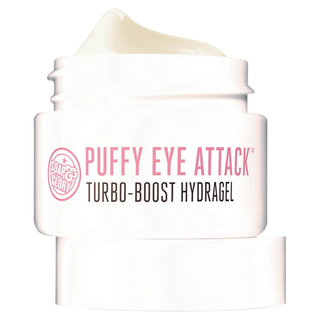
Soap and Glory Puffy Eye Attack Turbo-Boost Hydragel

Soap and Glory Puffy Eye Attack Turbo-Boost Hydragel

Efficacy75/100IrritancyMedium
Edit

Works for

2 of 2 advertised claims delivered

Anti-aging
Glycine soja protein, Nicotiana sylvestris leaf cell culture + 5 more
Moderate evidence
What the product description says
“Ultra-hydrating and soothing with anti-aging properties.”
Source: Skinstore

This product contains superoxide dismutase. This ingredient help neutralize free radicals in skin. By doing so, they might be able to prevent early signs of aging (like fine lines and wrinkles), at least to some extent. These ingredients will not be able to "reverse" signs of aging.

Glycine soja proteinEffect: LowA plant extract that helps to attract water to the upper layer of the skin and soften it. It might be helpful in neutralizing free radicals. It might be somewhat helpful for evening out the skin tone. It might be able to support elastin production but solid research is lacking~0.3–0.55%
Nicotiana sylvestris leaf cell cultureEffect: LowHas been claimed to have an ability to protect collagen and stimulate its production in skin but further research is lacking so far~0.15–0.25%
Butyrospermum parkii butterEffect: LowA great moisturising ingredient that softens the skin and reduces water loss from its upper layer. It also can be helpful in protecting skin from free radicals~1.5–1.8%
Ascorbic acidUnder-dosedEffect: HighThe most well-researched antioxidant that works in skin. Helps neutralize free radicals supporting collagen production, helping to even out the skin tone and preventing early signs of aging~0.15–0.25%
TocopherolEffect: Low, below effective dosePure form of vitamin E. Can help moisturise and protect the skin from free radicals. Often used to help stabilise other ingredients or the formula itself~0.25–0.45%
Ascorbyl palmitateEffect: Low, below effective doseBeing a lipid soluble form of vitamin C, it is more stable and can penetrate the skin better than L-Ascorbic acid. It is effective in protecting the skin from free radicals, as well as evening the skin tone, but is less effective in stimulating collagen production compared to L-Ascorbic acid.~0.25–0.45%
Aloe barbadensis leaf juiceEffect: Low, below effective doseTraditionally used to treat sunburns, dermatitis and inflammation, but evidence for its effectiveness is lacking. The extract can contain humectants that help attract water into the skin~0.25–0.45%
Moisturizing
Dimethicone, Glyceryl acrylate/acrylic acid copolymer + 21 more
Good evidence
What the product description says
“Puffy Eye Attack Turbo-Boost Hydragel”
From product name

This product can help improve hydration of the skin with the two types of ingredients.

The first type is called “humectants”:
these ingredients help attract water. When humectants are on the surface of the skin, they “pull in” the moisture from the outside environment, or from within deeper layers of the skin. The following ingredients in this product do the job: glycerin, glyceryl acrylate/acrylic acid copolymer.

This product also contains ingredients called “occlusives”. They help reduce the speed with which our skin loses moisture to the outside environment. These ingredients also help soften the upper layer of the skin, so it feels less tight and nicer to the touch. The following ingredients in this product do the job: butyrospermum parkii butter, dimethicone.

DimethiconeKey active· Emollient, OcclusiveEffect: HighA silicone that helps to reduce water loss from the surface of the skin. Can temporarily "fill in" lines and wrinkles, absorb oil, and create a nice product finish~1.7–2%
Glyceryl acrylate/acrylic acid copolymerKey active· HumectantEffect: HighHelps attract water to the upper layer of the skin and provide a longer-lasting hydration. Can create a thicker product consistency~0.25–0.45%
Sodium hyaluronateKey active· HumectantEffect: HighOne of the best moisturizing ingredients. Attracts water into the upper layer of the skin~0.25–0.45%
Superoxide dismutaseKey activeEffect: HighAn antioxidant enzyme that is naturally present in skin. It can help support skin barrier function and reduce inflammation in skin. It is used in topical medications for inflammatory skin conditions including atopic dermatitis (eczema) and psoriasis. There are three types of natural Superoxide Dismutase in human skin. The compound used in topical treatments and cosmetics are mimics of typically one of these natural variants~0.25–0.45%
Butyrospermum parkii butterKey active· Emollient, OcclusiveEffect: HighA great moisturising ingredient that softens the skin and reduces water loss from its upper layer. It also can be helpful in protecting skin from free radicals~1.5–1.8%
Oryza sativa bran oilKey active· EmollientEffect: HighHelps soften the upper layer of the skin and might have some anti-oxidant properties~0.25–0.5%
Hydroxyethyl ureaKey active· HumectantEffect: HighA derivative of urea, a compound that is naturally present in skin. Attracts water to the upper layer of the skin. Can enhance penetration of other ingredients~0.5–0.8%
GlycerinKey active· HumectantEffect: HighOne of the best moisturizing ingredients. Naturally present in skin. It attracts water to the upper layer of the skin working as a humectant~4.4–5.4%
Glycine soja proteinKey active· Humectant, EmollientEffect: MediumA plant extract that helps to attract water to the upper layer of the skin and soften it. It might be helpful in neutralizing free radicals. It might be somewhat helpful for evening out the skin tone. It might be able to support elastin production but solid research is lacking~0.3–0.55%
Nicotiana sylvestris leaf cell cultureKey active· EmollientEffect: MediumHas been claimed to have an ability to protect collagen and stimulate its production in skin but further research is lacking so far~0.15–0.25%
Hydrolyzed rice proteinKey active· HumectantEffect: MediumHelps attract water to the upper layer of the skin. Might have some anti-oxidant properties~0.7–1%
Coco-caprylate/caprateKey active· EmollientEffect: MediumHelps to soften the upper layer of the skin without creating a greasy texture~3.1–3.8%
Cetyl alcoholKey active· EmollientEffect: MediumA non-drying alcohol that works to soften the skin and stabilize product formulations helping oil and water mix together~0.5–0.75%
Prunus armeniaca fruit extractEffect: LowA fruit extract that might have some antioxidant properties and might help attract water to the skin, but evidence of effectiveness is lacking~0.15–0.25%
Peg-8· HumectantEffect: LowUsed to create a nice product consistency~2.3–2.8%
Butylene glycol· HumectantEffect: LowUsed to create a nice product texture and help delivery of other ingredients. Might be somewhat helpful in attracting water to the upper layer of the skin~3.9–4.8%
C12-16 alcohols· EmollientEffect: LowHelps soften the upper layer of the skin and improve the product's texture~0.3–0.55%
Glyceryl stearate· EmollientEffect: LowAn emollient that softens the skin and forms a protective layer on its surface. Helps water and oil mix together~0.65–0.95%
Hydrogenated polydecene· EmollientEffect: LowHelps to soften the upper layer of the skin and create a nice product texture~0.45–0.65%
Palmitic acid· EmollientEffect: LowAn emollient that is naturally present in skin and helps soften it~0.3–0.55%
Aloe barbadensis leaf juiceEffect: Low, below effective doseTraditionally used to treat sunburns, dermatitis and inflammation, but evidence for its effectiveness is lacking. The extract can contain humectants that help attract water into the skin~0.25–0.45%
TocopherolEffect: Low, below effective dosePure form of vitamin E. Can help moisturise and protect the skin from free radicals. Often used to help stabilise other ingredients or the formula itself~0.25–0.45%
Cucumis sativus fruit extractEffect: Low, below effective doseMight be somewhat helpful in reducing hyperpigmentation and neutralizing free radicals but its typical concentration in a product is too low for having an effect~0.25–0.45%
Anti-oxidation
Not advertised by the brand · Superoxide dismutase, Caffeine + 9 more
Strong evidence

This product contains antioxidants (superoxide dismutase) that can help neutralize free radicals in skin. By doing so, they can lessen the damage the skin gets from the UV light (sun).

Superoxide dismutaseKey activeEffect: HighAn antioxidant enzyme that is naturally present in skin. It can help support skin barrier function and reduce inflammation in skin. It is used in topical medications for inflammatory skin conditions including atopic dermatitis (eczema) and psoriasis. There are three types of natural Superoxide Dismutase in human skin. The compound used in topical treatments and cosmetics are mimics of typically one of these natural variants~0.25–0.45%
CaffeineEffect: LowMight be helpful in neutralizing free radicals. Can have a dehydration effect that might somewhat decrease the look of puffy eyes~0.3–0.55%
Butyrospermum parkii butterEffect: LowA great moisturising ingredient that softens the skin and reduces water loss from its upper layer. It also can be helpful in protecting skin from free radicals~1.5–1.8%
Prunus persica fruit extractEffect: LowA fruit extact. Might have some anti-oxidant properties~0.15–0.3%
Glycine soja proteinEffect: LowA plant extract that helps to attract water to the upper layer of the skin and soften it. It might be helpful in neutralizing free radicals. It might be somewhat helpful for evening out the skin tone. It might be able to support elastin production but solid research is lacking~0.3–0.55%
Hydrolyzed rice proteinEffect: LowHelps attract water to the upper layer of the skin. Might have some anti-oxidant properties~0.7–1%
Ascorbic acidUnder-dosedEffect: HighThe most well-researched antioxidant that works in skin. Helps neutralize free radicals supporting collagen production, helping to even out the skin tone and preventing early signs of aging~0.15–0.25%
TocopherolUnder-dosedEffect: HighPure form of vitamin E. Can help moisturise and protect the skin from free radicals. Often used to help stabilise other ingredients or the formula itself~0.25–0.45%
Cucumis sativus fruit extractEffect: Low, below effective doseMight be somewhat helpful in reducing hyperpigmentation and neutralizing free radicals but its typical concentration in a product is too low for having an effect~0.25–0.45%
Ascorbyl palmitateEffect: Low, below effective doseBeing a lipid soluble form of vitamin C, it is more stable and can penetrate the skin better than L-Ascorbic acid. It is effective in protecting the skin from free radicals, as well as evening the skin tone, but is less effective in stimulating collagen production compared to L-Ascorbic acid.~0.25–0.45%
Panax ginseng root extractEffect: Low, below effective doseA plant extract that might have some anti-inflammatory properties, but solid evidence is lacking. It can be irritating~0.3–0.5%
Exfoliation
Not advertised by the brand · Hydroxyethyl urea
Strong evidence

This product can help exfoliate the skin. In other words, it helps break down the bonds between dead cells on the surface of the skin and speed up the skin turnover. Skin often appears softer and brighter after exfoliation, but overdoing it can result in disrupted skin barrier. The following ingredient is doing the exfoliating job in this product: hydroxyethyl urea.

Hydroxyethyl ureaKey activeEffect: HighA derivative of urea, a compound that is naturally present in skin. Attracts water to the upper layer of the skin. Can enhance penetration of other ingredients~0.5–0.8%

Can it cause trouble?

Irritancy
1 strong irritant: Citrus nobilis fruit extract
Medium risk
We flagged 19 ingredients with irritancy potential. Severity depends on your sensitivity threshold; the table lists the worst offenders first.
IngredientFunctionIrritationEst. amount
Panax ginseng root extractA plant extract that might have some anti-inflammatory properties, but solid evidence is lacking. It can be irritatingHigh~0.3–0.5%est.
Ascorbic acidThe most well-researched antioxidant that works in skin. Helps neutralize free radicals supporting collagen production, helping to even out the skin tone and preventing early signs of agingHigh~0.15–0.25%est.
Citrus nobilis fruit extract—High~0.15–0.25%est.
Prunus persica fruit extractA fruit extact. Might have some anti-oxidant propertiesHigh~0.15–0.3%est.
Peg-8Used to create a nice product consistencyMedium~2.3–2.8%est.
Aluminum starch octenylsuccinateUsed to thicken the product's consistencyMedium~1.9–2.3%est.
EthylhexylglycerinA preservativeMedium~0.5–0.7%est.
Acrylates/c10-30 alkyl acrylate crosspolymerMaintains the texture of skincare products. Allows the product to spread evenly. Helps oil and water mix togetherMedium~0.45–0.65%est.
CaffeineMight be helpful in neutralizing free radicals. Can have a dehydration effect that might somewhat decrease the look of puffy eyesMedium~0.3–0.55%est.
Disodium edtaStabilizes the product formulationMedium~0.3–0.5%est.
C12-16 alcoholsHelps soften the upper layer of the skin and improve the product's textureMedium~0.3–0.55%est.
Glyceryl acrylate/acrylic acid copolymerHelps attract water to the upper layer of the skin and provide a longer-lasting hydration. Can create a thicker product consistencyMedium~0.25–0.45%est.
Aloe barbadensis leaf juiceTraditionally used to treat sunburns, dermatitis and inflammation, but evidence for its effectiveness is lacking. The extract can contain humectants that help attract water into the skinMedium~0.25–0.45%est.
Ascorbyl palmitateBeing a lipid soluble form of vitamin C, it is more stable and can penetrate the skin better than L-Ascorbic acid. It is effective in protecting the skin from free radicals, as well as evening the skin tone, but is less effective in stimulating collagen production compared to L-Ascorbic acid.Medium~0.25–0.45%est.
Cucumis sativus fruit extractMight be somewhat helpful in reducing hyperpigmentation and neutralizing free radicals but its typical concentration in a product is too low for having an effectMedium~0.25–0.45%est.
Potassium sorbateA preservativeMedium~0.2–0.4%est.
Citric acidCan work as an exfoliant but is typically used to adjust the product pHMedium~0.1–0.25%est.
Prunus armeniaca fruit extractA fruit extract that might have some antioxidant properties and might help attract water to the skin, but evidence of effectiveness is lackingMedium~0.15–0.25%est.
Nicotiana sylvestris leaf cell cultureHas been claimed to have an ability to protect collagen and stimulate its production in skin but further research is lacking so farMedium~0.15–0.25%est.
Comedogenic
1 ingredient rated 2 or more on the 0–5 pore-clogging scale
1 flagged
These ingredients have a comedogenic rating of 2 or more on a 0–5 scale; the table shows each one's rating. In leave-on products they can clog pores in acne-prone skin.
IngredientFunctionRatingEst. amount
Butyrospermum parkii butterA great moisturising ingredient that softens the skin and reduces water loss from its upper layer. It also can be helpful in protecting skin from free radicals3/5~1.5–1.8%est.
Edit

User reviews

Would you recommend?
No community reviews yet.

Be the first — your take helps the next person decide.

Write a review · ~30s

Ingredients

Filter by role to see what each ingredient is doing.

Water~45–55%
Formula
Irritation risk
Low

Plain old water

More about Water
Glycerin~4.4–5.4%
Key active
Irritation risk
Low
Works for
Moisturizing

One of the best moisturizing ingredients. Naturally present in skin. It attracts water to the upper layer of the skin working as a humectant

More about Glycerin
Butylene glycol~3.9–4.8%
Formula
Irritation risk
Low
Works for
Moisturizing

Used to create a nice product texture and help delivery of other ingredients. Might be somewhat helpful in attracting water to the upper layer of the skin

More about Butylene glycol
Coco-caprylate/caprate~3.1–3.8%
Key active
Irritation risk
Low
Works for
Moisturizing

Helps to soften the upper layer of the skin without creating a greasy texture

More about Coco-caprylate/caprate
Peg-8~2.3–2.8%
Irritant · medium
Irritation risk
Medium
Works for
Moisturizing

Used to create a nice product consistency

More about Peg-8
Aluminum starch octenylsuccinate~1.9–2.3%
Irritant · medium
Irritation risk
Medium

Used to thicken the product's consistency

More about Aluminum starch octenylsuccinate
Dimethicone~1.7–2%
Key active
Irritation risk
Low
Works for
MoisturizingMattifying

A silicone that helps to reduce water loss from the surface of the skin. Can temporarily "fill in" lines and wrinkles, absorb oil, and create a nice product finish

More about Dimethicone
Butyrospermum parkii butter~1.5–1.8%
Key activeComedogenic 3/5
Irritation risk
Low
Comedogenicity
3/5
Works for
MoisturizingAnti-agingAnti-oxidation

A great moisturising ingredient that softens the skin and reduces water loss from its upper layer. It also can be helpful in protecting skin from free radicals

More about Butyrospermum parkii butter
Phenoxyethanol~0.5–1%
Formula
Irritation risk
Low

A preservative. It helps prevent bacterial growth in cosmetic products

More about Phenoxyethanol
Sodium polyacrylate~1–1.3%
Formula
Irritation risk
Low
Works for
Mattifying

Used to create a gel-like product texture, as well as to stabilize emulsions

More about Sodium polyacrylate
Hydrolyzed rice protein~0.7–1%
Key active
Irritation risk
Low
Works for
MoisturizingAnti-oxidation

Helps attract water to the upper layer of the skin. Might have some anti-oxidant properties

More about Hydrolyzed rice protein
Glyceryl stearate~0.65–0.95%
Formula
Irritation risk
Low
Works for
CleansingMoisturizing

An emollient that softens the skin and forms a protective layer on its surface. Helps water and oil mix together

More about Glyceryl stearate
Hydroxyethyl urea~0.5–0.8%
Key active
Irritation risk
Low
Works for
ExfoliationMoisturizing

A derivative of urea, a compound that is naturally present in skin. Attracts water to the upper layer of the skin. Can enhance penetration of other ingredients

More about Hydroxyethyl urea
Ethylhexylglycerin~0.5–0.7%
Irritant · medium
Irritation risk
Medium

A preservative

More about Ethylhexylglycerin
Hydrogenated polydecene~0.45–0.65%
Formula
Irritation risk
Low
Works for
Moisturizing

Helps to soften the upper layer of the skin and create a nice product texture

More about Hydrogenated polydecene
Cetyl alcohol~0.5–0.75%
Key active
Irritation risk
Low
Works for
CleansingMoisturizing

A non-drying alcohol that works to soften the skin and stabilize product formulations helping oil and water mix together

More about Cetyl alcohol
Acrylates/c10-30 alkyl acrylate crosspolymer~0.45–0.65%
Irritant · medium
Irritation risk
Medium

Maintains the texture of skincare products. Allows the product to spread evenly. Helps oil and water mix together

More about Acrylates/c10-30 alkyl acrylate crosspolymer
Sclerotium gum~0.35–0.6%
Formula
Irritation risk
Low

Used to create gel-like formulas and stabilize emulsions

More about Sclerotium gum
Sodium hydroxide~0.3–0.6%
Formula
Irritation risk
Low

Used to adjust the product's pH

More about Sodium hydroxide
Caffeine~0.3–0.55%
Irritant · medium
Irritation risk
Medium
Works for
De-puffingAnti-oxidation

Might be helpful in neutralizing free radicals. Can have a dehydration effect that might somewhat decrease the look of puffy eyes

More about Caffeine
Disodium edta~0.3–0.5%
Irritant · medium
Irritation risk
Medium

Stabilizes the product formulation

More about Disodium edta
Trideceth-6~0.3–0.55%
Formula
Irritation risk
Low
Works for
Cleansing

Helps oil and water mix together

More about Trideceth-6
C12-16 alcohols~0.3–0.55%
Irritant · medium
Irritation risk
Medium
Works for
Moisturizing

Helps soften the upper layer of the skin and improve the product's texture

More about C12-16 alcohols
Glycine soja protein~0.3–0.55%
Key active
Irritation risk
Low
Works for
CleansingMoisturizingEvens skin toneAnti-agingAnti-oxidation

A plant extract that helps to attract water to the upper layer of the skin and soften it. It might be helpful in neutralizing free radicals. It might be somewhat helpful for evening out the skin tone. It might be able to support elastin production but solid research is lacking

More about Glycine soja protein
Panax ginseng root extract~0.3–0.5%
Irritant · high
Irritation risk
High
Works for
Anti-inflammatoryAnti-oxidation

A plant extract that might have some anti-inflammatory properties, but solid evidence is lacking. It can be irritating

More about Panax ginseng root extract
Superoxide dismutase~0.25–0.45%
Key active
Irritation risk
Low
Works for
Anti-oxidationMoisturizingAnti-inflammatory

An antioxidant enzyme that is naturally present in skin. It can help support skin barrier function and reduce inflammation in skin. It is used in topical medications for inflammatory skin conditions including atopic dermatitis (eczema) and psoriasis. There are three types of natural Superoxide Dismutase in human skin. The compound used in topical treatments and cosmetics are mimics of typically one of these natural variants

More about Superoxide dismutase
Glyceryl acrylate/acrylic acid copolymer~0.25–0.45%
Key activeIrritant · medium
Irritation risk
Medium
Works for
Moisturizing

Helps attract water to the upper layer of the skin and provide a longer-lasting hydration. Can create a thicker product consistency

More about Glyceryl acrylate/acrylic acid copolymer
Sodium benzoate~0.25–0.45%
Formula
Irritation risk
Low

A preservative

More about Sodium benzoate
Hydrogenated lecithin~0.25–0.5%
Formula
Irritation risk
Low
Works for
Cleansing

Helps to retain moisture by creating a protective barrier on the skin. Rich in fatty acids. Improves product texture and helps with the penetration of other ingredients.

More about Hydrogenated lecithin
Palmitic acid~0.3–0.55%
Formula
Irritation risk
Low
Works for
CleansingMoisturizing

An emollient that is naturally present in skin and helps soften it

More about Palmitic acid
Gynostemma pentaphyllum extract~0.25–0.45%
Formula
Ammonium lactate~0.25–0.45%
Formula
Sodium hyaluronate~0.25–0.45%
Key active
Irritation risk
Low
Works for
Moisturizing

One of the best moisturizing ingredients. Attracts water into the upper layer of the skin

More about Sodium hyaluronate
Oryza sativa starch~0.25–0.5%
Formula
Aloe barbadensis leaf juice~0.25–0.45%
Irritant · medium
Irritation risk
Medium
Works for
MoisturizingReduces rednessAnti-inflammatoryAntibacterialReduces irritationAnti-blemishAnti-aging

Traditionally used to treat sunburns, dermatitis and inflammation, but evidence for its effectiveness is lacking. The extract can contain humectants that help attract water into the skin

More about Aloe barbadensis leaf juice
Punica granatum bark extract~0.25–0.45%
Formula
Tocopherol~0.25–0.45%
Under-dosed
Irritation risk
Low
Works for
Anti-oxidationMoisturizingAnti-agingAnti-inflammatory

Pure form of vitamin E. Can help moisturise and protect the skin from free radicals. Often used to help stabilise other ingredients or the formula itself

More about Tocopherol
Sodium dextran sulfate~0.25–0.45%
Formula
Ascorbyl palmitate~0.25–0.45%
Irritant · medium
Irritation risk
Medium
Works for
Anti-oxidationAnti-aging

Being a lipid soluble form of vitamin C, it is more stable and can penetrate the skin better than L-Ascorbic acid. It is effective in protecting the skin from free radicals, as well as evening the skin tone, but is less effective in stimulating collagen production compared to L-Ascorbic acid.

More about Ascorbyl palmitate
Cucumis sativus fruit extract~0.25–0.45%
Irritant · medium
Irritation risk
Medium
Works for
Anti-oxidationMoisturizing

Might be somewhat helpful in reducing hyperpigmentation and neutralizing free radicals but its typical concentration in a product is too low for having an effect

More about Cucumis sativus fruit extract
Sophora japonica flower extract~0.25–0.4%
Formula
Oryza sativa bran oil~0.25–0.5%
Key active
Irritation risk
Low
Works for
Moisturizing

Helps soften the upper layer of the skin and might have some anti-oxidant properties

More about Oryza sativa bran oil
Potassium sorbate~0.2–0.4%
Irritant · medium
Irritation risk
Medium

A preservative

More about Potassium sorbate
Xanthan gum~0.2–0.35%
Formula
Irritation risk
Low
Works for
Cleansing

Used to create a thicker product consistency

More about Xanthan gum
Propylene glycol dicaprylate/dicaprate~0.2–0.4%
Formula
Ascorbic acid~0.15–0.25%
Under-dosedIrritant · high
Irritation risk
High
Works for
Evens skin toneAnti-agingAnti-oxidation

The most well-researched antioxidant that works in skin. Helps neutralize free radicals supporting collagen production, helping to even out the skin tone and preventing early signs of aging

More about Ascorbic acid
Citric acid~0.1–0.25%
Irritant · medium
Irritation risk
Medium

Can work as an exfoliant but is typically used to adjust the product pH

More about Citric acid
Citrus nobilis fruit extract~0.15–0.25%
Irritant · high
Prunus armeniaca fruit extract~0.15–0.25%
Irritant · medium
Irritation risk
Medium
Works for
MoisturizingAnti-inflammatory

A fruit extract that might have some antioxidant properties and might help attract water to the skin, but evidence of effectiveness is lacking

More about Prunus armeniaca fruit extract
Prunus persica fruit extract~0.15–0.3%
Irritant · high
Irritation risk
High
Works for
Anti-oxidation

A fruit extact. Might have some anti-oxidant properties

More about Prunus persica fruit extract
Nicotiana sylvestris leaf cell culture~0.15–0.25%
Key activeIrritant · medium
Irritation risk
Medium
Works for
MoisturizingAnti-aging

Has been claimed to have an ability to protect collagen and stimulate its production in skin but further research is lacking so far

More about Nicotiana sylvestris leaf cell culture
Ingredient list view

Water, Glycerin, Butylene glycol, Coco-caprylate/caprate, Peg-8, Aluminum starch octenylsuccinate, Dimethicone, Butyrospermum parkii butter, Phenoxyethanol, Sodium polyacrylate, Hydrolyzed rice protein, Glyceryl stearate, Hydroxyethyl urea, Ethylhexylglycerin, Hydrogenated polydecene, Cetyl alcohol, Acrylates/c10-30 alkyl acrylate crosspolymer, Sclerotium gum, Sodium hydroxide, Caffeine, Disodium edta, Trideceth-6, C12-16 alcohols, Glycine soja protein, Panax ginseng root extract, Superoxide dismutase, Glyceryl acrylate/acrylic acid copolymer, Sodium benzoate, Hydrogenated lecithin, Palmitic acid, Gynostemma pentaphyllum extract, Ammonium lactate, Sodium hyaluronate, Oryza sativa starch, Aloe barbadensis leaf juice, Punica granatum bark extract, Tocopherol, Sodium dextran sulfate, Ascorbyl palmitate, Cucumis sativus fruit extract, Sophora japonica flower extract, Oryza sativa bran oil, Potassium sorbate, Xanthan gum, Propylene glycol dicaprylate/dicaprate, Ascorbic acid, Citric acid, Citrus nobilis fruit extract, Prunus armeniaca fruit extract, Prunus persica fruit extract, Nicotiana sylvestris leaf cell culture

Compare prices

Retailers ranked by price — lowest first.

Walgreens
$12.79
Buy
Amazon US
Price unavailable
Check

Affiliate links · prices updated regularly · As an Amazon Associate, WIMJ earns from qualifying purchases.

Cheaper alternatives? See how this stacks up against similar formulas.
We compare ingredient profiles across our catalog — pick the closest match for your budget.
Open dupe finder

Sources cited in this review

Every concentration estimate and effectiveness label is anchored to one of these 24 studies and safety reviews.

  1. 1
  2. 2
  3. 3
  4. 4
  5. 5
  6. 6
Soap and Glory Puffy Eye Attack Turbo-Boost Hydragel
Soap and GloryPuffy Eye Attack Turbo-Boost Hydragel

Affiliate links · As an Amazon Associate, WIMJ earns from qualifying purchases.

As an Amazon Associate, WIMJ earns from qualifying purchases.