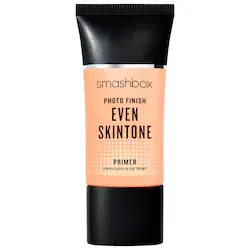
Smashbox Photo Finish Even Skintone Peach Primer
Works for
Anti-agingRetinyl palmitateMay help
“What it is: A color-correcting, peach-toned face primer that evens skin tone, blurs the look of pores, and reduces the appearance of fine lines.”
This product contains retinyl palmitate. This ingredient might be able to help reduce and prevent fine lines and wrinkles, improve skin elasticity and firmness, but there is not enough evidence that it actually works.
MoisturizingSide benefit · Cyclopentasiloxane, Dimethicone crosspolymer + 8 moreWorks
This product can help soften the skin and reduce its moisture loss with emollients and occlusives: caprylic/capric triglyceride, dimethicone.
Keep in mind that this product does not contain effective ingredients to attract water to the upper layer of the skin. This is why an additional product with humectants like glycerin or hyaluronic acid can be helpful (apply it before this product for the best results).
Evens skin toneSide benefit the brand mentions · Retinyl palmitateMay help
“Peach primer camouflages dark spots, evens skin tone, blurs pores and reduces the appearance of fine lines to prep skin for makeup.”
The following ingredient (ingredients) in this product might be helpful, but there is no evidence to confirm that it actually works: retinyl palmitate.
Can it cause trouble?
Irritancy2 strong irritants: Cymbopogon schoenanthus oil, Retinyl palmitateMedium risk
Comedogenic1 ingredient rated 2 or more on the 0–5 pore-clogging scale1 flagged
User reviews
Be the first — your take helps the next person decide.
Ingredients
Filter by role to see what each ingredient is doing.
Cyclopentasiloxane~23–35%
- Irritation risk
- Low
A silicone that helps improve the product texture and spreadability. Can absorb oil creating a short-term mattifying effect on the skin
More about CyclopentasiloxaneDimethicone crosspolymer~6–9.1%
- Irritation risk
- Low
Used to create a thicker product texture. Helps soften the upper layer of the skin and might be able to prevent moisture loss from its surface
More about Dimethicone crosspolymerCyclohexasiloxane~4.8–7.3%
- Irritation risk
- Low
A silicone that serves as an emollient. Helps create a nice non-greasy feels
More about CyclohexasiloxaneDimethicone~3.8–5.7%
- Irritation risk
- Low
A silicone that helps to reduce water loss from the surface of the skin. Can temporarily "fill in" lines and wrinkles, absorb oil, and create a nice product finish
More about DimethiconeTocopheryl acetate~2.5–3.7%
- Irritation risk
- Medium
A more stable but less bio-available form of vitamin E compared to Tocopherol. Might help moisturize and protect the skin from free radicals, but mostly used in low concentrations to stabilize other ingredients.
More about Tocopheryl acetateCymbidium grandiflorum flower extract~2–3%
- Irritation risk
- Low
Aloe barbadensis leaf extract~1.7–2.5%
- Irritation risk
- Medium
Traditionally used to treat sunburns, dermatitis and inflammation, but evidence for its effectiveness is lacking. The extract can contain humectants that help attract water into the skin
More about Aloe barbadensis leaf extractCarthamus tinctorius seed oil~1.3–1.9%
- Irritation risk
- Low
An emollient that helps soften the skin and might help calm down inflammation
More about Carthamus tinctorius seed oilCymbopogon schoenanthus oil~0.9–1.35%
- Irritation risk
- High
Glycine soja oil~0.85–1.3%
- Irritation risk
- Medium
- Comedogenicity
- 2/5
A good emollient that helps soften the skin and helps repair its barrier function. It can clog pores if used in high concentrations.
More about Glycine soja oilEthylhexylglycerin~0.5–1.15%
Methicone~0.45–1.1%
- Irritation risk
- Low
A type of silicone that helps soften the upper layer of the skin and reduces the water loss from the skin surface
More about MethiconeCaprylic/capric triglyceride~0.4–1%
- Irritation risk
- Medium
A good mix of fatty acids that forms a protective layer on the skin. Improves the shelf life of products. Derived from coconut and glycerin
More about Caprylic/capric triglycerideRetinyl palmitate~0.3–0.75%
- Irritation risk
- High
Three steps removed from the active form of vitamin A - retinoic acid. To have an effect in the skin, it first needs to be converted twice to become the retinoic acid. This means it is less potent than retinol, but could also be less irritating. Once converted to the retinoic acid in the skin, it helps against all signs of aging, improves skin cell turnover and helps fight blemishes and clogged pores. However, in many cosmetic formulations, it is used in a concentration that is too low to have the full effect
More about Retinyl palmitateEthylhexyl salicylate~0.4–0.9%
- Irritation risk
- Low
Octisalate. A UV filter. It offers some protection against the sun rays that cause sunburn (UVB), but does not protect against the most aging sun rays (UVA). It loses its effectiveness quickly when exposed to sunlight. It is an organic, or so called "chemical" sunscreen
More about Ethylhexyl salicylateTalc~0.4–1%
Caprylyl glycol~0.2–0.75%
- Irritation risk
- Medium
Helps preserve products and creates a nice product texture
More about Caprylyl glycolHexylene glycol~0.1–0.5%
- Irritation risk
- Medium
Helps create a more spreadable product texture
More about Hexylene glycolPhenoxyethanol~0.1–0.45%
- Irritation risk
- Low
A preservative. It helps prevent bacterial growth in cosmetic products
More about PhenoxyethanolTitanium dioxide~0.15–0.55%
- Irritation risk
- Low
Works as a UV filter when used in high concentrations. It is photostable and is effective mostly against the UVB light, with some protection in the UVA range. In small concentrations, used for its ability to improve the color of cosmetic products. Is usually well tolerated by the skin
More about Titanium dioxideIron oxides~0.1–0.5%
- Irritation risk
- Low
An umbrella term for the following three colorants: CI 77491, CI 77492, CI 77499. They might be able to offer some protection against visible light, but the degree of the protection is not clear
More about Iron oxidesChromium oxide greens~0.1–0.3%
- Irritation risk
- Low
Ci 77742~0.1–0.3%
Ultramarines~0.1–0.35%
- Irritation risk
- Low
Ci 19140~0.1–0.35%
Ingredient list view
Cyclopentasiloxane, Dimethicone crosspolymer, Cyclohexasiloxane, Dimethicone, Tocopheryl acetate, Cymbidium grandiflorum flower extract, Aloe barbadensis leaf extract, Carthamus tinctorius seed oil, Cymbopogon schoenanthus oil, Glycine soja oil, Ethylhexylglycerin, Methicone, Caprylic/capric triglyceride, Retinyl palmitate, Ethylhexyl salicylate, Talc, Caprylyl glycol, Hexylene glycol, Phenoxyethanol, Titanium dioxide, Iron oxides, Chromium oxide greens, Ci 77742, Ultramarines, Ci 19140
Compare prices
Retailers ranked by price — lowest first.
Worth comparing, line by line.
Match % combines shared ingredients, the first five ingredients, shared actives and hero ingredients, irritancy (lower counts in the alternative's favour), texture and body area. Only products in the same routine step are compared.
| SmashboxPhoto Finish Even Skintone Peach PrimerYOUR PRODUCT | Formula 10.0.6Hold Tight Vitamin B Smoothing Daily Primer | e.l.f. Cosmeticse.l.f. Illuminating Face Primer | COVER FXAnti-Aging Primer | |
|---|---|---|---|---|
| Match | — | 36% | 34% | 31% |
| Price | — | — | $10.50 | — |
| Shared key ingredients | — | 4 of 8 | 2 of 8 | 3 of 8 |
| Key difference | — | Panthenol | — | Hexapeptide-3 |
| Irritancy | Medium | Low | Low | Low |
| Drying alcohol | — | — | — | — |
| View product | Shop | Shop | Shop |


More alternatives: Peter Thomas Roth Skin to Die For No-Filter Mattifying Primer & Complexion PerfectorClinique Pore Refining Solutions Instant Perfector
Sources cited in this review
Every concentration estimate and effectiveness label is anchored to one of these 3 studies and safety reviews.
- 1
- 2Final Report on the Safety Assessment of Dimethicone Copolyoljournals.sagepub.com
- 3

Affiliate links · As an Amazon Associate, WIMJ earns from qualifying purchases.