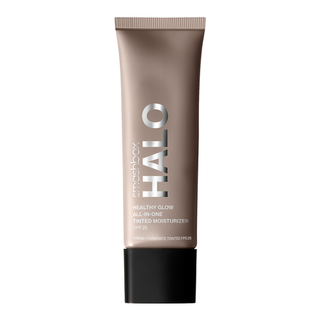
Smashbox Halo Healthy Glow All-in-One Tinted Moisturizer SPF 25
Works for
1 of 2 advertised claims delivered
Sun protectionSPF 25 · 4 UV filters · Partial spectrumWeak protectionSPF under 30
This product does not offer good protection against UVA rays.
Moisturizing19 ingredients credited for this claimStrong support
“Halo Healthy Glow All-in-One Tinted Moisturizer SPF 25”
This product can help improve hydration of the skin with the two types of ingredients.
The first type is called “humectants”:
these ingredients help attract water.
When humectants are on the surface of the skin, they “pull in” the moisture from the outside environment, or from
within deeper layers of the skin. The following ingredients in this product do the job:
glycerin, sodium hyaluronate.
This product also contains ingredients called “occlusives”. They help reduce the speed with which our skin loses moisture to the outside environment. These ingredients also help soften the upper layer of the skin, so it feels less tight and nicer to the touch. The following ingredients in this product do the job: dimethicone, methicone.
The following ingredients in this product are especially good for supporting the skin barrier and helping with the hydration level: niacinamide, palmitoyl hexapeptide-14
Evens skin toneNot advertised by the brand · 1 ingredient credited for this claimStrong support
This product can help reduce hypepigmentation and even out the skin tone because it contains the following effective ingredients: niacinamide
Keep in mind that you would need to apply any topical skincare targetted at hypigmentation consistently for a couple of months to get a result. No topical skincare product can help get rid of hyperpigmentation (including post-acne marks and age spots) instantly.
This product can also help with skin tone because it offers sun protection. Sun damage is the main factor causing age spots, darkening of post-acne marks and other discolorations. This is why sun protection is the best strategy for maintaining an even skin tone. We, however, do not recommend using this product as a sunscreen because the protection it offers is not strong enough).
Anti-blemishNot advertised by the brand · 1 ingredient credited for this claimStrong support
This product can help reduce breakouts and clogged pores because it contains the following ingredient: niacinamide. This ingredient is used for treating acne and can have a noticeable effect.
Anti-agingNot advertised by the brand · 2 ingredients credited for this claimStrong support
This product can help reduce and prevent fine lines and wrinkles, improve skin elasticity and firmness because it contains niacinamide.
These ingredients in the product can also be helpful, even though there is less evidence for their effectiveness: palmitoyl hexapeptide-14.
Keep in mind that it typically takes at least 6 weeks to notice any results because the changes that are needed to improve fine lines and elasticity happen in the deeper layers of the skin. No topical anti-aging product can “erase” wrinkles or fully reverse signs of aging.
Can it cause trouble?
Irritancy1 strong irritant: Rosa hybrid flower extract — patch-test recommendedHigh risk
Comedogenic3 ingredients rated 2 or more on the 0–5 pore-clogging scale3 flagged


User reviews
Be the first — your take helps the next person decide.
Ingredients
Filter by role to see what each ingredient is doing.
Water~45–55%
Octyldodecyl neopentanoate~4.7–5.8%
- Irritation risk
- Low
An emollient that helps soften the skin. Often used to stabilize other ingredients, for example, sunscreen
More about Octyldodecyl neopentanoateButyloctyl salicylate~4.1–5%
- Irritation risk
- Medium
A synthetic ester of salicylic acid that is used to help disperse pigments and boost effectiveness of sunscreen ingredients. It is able to absorb UV light (working as an organic, or chemical filter), but is not approved as a sunscreen ingredient on its own
More about Butyloctyl salicylateDimethicone~3.1–3.8%
- Irritation risk
- Low
A silicone that helps to reduce water loss from the surface of the skin. Can temporarily "fill in" lines and wrinkles, absorb oil, and create a nice product finish
More about DimethiconeButylene glycol~2.2–2.7%
- Irritation risk
- Low
Used to create a nice product texture and help delivery of other ingredients. Might be somewhat helpful in attracting water to the upper layer of the skin
More about Butylene glycolMethyl trimethicone~1.8–2.2%
- Irritation risk
- Low
A type of silicone that helps create a silky product finish and dissolve other ingredients
More about Methyl trimethiconeNiacinamide~1.6–1.9%
- Irritation risk
- Low
Is proven to be effective in reducing blemishes, evening out skin tone and helping to improve lines and wrinkles. It helps the skin to repair sun damage, calm down inflammation and keep maintain good levels of moisture. The concentration of about 2% is effective for supporting the skin barrier and evening out the skin tone. Concentration of 4-6% is better for helping with acne and balancing the sebum production
More about NiacinamideCetyl peg/ppg-10/1 dimethicone~1.3–1.6%
- Irritation risk
- Low
A type of silicone that helps water and oil mix together. Can help to soften upper layer of the skin
More about Cetyl peg/ppg-10/1 dimethiconeLauryl peg-9 polydimethylsiloxyethyl dimethicone~1.1–1.3%
- Irritation risk
- Low
A type of silicone that helps to soften upper layer of the skin and create a nice product texture
More about Lauryl peg-9 polydimethylsiloxyethyl dimethiconeDiethylhexyl succinate~0.95–1.15%
- Irritation risk
- Low
Helps soften the upper layer of the skin and create a nice product texture
More about Diethylhexyl succinateLaureth-4~0.6–0.95%
- Irritation risk
- Medium
- Comedogenicity
- 2/5
Helps water and oil mix together
More about Laureth-4Tocopheryl acetate~0.5–0.75%
- Irritation risk
- Medium
A more stable but less bio-available form of vitamin E compared to Tocopherol. Might help moisturize and protect the skin from free radicals, but mostly used in low concentrations to stabilize other ingredients.
More about Tocopheryl acetateSodium hyaluronate~0.45–0.65%
- Irritation risk
- Low
One of the best moisturizing ingredients. Attracts water into the upper layer of the skin
More about Sodium hyaluronateLecithin~0.45–0.65%
- Irritation risk
- Low
Used mostly for creating emulsions - helping oil and water mix together. Helps soften the upper layer of the skin
More about LecithinRosa hybrid flower extract~0.3–0.55%
- Irritation risk
- High
Pyrus malus fruit extract~0.3–0.55%
- Irritation risk
- Medium
Can have some moisturizing properties due to its sugar content
More about Pyrus malus fruit extractLens esculenta fruit extract~0.3–0.55%
- Irritation risk
- Medium
A plant extract containing sugars that might help attract water to the upper layer of the skin. Is claimed by the manufacturer to help reduce pore size but evidence is lacking
More about Lens esculenta fruit extractCitrullus lanatus fruit extract~0.25–0.5%
- Irritation risk
- Medium
A plant extract that can contain an antioxidant compound
More about Citrullus lanatus fruit extractLycium chinense fruit extract~0.25–0.45%
- Irritation risk
- Low
Palmitoyl hexapeptide-14~0.2–0.4%
Peat extract~0.2–0.35%
- Irritation risk
- Low
Gold~0.2–0.35%
Sodium lactate~0.15–0.3%
- Irritation risk
- Medium
Helps attract water to the upper layer of the skin. Is often used to adjust the pH level of the product
More about Sodium lactateMethicone~0.15–0.3%
- Irritation risk
- Low
A type of silicone that helps soften the upper layer of the skin and reduces the water loss from the skin surface
More about MethiconeSodium pca~0.15–0.3%
- Irritation risk
- Low
Naturally present in skin and helps to attract water to its upper layer
More about Sodium pcaHydrolyzed wheat protein/pvp crosspolymer~0.2–0.35%
- Irritation risk
- Low
Glycerin~0.2–0.35%
- Irritation risk
- Low
One of the best moisturizing ingredients. Naturally present in skin. It attracts water to the upper layer of the skin working as a humectant
More about GlycerinBarium sulfate~0.15–0.3%
- Irritation risk
- Low
Magnesium sulfate~0.2–0.35%
Dimethyl isosorbide~0.15–0.3%
- Irritation risk
- Low
Used to dissolve other ingredients in a product and can enhance their ability to penetrate the skin
More about Dimethyl isosorbideMaltodextrin~0.15–0.3%
- Irritation risk
- Low
Used to stabilize the product formulation and can help absorb oil
More about MaltodextrinTriethoxycaprylylsilane~0.15–0.3%
- Irritation risk
- Low
A type of silicone that helps oil and water mix well together. Helps to disperse other ingredients, e.g. pigments, evenly in a formulation
More about TriethoxycaprylylsilaneDimethicone crosspolymer-3~0.15–0.25%
- Irritation risk
- Low
Silica~0.25–0.5%
Aluminum hydroxide~0.2–0.35%
- Irritation risk
- Low
Is used to add opaque (non-transparent) appearance to formulations. Can be used to coat other ingredients for even dispersion. This is a different ingredient compared to the ones used in antipersperants (aluminium chloride and aluminium chlorohydrate)
More about Aluminum hydroxideDimethicone/peg-10/15 crosspolymer~0.15–0.25%
Trimethylsiloxysilicate~0.2–0.35%
- Irritation risk
- Low
A type of silicone that helps create a nice product consistency and support the delivery of other ingredients
More about TrimethylsiloxysilicateHexylene glycol~0.15–0.3%
- Irritation risk
- Medium
Helps create a more spreadable product texture
More about Hexylene glycolIsostearic acid~0.25–0.45%
- Irritation risk
- Low
Used to create a nice product texture
More about Isostearic acidCaprylyl glycol~0.2–0.35%
- Irritation risk
- Medium
Helps preserve products and creates a nice product texture
More about Caprylyl glycolStearic acid~0.25–0.5%
- Irritation risk
- Low
Helps oil and water mix together and works as an emollient
More about Stearic acidPolyglyceryl-2 triisostearate~0.2–0.35%
- Irritation risk
- Low
Helps to soften the upper layer of the skin and create a nice product texture
More about Polyglyceryl-2 triisostearateDipentaerythrityl tri-polyhydroxystearate~0.2–0.35%
- Irritation risk
- Low
Dipropylene glycol~0.15–0.25%
- Irritation risk
- Low
Helps to dissolve other ingredients in a formulation. Slows down the rate of product drying
More about Dipropylene glycolSodium citrate~0.15–0.3%
- Irritation risk
- Medium
Helps to control the skin's pH level. Maintains the skin's natural film of amino-lactic acids and oils. Helps to preserve products
More about Sodium citrateBht~0.15–0.3%
Disodium edta~0.15–0.3%
Sodium benzoate~0.15–0.3%
Potassium sorbate~0.15–0.3%
Phenoxyethanol~0.15–0.3%
- Irritation risk
- Low
A preservative. It helps prevent bacterial growth in cosmetic products
More about PhenoxyethanolWater~0.15–0.3%
Octyldodecyl neopentanoate~0.2–0.35%
- Irritation risk
- Low
An emollient that helps soften the skin. Often used to stabilize other ingredients, for example, sunscreen
More about Octyldodecyl neopentanoateButyloctyl salicylate~0.15–0.25%
- Irritation risk
- Medium
A synthetic ester of salicylic acid that is used to help disperse pigments and boost effectiveness of sunscreen ingredients. It is able to absorb UV light (working as an organic, or chemical filter), but is not approved as a sunscreen ingredient on its own
More about Butyloctyl salicylateDimethicone~0.2–0.4%
- Irritation risk
- Low
A silicone that helps to reduce water loss from the surface of the skin. Can temporarily "fill in" lines and wrinkles, absorb oil, and create a nice product finish
More about DimethiconeButylene glycol~0.15–0.3%
- Irritation risk
- Low
Used to create a nice product texture and help delivery of other ingredients. Might be somewhat helpful in attracting water to the upper layer of the skin
More about Butylene glycolMethyl trimethicone~0.15–0.25%
- Irritation risk
- Low
A type of silicone that helps create a silky product finish and dissolve other ingredients
More about Methyl trimethiconeNiacinamide~0.15–0.3%
- Irritation risk
- Low
Is proven to be effective in reducing blemishes, evening out skin tone and helping to improve lines and wrinkles. It helps the skin to repair sun damage, calm down inflammation and keep maintain good levels of moisture. The concentration of about 2% is effective for supporting the skin barrier and evening out the skin tone. Concentration of 4-6% is better for helping with acne and balancing the sebum production
More about NiacinamideCetyl peg/ppg-10/1 dimethicone~0.15–0.3%
- Irritation risk
- Low
A type of silicone that helps water and oil mix together. Can help to soften upper layer of the skin
More about Cetyl peg/ppg-10/1 dimethiconeLauryl peg-9 polydimethylsiloxyethyl dimethicone~0.15–0.3%
- Irritation risk
- Low
A type of silicone that helps to soften upper layer of the skin and create a nice product texture
More about Lauryl peg-9 polydimethylsiloxyethyl dimethiconeDiethylhexyl succinate~0.2–0.35%
- Irritation risk
- Low
Helps soften the upper layer of the skin and create a nice product texture
More about Diethylhexyl succinateLaureth-4~0.15–0.3%
- Irritation risk
- Medium
- Comedogenicity
- 2/5
Helps water and oil mix together
More about Laureth-4Trimethylsiloxysilicate~0.2–0.35%
- Irritation risk
- Low
A type of silicone that helps create a nice product consistency and support the delivery of other ingredients
More about TrimethylsiloxysilicateMagnesium sulfate~0.2–0.35%
Dipentaerythrityl tri-polyhydroxystearate~0.2–0.35%
- Irritation risk
- Low
Glycerin~0.2–0.35%
- Irritation risk
- Low
One of the best moisturizing ingredients. Naturally present in skin. It attracts water to the upper layer of the skin working as a humectant
More about GlycerinPolyglyceryl-2 triisostearate~0.2–0.35%
- Irritation risk
- Low
Helps to soften the upper layer of the skin and create a nice product texture
More about Polyglyceryl-2 triisostearateDimethicone/peg-10/15 crosspolymer~0.15–0.25%
Phenoxyethanol~0.15–0.3%
- Irritation risk
- Low
A preservative. It helps prevent bacterial growth in cosmetic products
More about PhenoxyethanolTocopheryl acetate~0.15–0.3%
- Irritation risk
- Medium
A more stable but less bio-available form of vitamin E compared to Tocopherol. Might help moisturize and protect the skin from free radicals, but mostly used in low concentrations to stabilize other ingredients.
More about Tocopheryl acetateLycium chinense fruit extract~0.15–0.3%
- Irritation risk
- Low
Hydrolyzed wheat protein/pvp crosspolymer~0.2–0.35%
- Irritation risk
- Low
Aluminum hydroxide~0.2–0.35%
- Irritation risk
- Low
Is used to add opaque (non-transparent) appearance to formulations. Can be used to coat other ingredients for even dispersion. This is a different ingredient compared to the ones used in antipersperants (aluminium chloride and aluminium chlorohydrate)
More about Aluminum hydroxideStearic acid~0.25–0.5%
- Irritation risk
- Low
Helps oil and water mix together and works as an emollient
More about Stearic acidCaprylyl glycol~0.2–0.35%
- Irritation risk
- Medium
Helps preserve products and creates a nice product texture
More about Caprylyl glycolSodium pca~0.15–0.3%
- Irritation risk
- Low
Naturally present in skin and helps to attract water to its upper layer
More about Sodium pcaIsostearic acid~0.25–0.45%
- Irritation risk
- Low
Used to create a nice product texture
More about Isostearic acidMethicone~0.15–0.3%
- Irritation risk
- Low
A type of silicone that helps soften the upper layer of the skin and reduces the water loss from the skin surface
More about MethiconeLecithin~0.2–0.35%
- Irritation risk
- Low
Used mostly for creating emulsions - helping oil and water mix together. Helps soften the upper layer of the skin
More about LecithinSilica~0.25–0.5%
Citrullus lanatus fruit extract~0.15–0.25%
- Irritation risk
- Medium
A plant extract that can contain an antioxidant compound
More about Citrullus lanatus fruit extractPotassium sorbate~0.15–0.3%
Disodium edta~0.15–0.3%
Sodium hyaluronate~0.15–0.3%
- Irritation risk
- Low
One of the best moisturizing ingredients. Attracts water into the upper layer of the skin
More about Sodium hyaluronateDimethicone crosspolymer-3~0.15–0.25%
- Irritation risk
- Low
Lens esculenta fruit extract~0.15–0.25%
- Irritation risk
- Medium
A plant extract containing sugars that might help attract water to the upper layer of the skin. Is claimed by the manufacturer to help reduce pore size but evidence is lacking
More about Lens esculenta fruit extractPyrus malus fruit extract~0.15–0.25%
- Irritation risk
- Medium
Can have some moisturizing properties due to its sugar content
More about Pyrus malus fruit extractTriethoxycaprylylsilane~0.15–0.3%
- Irritation risk
- Low
A type of silicone that helps oil and water mix well together. Helps to disperse other ingredients, e.g. pigments, evenly in a formulation
More about TriethoxycaprylylsilaneMaltodextrin~0.15–0.3%
- Irritation risk
- Low
Used to stabilize the product formulation and can help absorb oil
More about MaltodextrinDimethyl isosorbide~0.15–0.3%
- Irritation risk
- Low
Used to dissolve other ingredients in a product and can enhance their ability to penetrate the skin
More about Dimethyl isosorbideBarium sulfate~0.15–0.3%
- Irritation risk
- Low
Rosa hybrid flower extract~0.15–0.25%
- Irritation risk
- High
Sodium lactate~0.15–0.3%
- Irritation risk
- Medium
Helps attract water to the upper layer of the skin. Is often used to adjust the pH level of the product
More about Sodium lactateDipropylene glycol~0.15–0.25%
- Irritation risk
- Low
Helps to dissolve other ingredients in a formulation. Slows down the rate of product drying
More about Dipropylene glycolSodium benzoate~0.15–0.3%
Bht~0.15–0.3%
Sodium citrate~0.15–0.3%
- Irritation risk
- Medium
Helps to control the skin's pH level. Maintains the skin's natural film of amino-lactic acids and oils. Helps to preserve products
More about Sodium citrateGold~0.15–0.3%
Hexylene glycol~0.15–0.3%
- Irritation risk
- Medium
Helps create a more spreadable product texture
More about Hexylene glycolPeat extract~0.15–0.25%
- Irritation risk
- Low
Palmitoyl hexapeptide-14~0.15–0.25%
Rna~0.15–0.25%
- Irritation risk
- Low
Water~0.15–0.3%
Octyldodecyl neopentanoate~0.2–0.35%
- Irritation risk
- Low
An emollient that helps soften the skin. Often used to stabilize other ingredients, for example, sunscreen
More about Octyldodecyl neopentanoateEthylhexyl methoxycinnamate6.7%
- Irritation risk
- High
Octinoxate. When used in higher concentrations, works as a sunscreen protecting the skin from UVB rays. When used in lower concentration, helps to preserve the product formulation. Is shown to be harmful to coral reefs - consider avoiding bathing in coral reef areas when wearing a product with this ingredient. It can be irritating
More about Ethylhexyl methoxycinnamateButyloctyl salicylate~0.2–0.35%
- Irritation risk
- Medium
A synthetic ester of salicylic acid that is used to help disperse pigments and boost effectiveness of sunscreen ingredients. It is able to absorb UV light (working as an organic, or chemical filter), but is not approved as a sunscreen ingredient on its own
More about Butyloctyl salicylateDimethicone~0.25–0.45%
- Irritation risk
- Low
A silicone that helps to reduce water loss from the surface of the skin. Can temporarily "fill in" lines and wrinkles, absorb oil, and create a nice product finish
More about DimethiconeTitanium dioxide3.1%
- Irritation risk
- Low
Works as a UV filter when used in high concentrations. It is photostable and is effective mostly against the UVB light, with some protection in the UVA range. In small concentrations, used for its ability to improve the color of cosmetic products. Is usually well tolerated by the skin
More about Titanium dioxideButylene glycol~0.2–0.35%
- Irritation risk
- Low
Used to create a nice product texture and help delivery of other ingredients. Might be somewhat helpful in attracting water to the upper layer of the skin
More about Butylene glycolMethyl trimethicone~0.2–0.35%
- Irritation risk
- Low
A type of silicone that helps create a silky product finish and dissolve other ingredients
More about Methyl trimethiconeNiacinamide~0.2–0.35%
- Irritation risk
- Low
Is proven to be effective in reducing blemishes, evening out skin tone and helping to improve lines and wrinkles. It helps the skin to repair sun damage, calm down inflammation and keep maintain good levels of moisture. The concentration of about 2% is effective for supporting the skin barrier and evening out the skin tone. Concentration of 4-6% is better for helping with acne and balancing the sebum production
More about NiacinamideCetyl peg/ppg-10/1 dimethicone~0.2–0.35%
- Irritation risk
- Low
A type of silicone that helps water and oil mix together. Can help to soften upper layer of the skin
More about Cetyl peg/ppg-10/1 dimethiconeLauryl peg-9 polydimethylsiloxyethyl dimethicone~0.2–0.35%
- Irritation risk
- Low
A type of silicone that helps to soften upper layer of the skin and create a nice product texture
More about Lauryl peg-9 polydimethylsiloxyethyl dimethiconeDiethylhexyl succinate~0.25–0.45%
- Irritation risk
- Low
Helps soften the upper layer of the skin and create a nice product texture
More about Diethylhexyl succinateZinc oxide1.3%
- Irritation risk
- Low
A broad spectrum sunblock (protects from both UVA and UVB rays). Is suitable for most sensitive skins. In small concentrations, can be used as a colorant
More about Zinc oxideLaureth-4~0.2–0.4%
- Irritation risk
- Medium
- Comedogenicity
- 2/5
Helps water and oil mix together
More about Laureth-4Tocopheryl acetate~0.2–0.4%
- Irritation risk
- Medium
A more stable but less bio-available form of vitamin E compared to Tocopherol. Might help moisturize and protect the skin from free radicals, but mostly used in low concentrations to stabilize other ingredients.
More about Tocopheryl acetateSodium hyaluronate~0.2–0.35%
- Irritation risk
- Low
One of the best moisturizing ingredients. Attracts water into the upper layer of the skin
More about Sodium hyaluronateLecithin~0.25–0.4%
- Irritation risk
- Low
Used mostly for creating emulsions - helping oil and water mix together. Helps soften the upper layer of the skin
More about LecithinRosa hybrid flower extract~0.15–0.3%
- Irritation risk
- High
Pyrus malus fruit extract~0.2–0.35%
- Irritation risk
- Medium
Can have some moisturizing properties due to its sugar content
More about Pyrus malus fruit extractLens esculenta fruit extract~0.2–0.35%
- Irritation risk
- Medium
A plant extract containing sugars that might help attract water to the upper layer of the skin. Is claimed by the manufacturer to help reduce pore size but evidence is lacking
More about Lens esculenta fruit extractCitrullus lanatus fruit extract~0.2–0.35%
- Irritation risk
- Medium
A plant extract that can contain an antioxidant compound
More about Citrullus lanatus fruit extractLycium chinense fruit extract~0.2–0.4%
- Irritation risk
- Low
Palmitoyl hexapeptide-14~0.2–0.35%
Peat extract~0.2–0.35%
- Irritation risk
- Low
Gold~0.2–0.4%
Sodium lactate~0.2–0.4%
- Irritation risk
- Medium
Helps attract water to the upper layer of the skin. Is often used to adjust the pH level of the product
More about Sodium lactateMethicone~0.25–0.4%
- Irritation risk
- Low
A type of silicone that helps soften the upper layer of the skin and reduces the water loss from the skin surface
More about MethiconeSodium pca~0.2–0.4%
- Irritation risk
- Low
Naturally present in skin and helps to attract water to its upper layer
More about Sodium pcaHydrolyzed wheat protein/pvp crosspolymer~0.25–0.45%
- Irritation risk
- Low
Glycerin~0.25–0.45%
- Irritation risk
- Low
One of the best moisturizing ingredients. Naturally present in skin. It attracts water to the upper layer of the skin working as a humectant
More about GlycerinBarium sulfate~0.2–0.4%
- Irritation risk
- Low
Magnesium sulfate~0.25–0.45%
Dimethyl isosorbide~0.2–0.4%
- Irritation risk
- Low
Used to dissolve other ingredients in a product and can enhance their ability to penetrate the skin
More about Dimethyl isosorbideMaltodextrin~0.2–0.4%
- Irritation risk
- Low
Used to stabilize the product formulation and can help absorb oil
More about MaltodextrinTriethoxycaprylylsilane~0.2–0.4%
- Irritation risk
- Low
A type of silicone that helps oil and water mix well together. Helps to disperse other ingredients, e.g. pigments, evenly in a formulation
More about TriethoxycaprylylsilaneDimethicone crosspolymer-3~0.2–0.35%
- Irritation risk
- Low
Silica~0.3–0.55%
Aluminum hydroxide~0.25–0.45%
- Irritation risk
- Low
Is used to add opaque (non-transparent) appearance to formulations. Can be used to coat other ingredients for even dispersion. This is a different ingredient compared to the ones used in antipersperants (aluminium chloride and aluminium chlorohydrate)
More about Aluminum hydroxideDimethicone/peg-10/15 crosspolymer~0.2–0.4%
Trimethylsiloxysilicate~0.25–0.45%
- Irritation risk
- Low
A type of silicone that helps create a nice product consistency and support the delivery of other ingredients
More about TrimethylsiloxysilicateHexylene glycol~0.2–0.4%
- Irritation risk
- Medium
Helps create a more spreadable product texture
More about Hexylene glycolIsostearic acid~0.3–0.55%
- Irritation risk
- Low
Used to create a nice product texture
More about Isostearic acidCaprylyl glycol~0.25–0.45%
- Irritation risk
- Medium
Helps preserve products and creates a nice product texture
More about Caprylyl glycolStearic acid~0.3–0.6%
- Irritation risk
- Low
Helps oil and water mix together and works as an emollient
More about Stearic acidPolyglyceryl-2 triisostearate~0.2–0.4%
- Irritation risk
- Low
Helps to soften the upper layer of the skin and create a nice product texture
More about Polyglyceryl-2 triisostearateDipentaerythrityl tri-polyhydroxystearate~0.25–0.45%
- Irritation risk
- Low
Dipropylene glycol~0.15–0.25%
- Irritation risk
- Low
Helps to dissolve other ingredients in a formulation. Slows down the rate of product drying
More about Dipropylene glycolSodium citrate~0.15–0.3%
- Irritation risk
- Medium
Helps to control the skin's pH level. Maintains the skin's natural film of amino-lactic acids and oils. Helps to preserve products
More about Sodium citrateBht~0.15–0.25%
Disodium edta~0.15–0.25%
Sodium benzoate~0.15–0.25%
Potassium sorbate~0.15–0.25%
Phenoxyethanol~0.15–0.25%
- Irritation risk
- Low
A preservative. It helps prevent bacterial growth in cosmetic products
More about PhenoxyethanolIngredient list view
Water, Octyldodecyl neopentanoate, Butyloctyl salicylate, Dimethicone, Butylene glycol, Methyl trimethicone, Niacinamide, Cetyl peg/ppg-10/1 dimethicone, Lauryl peg-9 polydimethylsiloxyethyl dimethicone, Diethylhexyl succinate, Laureth-4, Tocopheryl acetate, Sodium hyaluronate, Lecithin, Rosa hybrid flower extract, Pyrus malus fruit extract, Lens esculenta fruit extract, Citrullus lanatus fruit extract, Lycium chinense fruit extract, Palmitoyl hexapeptide-14, Peat extract, Gold, Sodium lactate, Methicone, Sodium pca, Hydrolyzed wheat protein/pvp crosspolymer, Glycerin, Barium sulfate, Magnesium sulfate, Dimethyl isosorbide, Maltodextrin, Triethoxycaprylylsilane, Dimethicone crosspolymer-3, Silica, Aluminum hydroxide, Dimethicone/peg-10/15 crosspolymer, Trimethylsiloxysilicate, Hexylene glycol, Isostearic acid, Caprylyl glycol, Stearic acid, Polyglyceryl-2 triisostearate, Dipentaerythrityl tri-polyhydroxystearate, Dipropylene glycol, Sodium citrate, Bht, Disodium edta, Sodium benzoate, Potassium sorbate, Phenoxyethanol, Water, Octyldodecyl neopentanoate, Butyloctyl salicylate, Dimethicone, Butylene glycol, Methyl trimethicone, Niacinamide, Cetyl peg/ppg-10/1 dimethicone, Lauryl peg-9 polydimethylsiloxyethyl dimethicone, Diethylhexyl succinate, Laureth-4, Trimethylsiloxysilicate, Magnesium sulfate, Dipentaerythrityl tri-polyhydroxystearate, Glycerin, Polyglyceryl-2 triisostearate, Dimethicone/peg-10/15 crosspolymer, Phenoxyethanol, Tocopheryl acetate, Lycium chinense fruit extract, Hydrolyzed wheat protein/pvp crosspolymer, Aluminum hydroxide, Stearic acid, Caprylyl glycol, Sodium pca, Isostearic acid, Methicone, Lecithin, Silica, Citrullus lanatus fruit extract, Potassium sorbate, Disodium edta, Sodium hyaluronate, Dimethicone crosspolymer-3, Lens esculenta fruit extract, Pyrus malus fruit extract, Triethoxycaprylylsilane, Maltodextrin, Dimethyl isosorbide, Barium sulfate, Rosa hybrid flower extract, Sodium lactate, Dipropylene glycol, Sodium benzoate, Bht, Sodium citrate, Gold, Hexylene glycol, Peat extract, Palmitoyl hexapeptide-14, Rna, Water, Octyldodecyl neopentanoate, Ethylhexyl methoxycinnamate, Butyloctyl salicylate, Dimethicone, Titanium dioxide, Butylene glycol, Methyl trimethicone, Niacinamide, Cetyl peg/ppg-10/1 dimethicone, Lauryl peg-9 polydimethylsiloxyethyl dimethicone, Diethylhexyl succinate, Zinc oxide, Laureth-4, Tocopheryl acetate, Sodium hyaluronate, Lecithin, Rosa hybrid flower extract, Pyrus malus fruit extract, Lens esculenta fruit extract, Citrullus lanatus fruit extract, Lycium chinense fruit extract, Palmitoyl hexapeptide-14, Peat extract, Gold, Sodium lactate, Methicone, Sodium pca, Hydrolyzed wheat protein/pvp crosspolymer, Glycerin, Barium sulfate, Magnesium sulfate, Dimethyl isosorbide, Maltodextrin, Triethoxycaprylylsilane, Dimethicone crosspolymer-3, Silica, Aluminum hydroxide, Dimethicone/peg-10/15 crosspolymer, Trimethylsiloxysilicate, Hexylene glycol, Isostearic acid, Caprylyl glycol, Stearic acid, Polyglyceryl-2 triisostearate, Dipentaerythrityl tri-polyhydroxystearate, Dipropylene glycol, Sodium citrate, Bht, Disodium edta, Sodium benzoate, Potassium sorbate, Phenoxyethanol
Compare prices
Retailers ranked by price — lowest first.

Worth comparing, line by line.
Match % combines shared ingredients, the first five ingredients, shared actives and hero ingredients, irritancy (lower counts in the alternative's favour), texture and body area. Only products in the same routine step are compared.
| SmashboxHalo Healthy Glow All-in-One Tinted Moisturizer SPF 25YOUR PRODUCT | Relevant SkinOne & Done Everyday Cream with SPF 40 | DAYCELLEsthenique Snail Sun Cream SPF50+ PA+++ | Skincare by Dr. VInZincable SPF 50 | |
|---|---|---|---|---|
| Match | — | 77% | 74% | 74% |
| Price | $18.51 | — | $23.90+$5.39 | $33.04+$14.53 |
| Shared key ingredients | — | 7 of 13 | 8 of 13 | 6 of 13 |
| Key difference | — | Bisabolol | Adenosine | Bisabolol |
| Irritancy | High | Low | Medium | Low |
| SPF | SPF 25 | SPF 40 | SPF 50 | SPF 50 |
| Drying alcohol | — | — | — | — |
| View product | Shop | Shop | Shop |


Product summary
We do not recommend "Smashbox - Halo Healthy Glow All-in-One Tinted Moisturizer SPF 25" because it does not provide good UVA protection. UVA sun rays don't burn the skin, but they still lead to photoaging and hyperpigmentation.
It contains good moisturizing ingredients and can double as a hydrating day cream. Like all broad-spectrum sunscreens, this product helps prevent early signs of aging.
Sunscreen filters
This is a "mixed" sunscreen in the sense that it uses both mineral and organic (so-called "chemical") sun filters. Here are the organic filters this product uses: butyloctyl salicylate and octinoxate. As for the mineral filters, this sunscreen uses titanium dioxide.
Irritation risk
This formulation includes some common irritants, including ingredients that do not provide a benefit for the skin. We assess the overall irritancy of this moisturizer to be high. For a detailed overview of all potential irritants: click here
You can see the detailed formula review with the breakdown of all actives in the product and the full ingredient list with estimated concentrations in the tables below.
About the brand
According to Cruelty-Free Kitty "Smashbox" is cruelty free, but its parent company is not.
Price
The product retails from 24.15$ up to 41.00$ in the United States, for 74.62A$ in Australia, for 43.16£ in the United Kingdom, for 55.50CA$ in Canada and for 320.00HK$ in Hong Kong.
For a detailed price comparison: click here.
Sources cited in this review
Every concentration estimate and effectiveness label is anchored to one of these 20 studies and safety reviews.
- 1
- 2
- 3
- 4Final Report on the Safety Assessment of Dimethicone Copolyoljournals.sagepub.com
- 5
- 6

Affiliate links · As an Amazon Associate, WIMJ earns from qualifying purchases.