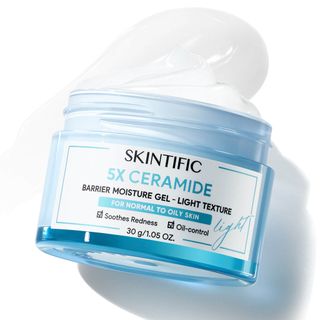
skintific Ceramide Barrier Face Moisture Gel Light Texture
Works for
1 of 1 advertised claim delivered
MoisturizingCeramide ap, Ceramide as + 19 moreStrong evidence
“hydrating”
This product can help improve hydration of the skin with the two types of ingredients.
The first type is called “humectants”:
these ingredients help attract water.
When humectants are on the surface of the skin, they “pull in” the moisture from the outside environment, or from
within deeper layers of the skin. The following ingredients in this product do the job:
arginine, erythritol.
This product also contains ingredients called “occlusives”. They help reduce the speed with which our skin loses moisture to the outside environment. These ingredients also help soften the upper layer of the skin, so it feels less tight and nicer to the touch. The following ingredients in this product do the job: arginine, dimethicone.
The following ingredients in this product are especially good for supporting the skin barrier and helping with the hydration level: ceramide ap, ceramide as, ceramide eop, ceramide np, ceramide ns, phytosphingosine
Anti-oxidationNot advertised by the brand · Epigallocatechin gallatyl glucoside, Zingiber officinale root extract + 2 moreStrong evidence
This product contains antioxidants (epigallocatechin gallatyl glucoside) that can help neutralize free radicals in skin. By doing so, they can lessen the damage the skin gets from the UV light (sun).
Anti-agingNot advertised by the brand · Epigallocatechin gallatyl glucoside, Ascorbyl palmitate + 1 moreModerate evidence
This product contains epigallocatechin gallatyl glucoside. This ingredient might be able to help reduce and prevent fine lines and wrinkles, improve skin elasticity and firmness, but there is not enough evidence that it actually works.
Can it cause trouble?
Irritancy1 strong irritant: Zingiber officinale root extractMedium risk
Comedogenic1 ingredient rated 2 or more on the 0–5 pore-clogging scale1 flagged

User reviews
Be the first — your take helps the next person decide.
Ingredients
Filter by role to see what each ingredient is doing.
Water~45–55%
Peg-8~4.8–5.9%
- Irritation risk
- Medium
Used to create a nice product consistency
More about Peg-8Erythritol~4–4.9%
- Irritation risk
- Low
Helps to attract water to the upper layer of the skin
More about ErythritolButylene glycol~3.1–3.7%
- Irritation risk
- Low
Used to create a nice product texture and help delivery of other ingredients. Might be somewhat helpful in attracting water to the upper layer of the skin
More about Butylene glycolDimethicone~2.5–3%
- Irritation risk
- Low
A silicone that helps to reduce water loss from the surface of the skin. Can temporarily "fill in" lines and wrinkles, absorb oil, and create a nice product finish
More about DimethiconePentylene glycol~2–2.5%
- Irritation risk
- Medium
Used to preserve products, dissolve other ingredients and create a nice product texture
More about Pentylene glycolPropanediol~1.7–2.1%
- Irritation risk
- Low
Acts as a solvent for other ingredients. Speeds up the absorption of other ingredients into the skin
More about PropanediolGlycerin~1.5–1.9%
- Irritation risk
- Low
One of the best moisturizing ingredients. Naturally present in skin. It attracts water to the upper layer of the skin working as a humectant
More about GlycerinAmmonium acryloyldimethyltaurate/beheneth-25 methacrylate crosspolymer~1.2–1.5%
- Irritation risk
- Medium
Used to stabilize product formulations
More about Ammonium acryloyldimethyltaurate/beheneth-25 methacrylate crosspolymer1,2-hexanediol~0.75–1.1%
Hydroxyacetophenone~0.75–1.1%
Sodium polyacryloyldimethyl taurate~0.65–0.95%
- Irritation risk
- Medium
Helps oil and water mix together
More about Sodium polyacryloyldimethyl taurateCeramide np~0.6–0.95%
- Irritation risk
- Low
A type of lipid similar to ceramides naturally present in skin. Helps to soften the upper layer of the skin and supports the skin barrier function to keep it hydrated. Can help to prevent inflammation in skin
More about Ceramide npXanthan gum~0.55–0.85%
- Irritation risk
- Low
Used to create a thicker product consistency
More about Xanthan gumBisabolol~0.45–0.7%
- Irritation risk
- Low
An active component of chamomile plant that historically has been used to calm down irritated skin. A recent study shows that bisabolol indeed can have some anti-inflammatory effect on skin, even though conclusive data is lacking. Bisabolol has a sweet floral scent and can be added to products for its aromatic properties
More about BisabololHydroxyphenyl propamidobenzoic acid~0.5–0.75%
- Irritation risk
- Low
Might help to reduce inflammation in skin, but solid research is lacking
More about Hydroxyphenyl propamidobenzoic acidCeramide ap~0.5–0.7%
- Irritation risk
- Low
A type of lipid similar to ceramides naturally present in skin. Helps to soften the upper layer of the skin and supports the skin barrier function to keep it hydrated. Can help to prevent inflammation in skin
More about Ceramide apCeramide ns~0.5–0.75%
- Irritation risk
- Low
A type of lipid similar to ceramides naturally present in skin. Helps to soften the upper layer of the skin and supports the skin barrier function to keep it hydrated. Can help to prevent inflammation in skin
More about Ceramide nsLactic acid~0.4–0.65%
- Irritation risk
- Medium
An exfoliating and moisturizing alpha-hydroxy acid (AHA). Typically causes less irritation than other AHAs, for example, glycolic acid. At high concentrations (about 15%), lactic acid can help reduce lines and wrinkles. Recent studies show that lactic acid can support the "good" bacteria living on skin's surface (healthy skin microbiome)
More about Lactic acidPotassium sorbate~0.3–0.6%
Zingiber officinale root extract~0.35–0.6%
- Irritation risk
- High
A plant extract that can contain an irritating essential oil. Might have some anti-oxidant effect, but evidence is lacking
More about Zingiber officinale root extractAscorbyl palmitate~0.35–0.6%
- Irritation risk
- Medium
Being a lipid soluble form of vitamin C, it is more stable and can penetrate the skin better than L-Ascorbic acid. It is effective in protecting the skin from free radicals, as well as evening the skin tone, but is less effective in stimulating collagen production compared to L-Ascorbic acid.
More about Ascorbyl palmitateCeramide as~0.3–0.55%
- Irritation risk
- Low
A type of lipid similar to ceramides naturally present in skin. Helps to soften the upper layer of the skin and supports the skin barrier function to keep it hydrated. Can help to prevent inflammation in skin
More about Ceramide asCeramide eop~0.35–0.65%
- Irritation risk
- Low
A type of lipid similar to ceramides naturally present in skin. Helps to soften the upper layer of the skin and supports the skin barrier function to keep it hydrated. Can help to prevent inflammation in skin
More about Ceramide eopDimethicone/vinyl dimethicone crosspolymer~0.3–0.6%
- Irritation risk
- Low
Used to stabilize product formulations and create a nice product texture
More about Dimethicone/vinyl dimethicone crosspolymerArginine~0.3–0.55%
- Irritation risk
- Low
An amino acid that is naturally present in skin and helps keep it hydrated. When used together with AHAs, it can reduce their irritating effect on the skin
More about ArginineSodium lauroyl lactylate~0.35–0.6%
- Irritation risk
- Medium
Helps water and oil mix together
More about Sodium lauroyl lactylateOctyldodecanol~0.35–0.6%
- Irritation risk
- Low
An emollient that helps to soften the skin and create a pleasant product texture and stabilize the formulation
More about OctyldodecanolDiglucosyl gallic acid~0.3–0.6%
- Irritation risk
- Low
Hydrolyzed algae extract~0.3–0.55%
- Irritation risk
- Low
- Comedogenicity
- 3/5
Helps attract water to the upper layer of the skin
More about Hydrolyzed algae extractHydrogenated lecithin~0.3–0.6%
- Irritation risk
- Low
Helps to retain moisture by creating a protective barrier on the skin. Rich in fatty acids. Improves product texture and helps with the penetration of other ingredients.
More about Hydrogenated lecithinBioflavonoids~0.25–0.5%
- Irritation risk
- Low
Ppg-26-buteth-26~0.3–0.55%
Peg-40 hydrogenated castor oil~0.3–0.55%
- Irritation risk
- Medium
Helps oil and water mix together
More about Peg-40 hydrogenated castor oilDiisostearyl malate~0.3–0.55%
- Irritation risk
- Medium
Helps to soften the upper layer of the skin
More about Diisostearyl malateEpigallocatechin gallatyl glucoside~0.25–0.5%
- Irritation risk
- Low
A synthetic version of green tea polyphenol that helps neutralize free radicals in skin
More about Epigallocatechin gallatyl glucosideEthoxydiglycol~0.2–0.4%
Lecithin~0.3–0.55%
- Irritation risk
- Low
Used mostly for creating emulsions - helping oil and water mix together. Helps soften the upper layer of the skin
More about LecithinSodium benzoate~0.15–0.3%
Polyglyceryl-10 stearate~0.2–0.35%
- Irritation risk
- Medium
Helps water and oil mix together and softens the upper layer of the skin
More about Polyglyceryl-10 stearateDisodium edta~0.15–0.25%
Sucrose stearate~0.2–0.4%
Phytosphingosine~0.2–0.4%
- Irritation risk
- Low
A type of lipid that is naturally present in skin. It might help in repairing skin barrier function and has anti-bacterial effect
More about PhytosphingosineHexyldecanol~0.15–0.25%
- Irritation risk
- Low
Helps soften the upper layer of the skin
More about HexyldecanolCaprylic/capric triglyceride~0.15–0.3%
- Irritation risk
- Medium
A good mix of fatty acids that forms a protective layer on the skin. Improves the shelf life of products. Derived from coconut and glycerin
More about Caprylic/capric triglycerideIngredient list view
Water, Peg-8, Erythritol, Butylene glycol, Dimethicone, Pentylene glycol, Propanediol, Glycerin, Ammonium acryloyldimethyltaurate/beheneth-25 methacrylate crosspolymer, 1,2-hexanediol, Hydroxyacetophenone, Sodium polyacryloyldimethyl taurate, Ceramide np, Xanthan gum, Bisabolol, Unknown, Hydroxyphenyl propamidobenzoic acid, Ceramide ap, Ceramide ns, Lactic acid, Potassium sorbate, Zingiber officinale root extract, Ascorbyl palmitate, Ceramide as, Ceramide eop, Dimethicone/vinyl dimethicone crosspolymer, Arginine, Sodium lauroyl lactylate, Octyldodecanol, Diglucosyl gallic acid, Hydrolyzed algae extract, Hydrogenated lecithin, Bioflavonoids, Ppg-26-buteth-26, Peg-40 hydrogenated castor oil, Diisostearyl malate, Epigallocatechin gallatyl glucoside, Ethoxydiglycol, Lecithin, Sodium benzoate, Polyglyceryl-10 stearate, Disodium edta, Sucrose stearate, Phytosphingosine, Hexyldecanol, Caprylic/capric triglyceride
Compare prices
Retailers ranked by price — lowest first.

Affiliate links · prices updated regularly
Worth comparing, line by line.
Match % combines shared ingredients, the first five ingredients, shared actives and hero ingredients, irritancy (lower counts in the alternative's favour), texture and body area. Only products in the same routine step are compared.
| skintificCeramide Barrier Face Moisture Gel Light TextureYOUR PRODUCT | BIOHEAL BOHCeramide Water Gel Cream | COSRXDerma Water Barrier Moisturizer | KnoursPhyto Mucin Skin Barrier Moisturizer | |
|---|---|---|---|---|
| Match | — | 56% | 55% | 53% |
| Price | — | $22.29 | — | $28.00 |
| Shared key ingredients | — | 10 of 15 | 8 of 15 | 8 of 15 |
| Key difference | — | Niacinamide | Niacinamide | Ceramide Ng |
| Irritancy | Medium | Medium | Low | Medium |
| Drying alcohol | — | — | — | — |
| View product | Shop | Shop | Shop |

Sources cited in this review
Every concentration estimate and effectiveness label is anchored to one of these 15 studies and safety reviews.
- 1
- 2Final Report on the Safety Assessment of Dimethicone Copolyoljournals.sagepub.com
- 3
- 4
- 5
- 6

Affiliate links · As an Amazon Associate, WIMJ earns from qualifying purchases.