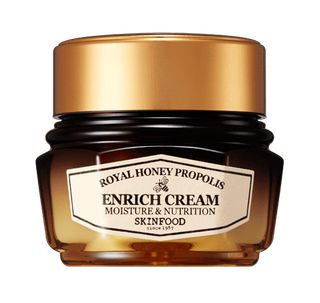
Skinfood Royal Honey Propolis Enrich Cream
Works for
1 of 1 advertised claim delivered
MoisturizingCeramide np, Squalane + 14 moreStrong evidence
“Royal Honey Propolis Enrich Cream”
This product can help improve hydration of the skin with the two types of ingredients.
The first type is called “humectants”:
these ingredients help attract water.
When humectants are on the surface of the skin, they “pull in” the moisture from the outside environment, or from
within deeper layers of the skin. The following ingredients in this product do the job:
glycerin, lactobacillus ferment.
This product also contains ingredients called “occlusives”. They help reduce the speed with which our skin loses moisture to the outside environment. These ingredients also help soften the upper layer of the skin, so it feels less tight and nicer to the touch. The following ingredients in this product do the job: dimethicone, peg-10 dimethicone.
The following ingredients in this product are especially good for supporting the skin barrier and helping with the hydration level: ceramide np
Can it cause trouble?
Irritancy10 strong irritants: Alcohol denat., Citrus tangerina peel oil + 8 more — patch-test recommendedHigh risk
ComedogenicClean of flagged comedogenic ingredientsNone flagged


User reviews
Be the first — your take helps the next person decide.
Ingredients
Filter by role to see what each ingredient is doing.
Propolis extract~22–33%
- Irritation risk
- High
A complex substance produced by honey bees. Can have anti-bacterial and some anti-oxidant effect. Is an allergen and can be irritating
More about Propolis extractCyclopentasiloxane~5.9–8.9%
- Irritation risk
- Low
A silicone that helps improve the product texture and spreadability. Can absorb oil creating a short-term mattifying effect on the skin
More about CyclopentasiloxaneHoney extract~4.4–6.7%
- Irritation risk
- Medium
Helps attract water to the upper layer of the skin
More about Honey extractRoyal jelly extract~3.2–4.8%
- Irritation risk
- Medium
A compound secreted by bees. Might be able to attract water to the top layer of the skin. Avoid if sensitive to honey and bee products
More about Royal jelly extractGlycerin~2.6–3.9%
- Irritation risk
- Low
One of the best moisturizing ingredients. Naturally present in skin. It attracts water to the upper layer of the skin working as a humectant
More about GlycerinWater~1.9–2.9%
Squalane~1.7–2.6%
- Irritation risk
- Low
An oil naturally present in skin. Works as an emollient to soften the skin and form a protective layer on its surface without a greasy feeling.
More about SqualaneDimethicone~1.5–2.3%
- Irritation risk
- Low
A silicone that helps to reduce water loss from the surface of the skin. Can temporarily "fill in" lines and wrinkles, absorb oil, and create a nice product finish
More about DimethiconePeg-10 dimethicone~1.3–2%
- Irritation risk
- Low
A silicone that works to soften the upper layer of the skin and reduce its water loss
More about Peg-10 dimethiconeSynthetic wax~0.95–1.4%
- Irritation risk
- Low
Used to stabilize product formulations and thicken product consistency
More about Synthetic waxAlcohol denat.~0.55–1.25%
- Irritation risk
- High
Produces temporary toning effect. Can help dissolve other ingredients or preserve products
More about Alcohol denat.Dimethicone/peg-10/15 crosspolymer~0.85–1.3%
Sodium chloride~0.45–1.1%
- Irritation risk
- Low
Used to stabilize mixtures of oil and water, and create thicker, gel-like product textures
More about Sodium chlorideDipropylene glycol~0.35–0.85%
- Irritation risk
- Low
Helps to dissolve other ingredients in a formulation. Slows down the rate of product drying
More about Dipropylene glycolDisteardimonium hectorite~0.35–0.8%
- Irritation risk
- Low
A type of clay that is used to thicken the product consistency
More about Disteardimonium hectoriteCaprylic/capric triglyceride~0.4–1%
- Irritation risk
- Medium
A good mix of fatty acids that forms a protective layer on the skin. Improves the shelf life of products. Derived from coconut and glycerin
More about Caprylic/capric triglycerideSodium polyacrylate~0.5–1.15%
- Irritation risk
- Low
Used to create a gel-like product texture, as well as to stabilize emulsions
More about Sodium polyacrylateSorbitol~0.3–0.7%
- Irritation risk
- Low
Helps attract water to the upper layer of the skin and improves the product texture
More about SorbitolLactobacillus ferment~0.2–0.75%
- Irritation risk
- Low
A fermentation product created by bacteria Lactobacillus. The fermented product has anti-bacterial properties and might be helpful in calming down inflammation, but studies are lacking. Helps attract water to the upper layer of the skin. Can be used as a preservative
More about Lactobacillus fermentSaccharomyces ferment~0.2–0.75%
- Irritation risk
- Low
A product of yeast fermentation. Helps attract water to the upper layer of the skin
More about Saccharomyces fermentCitrus tangerina peel oil~0.2–0.7%
- Irritation risk
- High
Essential oil that can be irritating. Can lead to photosensitivity
More about Citrus tangerina peel oilHydrogenated lecithin~0.2–0.75%
- Irritation risk
- Low
Helps to retain moisture by creating a protective barrier on the skin. Rich in fatty acids. Improves product texture and helps with the penetration of other ingredients.
More about Hydrogenated lecithinCeramide np~0.3–0.7%
- Irritation risk
- Low
A type of lipid similar to ceramides naturally present in skin. Helps to soften the upper layer of the skin and supports the skin barrier function to keep it hydrated. Can help to prevent inflammation in skin
More about Ceramide npCitrus aurantium bergamia fruit oil~0.15–0.6%
- Irritation risk
- High
A plant oil with a high content of volatile compounds that can irritate the skin and lead to allergic reactions. Can lead to photosensitivity
More about Citrus aurantium bergamia fruit oilDisodium edta~0.15–0.65%
Pelargonium graveolens flower oil~0.2–0.7%
- Irritation risk
- High
An essential oil. Can be irritating. Can become an allergen with oxidation
More about Pelargonium graveolens flower oilBoswellia carterii oil~0.15–0.65%
Sodium citrate~0.15–0.65%
- Irritation risk
- Medium
Helps to control the skin's pH level. Maintains the skin's natural film of amino-lactic acids and oils. Helps to preserve products
More about Sodium citrateLavandula angustifolia oil~0.15–0.65%
- Irritation risk
- High
An essential oil. Potential allergen and can be irritating. It has some anti-bacterial properties
More about Lavandula angustifolia oilCitrus limon peel oil~0.15–0.55%
Cholesterol~0.3–0.75%
- Irritation risk
- Low
An emollient that is naturally found in skin
More about CholesterolRosmarinus officinalis leaf oil~0.15–0.65%
- Irritation risk
- High
A plant oil with high content of volatile compounds that can irritate the skin. Can be used as a fragrance. Has anti-bacterial properties and might help neutralize free radicals on the surface of the skin
More about Rosmarinus officinalis leaf oilTocopherol~0.15–0.6%
- Irritation risk
- Low
Pure form of vitamin E. Can help moisturise and protect the skin from free radicals. Often used to help stabilise other ingredients or the formula itself
More about TocopherolEucalyptus globulus leaf oil~0.1–0.5%
- Irritation risk
- High
An essential oil that can be very irritating. Has some anti-bacterial properties
More about Eucalyptus globulus leaf oilCananga odorata flower oil~0.1–0.35%
Cinnamomum zeylanicum bark oil~0.1–0.35%
- Irritation risk
- Low
Oleic acid~0.15–0.55%
- Irritation risk
- Medium
Helps soften the upper layer of the skin. At the same time, it can weaken the skin's barrier enhancing penetration of other ingredients and increasing the risk of skin dryness
More about Oleic acidEthylhexylglycerin~0.05–0.25%
2-hexanol~0.05–0.2%
- Irritation risk
- Low
Ingredient list view
Propolis extract, Cyclopentasiloxane, Honey extract, Royal jelly extract, Glycerin, Water, Squalane, Dimethicone, Peg-10 dimethicone, Synthetic wax, Alcohol denat., Dimethicone/peg-10/15 crosspolymer, Sodium chloride, Dipropylene glycol, Disteardimonium hectorite, Caprylic/capric triglyceride, Sodium polyacrylate, Sorbitol, Lactobacillus ferment, Saccharomyces ferment, Citrus tangerina peel oil, Hydrogenated lecithin, Ceramide np, Citrus aurantium bergamia fruit oil, Disodium edta, Pelargonium graveolens flower oil, Boswellia carterii oil, Sodium citrate, Lavandula angustifolia oil, Citrus limon peel oil, Cholesterol, Rosmarinus officinalis leaf oil, Tocopherol, Eucalyptus globulus leaf oil, Cananga odorata flower oil, Cinnamomum zeylanicum bark oil, Oleic acid, Ethylhexylglycerin, 2-hexanol
Compare prices
Retailers ranked by price — lowest first.
Affiliate links · prices updated regularly · As an Amazon Associate, WIMJ earns from qualifying purchases.
Worth comparing, line by line.
Match % combines shared ingredients, the first five ingredients, shared actives and hero ingredients, irritancy (lower counts in the alternative's favour), texture and body area. Only products in the same routine step are compared.
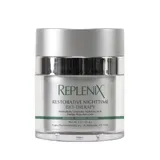
| SkinfoodRoyal Honey Propolis Enrich CreamYOUR PRODUCT | Dr. Zenovia SkincarePeptide and Ceramide Repairing Moisturiser | ReplenixRestorative Nighttime Bio-Therapy | SCINICPinktamin Tone-Up Cream | |
|---|---|---|---|---|
| Match | — | 61% | 61% | 61% |
| Price | $18.53 | $79.00+$60.47 | $76.50+$57.97 | $17.70−$0.83 |
| Shared key ingredients | — | 7 of 11 | 7 of 11 | 7 of 11 |
| Key difference | — | Bakuchiol | Phytosphingosine | Niacinamide |
| Irritancy | High | Medium | Medium | Medium |
| Drying alcohol | Contains drying alcohol | — | — | — |
| View product | Shop | Shop | Shop |


Sources cited in this review
Every concentration estimate and effectiveness label is anchored to one of these 24 studies and safety reviews.
- 1
- 2
- 3
- 4Final Report on the Safety Assessment of Dimethicone Copolyoljournals.sagepub.com
- 5
- 6

Affiliate links · As an Amazon Associate, WIMJ earns from qualifying purchases.