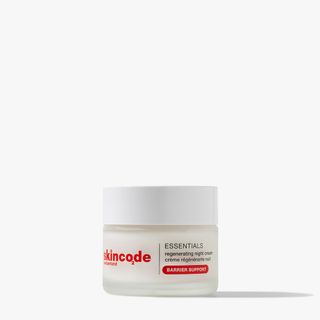
skincode-Swiss Regenerating Night Cream
Works for
1 of 2 advertised claims delivered
Moisturizing17 ingredients credited for this claimStrong support
“A nourishing night cream”
This product can help improve hydration of the skin with the two types of ingredients.
The first type is called “humectants”:
these ingredients help attract water.
When humectants are on the surface of the skin, they “pull in” the moisture from the outside environment, or from
within deeper layers of the skin. The following ingredients in this product do the job:
glycerin, butylene glycol.
This product also contains ingredients called “occlusives”. They help reduce the speed with which our skin loses moisture to the outside environment. These ingredients also help soften the upper layer of the skin, so it feels less tight and nicer to the touch. The following ingredients in this product do the job: caprylic/capric triglyceride, dimethicone.
The following ingredients in this product are especially good for supporting the skin barrier and helping with the hydration level: panthenol
Anti-aging4 ingredients credited for this claimLimited support
“First signs of aging”
This product does not contain ingredients that are able to reduce fine lines and wrinkles or help with skin elasticity, but it can improve the look of the skin temporarily through moisturization. Well-moisturized skin might also be able to repair the sun damage better.This ingredient - nicotiana sylvestris leaf cell culture - could be helpful for preventing or repairing signs of aging in theory, but there is no evidence that it actually works.
Can it cause trouble?
Irritancy1 strong irritant: Rosmarinus officinalis leaf extractMedium risk
Comedogenic1 ingredient rated 2 or more on the 0–5 pore-clogging scale1 flagged
User reviews
Be the first — your take helps the next person decide.
Ingredients
Filter by role to see what each ingredient is doing.
Water~45–55%
C12-20 acid peg-8 ester~6.5–8%
- Irritation risk
- Medium
Helps oil and water mix together
More about C12-20 acid peg-8 esterCaprylic/capric triglyceride~4.6–5.6%
- Irritation risk
- Medium
A good mix of fatty acids that forms a protective layer on the skin. Improves the shelf life of products. Derived from coconut and glycerin
More about Caprylic/capric triglyceridePentylene glycol~3.2–3.9%
- Irritation risk
- Medium
Used to preserve products, dissolve other ingredients and create a nice product texture
More about Pentylene glycolGlycerin~2.5–3.1%
- Irritation risk
- Low
One of the best moisturizing ingredients. Naturally present in skin. It attracts water to the upper layer of the skin working as a humectant
More about GlycerinButylene glycol~2–2.4%
- Irritation risk
- Low
Used to create a nice product texture and help delivery of other ingredients. Might be somewhat helpful in attracting water to the upper layer of the skin
More about Butylene glycolDimethicone~1.8–2.2%
- Irritation risk
- Low
A silicone that helps to reduce water loss from the surface of the skin. Can temporarily "fill in" lines and wrinkles, absorb oil, and create a nice product finish
More about DimethiconeOctyldodecanol~1.4–1.7%
- Irritation risk
- Low
An emollient that helps to soften the skin and create a pleasant product texture and stabilize the formulation
More about OctyldodecanolDicaprylyl carbonate~1.2–1.4%
- Irritation risk
- Low
Helps products spread more easily and works as an emollient to soften skin
More about Dicaprylyl carbonatePeg-8~0.95–1.15%
- Irritation risk
- Medium
Used to create a nice product consistency
More about Peg-8Cetyl alcohol~0.75–1.15%
- Irritation risk
- Low
A non-drying alcohol that works to soften the skin and stabilize product formulations helping oil and water mix together
More about Cetyl alcoholPanthenol~0.55–0.8%
- Irritation risk
- Low
Helps attract water to the upper layer of the skin and can help improve skin barrier function
More about PanthenolSodium carboxymethyl beta-glucan~0.95–1.15%
- Irritation risk
- Low
Helps thicken the product formulation and create a gel-like texture
More about Sodium carboxymethyl beta-glucanGlycine soja oil~0.45–0.7%
- Irritation risk
- Medium
- Comedogenicity
- 2/5
A good emollient that helps soften the skin and helps repair its barrier function. It can clog pores if used in high concentrations.
More about Glycine soja oilHelianthus annuus seed oil~0.45–0.65%
- Irritation risk
- Low
A great emollient due to its high linoleic acid content. One of the most effective plant oils in helping skin hydration and repairing skin barrier function
More about Helianthus annuus seed oilRosmarinus officinalis leaf extract~0.35–0.65%
- Irritation risk
- High
Can be helpful in reducing inflammation in skin, including inflamed acne. It can be irritating
More about Rosmarinus officinalis leaf extractAscorbyl tetraisopalmitate~0.45–0.65%
- Irritation risk
- Medium
A vitamin C derivative. Studies show that is might be effective in reducing hyperpigmentation, but there are no studies confirming that it is effectively converted into the bioavailable form of Vitamin C in skin. It is not clear how this derivative compares in effectiveness to the topical application of bioavailable form of vitamin C (L-ascorbic acid)
More about Ascorbyl tetraisopalmitateCamellia sinensis leaf extract~0.35–0.6%
- Irritation risk
- Low
Can contain potent anti-oxidant compounds (abbreviated ECG, GCG, EGC, and EGCG) that might help protect the skin from free radicals. Can help calm down inflammation and has some anti-bacterial properties. Unfortunately, these antioxidants are unstable and lose their effectiveness very quickly in products. The concentration of the antioxidant compounds in the extract also tends to be low to be effective in topical formulation
More about Camellia sinensis leaf extractNicotiana sylvestris leaf cell culture~0.35–0.6%
- Irritation risk
- Medium
Has been claimed to have an ability to protect collagen and stimulate its production in skin but further research is lacking so far
More about Nicotiana sylvestris leaf cell culturePotassium cetyl phosphate~0.3–0.55%
- Irritation risk
- Medium
Helps oil and water mix together
More about Potassium cetyl phosphatePolymethylsilsesquioxane~0.25–0.5%
- Irritation risk
- Low
A silicone that improves product texture and helps dissolve other ingredients. Can form a non-greasy film on the skin to prevent moisture loss
More about PolymethylsilsesquioxaneCarbomer~0.2–0.4%
- Irritation risk
- Low
Helps create a thicker or gel-like product texture. It is not a surfactant but can be used in gentle cleansing formulations
More about CarbomerEthylhexylglycerin~0.2–0.4%
Ci 77891~0.2–0.35%
- Irritation risk
- Low
Disodium edta~0.15–0.3%
Sodium hydroxide~0.15–0.3%
Tocopherol~0.15–0.25%
- Irritation risk
- Low
Pure form of vitamin E. Can help moisturise and protect the skin from free radicals. Often used to help stabilise other ingredients or the formula itself
More about TocopherolPpg-26-buteth-26~0.15–0.25%
Pentadecalactone~0.1–0.15%
- Irritation risk
- Low
Peg-40 hydrogenated castor oil~0.1–0.15%
- Irritation risk
- Medium
Helps oil and water mix together
More about Peg-40 hydrogenated castor oilIngredient list view
Water, C12-20 acid peg-8 ester, Caprylic/capric triglyceride, Pentylene glycol, Glycerin, Butylene glycol, Dimethicone, Octyldodecanol, Dicaprylyl carbonate, Peg-8, Cetyl alcohol, Panthenol, Sodium carboxymethyl beta-glucan, Glycine soja oil, Helianthus annuus seed oil, Rosmarinus officinalis leaf extract, Ascorbyl tetraisopalmitate, Camellia sinensis leaf extract, Nicotiana sylvestris leaf cell culture, Potassium cetyl phosphate, Polymethylsilsesquioxane, Carbomer, Ethylhexylglycerin, Ci 77891, Disodium edta, Sodium hydroxide, Tocopherol, Ppg-26-buteth-26, Pentadecalactone, Peg-40 hydrogenated castor oil
Compare prices
Retailers ranked by price — lowest first.

Affiliate links · prices updated regularly
Worth comparing, line by line.
Match % combines shared ingredients, the first five ingredients, shared actives and hero ingredients, irritancy (lower counts in the alternative's favour), texture and body area. Only products in the same routine step are compared.
| skincode-SwissRegenerating Night CreamYOUR PRODUCT | CetaphilRedness Relieving Night Moisturizer | DR. JETSKE ULTEERepair Cream | Lumixyl Skin BrighteningLumixyl Brightening Cream | |
|---|---|---|---|---|
| Match | — | 65% | 62% | 62% |
| Price | — | $9.51 | — | $183.76 |
| Shared key ingredients | — | 5 of 9 | 5 of 9 | 4 of 9 |
| Key difference | — | Niacinamide | Ceramide Np | Decapeptide-1 |
| Irritancy | Medium | Low | Low | Low |
| Drying alcohol | — | — | — | — |
| View product | Shop | Shop | Shop |


Sources cited in this review
Every concentration estimate and effectiveness label is anchored to one of these 20 studies and safety reviews.
- 1
- 2
- 3Final Report on the Safety Assessment of Dimethicone Copolyoljournals.sagepub.com
- 4Skin moisturizing effects of panthenol-based formulationspdfs.semanticscholar.org
- 5
- 6

Affiliate links · As an Amazon Associate, WIMJ earns from qualifying purchases.