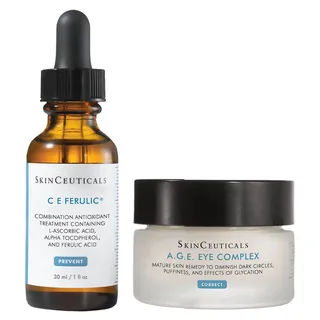
SkinCeuticals Anti-Aging Regimen

SkinCeuticals Anti-Aging Regimen

Efficacy100/100IrritancyMedium

Works for

Anti-oxidation
Ascorbic acid, Tocopherol + 7 more
Works well

This product contains antioxidants (ascorbic acid, ferulic acid, tocopherol) that can help neutralize free radicals in skin. By doing so, they can lessen the damage the skin gets from the UV light (sun).

The following ingredients - chrysin also can have an antioxidant effect, but there is less evidence to confirm their effectiveness in skin.

Ascorbic acidHeroEffect: HighThe most well-researched antioxidant that works in skin. Helps neutralize free radicals supporting collagen production, helping to even out the skin tone and preventing early signs of aging~4.6–5.6%
TocopherolKey activeEffect: HighPure form of vitamin E. Can help moisturise and protect the skin from free radicals. Often used to help stabilise other ingredients or the formula itself~1.6–2%
Ferulic acidKey activeEffect: HighA potent anti-oxidant that has been shown to be effective in neutralizing free radicals in skin. There seem to have a synergetic effect of ferulic acid, vitamin E and C, meaning that when the ingredients are used together, they enhance each other's ability protect the skin against free radicals. Ferulic acid also helps to stabilize other ingredients - including vitamins C and E. It can help to even out the skin tone. Ferulic acid is approved for use as a sunscreen ingredient in Japan in concentrations up to 10%~1.4–1.7%
ChrysinKey activeEffect: MediumMight be helpful in reducing fine lines and wrinkles, as well as lightening the skin, but solid evidence is missing. Could somewhat help in reducing the darkness of the under-eye area. Helps to neutralise free radicals in skin~0.1–0.2%
Vaccinium myrtillus fruit extractEffect: LowA plant extract that might help neutralize free radicals in skin, but research on its efficacy in skin is lacking~0.25–0.45%
CaffeineEffect: LowMight be helpful in neutralizing free radicals. Can have a dehydration effect that might somewhat decrease the look of puffy eyes~0.25–0.5%
Hesperidin methyl chalconeEffect: LowMight help neutralize free radicals in skin. Is claimed to be able to improve the appearance of undereye darkness but evidence is missing. Can be an allergen and cause irritation~0.25–0.5%
Tocopheryl acetateEffect: Low, below effective doseA more stable but less bio-available form of vitamin E compared to Tocopherol. Might help moisturize and protect the skin from free radicals, but mostly used in low concentrations to stabilize other ingredients.~0.25–0.5%
Ascorbyl glucosideUnder-dosedA vitamin C derivative that is more stable but less potent than pure form of vitamin C. Has a potential to boost collagen production, nutralise free radicals and reduce hyperpigmentation, but the required concentration is likely to be much higher than for the pure form of vitamin C, limiting the ingredient's effectiveness in products~0.25–0.5%
Anti-aging
Ascorbic acid, Ferulic acid + 6 more
Works well
What the product description says
“Anti-Aging Regimen”
From product name

This product can help reduce and prevent fine lines and wrinkles, improve skin elasticity and firmness because it contains ascorbic acid.

These ingredients in the product can also be helpful, even though there is less evidence for their effectiveness: dipeptide-2, ferulic acid, palmitoyl oligopeptide, palmitoyl tetrapeptide-7.

Keep in mind that it typically takes at least 6 weeks to notice any results because the changes that are needed to improve fine lines and elasticity happen in the deeper layers of the skin. No topical anti-aging product can “erase” wrinkles or fully reverse signs of aging.

Ascorbic acidHeroEffect: HighThe most well-researched antioxidant that works in skin. Helps neutralize free radicals supporting collagen production, helping to even out the skin tone and preventing early signs of aging~4.6–5.6%
Ferulic acidKey activeEffect: MediumA potent anti-oxidant that has been shown to be effective in neutralizing free radicals in skin. There seem to have a synergetic effect of ferulic acid, vitamin E and C, meaning that when the ingredients are used together, they enhance each other's ability protect the skin against free radicals. Ferulic acid also helps to stabilize other ingredients - including vitamins C and E. It can help to even out the skin tone. Ferulic acid is approved for use as a sunscreen ingredient in Japan in concentrations up to 10%~1.4–1.7%
Palmitoyl oligopeptideKey activeEffect: MediumA type of peptide. Peptides are excellent moisturizers and might be able support collagen production reducing fine lines and wrinkles~0.3–0.5%
Palmitoyl tetrapeptide-7Key activeEffect: MediumA type of peptide. Peptides are excellent moisturizers and might be able support collagen production reducing fine lines and wrinkles~0.2–0.4%
Dipeptide-2Key activeEffect: MediumA type of peptide. Peptides are excellent moisturizers and might be able support collagen production reducing fine lines and wrinkles~0.2–0.4%
TocopherolEffect: LowPure form of vitamin E. Can help moisturise and protect the skin from free radicals. Often used to help stabilise other ingredients or the formula itself~1.6–2%
ChrysinEffect: LowMight be helpful in reducing fine lines and wrinkles, as well as lightening the skin, but solid evidence is missing. Could somewhat help in reducing the darkness of the under-eye area. Helps to neutralise free radicals in skin~0.1–0.2%
Ascorbyl glucosideUnder-dosedA vitamin C derivative that is more stable but less potent than pure form of vitamin C. Has a potential to boost collagen production, nutralise free radicals and reduce hyperpigmentation, but the required concentration is likely to be much higher than for the pure form of vitamin C, limiting the ingredient's effectiveness in products~0.25–0.5%
Evens skin tone
Side benefit · Ascorbic acid, Ferulic acid + 3 more
Works well

This product can help reduce hypepigmentation and even out the skin tone because it contains the following effective ingredients: ascorbic acid.

The following ingredient (ingredients) in this product might be helpful, but there is no evidence to confirm that it actually can help even out the skin tone: chrysin, ferulic acid.

Keep in mind that you would need to apply any topical skincare targetted at hypigmentation consistently for a couple of months to get a result. No topical skincare product can help get rid of hyperpigmentation (including post-acne marks and age spots) instantly.

Ascorbic acidHeroEffect: HighThe most well-researched antioxidant that works in skin. Helps neutralize free radicals supporting collagen production, helping to even out the skin tone and preventing early signs of aging~4.6–5.6%
Ferulic acidKey activeEffect: MediumA potent anti-oxidant that has been shown to be effective in neutralizing free radicals in skin. There seem to have a synergetic effect of ferulic acid, vitamin E and C, meaning that when the ingredients are used together, they enhance each other's ability protect the skin against free radicals. Ferulic acid also helps to stabilize other ingredients - including vitamins C and E. It can help to even out the skin tone. Ferulic acid is approved for use as a sunscreen ingredient in Japan in concentrations up to 10%~1.4–1.7%
ChrysinKey activeEffect: MediumMight be helpful in reducing fine lines and wrinkles, as well as lightening the skin, but solid evidence is missing. Could somewhat help in reducing the darkness of the under-eye area. Helps to neutralise free radicals in skin~0.1–0.2%
N-hydroxysuccinimideEffect: LowIs claimed to be able to brighten skin tone by removing some blood-related pigmented compounds in skin (hemoglobin and related elements) but solid research is missing. Can be irritating~0.25–0.4%
Ascorbyl glucosideUnder-dosedA vitamin C derivative that is more stable but less potent than pure form of vitamin C. Has a potential to boost collagen production, nutralise free radicals and reduce hyperpigmentation, but the required concentration is likely to be much higher than for the pure form of vitamin C, limiting the ingredient's effectiveness in products~0.25–0.5%
Moisturizing
Side benefit · Palmitoyl oligopeptide, Palmitoyl tetrapeptide-7 + 14 more
Works well

This product can help improve hydration of the skin with the two types of ingredients.

The first type is called “humectants”:
these ingredients help attract water. When humectants are on the surface of the skin, they “pull in” the moisture from the outside environment, or from within deeper layers of the skin. The following ingredients in this product do the job: glycerin, sodium hyaluronate.

This product also contains ingredients called “occlusives”. They help reduce the speed with which our skin loses moisture to the outside environment. These ingredients also help soften the upper layer of the skin, so it feels less tight and nicer to the touch. The following ingredients in this product do the job: dimethicone, paraffin.

The following ingredients in this product are especially good for supporting the skin barrier and helping with the hydration level: dipeptide-2, palmitoyl oligopeptide, palmitoyl tetrapeptide-7

Palmitoyl oligopeptideHeroEffect: HighA type of peptide. Peptides are excellent moisturizers and might be able support collagen production reducing fine lines and wrinkles~0.3–0.5%
Palmitoyl tetrapeptide-7HeroEffect: HighA type of peptide. Peptides are excellent moisturizers and might be able support collagen production reducing fine lines and wrinkles~0.2–0.4%
Dipeptide-2HeroEffect: HighA type of peptide. Peptides are excellent moisturizers and might be able support collagen production reducing fine lines and wrinkles~0.2–0.4%
Sodium hyaluronateKey activeEffect: HighOne of the best moisturizing ingredients. Attracts water into the upper layer of the skin~1.2–1.4%
GlycerinKey activeEffect: HighOne of the best moisturizing ingredients. Naturally present in skin. It attracts water to the upper layer of the skin working as a humectant~0.7–1.1%
DimethiconeKey activeEffect: HighA silicone that helps to reduce water loss from the surface of the skin. Can temporarily "fill in" lines and wrinkles, absorb oil, and create a nice product finish~0.65–0.95%
Hydroxypropyl tetrahydropyrantriolKey activeEffect: HighA sugar-derived compound that helps to attract water to the upper layer of the skin and might be able to stimulate synthesis of skin's own moisturizing factors, but solid research is lacking. It could be irritating~0.3–0.5%
TocopherolEffect: LowPure form of vitamin E. Can help moisturise and protect the skin from free radicals. Often used to help stabilise other ingredients or the formula itself~1.6–2%
IsohexadecaneEffect: LowImproves the texture of the product and helps soften the skin. Helps oil and water mix together and can be used as a cleansing agent~0.7–1.05%
ParaffinEffect: LowPrevents water loss from the skin surface and thickens the product consistency~0.45–0.65%
Cetyl peg/ppg-10/1 dimethiconeEffect: LowA type of silicone that helps water and oil mix together. Can help to soften upper layer of the skin~0.4–0.6%
Hexyl laurateEffect: LowHelps soften the upper layer of the skin and create a nice product consistency~0.35–0.65%
OctyldodecanolEffect: LowAn emollient that helps to soften the skin and create a pleasant product texture and stabilize the formulation~0.25–0.5%
SorbitolEffect: LowHelps attract water to the upper layer of the skin and improves the product texture~0.25–0.5%
Stearic acidEffect: Low, below effective doseHelps oil and water mix together and works as an emollient~0.5–0.75%
Caprylic/capric triglycerideUnder-dosedA good mix of fatty acids that forms a protective layer on the skin. Improves the shelf life of products. Derived from coconut and glycerin~0.3–0.6%

Can it cause trouble?

Irritancy
1 strong irritant: Menthoxypropanediol
Medium risk
We flagged 24 ingredients with irritancy potential. Severity depends on your sensitivity threshold; the table lists the worst offenders first.
IngredientFunctionIrritationEst. amount
Ascorbic acidThe most well-researched antioxidant that works in skin. Helps neutralize free radicals supporting collagen production, helping to even out the skin tone and preventing early signs of agingHigh~4.6–5.6%est.
Propylene glycolHelps oil and water mix together and can enhance the penetration of other ingredients into the skin. It can be irritatingHigh~0.45–0.65%est.
Hydroxypropyl tetrahydropyrantriolA sugar-derived compound that helps to attract water to the upper layer of the skin and might be able to stimulate synthesis of skin's own moisturizing factors, but solid research is lacking. It could be irritatingHigh~0.3–0.5%est.
MenthoxypropanediolUsed as a fragrance. Can be irritatingHigh~0.25–0.5%est.
Hesperidin methyl chalconeMight help neutralize free radicals in skin. Is claimed to be able to improve the appearance of undereye darkness but evidence is missing. Can be an allergen and cause irritationHigh~0.25–0.5%est.
N-hydroxysuccinimideIs claimed to be able to brighten skin tone by removing some blood-related pigmented compounds in skin (hemoglobin and related elements) but solid research is missing. Can be irritatingHigh~0.25–0.4%est.
Laureth-23Helps oil and water mix togetherMedium~2.7–3.2%est.
Polyglyceryl-4 isostearateHelps water and oil mix togetherMedium~0.45–0.7%est.
Hexyl laurateHelps soften the upper layer of the skin and create a nice product consistencyMedium~0.35–0.65%est.
Ascorbyl glucosideA vitamin C derivative that is more stable but less potent than pure form of vitamin C. Has a potential to boost collagen production, nutralise free radicals and reduce hyperpigmentation, but the required concentration is likely to be much higher than for the pure form of vitamin C, limiting the ingredient's effectiveness in productsMedium~0.25–0.5%est.
Caprylic/capric triglycerideA good mix of fatty acids that forms a protective layer on the skin. Improves the shelf life of products. Derived from coconut and glycerinMedium~0.3–0.6%est.
Tocopheryl acetateA more stable but less bio-available form of vitamin E compared to Tocopherol. Might help moisturize and protect the skin from free radicals, but mostly used in low concentrations to stabilize other ingredients.Medium~0.25–0.5%est.
TriethanolamineUsed to adjust pH of the product and can help improve the product's smellMedium~0.3–0.5%est.
Sodium citrateHelps to control the skin's pH level. Maintains the skin's natural film of amino-lactic acids and oils. Helps to preserve productsMedium~0.25–0.5%est.
ChlorphenesinA preservativeMedium~0.16–0.32%est.
CaffeineMight be helpful in neutralizing free radicals. Can have a dehydration effect that might somewhat decrease the look of puffy eyesMedium~0.25–0.5%est.
Vaccinium myrtillus fruit extractA plant extract that might help neutralize free radicals in skin, but research on its efficacy in skin is lackingMedium~0.25–0.45%est.
Steareth-20Helps oil and water mix togetherMedium~0.5–0.7%est.
T-butyl alcoholUsed to dissolve other ingredients and to improve smell of products. It could be irritatingMedium~0.2–0.4%est.
Chlorhexidine digluconateA preservativeMedium~0.15–0.3%est.
Potassium sorbateA preservativeMedium~0.2–0.4%est.
BhtA preservativeMedium~0.15–0.3%est.
Citric acidCan work as an exfoliant but is typically used to adjust the product pHMedium~0.15–0.3%est.
ChrysinMight be helpful in reducing fine lines and wrinkles, as well as lightening the skin, but solid evidence is missing. Could somewhat help in reducing the darkness of the under-eye area. Helps to neutralise free radicals in skinMedium~0.1–0.2%est.
Comedogenic
1 ingredient rated 2 or more on the 0–5 pore-clogging scale
1 flagged
These ingredients have a comedogenic rating of 2 or more on a 0–5 scale; the table shows each one's rating. In leave-on products they can clog pores in acne-prone skin.
IngredientFunctionRatingEst. amount
Laureth-23Helps oil and water mix together2/5~2.7–3.2%est.

User reviews

Would you recommend?
No community reviews yet.

Be the first — your take helps the next person decide.

Ingredients

Filter by role to see what each ingredient is doing.

Water~45–55%
Formula
Irritation risk
Low

Plain old water

More about Water
Dipropylene glycol~6.3–7.7%
Formula
Irritation risk
Low

Helps to dissolve other ingredients in a formulation. Slows down the rate of product drying

More about Dipropylene glycol
Ascorbic acid~4.6–5.6%
Hero · Anti-aging, Anti-oxidation, Evens skin toneIrritant · high
Irritation risk
High
Works for
Evens skin toneAnti-agingAnti-oxidation

The most well-researched antioxidant that works in skin. Helps neutralize free radicals supporting collagen production, helping to even out the skin tone and preventing early signs of aging

More about Ascorbic acid
Glycerin~3.1–3.8%
Key active
Irritation risk
Low
Works for
Moisturizing

One of the best moisturizing ingredients. Naturally present in skin. It attracts water to the upper layer of the skin working as a humectant

More about Glycerin
Laureth-23~2.7–3.2%
Comedogenic 2/5Irritant · medium
Irritation risk
Medium
Comedogenicity
2/5
Works for
Cleansing

Helps oil and water mix together

More about Laureth-23
Phenoxyethanol~0.5–1%
Formula
Irritation risk
Low

A preservative. It helps prevent bacterial growth in cosmetic products

More about Phenoxyethanol
Tocopherol~1.6–2%
Key active
Irritation risk
Low
Works for
Anti-oxidationAnti-inflammatoryMoisturizingAnti-aging

Pure form of vitamin E. Can help moisturise and protect the skin from free radicals. Often used to help stabilise other ingredients or the formula itself

More about Tocopherol
Ferulic acid~1.4–1.7%
Key active
Irritation risk
Low
Works for
Anti-oxidationAnti-agingEvens skin toneAnti-inflammatory

A potent anti-oxidant that has been shown to be effective in neutralizing free radicals in skin. There seem to have a synergetic effect of ferulic acid, vitamin E and C, meaning that when the ingredients are used together, they enhance each other's ability protect the skin against free radicals. Ferulic acid also helps to stabilize other ingredients - including vitamins C and E. It can help to even out the skin tone. Ferulic acid is approved for use as a sunscreen ingredient in Japan in concentrations up to 10%

More about Ferulic acid
Sodium hyaluronate~1.2–1.4%
Key active
Irritation risk
Low
Works for
Moisturizing

One of the best moisturizing ingredients. Attracts water into the upper layer of the skin

More about Sodium hyaluronate
Eye complex
Not recognized
Water~0.95–1.15%
Formula
Irritation risk
Low

Plain old water

More about Water
Glycerin~0.7–1.1%
Key active
Irritation risk
Low
Works for
Moisturizing

One of the best moisturizing ingredients. Naturally present in skin. It attracts water to the upper layer of the skin working as a humectant

More about Glycerin
Dimethicone~0.65–0.95%
Key active
Irritation risk
Low
Works for
MoisturizingMattifying

A silicone that helps to reduce water loss from the surface of the skin. Can temporarily "fill in" lines and wrinkles, absorb oil, and create a nice product finish

More about Dimethicone
Isohexadecane~0.7–1.05%
Formula
Irritation risk
Low
Works for
CleansingMoisturizing

Improves the texture of the product and helps soften the skin. Helps oil and water mix together and can be used as a cleansing agent

More about Isohexadecane
Paraffin~0.45–0.65%
Formula
Irritation risk
Low
Works for
Moisturizing

Prevents water loss from the skin surface and thickens the product consistency

More about Paraffin
Propylene glycol~0.45–0.65%
Irritant · high
Irritation risk
High
Works for
Moisturizing

Helps oil and water mix together and can enhance the penetration of other ingredients into the skin. It can be irritating

More about Propylene glycol
Silica~0.65–0.95%
Formula
Irritation risk
Low

Used to absorb oil and can temporarily mattify skin

More about Silica
Polyglyceryl-4 isostearate~0.45–0.7%
Irritant · medium
Irritation risk
Medium
Works for
Cleansing

Helps water and oil mix together

More about Polyglyceryl-4 isostearate
Cetyl peg/ppg-10/1 dimethicone~0.4–0.6%
Formula
Irritation risk
Low
Works for
CleansingMoisturizing

A type of silicone that helps water and oil mix together. Can help to soften upper layer of the skin

More about Cetyl peg/ppg-10/1 dimethicone
Hexyl laurate~0.35–0.65%
Irritant · medium
Irritation risk
Medium
Works for
Moisturizing

Helps soften the upper layer of the skin and create a nice product consistency

More about Hexyl laurate
Nylon-12~0.35–0.65%
Formula
Irritation risk
Low

Used to create a nice product consistency

More about Nylon-12
Hydroxypropyl tetrahydropyrantriol~0.3–0.5%
Key activeIrritant · high
Irritation risk
High
Works for
Moisturizing

A sugar-derived compound that helps to attract water to the upper layer of the skin and might be able to stimulate synthesis of skin's own moisturizing factors, but solid research is lacking. It could be irritating

More about Hydroxypropyl tetrahydropyrantriol
Methylsilanol/silicate crosspolymer~0.25–0.5%
Formula
Polyethylene~0.4–0.65%
Formula
Irritation risk
Low

Used to thicken the product's texture

More about Polyethylene
Ascorbyl glucoside~0.25–0.5%
Under-dosedIrritant · medium
Irritation risk
Medium
Works for
Anti-oxidationEvens skin toneAnti-aging

A vitamin C derivative that is more stable but less potent than pure form of vitamin C. Has a potential to boost collagen production, nutralise free radicals and reduce hyperpigmentation, but the required concentration is likely to be much higher than for the pure form of vitamin C, limiting the ingredient's effectiveness in products

More about Ascorbyl glucoside
Caprylic/capric triglyceride~0.3–0.6%
Under-dosedIrritant · medium
Irritation risk
Medium
Works for
Moisturizing

A good mix of fatty acids that forms a protective layer on the skin. Improves the shelf life of products. Derived from coconut and glycerin

More about Caprylic/capric triglyceride
Octyldodecanol~0.25–0.5%
Formula
Irritation risk
Low
Works for
Moisturizing

An emollient that helps to soften the skin and create a pleasant product texture and stabilize the formulation

More about Octyldodecanol
Phenoxyethanol~0.25–0.5%
Formula
Irritation risk
Low

A preservative. It helps prevent bacterial growth in cosmetic products

More about Phenoxyethanol
Tocopheryl acetate~0.25–0.5%
Irritant · medium
Irritation risk
Medium
Works for
Anti-oxidation

A more stable but less bio-available form of vitamin E compared to Tocopherol. Might help moisturize and protect the skin from free radicals, but mostly used in low concentrations to stabilize other ingredients.

More about Tocopheryl acetate
Ammonium polyacryloyldimethyl taurate~0.25–0.5%
Formula
Irritation risk
Low

Used to create a thicker product consistency

More about Ammonium polyacryloyldimethyl taurate
Peg-6 isostearate~0.3–0.55%
Formula
Irritation risk
Low
Works for
Cleansing
More about Peg-6 isostearate
Triethanolamine~0.3–0.5%
Irritant · medium
Irritation risk
Medium
Works for
Cleansing

Used to adjust pH of the product and can help improve the product's smell

More about Triethanolamine
Sodium citrate~0.25–0.5%
Irritant · medium
Irritation risk
Medium

Helps to control the skin's pH level. Maintains the skin's natural film of amino-lactic acids and oils. Helps to preserve products

More about Sodium citrate
Methylparaben~0.15–0.3%
Formula
Irritation risk
Low

A preservative

More about Methylparaben
Chlorphenesin~0.16–0.32%
Irritant · medium
Irritation risk
Medium

A preservative

More about Chlorphenesin
Caffeine~0.25–0.5%
Irritant · medium
Irritation risk
Medium
Works for
De-puffingAnti-oxidation

Might be helpful in neutralizing free radicals. Can have a dehydration effect that might somewhat decrease the look of puffy eyes

More about Caffeine
Titanium dioxide~0.35–0.65%
Formula
Irritation risk
Low
Works for
Sun protection

Works as a UV filter when used in high concentrations. It is photostable and is effective mostly against the UVB light, with some protection in the UVA range. In small concentrations, used for its ability to improve the color of cosmetic products. Is usually well tolerated by the skin

More about Titanium dioxide
Ethylparaben~0.2–0.4%
Formula
Irritation risk
Low

A preservative

More about Ethylparaben
Menthoxypropanediol~0.25–0.5%
Irritant · high
Irritation risk
High

Used as a fragrance. Can be irritating

More about Menthoxypropanediol
Sorbitol~0.25–0.5%
Formula
Irritation risk
Low
Works for
Moisturizing

Helps attract water to the upper layer of the skin and improves the product texture

More about Sorbitol
Vaccinium myrtillus fruit extract~0.25–0.45%
Irritant · medium
Irritation risk
Medium
Works for
Anti-oxidation

A plant extract that might help neutralize free radicals in skin, but research on its efficacy in skin is lacking

More about Vaccinium myrtillus fruit extract
Steareth-20~0.5–0.7%
Irritant · medium
Irritation risk
Medium
Works for
Cleansing

Helps oil and water mix together

More about Steareth-20
Hesperidin methyl chalcone~0.25–0.5%
Irritant · high
Irritation risk
High
Works for
Anti-oxidation

Might help neutralize free radicals in skin. Is claimed to be able to improve the appearance of undereye darkness but evidence is missing. Can be an allergen and cause irritation

More about Hesperidin methyl chalcone
Pentasodium pentetate~0.25–0.5%
Formula
Irritation risk
Low

Helps preserve the product formulation

More about Pentasodium pentetate
Aluminum hydroxide~0.3–0.55%
Formula
Irritation risk
Low

Is used to add opaque (non-transparent) appearance to formulations. Can be used to coat other ingredients for even dispersion. This is a different ingredient compared to the ones used in antipersperants (aluminium chloride and aluminium chlorohydrate)

More about Aluminum hydroxide
Stearic acid~0.5–0.75%
Formula
Irritation risk
Low
Works for
CleansingMoisturizing

Helps oil and water mix together and works as an emollient

More about Stearic acid
Hesperetin laurate~0.25–0.45%
Formula
T-butyl alcohol~0.2–0.4%
Irritant · medium
Irritation risk
Medium

Used to dissolve other ingredients and to improve smell of products. It could be irritating

More about T-butyl alcohol
Chlorhexidine digluconate~0.15–0.3%
Irritant · medium
Irritation risk
Medium

A preservative

More about Chlorhexidine digluconate
N-hydroxysuccinimide~0.25–0.4%
Irritant · high
Irritation risk
High
Works for
Evens skin tone

Is claimed to be able to brighten skin tone by removing some blood-related pigmented compounds in skin (hemoglobin and related elements) but solid research is missing. Can be irritating

More about N-hydroxysuccinimide
Potassium sorbate~0.2–0.4%
Irritant · medium
Irritation risk
Medium

A preservative

More about Potassium sorbate
Dipeptide-2~0.2–0.4%
Hero · Moisturizing
Irritation risk
Low
Works for
MoisturizingAnti-aging

A type of peptide. Peptides are excellent moisturizers and might be able support collagen production reducing fine lines and wrinkles

More about Dipeptide-2
Bht~0.15–0.3%
Irritant · medium
Irritation risk
Medium

A preservative

More about Bht
Citric acid~0.15–0.3%
Irritant · medium
Irritation risk
Medium

Can work as an exfoliant but is typically used to adjust the product pH

More about Citric acid
Palmitoyl tetrapeptide-7~0.2–0.4%
Hero · Moisturizing
Irritation risk
Low
Works for
MoisturizingAnti-aging

A type of peptide. Peptides are excellent moisturizers and might be able support collagen production reducing fine lines and wrinkles

More about Palmitoyl tetrapeptide-7
Pentaerythrityl tetra-di-t-butyl hydroxyhydrocinnamate~0.2–0.35%
Formula
Irritation risk
Low

Used to increase stability of product formulations

More about Pentaerythrityl tetra-di-t-butyl hydroxyhydrocinnamate
Palmitoyl oligopeptide~0.3–0.5%
Hero · Moisturizing
Irritation risk
Low
Works for
MoisturizingCleansingAnti-aging

A type of peptide. Peptides are excellent moisturizers and might be able support collagen production reducing fine lines and wrinkles

More about Palmitoyl oligopeptide
Chrysin~0.1–0.2%
Key activeIrritant · medium
Irritation risk
Medium
Works for
Anti-oxidationEvens skin toneAnti-aging

Might be helpful in reducing fine lines and wrinkles, as well as lightening the skin, but solid evidence is missing. Could somewhat help in reducing the darkness of the under-eye area. Helps to neutralise free radicals in skin

More about Chrysin
Ingredient list view

Water, Dipropylene glycol, Ascorbic acid, Glycerin, Laureth-23, Phenoxyethanol, Tocopherol, Ferulic acid, Sodium hyaluronate, Unknown, Water, Glycerin, Dimethicone, Isohexadecane, Paraffin, Propylene glycol, Silica, Polyglyceryl-4 isostearate, Cetyl peg/ppg-10/1 dimethicone, Hexyl laurate, Nylon-12, Hydroxypropyl tetrahydropyrantriol, Methylsilanol/silicate crosspolymer, Polyethylene, Ascorbyl glucoside, Caprylic/capric triglyceride, Octyldodecanol, Phenoxyethanol, Tocopheryl acetate, Ammonium polyacryloyldimethyl taurate, Peg-6 isostearate, Triethanolamine, Sodium citrate, Methylparaben, Chlorphenesin, Caffeine, Titanium dioxide, Ethylparaben, Menthoxypropanediol, Sorbitol, Vaccinium myrtillus fruit extract, Steareth-20, Hesperidin methyl chalcone, Pentasodium pentetate, Aluminum hydroxide, Stearic acid, Hesperetin laurate, T-butyl alcohol, Chlorhexidine digluconate, N-hydroxysuccinimide, Potassium sorbate, Dipeptide-2, Bht, Citric acid, Palmitoyl tetrapeptide-7, Pentaerythrityl tetra-di-t-butyl hydroxyhydrocinnamate, Palmitoyl oligopeptide, Chrysin

Compare prices

Retailers ranked by price — lowest first.

No pricing data available yet for this product.

Worth comparing, line by line.

Match % combines shared ingredients, the first five ingredients, shared actives and hero ingredients, irritancy (lower counts in the alternative's favour), texture and body area. Only products in the same routine step are compared.

Side-by-side comparison of this product against its closest alternatives
SkinCeuticalsAnti-Aging RegimenYOUR PRODUCTGoldfaden MDBrightening Elixir Advanced Brightening + Anti-Oxidant TreatmentReform SkincareEveryday MoisturiserK republiqGlass Skin Finishing Glaze
Match—69%67%64%
Price—$48.00——
Shared key ingredients—4 of 154 of 155 of 15
Key difference—PanthenolPanthenolButyrospermum Parkii Butter
Irritancy Medium Low Low Low
Drying alcohol————
View product Shop Shop Shop

More alternatives: Brandefy Skincall Silks Triple Lipid CreamLa Roche-Posay Active C10 Vitamin C Anti-Wrinkle Face Cream

Cheaper alternatives? Browse formulas in the same category.
We compare ingredient profiles across our catalog — pick the closest match for your budget.
Open dupe finder

Sources cited in this review

Every concentration estimate and effectiveness label is anchored to one of these 29 studies and safety reviews.

  1. 1
  2. 2
    Vitamin E in dermatologyncbi.nlm.nih.gov
  3. 3
    Vitamin E and Skin Healthlpi.oregonstate.edu
  4. 4
  5. 5
  6. 6
SkinCeuticals Anti-Aging Regimen
SkinCeuticalsAnti-Aging Regimen

Affiliate links · As an Amazon Associate, WIMJ earns from qualifying purchases.

As an Amazon Associate, WIMJ earns from qualifying purchases.