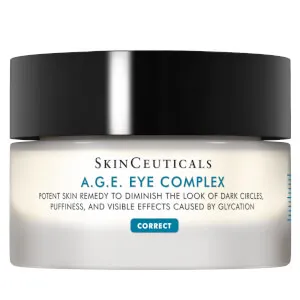
SkinCeuticals A.G.E. Eye Complex for Dark Circles
Works for
MoisturizingPalmitoyl tetrapeptide-7, Palmitoyl tripeptide-1 + 13 moreWorks well
“Restores comfort to dry, aging skin”
This product can help improve hydration of the skin with the two types of ingredients.
The first type is called “humectants”:
these ingredients help attract water.
When humectants are on the surface of the skin, they “pull in” the moisture from the outside environment, or from
within deeper layers of the skin. The following ingredients in this product do the job:
glycerin, propylene glycol.
This product also contains ingredients called “occlusives”. They help reduce the speed with which our skin loses moisture to the outside environment. These ingredients also help soften the upper layer of the skin, so it feels less tight and nicer to the touch. The following ingredients in this product do the job: caprylic/capric triglyceride, dimethicone.
The following ingredients in this product are especially good for supporting the skin barrier and helping with the hydration level: dipeptide-2, palmitoyl tetrapeptide-7, palmitoyl tripeptide-1
Evens skin toneChrysin, N-hydroxysuccinimide + 1 moreMay help
“Over time skin begins to change and fine lines, wrinkles, discoloration and loss of elasticity can become more apparent.”
The following ingredient (ingredients) in this product might be helpful, but there is no evidence to confirm that it actually works: chrysin.
Anti-agingDipeptide-2, Palmitoyl tripeptide-1 + 3 moreMay help
“An anti-wrinkle eye cream to fight the appearance of crow's feet, dark circles, and puffiness”
This product contains dipeptide-2, palmitoyl tetrapeptide-7, palmitoyl tripeptide-1. These ingredients might be able to help reduce and prevent fine lines and wrinkles, improve skin elasticity and firmness, but there is not enough evidence that it actually works.
Anti-oxidationSide benefit · Chrysin, Vaccinium myrtillus fruit extract + 4 moreMay help
This product contains antioxidants (chrysin) that might be able to help neutralize free radicals in skin to lessen the damage it gets from the UV light (sun). There is not enough evidence to confirm their effectiveness in skin though.
Can it cause trouble?
Irritancy2 strong irritants: Menthoxypropanediol, AlcoholMedium risk
ComedogenicClean of flagged comedogenic ingredientsNone flagged


User reviews
Be the first — your take helps the next person decide.
Ingredients
Filter by role to see what each ingredient is doing.
Water~45–55%
Glycerin~4.7–5.8%
- Irritation risk
- Low
One of the best moisturizing ingredients. Naturally present in skin. It attracts water to the upper layer of the skin working as a humectant
More about GlycerinDimethicone~4.6–5.7%
- Irritation risk
- Low
A silicone that helps to reduce water loss from the surface of the skin. Can temporarily "fill in" lines and wrinkles, absorb oil, and create a nice product finish
More about DimethiconeIsohexadecane~3.5–4.3%
- Irritation risk
- Low
Improves the texture of the product and helps soften the skin. Helps oil and water mix together and can be used as a cleansing agent
More about IsohexadecaneParaffin~2.7–3.3%
- Irritation risk
- Low
Prevents water loss from the skin surface and thickens the product consistency
More about ParaffinPropylene glycol~2.3–2.8%
- Irritation risk
- High
Helps oil and water mix together and can enhance the penetration of other ingredients into the skin. It can be irritating
More about Propylene glycolSilica~2.2–2.7%
Polyglyceryl-4 isostearate~1.9–2.3%
- Irritation risk
- Medium
Helps water and oil mix together
More about Polyglyceryl-4 isostearateCetyl peg/ppg-10/1 dimethicone~1.6–1.9%
- Irritation risk
- Low
A type of silicone that helps water and oil mix together. Can help to soften upper layer of the skin
More about Cetyl peg/ppg-10/1 dimethiconeHexyl laurate~1.4–1.7%
- Irritation risk
- Medium
Helps soften the upper layer of the skin and create a nice product consistency
More about Hexyl laurateNylon-12~1.3–1.6%
Hydroxypropyl tetrahydropyrantriol~1–1.2%
- Irritation risk
- High
A sugar-derived compound that helps to attract water to the upper layer of the skin and might be able to stimulate synthesis of skin's own moisturizing factors, but solid research is lacking. It could be irritating
More about Hydroxypropyl tetrahydropyrantriolMethylsilanol/silicate crosspolymer~0.8–1.15%
- Irritation risk
- Low
Polyethylene~1–1.3%
Ascorbyl glucoside~0.65–0.95%
- Irritation risk
- Medium
A vitamin C derivative that is more stable but less potent than pure form of vitamin C. Has a potential to boost collagen production, nutralise free radicals and reduce hyperpigmentation, but the required concentration is likely to be much higher than for the pure form of vitamin C, limiting the ingredient's effectiveness in products
More about Ascorbyl glucosideCaprylic/capric triglyceride~0.75–1.15%
- Irritation risk
- Medium
A good mix of fatty acids that forms a protective layer on the skin. Improves the shelf life of products. Derived from coconut and glycerin
More about Caprylic/capric triglycerideOctyldodecanol~0.7–1.05%
- Irritation risk
- Low
An emollient that helps to soften the skin and create a pleasant product texture and stabilize the formulation
More about OctyldodecanolPhenoxyethanol~0.7–1%
- Irritation risk
- Low
A preservative. It helps prevent bacterial growth in cosmetic products
More about PhenoxyethanolTocopheryl acetate~0.55–0.85%
- Irritation risk
- Medium
A more stable but less bio-available form of vitamin E compared to Tocopherol. Might help moisturize and protect the skin from free radicals, but mostly used in low concentrations to stabilize other ingredients.
More about Tocopheryl acetateAmmonium polyacryloyldimethyl taurate~0.6–0.95%
- Irritation risk
- Low
Used to create a thicker product consistency
More about Ammonium polyacryloyldimethyl tauratePeg-6 isostearate~0.65–0.95%
Triethanolamine~0.6–0.9%
- Irritation risk
- Medium
Used to adjust pH of the product and can help improve the product's smell
More about TriethanolamineSodium citrate~0.55–0.85%
- Irritation risk
- Medium
Helps to control the skin's pH level. Maintains the skin's natural film of amino-lactic acids and oils. Helps to preserve products
More about Sodium citrateMethylparaben~0.15–0.3%
Chlorphenesin~0.16–0.32%
Caffeine~0.5–0.7%
- Irritation risk
- Medium
Might be helpful in neutralizing free radicals. Can have a dehydration effect that might somewhat decrease the look of puffy eyes
More about CaffeineTitanium dioxide~0.65–1%
- Irritation risk
- Low
Works as a UV filter when used in high concentrations. It is photostable and is effective mostly against the UVB light, with some protection in the UVA range. In small concentrations, used for its ability to improve the color of cosmetic products. Is usually well tolerated by the skin
More about Titanium dioxideEthylparaben~0.2–0.4%
Menthoxypropanediol~0.55–0.85%
Sorbitol~0.55–0.85%
- Irritation risk
- Low
Helps attract water to the upper layer of the skin and improves the product texture
More about SorbitolVaccinium myrtillus fruit extract~0.55–0.85%
- Irritation risk
- Medium
A plant extract that might help neutralize free radicals in skin, but research on its efficacy in skin is lacking
More about Vaccinium myrtillus fruit extractSteareth-20~0.65–1%
Sodium phytate~0.55–0.85%
Hesperidin methyl chalcone~0.5–0.7%
- Irritation risk
- High
Might help neutralize free radicals in skin. Is claimed to be able to improve the appearance of undereye darkness but evidence is missing. Can be an allergen and cause irritation
More about Hesperidin methyl chalconeHesperetin laurate~0.5–0.7%
- Irritation risk
- Low
Chlorhexidine digluconate~0.15–0.3%
Aluminum hydroxide~0.6–0.9%
- Irritation risk
- Low
Is used to add opaque (non-transparent) appearance to formulations. Can be used to coat other ingredients for even dispersion. This is a different ingredient compared to the ones used in antipersperants (aluminium chloride and aluminium chlorohydrate)
More about Aluminum hydroxideN-hydroxysuccinimide~0.55–0.8%
- Irritation risk
- High
Is claimed to be able to brighten skin tone by removing some blood-related pigmented compounds in skin (hemoglobin and related elements) but solid research is missing. Can be irritating
More about N-hydroxysuccinimideAlcohol~0.55–0.8%
- Irritation risk
- High
Can be drying and contribute to skin irritation. Used in formulars to dissolve other ingredients, create a thinner product consistency or for its antibacterial properties
More about AlcoholPotassium sorbate~0.3–0.6%
Dipeptide-2~0.5–0.8%
- Irritation risk
- Low
A type of peptide. Peptides are excellent moisturizers and might be able support collagen production reducing fine lines and wrinkles
More about Dipeptide-2Bht~0.4–0.6%
Citric acid~0.45–0.7%
- Irritation risk
- Medium
Can work as an exfoliant but is typically used to adjust the product pH
More about Citric acidPalmitoyl tetrapeptide-7~0.5–0.75%
- Irritation risk
- Low
A type of peptide. Peptides are excellent moisturizers and might be able support collagen production reducing fine lines and wrinkles
More about Palmitoyl tetrapeptide-7Pentaerythrityl tetra-di-t-butyl hydroxyhydrocinnamate~0.4–0.6%
- Irritation risk
- Low
Used to increase stability of product formulations
More about Pentaerythrityl tetra-di-t-butyl hydroxyhydrocinnamatePalmitoyl tripeptide-1~0.5–0.75%
- Irritation risk
- Low
A type of peptide. Peptides are excellent moisturizers and might be able support collagen production reducing fine lines and wrinkles
More about Palmitoyl tripeptide-1Chrysin~0.35–0.65%
- Irritation risk
- Medium
Might be helpful in reducing fine lines and wrinkles, as well as lightening the skin, but solid evidence is missing. Could somewhat help in reducing the darkness of the under-eye area. Helps to neutralise free radicals in skin
More about ChrysinBiotin~0.3–0.5%
- Irritation risk
- Low
Might have some moisturising properties. Is not effective when applied topically beyond some moisturizing effect
More about BiotinIngredient list view
Water, Glycerin, Dimethicone, Isohexadecane, Paraffin, Propylene glycol, Silica, Polyglyceryl-4 isostearate, Cetyl peg/ppg-10/1 dimethicone, Hexyl laurate, Nylon-12, Hydroxypropyl tetrahydropyrantriol, Methylsilanol/silicate crosspolymer, Polyethylene, Ascorbyl glucoside, Caprylic/capric triglyceride, Octyldodecanol, Phenoxyethanol, Tocopheryl acetate, Ammonium polyacryloyldimethyl taurate, Peg-6 isostearate, Triethanolamine, Sodium citrate, Methylparaben, Chlorphenesin, Caffeine, Titanium dioxide, Ethylparaben, Menthoxypropanediol, Sorbitol, Vaccinium myrtillus fruit extract, Steareth-20, Sodium phytate, Hesperidin methyl chalcone, Hesperetin laurate, Chlorhexidine digluconate, Aluminum hydroxide, N-hydroxysuccinimide, Alcohol, Potassium sorbate, Dipeptide-2, Bht, Citric acid, Palmitoyl tetrapeptide-7, Pentaerythrityl tetra-di-t-butyl hydroxyhydrocinnamate, Palmitoyl tripeptide-1, Chrysin, Biotin
Compare prices
Retailers ranked by price — lowest first.

Worth comparing, line by line.
Match % combines shared ingredients, the first five ingredients, shared actives and hero ingredients, irritancy (lower counts in the alternative's favour), texture and body area. Only products in the same routine step are compared.
| SkinCeuticalsA.G.E. Eye Complex for Dark CirclesYOUR PRODUCT | SKINA.G.E. Eye Complex | BAD HABITEyes Open Caffeine & Peptide Eye Cream | CivantEye Complex | |
|---|---|---|---|---|
| Match | — | 63% | 58% | 57% |
| Price | $105.00 | $128.86+$23.86 | — | $44.00−$61.00 |
| Shared key ingredients | — | 10 of 11 | 8 of 11 | 7 of 11 |
| Key difference | — | Palmitoyl Oligopeptide | Palmitoyl Tripeptide-5 | Niacinamide |
| Irritancy | Medium | Medium | Medium | Medium |
| Drying alcohol | Contains drying alcohol | — | — | — |
| View product | Shop | Shop | Shop |


More alternatives: Be Minimalist Vitamin K +Retinal Eye CreamDr Dennis Gross C + Collagen Brighten + Firm Eye Cream
Product summary
"SkinCeuticals - A. G. E. Eye Complex for Dark Circles" is effective for: Moisturizing
This product could be helpful for: Anti-aging and Evens skin tone, but its actives are not the most effective or are not well-studied.
Ingredient callouts
- Peptides (palmitoyl oligopeptide 0.50% - 0.75%, palmitoyl tetrapeptide-7 0.50% - 0.70% and dipeptide-2 0.45% - 0.70%). Peptides are a very big group of ingredients. They all consist of a different combination of aminoacids. Our skin produces Peptides naturally. Some of them work as natural antibiotics, promote wound-healing and production of collagen. The scientists are still studying how effective the topical application of Peptides is, but it is very likely that theynare helpful. Peptides might be able to support skin barrier restoration and even have an anti-aging benefit. At the very least, they certainly help attract water to the skin and support the hydration in this way.
- Humectants (glycerin 4.70% - 5.80%). These ingredients help attract water to the upper layer of the skin and improve the skin hydration.
Price
The product retails from 105.00$ up to 123.00$ in the United States and from 82.00£ up to 88.00£ in the United Kingdom.
For a detailed price comparison: click here.
Sources cited in this review
Every concentration estimate and effectiveness label is anchored to one of these 21 studies and safety reviews.
- 1
- 2
- 3Final Report on the Safety Assessment of Dimethicone Copolyoljournals.sagepub.com
- 4Surfactants and experimental irritant contact dermatitisncbi.nlm.nih.gov
- 5Propylene Glycolpubmed.ncbi.nlm.nih.gov
- 6Skin-sensitizing and irritant properties of propylene glycolonlinelibrary.wiley.com

Affiliate links · As an Amazon Associate, WIMJ earns from qualifying purchases.