Works for
2 of 2 advertised claims delivered
Anti-aging9 ingredients credited for this claimStrong support
“Highly concentrated Pitera™, along with a unique blend of skin-conditioning agents and skin-loving vitamins, helps to condition skin to assist in refining texture and uneven tone, while improving radiance and signs of aging.”
This product can help reduce and prevent fine lines and wrinkles, improve skin elasticity and firmness because it contains niacinamide.
These ingredients in the product can also be helpful, even though there is less evidence for their effectiveness: acetyl hexapeptide-8, galactomyces ferment filtrate, hexapeptide-3.
Keep in mind that it typically takes at least 6 weeks to notice any results because the changes that are needed to improve fine lines and elasticity happen in the deeper layers of the skin. No topical anti-aging product can “erase” wrinkles or fully reverse signs of aging.
Moisturizing25 ingredients credited for this claimStrong support
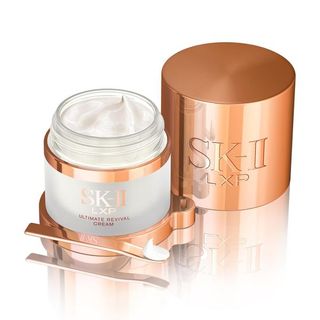
“LXP Ultimate Revival Cream”
This product contains good ingredients to attract water to the upper layer of the skin. These ingredients are called "humectants": galactomyces ferment filtrate, glycerin.
When humectants are on the surface of the skin, they “pull in” the moisture from the outside environment, or from within deeper layers of the skin. If the air is dry, humectants can speed up the moisture loss from the skin. This is why it is a good idea to use another product on top of this one to help "seal in" the moisture (look for ingredients like dimethicone, squalane, oils and butters).
The following ingredients in this product are especially good for supporting the skin barrier and helping with the hydration level: acetyl hexapeptide-8, hexapeptide-3, niacinamide, panthenol
Anti-oxidationNot advertised by the brand · 7 ingredients credited for this claimStrong support
This product contains antioxidants (galactomyces ferment filtrate) that can help neutralize free radicals in skin. By doing so, they can lessen the damage the skin gets from the UV light (sun).
Evens skin toneNot advertised by the brand · 6 ingredients credited for this claimStrong support
This product can help reduce hypepigmentation and even out the skin tone because it contains the following effective ingredients: niacinamide
The following ingredient (ingredients) in this product might be helpful, but there is no evidence to confirm that it actually can help even out the skin tone: galactomyces ferment filtrate.
Keep in mind that you would need to apply any topical skincare targetted at hypigmentation consistently for a couple of months to get a result. No topical skincare product can help get rid of hyperpigmentation (including post-acne marks and age spots) instantly.
Can it cause trouble?
Irritancy1 strong irritant: ParfumMedium risk
Comedogenic3 ingredients rated 2 or more on the 0–5 pore-clogging scale3 flagged


User reviews
Be the first — your take helps the next person decide.
Ingredients
Filter by role to see what each ingredient is doing.
Water~45–55%
Glycerin~4.5–5.6%
- Irritation risk
- Low
One of the best moisturizing ingredients. Naturally present in skin. It attracts water to the upper layer of the skin working as a humectant
More about GlycerinGalactomyces ferment filtrate~3.9–4.7%
- Irritation risk
- Low
A yeast ferment filtrate (also known as Pitera - a trademarked name for the filtrate reserved by the SK-II brand). It helps attract water to the upper layer of the skin, can help neutralize antioxidants and can be helpful in evening out the skin tone. It might be somewhat helpful in preventing premature skin aging but solid evidence is lacking. A small manufacturer study also shows that, when used in high concentrations, it can help reduce sebum production and help against blocked pores
More about Galactomyces ferment filtrateNiacinamide~3–3.7%
- Irritation risk
- Low
Is proven to be effective in reducing blemishes, evening out skin tone and helping to improve lines and wrinkles. It helps the skin to repair sun damage, calm down inflammation and keep maintain good levels of moisture. The concentration of about 2% is effective for supporting the skin barrier and evening out the skin tone. Concentration of 4-6% is better for helping with acne and balancing the sebum production
More about NiacinamidePhytosteryl/behenyl/octyldodecyl lauroyl glutamate~2.2–2.7%
- Irritation risk
- Low
Ethylhexyl isononanoate~1.9–2.3%
- Irritation risk
- Low
Helps soften the upper layer of the skin and improve the product consistency
More about Ethylhexyl isononanoateButylene glycol~1.5–1.9%
- Irritation risk
- Low
Used to create a nice product texture and help delivery of other ingredients. Might be somewhat helpful in attracting water to the upper layer of the skin
More about Butylene glycolTriethylhexanoin~1.2–1.5%
- Irritation risk
- Medium
Helps soften the upper layer of the skin
More about TriethylhexanoinNeopentyl glycol diethylhexanoate~1.1–1.4%
- Irritation risk
- Low
Simmondsia chinensis seed oil~0.95–1.15%
- Irritation risk
- Medium
Softens the upper layer of skin and helps restore the healthy skin barrier. Has shown to help calm down inflammation in skin. It is a stable oil, meaning that it retains its properties even when exposed to air.
More about Simmondsia chinensis seed oilSucrose polycottonseedate~0.65–1%
Glyceryl stearate se~0.55–0.8%
- Irritation risk
- Low
- Comedogenicity
- 2/5
Used to stabilize the product formulations and works as an emollient
More about Glyceryl stearate seMyristyl myristate~0.55–0.8%
- Irritation risk
- Medium
- Comedogenicity
- 3/5
An emollient. Is not recommended for acne-prone skin as it can be comedogenic
More about Myristyl myristateHydrogenated coco-glycerides~0.45–0.7%
- Irritation risk
- Medium
Helps oil and water mix together while creating a nice finish on the skin
More about Hydrogenated coco-glyceridesPentylene glycol~0.45–0.65%
- Irritation risk
- Medium
Used to preserve products, dissolve other ingredients and create a nice product texture
More about Pentylene glycolSorbitan stearate~0.4–0.6%
Myristyl alcohol~0.4–0.6%
- Irritation risk
- High
Helps to stabilize the product formulation while softening the upper layer of the skin. Can be irritating
More about Myristyl alcoholPeg-40 stearate~0.35–0.6%
Panthenol~0.3–0.5%
- Irritation risk
- Low
Helps attract water to the upper layer of the skin and can help improve skin barrier function
More about PanthenolCaprylic/capric triglyceride~0.3–0.6%
- Irritation risk
- Medium
A good mix of fatty acids that forms a protective layer on the skin. Improves the shelf life of products. Derived from coconut and glycerin
More about Caprylic/capric triglycerideC13-14 isoparaffin~0.3–0.5%
- Irritation risk
- Low
Helps soften the upper layer of the skin, dissolve other ingredients and create a thicker product consistency
More about C13-14 isoparaffinCrithmum maritimum extract~0.2–0.4%
- Irritation risk
- Low
- Comedogenicity
- 3/5
An algae extract that might have anti-oxidant properties
More about Crithmum maritimum extractMagnesium aspartate~0.2–0.4%
- Irritation risk
- Low
Might be helpful in restoring skin barrier function and calm down inflammation in skin
More about Magnesium aspartateZinc gluconate~0.2–0.4%
- Irritation risk
- Medium
Typically used to stabilize the product formulations. It is a salt of a polyhydroxy acid (PHA) and in larger concentrations, can help shed the dead cells from the skin surface revealing smoother skin. It can help attract water to the upper layer of the skin. Might to be helpful against acne and clogged pores. Could be helpful in neutralizing free radicals, but solid research is missing. Due to the zinc content, might help calm down inflammation in skin
More about Zinc gluconateCamellia sinensis leaf extract~0.25–0.45%
- Irritation risk
- Low
Can contain potent anti-oxidant compounds (abbreviated ECG, GCG, EGC, and EGCG) that might help protect the skin from free radicals. Can help calm down inflammation and has some anti-bacterial properties. Unfortunately, these antioxidants are unstable and lose their effectiveness very quickly in products. The concentration of the antioxidant compounds in the extract also tends to be low to be effective in topical formulation
More about Camellia sinensis leaf extractCopper gluconate~0.2–0.4%
- Irritation risk
- Medium
Typically used to stabilize the product formulations. It is a salt of polyhydroxy acid (PHA) and in larger concentrations, can help shed the dead cells from the skin surface revealing smoother skin. It can help attract water to the upper layer of the skin. Might to be helpful against acne and clogged pores. Could be helpful in neutralizing free radicals, but solid research is missing
More about Copper gluconateSaccharomyces cerevisiae extract~0.2–0.4%
- Irritation risk
- Medium
A moisturizing ingredient that works as a humectant to attract water to the upper layer of the skin.
More about Saccharomyces cerevisiae extractPalmitoyl dipeptide-7~0.2–0.4%
- Irritation risk
- Low
Acetyl hexapeptide-8~0.2–0.4%
- Irritation risk
- Low
A type of peptide. Peptides are excellent moisturizers and might be able support collagen production reducing fine lines and wrinkles
More about Acetyl hexapeptide-8Hexapeptide-3~0.2–0.4%
- Irritation risk
- Low
A type of peptide. Peptides are excellent moisturizers and might be able support collagen production reducing fine lines and wrinkles
More about Hexapeptide-3Tocopheryl acetate~0.25–0.45%
- Irritation risk
- Medium
A more stable but less bio-available form of vitamin E compared to Tocopherol. Might help moisturize and protect the skin from free radicals, but mostly used in low concentrations to stabilize other ingredients.
More about Tocopheryl acetateTocopherol~0.2–0.4%
- Irritation risk
- Low
Pure form of vitamin E. Can help moisturise and protect the skin from free radicals. Often used to help stabilise other ingredients or the formula itself
More about TocopherolPolysorbate 65~0.25–0.45%
Hydrogenated lecithin~0.25–0.45%
- Irritation risk
- Low
Helps to retain moisture by creating a protective barrier on the skin. Rich in fatty acids. Improves product texture and helps with the penetration of other ingredients.
More about Hydrogenated lecithinLaureth-7~0.25–0.45%
Batyl alcohol~0.25–0.45%
- Irritation risk
- Low
Non-drying alcohol. Used to stabilize other ingredients and is an emollient
More about Batyl alcoholLactic acid~0.2–0.4%
- Irritation risk
- Medium
An exfoliating and moisturizing alpha-hydroxy acid (AHA). Typically causes less irritation than other AHAs, for example, glycolic acid. At high concentrations (about 15%), lactic acid can help reduce lines and wrinkles. Recent studies show that lactic acid can support the "good" bacteria living on skin's surface (healthy skin microbiome)
More about Lactic acidCaramel~0.2–0.4%
- Irritation risk
- Low
Decyl glucoside~0.3–0.5%
- Irritation risk
- High
Helps oil and water mix together. Can be irritating
More about Decyl glucosidePolyacrylamide~0.2–0.4%
- Irritation risk
- Medium
Used to improve product texture and help oil and water mix together
More about PolyacrylamideMethylparaben~0.15–0.3%
Ethylparaben~0.15–0.3%
Butylparaben~0.15–0.25%
Propylparaben~0.1–0.2%
Isobutylparaben~0.15–0.25%
Phenoxyethanol~0.1–0.2%
- Irritation risk
- Low
A preservative. It helps prevent bacterial growth in cosmetic products
More about PhenoxyethanolDisodium edta~0.1–0.2%
Sodium hydroxide~0.1–0.2%
Benzyl alcohol~0.1–0.15%
- Irritation risk
- High
A preservative. Can be used to mask unpleasant smell. Can be irritating
More about Benzyl alcoholParfum~0.05–0.1%
- Irritation risk
- High
An aromatic blend of unspecified and possibly irritating ingredients
More about ParfumIngredient list view
Water, Glycerin, Galactomyces ferment filtrate, Niacinamide, Phytosteryl/behenyl/octyldodecyl lauroyl glutamate, Ethylhexyl isononanoate, Butylene glycol, Triethylhexanoin, Neopentyl glycol diethylhexanoate, Simmondsia chinensis seed oil, Sucrose polycottonseedate, Glyceryl stearate se, Myristyl myristate, Hydrogenated coco-glycerides, Pentylene glycol, Sorbitan stearate, Myristyl alcohol, Peg-40 stearate, Panthenol, Caprylic/capric triglyceride, C13-14 isoparaffin, Crithmum maritimum extract, Magnesium aspartate, Zinc gluconate, Camellia sinensis leaf extract, Copper gluconate, Saccharomyces cerevisiae extract, Palmitoyl dipeptide-7, Acetyl hexapeptide-8, Hexapeptide-3, Tocopheryl acetate, Tocopherol, Polysorbate 65, Hydrogenated lecithin, Laureth-7, Batyl alcohol, Lactic acid, Caramel, Decyl glucoside, Polyacrylamide, Methylparaben, Ethylparaben, Butylparaben, Propylparaben, Isobutylparaben, Phenoxyethanol, Disodium edta, Sodium hydroxide, Benzyl alcohol, Parfum
Compare prices
Retailers ranked by price — lowest first.

Worth comparing, line by line.
Match % combines shared ingredients, the first five ingredients, shared actives and hero ingredients, irritancy (lower counts in the alternative's favour), texture and body area. Only products in the same routine step are compared.
| SK-IILXP Ultimate Revival CreamYOUR PRODUCT | NEOGEN X SUR.MEDICV.Biome Advanced Eye Cream | ArtNaturals LUXEEye Cream | MediFlowerARONYX D-Panthenol Cica Repair Eye Cream | |
|---|---|---|---|---|
| Match | — | 74% | 74% | 73% |
| Price | $200.00 | $25.16−$174.84 | $10.00−$190.00 | $7.90−$192.10 |
| Shared key ingredients | — | 6 of 16 | 5 of 16 | 6 of 16 |
| Key difference | — | Copper Tripeptide-1 | Palmitoyl Tetrapeptide-7 | Adenosine |
| Irritancy | Medium | Medium | Medium | Medium |
| Drying alcohol | — | — | Contains drying alcohol | — |
| View product | Shop | Shop | Shop |


Product summary
Based on the ingredients included, "SK-II - LXP Ultimate Revival Cream" works well for moisturizing the skin. The formulation is based on a combination of good humectants and emollients. Both are needed to increase the skin hydration level. Humectants in this product (acetyl hexapeptide-8, panthenol, galactomyces ferment filtrate, glycerin and saccharomyces cerevisiae extract) help to increase the water content in the upper layer of the skin. (These ingredients do so by "capturing" water molecules from the outside air or from within the deeper layers of the skin). Batyl alcohol, c13-14 isoparaffin, ethylhexyl isononanoate, pentylene glycol and myristyl alcohol in this product help decrease the water evoporation from the skin, so that it stays hydrated for longer. These ingredients also soften the skin and take away the feeling of tightness and dryness.
Ingredient callouts
- We particularly like that there is a good concentration of Niacinamide (3.00% - 3.70%) in this moisturizer. Niacinamide is a well-studied multi-tasking active. It is a great ingredient to have in a moisturizer. It is stable, and can work well in almost any hydrating formulation. There is solid evidence that Niacinamide can help support skin barrier, regulate oil production and reduce acne and clogged pores. It also helps to fight photodamage and help improve the skin tone, reducing pigmentation marks.
- We like that this moisturizer contains peptides (hexapeptide-3 0.20% - 0.40% and acetyl hexapeptide-8 0.20% - 0.40%). There are many different kind of Peptides and they are naturally present in our skin. They all are a combination of aminoacids. Some of them work as natural antibiotics, promote wound-healing and production of collagen. The science is still not settled on how effective Peptides are in skincare, but it is very likely that they have a benefit. Peptides might help restore the skin barrier and fight the signs of aging. At the very least, Peptides work as humectants: they attract water to the upper layer of the skin and improve its hydration.
Irritation risk
This formulation includes some common irritants, including ingredients that do not provide a benefit for the skin. We assess the overall irritancy of this moisturizer to be medium. For a detailed overview of all potential irritants: click here
You can see the detailed formula review with the breakdown of all actives in the product and the full ingredient list with estimated concentrations in the tables below.
Price
The product retails from 122.94$ up to 385.00$ in the United States, for 252.65CA$ in Canada, for 613.29A$ in Australia and for 177.21£ in the United Kingdom.
For a detailed price comparison: click here.
Sources cited in this review
Every concentration estimate and effectiveness label is anchored to one of these 30 studies and safety reviews.
- 1
- 2
- 3
- 4
- 5
- 6

Affiliate links · As an Amazon Associate, WIMJ earns from qualifying purchases.