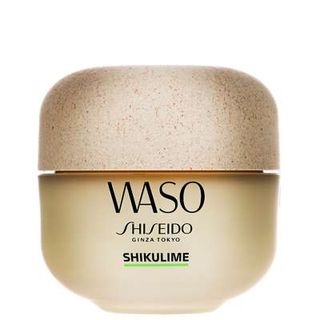
Shiseido Treatments Waso: SHIKULIME Mega Hydrating Moisturizer
Works for
1 of 1 advertised claim delivered
Moisturizing16 ingredients credited for this claimGood support
“SHIKULIME Mega Hydrating Moisturizer”
This product can help improve hydration of the skin with the two types of ingredients.
The first type is called “humectants”:
these ingredients help attract water.
When humectants are on the surface of the skin, they “pull in” the moisture from the outside environment, or from
within deeper layers of the skin. The following ingredients in this product do the job:
erythritol, glycerin.
This product also contains ingredients called “occlusives”. They help reduce the speed with which our skin loses moisture to the outside environment. These ingredients also help soften the upper layer of the skin, so it feels less tight and nicer to the touch. The following ingredients in this product do the job: dimethicone, squalane.
Can it cause trouble?
Irritancy7 strong irritants: Alcohol, Rosmarinus officinalis leaf oil + 5 more — patch-test recommendedHigh risk
Comedogenic2 ingredients rated 2 or more on the 0–5 pore-clogging scale2 flagged
User reviews
Be the first — your take helps the next person decide.
Ingredients
Filter by role to see what each ingredient is doing.
Water~45–55%
Cetyl ethylhexanoate~5.1–6.2%
- Irritation risk
- Medium
An emollient that helps soften the skin and creates a thicker product texture
More about Cetyl ethylhexanoateHydrogenated polydecene~4.3–5.3%
- Irritation risk
- Low
Helps to soften the upper layer of the skin and create a nice product texture
More about Hydrogenated polydeceneButylene glycol~3.1–3.8%
- Irritation risk
- Low
Used to create a nice product texture and help delivery of other ingredients. Might be somewhat helpful in attracting water to the upper layer of the skin
More about Butylene glycolDimethicone~2.5–3%
- Irritation risk
- Low
A silicone that helps to reduce water loss from the surface of the skin. Can temporarily "fill in" lines and wrinkles, absorb oil, and create a nice product finish
More about DimethiconeXylitol~2–2.4%
- Irritation risk
- Low
Helps attract water to the upper layer of the skin and repair the skin barrier function
More about XylitolGlycerin~1.8–2.2%
- Irritation risk
- Low
One of the best moisturizing ingredients. Naturally present in skin. It attracts water to the upper layer of the skin working as a humectant
More about GlycerinSilica~1.7–2.1%
Squalane~1.3–1.6%
- Irritation risk
- Low
An oil naturally present in skin. Works as an emollient to soften the skin and form a protective layer on its surface without a greasy feeling.
More about SqualanePeg-60 glyceryl isostearate~1–1.2%
Alcohol~0.7–1.1%
- Irritation risk
- High
Can be drying and contribute to skin irritation. Used in formulars to dissolve other ingredients, create a thinner product consistency or for its antibacterial properties
More about AlcoholStearyl alcohol~0.7–1.05%
- Irritation risk
- Low
An emollient that helps soften the skin
More about Stearyl alcoholButyrospermum parkii butter~0.6–0.9%
- Irritation risk
- Low
- Comedogenicity
- 3/5
A great moisturising ingredient that softens the skin and reduces water loss from its upper layer. It also can be helpful in protecting skin from free radicals
More about Butyrospermum parkii butterGlyceryl stearate~0.55–0.85%
- Irritation risk
- Low
An emollient that softens the skin and forms a protective layer on its surface. Helps water and oil mix together
More about Glyceryl stearateErythritol~0.45–0.7%
- Irritation risk
- Low
Helps to attract water to the upper layer of the skin
More about ErythritolBehenyl alcohol~0.55–0.8%
- Irritation risk
- Low
Non-drying alcohol that helps water and oil mix together. Also serves as an emollient
More about Behenyl alcoholTrehalose~0.45–0.65%
- Irritation risk
- Low
A sugar that attracts water to the upper layer of the skin
More about TrehaloseTitanium dioxide~0.5–0.75%
- Irritation risk
- Low
Works as a UV filter when used in high concentrations. It is photostable and is effective mostly against the UVB light, with some protection in the UVA range. In small concentrations, used for its ability to improve the color of cosmetic products. Is usually well tolerated by the skin
More about Titanium dioxideCi 77891~0.45–0.65%
- Irritation risk
- Low
Phenoxyethanol~0.35–0.6%
- Irritation risk
- Low
A preservative. It helps prevent bacterial growth in cosmetic products
More about PhenoxyethanolIsostearic acid~0.45–0.65%
- Irritation risk
- Low
Used to create a nice product texture
More about Isostearic acidHydrogenated palm oil~0.35–0.6%
- Irritation risk
- Low
Helps soften the upper layer of the skin
More about Hydrogenated palm oilMica~0.3–0.6%
- Irritation risk
- Low
Creates an illusion of smoother and more radiant skin tone. Adds shimmer to the skin by reflecting light
More about MicaPyrus malus fruit water~0.3–0.5%
- Irritation risk
- Low
Elaeis guineensis kernel oil~0.3–0.6%
- Irritation risk
- Low
Helps soften the upper layer of the skin
More about Elaeis guineensis kernel oilElaeis guineensis oil~0.3–0.6%
- Irritation risk
- Low
Helps soften the upper layer of the skin
More about Elaeis guineensis oilChlorphenesin~0.16–0.32%
Xanthan gum~0.3–0.55%
- Irritation risk
- Low
Used to create a thicker product consistency
More about Xanthan gumDipropylene glycol~0.25–0.45%
- Irritation risk
- Low
Helps to dissolve other ingredients in a formulation. Slows down the rate of product drying
More about Dipropylene glycolAcrylates/c10-30 alkyl acrylate crosspolymer~0.3–0.55%
- Irritation risk
- Medium
Maintains the texture of skincare products. Allows the product to spread evenly. Helps oil and water mix together
More about Acrylates/c10-30 alkyl acrylate crosspolymerDisodium edta~0.25–0.5%
Tin oxide~0.45–0.65%
- Irritation risk
- Low
A colorant that can add a pearl-like appearance to the formulation
More about Tin oxideSodium metaphosphate~0.25–0.5%
Rosmarinus officinalis leaf oil~0.25–0.45%
- Irritation risk
- High
A plant oil with high content of volatile compounds that can irritate the skin. Can be used as a fragrance. Has anti-bacterial properties and might help neutralize free radicals on the surface of the skin
More about Rosmarinus officinalis leaf oilSodium polyacrylate~0.3–0.55%
- Irritation risk
- Low
Used to create a gel-like product texture, as well as to stabilize emulsions
More about Sodium polyacrylateLimonene~0.25–0.4%
- Irritation risk
- High
A common frangrance that can easily irritate skin, especially if exposed to air, light or heat
More about LimoneneCitrus aurantium dulcis oil~0.25–0.45%
- Irritation risk
- High
Used as a fragrance. It can be irritating and cause photosensitivity
More about Citrus aurantium dulcis oilLavandula angustifolia oil~0.25–0.45%
- Irritation risk
- High
An essential oil. Potential allergen and can be irritating. It has some anti-bacterial properties
More about Lavandula angustifolia oilTocopherol~0.25–0.45%
- Irritation risk
- Low
Pure form of vitamin E. Can help moisturise and protect the skin from free radicals. Often used to help stabilise other ingredients or the formula itself
More about TocopherolIron oxides~0.2–0.4%
- Irritation risk
- Low
An umbrella term for the following three colorants: CI 77491, CI 77492, CI 77499. They might be able to offer some protection against visible light, but the degree of the protection is not clear
More about Iron oxidesCi 77492~0.2–0.35%
Citrus depressa peel extract~0.15–0.3%
- Irritation risk
- High
A citrus extract. Used as a fragrance. Can be irritating
More about Citrus depressa peel extractSalvia officinalis oil~0.15–0.3%
- Irritation risk
- High
Potassium hydroxide~0.2–0.35%
Plankton extract~0.15–0.25%
- Irritation risk
- Medium
- Comedogenicity
- 3/5
Can help attract water to the upper layer of the skin
More about Plankton extractCitric acid~0.1–0.15%
- Irritation risk
- Medium
Can work as an exfoliant but is typically used to adjust the product pH
More about Citric acidIngredient list view
Water, Cetyl ethylhexanoate, Hydrogenated polydecene, Butylene glycol, Dimethicone, Xylitol, Glycerin, Silica, Squalane, Peg-60 glyceryl isostearate, Alcohol, Stearyl alcohol, Butyrospermum parkii butter, Glyceryl stearate, Erythritol, Behenyl alcohol, Trehalose, Titanium dioxide, Ci 77891, Phenoxyethanol, Isostearic acid, Hydrogenated palm oil, Mica, Pyrus malus fruit water, Elaeis guineensis kernel oil, Elaeis guineensis oil, Chlorphenesin, Xanthan gum, Dipropylene glycol, Acrylates/c10-30 alkyl acrylate crosspolymer, Disodium edta, Tin oxide, Sodium metaphosphate, Rosmarinus officinalis leaf oil, Sodium polyacrylate, Limonene, Citrus aurantium dulcis oil, Lavandula angustifolia oil, Tocopherol, Iron oxides, Ci 77492, Citrus depressa peel extract, Salvia officinalis oil, Potassium hydroxide, Plankton extract, Citric acid
Compare prices
Retailers ranked by price — lowest first.

Affiliate links · prices updated regularly
Sources cited in this review
Every concentration estimate and effectiveness label is anchored to one of these 19 studies and safety reviews.
- 1Safety Assessment of Polyene Group as Used in Cosmeticscir-safety.org
- 2
- 3Final Report on the Safety Assessment of Dimethicone Copolyoljournals.sagepub.com
- 4
- 5
- 6

Affiliate links · As an Amazon Associate, WIMJ earns from qualifying purchases.