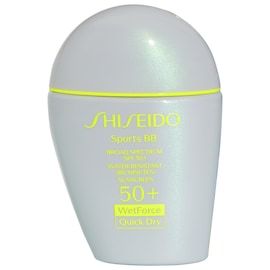
Shiseido Sports BB SPF 50+
Works for
0 of 1 advertised claim delivered
Sun protectionSPF 50 · 2 UV filters · Partial spectrumWeak protection
This product does not offer good protection against UVA rays.
MoisturizingNot advertised by the brand · 11 ingredients credited for this claimGood support
This product can help soften the skin and reduce its moisture loss with emollients and occlusives: isopropyl myristate, phytosteryl macadamiate.
Keep in mind that this product does not contain effective ingredients to attract water to the upper layer of the skin. This is why an additional product with humectants like glycerin or hyaluronic acid can be helpful (apply it before this product for the best results).
Can it cause trouble?
Irritancy2 strong irritants: Sd alcohol 40-b, ParfumMedium risk
Comedogenic1 ingredient rated 2 or more on the 0–5 pore-clogging scale1 flagged
User reviews
Be the first — your take helps the next person decide.
Ingredients
Filter by role to see what each ingredient is doing.
Ethylhexyl methoxycinnamate4.9%
- Irritation risk
- High
Octinoxate. When used in higher concentrations, works as a sunscreen protecting the skin from UVB rays. When used in lower concentration, helps to preserve the product formulation. Is shown to be harmful to coral reefs - consider avoiding bathing in coral reef areas when wearing a product with this ingredient. It can be irritating
More about Ethylhexyl methoxycinnamateSilica~25–38%
Bis-peg-18 methyl ether dimethyl silane~6.4–9.5%
- Irritation risk
- Low
A type of silicone that helps soften the upper layer of the skin and create a nice product texture
More about Bis-peg-18 methyl ether dimethyl silaneIsododecane~5.2–7.8%
- Irritation risk
- Low
An emollient that helps soften the skin and can decrease moisture loss. Helps create a nice product texture
More about IsododecaneTrimethylsiloxysilicate~4–6%
- Irritation risk
- Low
A type of silicone that helps create a nice product consistency and support the delivery of other ingredients
More about TrimethylsiloxysilicateSd alcohol 40-b~2.8–4.2%
- Irritation risk
- High
Can be drying and contribute to skin irritation. Used in formulars to dissolve other ingredients, create a thinner product consistency or for its antibacterial properties
More about Sd alcohol 40-bTrimethylsiloxysilicate/dimethiconol crosspolymer~2.2–3.3%
- Irritation risk
- Low
Isopropyl myristate~1.8–2.7%
- Irritation risk
- Low
- Comedogenicity
- 3/5
An emollient that helps soften the skin. Could be comedogenic
More about Isopropyl myristateAluminum hydroxide~1.5–2.3%
- Irritation risk
- Low
Is used to add opaque (non-transparent) appearance to formulations. Can be used to coat other ingredients for even dispersion. This is a different ingredient compared to the ones used in antipersperants (aluminium chloride and aluminium chlorohydrate)
More about Aluminum hydroxidePeg-9 polydimethylsiloxyethyl dimethicone~1.2–1.8%
- Irritation risk
- Medium
A type of silicone that helps water and oil mix together
More about Peg-9 polydimethylsiloxyethyl dimethiconeStearic acid~1.2–1.7%
- Irritation risk
- Low
Helps oil and water mix together and works as an emollient
More about Stearic acidIsostearic acid~0.95–1.45%
- Irritation risk
- Low
Used to create a nice product texture
More about Isostearic acidDextrin palmitate~0.5–1.2%
- Irritation risk
- Medium
Helps water and oil mix together
More about Dextrin palmitateDisteardimonium hectorite~0.45–1.1%
- Irritation risk
- Low
A type of clay that is used to thicken the product consistency
More about Disteardimonium hectoriteBis-butyldimethicone polyglyceryl-3~1.1–1.7%
Lauroyl lysine~0.4–0.95%
- Irritation risk
- Low
Helps soften the upper layer of the skin and creates a nice product texture
More about Lauroyl lysinePeg/ppg-14/7 dimethyl ether~0.45–1.1%
- Irritation risk
- Low
An emollient that helps soften the skin. It also forms a protective on its surface to reduce water loss
More about Peg/ppg-14/7 dimethyl etherPca dimethicone~0.4–0.95%
- Irritation risk
- Low
Phytosteryl/octyldodecyl lauroyl glutamate~0.45–1.05%
- Irritation risk
- Low
A mix of amino acids and plant-based lipids. Helps to soften the upper layer of the skin and reduce water loss over time
More about Phytosteryl/octyldodecyl lauroyl glutamatePhytosteryl macadamiate~0.4–0.95%
- Irritation risk
- Low
Helps soften the upper layer of the skin
More about Phytosteryl macadamiateLecithin~0.4–0.95%
- Irritation risk
- Low
Used mostly for creating emulsions - helping oil and water mix together. Helps soften the upper layer of the skin
More about LecithinGlycyrrhiza glabra root extract~0.3–0.7%
- Irritation risk
- Medium
A plant extract that can help lighten the skin and calm down inflammation. Might be helpful in neutralizing free radicals
More about Glycyrrhiza glabra root extractSucrose tetrastearate triacetate~0.4–0.9%
Polymethylsilsesquioxane~0.35–0.75%
- Irritation risk
- Low
A silicone that improves product texture and helps dissolve other ingredients. Can form a non-greasy film on the skin to prevent moisture loss
More about PolymethylsilsesquioxaneTalc~0.4–1%
Methyl methacrylate crosspolymer~0.4–0.9%
- Irritation risk
- Low
Helps thicken the product consistency
More about Methyl methacrylate crosspolymerAlumina~0.45–1%
- Irritation risk
- Low
The same compound that is used safely in dental implants and bone cements. In cosmetics, it is used to improve the consistency of products
More about AluminaPolysilicone-2~0.35–0.75%
- Irritation risk
- Low
Triethoxycaprylylsilane~0.2–0.8%
- Irritation risk
- Low
A type of silicone that helps oil and water mix well together. Helps to disperse other ingredients, e.g. pigments, evenly in a formulation
More about TriethoxycaprylylsilaneHydrogen dimethicone~0.3–0.7%
- Irritation risk
- Low
Helps the function of sunscreen and pigment ingredients in the formulation
More about Hydrogen dimethiconeTocopherol~0.15–0.55%
- Irritation risk
- Low
Pure form of vitamin E. Can help moisturise and protect the skin from free radicals. Often used to help stabilise other ingredients or the formula itself
More about TocopherolBht~0.1–0.4%
Ethylparaben~0.1–0.35%
Parfum~0.1–0.4%
- Irritation risk
- High
An aromatic blend of unspecified and possibly irritating ingredients
More about ParfumTitanium dioxide15%
- Irritation risk
- Low
Works as a UV filter when used in high concentrations. It is photostable and is effective mostly against the UVB light, with some protection in the UVA range. In small concentrations, used for its ability to improve the color of cosmetic products. Is usually well tolerated by the skin
More about Titanium dioxideIron oxides~0.1–0.3%
- Irritation risk
- Low
An umbrella term for the following three colorants: CI 77491, CI 77492, CI 77499. They might be able to offer some protection against visible light, but the degree of the protection is not clear
More about Iron oxidesMica~0.1–0.35%
- Irritation risk
- Low
Creates an illusion of smoother and more radiant skin tone. Adds shimmer to the skin by reflecting light
More about MicaIngredient list view
Ethylhexyl methoxycinnamate, Silica, Bis-peg-18 methyl ether dimethyl silane, Isododecane, Trimethylsiloxysilicate, Sd alcohol 40-b, Trimethylsiloxysilicate/dimethiconol crosspolymer, Isopropyl myristate, Aluminum hydroxide, Peg-9 polydimethylsiloxyethyl dimethicone, Stearic acid, Isostearic acid, Dextrin palmitate, Disteardimonium hectorite, Bis-butyldimethicone polyglyceryl-3, Lauroyl lysine, Peg/ppg-14/7 dimethyl ether, Pca dimethicone, Phytosteryl/octyldodecyl lauroyl glutamate, Phytosteryl macadamiate, Lecithin, Glycyrrhiza glabra root extract, Sucrose tetrastearate triacetate, Polymethylsilsesquioxane, Talc, Methyl methacrylate crosspolymer, Alumina, Polysilicone-2, Triethoxycaprylylsilane, Hydrogen dimethicone, Tocopherol, Bht, Ethylparaben, Parfum, Titanium dioxide, Iron oxides, Mica
Compare prices
Retailers ranked by price — lowest first.
Affiliate links · prices updated regularly · As an Amazon Associate, WIMJ earns from qualifying purchases.
Product summary
We do not recommend "Shiseido - Sports BB SPF 50+" because it does not provide good UVA protection. UVA sun rays don't burn the skin, but they still lead to photoaging and hyperpigmentation.
This sunscreen should also be hydrating enough to use without an additional moisturizer during the day.
Sunscreen filters
This sunscreen uses a mixture of both mineral and organic (so-called "chemical") UV filters. Here are the organic filters this product uses: octinoxate. As for the mineral filters, this sunscreen uses titanium dioxide.
Irritation risk
This formulation includes some common irritants, including ingredients that do not provide a benefit for the skin. We assess the overall irritancy of this sunscreen to be medium. For a detailed overview of all potential irritants: click here
You can see the detailed formula review with the breakdown of all actives in the product and the full ingredient list with estimated concentrations in the tables below.
Sources cited in this review
Every concentration estimate and effectiveness label is anchored to one of these 5 studies and safety reviews.
- 1
- 2
- 3Safety Assessment of Phytosterols as Used in Cosmeticscir-safety.org
- 4Vitamin E in dermatologyncbi.nlm.nih.gov
- 5Vitamin E and Skin Healthlpi.oregonstate.edu

Affiliate links · As an Amazon Associate, WIMJ earns from qualifying purchases.