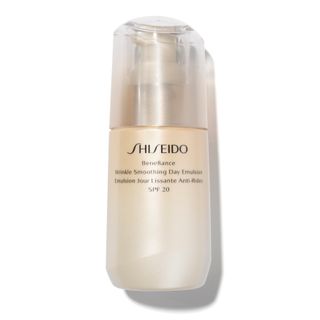
Shiseido Benefiance Wrinkle Smoothing Day Emulsion SPF 20
Works for
1 of 4 advertised claims delivered
Sun protectionSPF 20 · 4 UV filters · Broad spectrumWeak protectionSPF under 30
This product offers broad spectrum sun protection, but it is weak. We recommend to use a broad spectrum sunscreen with at least SPF 30.
Moisturizing13 ingredients credited for this claimGood support
“providing essential hydration”
This product can help improve hydration of the skin with the two types of ingredients.
The first type is called “humectants”:
these ingredients help attract water.
When humectants are on the surface of the skin, they “pull in” the moisture from the outside environment, or from
within deeper layers of the skin. The following ingredients in this product do the job:
erythritol, glycerin.
This product also contains ingredients called “occlusives”. They help reduce the speed with which our skin loses moisture to the outside environment. These ingredients also help soften the upper layer of the skin, so it feels less tight and nicer to the touch. The following ingredients in this product do the job: dimethicone, phytosteryl macadamiate.
Anti-aging2 ingredients credited for this claimLimited support
“visible anti-aging results”
This product does not contain ingredients that are able to reduce fine lines and wrinkles or help with skin elasticity, but it can improve the look of the skin temporarily through moisturization. Well-moisturized skin might also be able to repair the sun damage better.
The biggest anti-aging effect in this product comes from sun protection. Sun damage is the main factor causing early signs of skin aging. We, however, do not recommend using this product as a sunscreen because the protection it offers is not strong enough).
Evens skin tone1 ingredient credited for this claimLimited support
“Promotes a brighter tone”
This product contains ingredients () that could help reduce hyperpigmentation (for example, post-acne marks or age spots) in theory, but there is not enough evidence that they actually work.
The biggest effect for evening out skin tone in this product comes from sun protection. Sun damage is the main factor causing age spots, darkening of post-acne marks and other discolorations. This is why sun protection is the best strategy for maintaining an even skin tone. We, however, do not recommend using this product as a sunscreen because the protection it offers is not strong enough).
Can it cause trouble?
Irritancy10 strong irritants: Alcohol, Parfum + 8 more — patch-test recommendedHigh risk
Comedogenic1 ingredient rated 2 or more on the 0–5 pore-clogging scale1 flagged
User reviews
Be the first — your take helps the next person decide.
Ingredients
Filter by role to see what each ingredient is doing.
Water~45–55%
Alcohol~7.5–9.1%
- Irritation risk
- High
Can be drying and contribute to skin irritation. Used in formulars to dissolve other ingredients, create a thinner product consistency or for its antibacterial properties
More about AlcoholDipropylene glycol~4.3–5.2%
- Irritation risk
- Low
Helps to dissolve other ingredients in a formulation. Slows down the rate of product drying
More about Dipropylene glycolGlycerin~3–3.7%
- Irritation risk
- Low
One of the best moisturizing ingredients. Naturally present in skin. It attracts water to the upper layer of the skin working as a humectant
More about GlycerinEthylhexyl methoxycinnamate~3.1–3.8%
- Irritation risk
- High
Octinoxate. When used in higher concentrations, works as a sunscreen protecting the skin from UVB rays. When used in lower concentration, helps to preserve the product formulation. Is shown to be harmful to coral reefs - consider avoiding bathing in coral reef areas when wearing a product with this ingredient. It can be irritating
More about Ethylhexyl methoxycinnamateDimethicone~2–2.4%
- Irritation risk
- Low
A silicone that helps to reduce water loss from the surface of the skin. Can temporarily "fill in" lines and wrinkles, absorb oil, and create a nice product finish
More about DimethiconeCaprylyl methicone~1.5–1.9%
- Irritation risk
- Low
A type of silicone that helps to soften the upper layer of the skin and create a nice product finish on the skin
More about Caprylyl methiconeXylitol~1.3–1.6%
- Irritation risk
- Low
Helps attract water to the upper layer of the skin and repair the skin barrier function
More about XylitolOctocrylene~1.5–1.9%
- Irritation risk
- Medium
A weak sunscreen that protects against the sun rays that cause sunburn (UVB) and is somewhat effective against the UVA rays. It is quite stable and can help stabilize other, more vulnerable, sunscreen ingredients like Avobenzone. It is an organic, or so called "chemical" sunscreen
More about OctocryleneDiisopropyl sebacate~0.75–1.15%
- Irritation risk
- Low
Helps soften the upper layer of the skin without creatng a greasy finish
More about Diisopropyl sebacateBis-ethylhexyloxyphenol methoxyphenyl triazine~1–1.2%
- Irritation risk
- Medium
Tinosorb S. One of the most effective broad spectrum sunscreen ingredients. Protects from both UVA and UVB rays. It is photostable. Unfortunately, not approved by FDA (US) yet.
More about Bis-ethylhexyloxyphenol methoxyphenyl triazinePhenylbenzimidazole sulfonic acid~0.75–1.1%
- Irritation risk
- Medium
Ensulizole. A UV filter that is effective against UVB rays. Does not protect against UVA light. It is photostable and can be used to help stabilize other sunscreen ingredients. It is water-soluble meaning that it can help create lighter sunscreen formulations
More about Phenylbenzimidazole sulfonic acidTriethanolamine~0.45–0.65%
- Irritation risk
- Medium
Used to adjust pH of the product and can help improve the product's smell
More about TriethanolaminePpg-8-ceteth-20~0.45–0.65%
Phenoxyethanol~0.3–0.6%
- Irritation risk
- Low
A preservative. It helps prevent bacterial growth in cosmetic products
More about PhenoxyethanolHdi/trimethylol hexyllactone crosspolymer~0.3–0.6%
- Irritation risk
- Low
Used to create a silky product texture and add volume to products
More about Hdi/trimethylol hexyllactone crosspolymerSilica~0.55–0.8%
Carbomer~0.25–0.5%
- Irritation risk
- Low
Helps create a thicker or gel-like product texture. It is not a surfactant but can be used in gentle cleansing formulations
More about CarbomerIsostearic acid~0.35–0.65%
- Irritation risk
- Low
Used to create a nice product texture
More about Isostearic acidAminopropyl dimethicone~0.25–0.45%
- Irritation risk
- Low
A type of silicone. Helps soften the upper layer of the skin and create a nice product texture
More about Aminopropyl dimethiconeErythritol~0.2–0.4%
- Irritation risk
- Low
Helps to attract water to the upper layer of the skin
More about ErythritolPeg/ppg-14/7 dimethyl ether~0.25–0.5%
- Irritation risk
- Low
An emollient that helps soften the skin. It also forms a protective on its surface to reduce water loss
More about Peg/ppg-14/7 dimethyl etherPeg/ppg-17/4 dimethyl ether~0.2–0.4%
Tocopheryl acetate~0.25–0.45%
- Irritation risk
- Medium
A more stable but less bio-available form of vitamin E compared to Tocopherol. Might help moisturize and protect the skin from free radicals, but mostly used in low concentrations to stabilize other ingredients.
More about Tocopheryl acetateXanthan gum~0.25–0.45%
- Irritation risk
- Low
Used to create a thicker product consistency
More about Xanthan gumPhytosteryl macadamiate~0.25–0.5%
- Irritation risk
- Low
Helps soften the upper layer of the skin
More about Phytosteryl macadamiateAcrylates/c10-30 alkyl acrylate crosspolymer~0.25–0.45%
- Irritation risk
- Medium
Maintains the texture of skincare products. Allows the product to spread evenly. Helps oil and water mix together
More about Acrylates/c10-30 alkyl acrylate crosspolymerParfum~0.2–0.4%
- Irritation risk
- High
An aromatic blend of unspecified and possibly irritating ingredients
More about ParfumButylene glycol~0.25–0.45%
- Irritation risk
- Low
Used to create a nice product texture and help delivery of other ingredients. Might be somewhat helpful in attracting water to the upper layer of the skin
More about Butylene glycolSodium metaphosphate~0.25–0.45%
Caffeine~0.25–0.4%
- Irritation risk
- Medium
Might be helpful in neutralizing free radicals. Can have a dehydration effect that might somewhat decrease the look of puffy eyes
More about CaffeineDisodium edta~0.25–0.45%
Iron oxides~0.2–0.4%
- Irritation risk
- Low
An umbrella term for the following three colorants: CI 77491, CI 77492, CI 77499. They might be able to offer some protection against visible light, but the degree of the protection is not clear
More about Iron oxidesPpg-3 dipivalate~0.25–0.45%
Linalool~0.2–0.4%
Limonene~0.2–0.4%
- Irritation risk
- High
A common frangrance that can easily irritate skin, especially if exposed to air, light or heat
More about LimoneneTocopherol~0.25–0.45%
- Irritation risk
- Low
Pure form of vitamin E. Can help moisturise and protect the skin from free radicals. Often used to help stabilise other ingredients or the formula itself
More about TocopherolSapindus mukorossi peel extract~0.2–0.4%
- Irritation risk
- Medium
A plant extract that can contain saponins. Might have anti-bactrial and anti-oxidant effect in skin. Also can be used to help oil and water mix together
More about Sapindus mukorossi peel extractBht~0.25–0.45%
Citronellol~0.2–0.35%
Geraniol~0.2–0.4%
Angelica keiskei leaf/stem extract~0.25–0.45%
- Irritation risk
- High
A fragrant plant extract. Might have some anti-oxidant properties. Can be irritating
More about Angelica keiskei leaf/stem extractAlpha-isomethyl ionone~0.2–0.35%
- Irritation risk
- High
A fragrance. Potential allergen and can be irritating
More about Alpha-isomethyl iononeCamellia sinensis leaf extract~0.25–0.45%
- Irritation risk
- Low
Can contain potent anti-oxidant compounds (abbreviated ECG, GCG, EGC, and EGCG) that might help protect the skin from free radicals. Can help calm down inflammation and has some anti-bacterial properties. Unfortunately, these antioxidants are unstable and lose their effectiveness very quickly in products. The concentration of the antioxidant compounds in the extract also tends to be low to be effective in topical formulation
More about Camellia sinensis leaf extractCitrus junos seed extract~0.2–0.4%
- Irritation risk
- High
Ziziphus jujuba fruit extract~0.2–0.35%
- Irritation risk
- Low
Iron oxides~0.15–0.3%
- Irritation risk
- Low
An umbrella term for the following three colorants: CI 77491, CI 77492, CI 77499. They might be able to offer some protection against visible light, but the degree of the protection is not clear
More about Iron oxidesEucheuma serra/grateloupia sparsa/saccharina angustata/ulva linza/undaria pinnatifida extract~0.2–0.35%
- Irritation risk
- High
Helps oil and water mix together. Can be irritating
More about Eucheuma serra/grateloupia sparsa/saccharina angustata/ulva linza/undaria pinnatifida extractCurcuma longa rhizome extract~0.15–0.3%
- Irritation risk
- Medium
A plant extract that might have some anti-oxidant properties but there is no evidence of effectiveness in skin
More about Curcuma longa rhizome extractPolyquaternium-51~0.2–0.35%
- Irritation risk
- Low
An emollient that helps create a nice silky finish on the skin
More about Polyquaternium-51Saccharina angustata/undaria pinnatifida extract~0.15–0.25%
- Irritation risk
- Low
Chlorella vulgaris extract~0.1–0.2%
- Irritation risk
- Medium
- Comedogenicity
- 3/5
A plant extract that can help to attract water to the upper layer of the skin and might have some anti-oxidant and anti-inflammatory properties
More about Chlorella vulgaris extractIngredient list view
Water, Alcohol, Dipropylene glycol, Glycerin, Ethylhexyl methoxycinnamate, Dimethicone, Caprylyl methicone, Xylitol, Octocrylene, Diisopropyl sebacate, Bis-ethylhexyloxyphenol methoxyphenyl triazine, Phenylbenzimidazole sulfonic acid, Triethanolamine, Ppg-8-ceteth-20, Phenoxyethanol, Hdi/trimethylol hexyllactone crosspolymer, Silica, Carbomer, Isostearic acid, Aminopropyl dimethicone, Erythritol, Peg/ppg-14/7 dimethyl ether, Peg/ppg-17/4 dimethyl ether, Tocopheryl acetate, Xanthan gum, Phytosteryl macadamiate, Acrylates/c10-30 alkyl acrylate crosspolymer, Parfum, Butylene glycol, Sodium metaphosphate, Caffeine, Disodium edta, Iron oxides, Ppg-3 dipivalate, Linalool, Limonene, Tocopherol, Sapindus mukorossi peel extract, Bht, Citronellol, Geraniol, Angelica keiskei leaf/stem extract, Alpha-isomethyl ionone, Camellia sinensis leaf extract, Citrus junos seed extract, Ziziphus jujuba fruit extract, Iron oxides, Eucheuma serra/grateloupia sparsa/saccharina angustata/ulva linza/undaria pinnatifida extract, Curcuma longa rhizome extract, Polyquaternium-51, Saccharina angustata/undaria pinnatifida extract, Chlorella vulgaris extract
Compare prices
Retailers ranked by price — lowest first.


Sources cited in this review
Every concentration estimate and effectiveness label is anchored to one of these 13 studies and safety reviews.
- 1
- 2
- 3Final Report on the Safety Assessment of Dimethicone Copolyoljournals.sagepub.com
- 4
- 5Safety Assessment of Phytosterols as Used in Cosmeticscir-safety.org
- 6

Affiliate links · As an Amazon Associate, WIMJ earns from qualifying purchases.