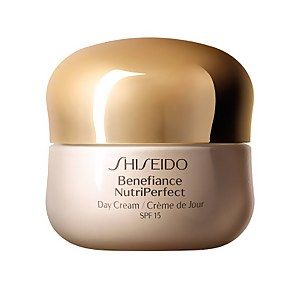
Shiseido Benefiance NutriPerfect Day Cream SPF15
Works for
2 of 3 advertised claims delivered
Sun protectionSPF 15 · 5 UV filters · Broad spectrumWeak protectionSPF under 30
This product offers broad spectrum sun protection, but it is weak. We recommend to use a broad spectrum sunscreen with at least SPF 30.
This product can be considered "reef safe" because it does not contain the UV filters (oxybenzone and octinoxate) that can be harmful to coral reefs when present in the water in high concentrations.
Moisturizing17 ingredients credited for this claimGood support
“A high performance cream with broad protection from harmful sun rays Created for mature skin having wrinkles, discoloration & loss of resilience Defenses skin from free radicals damaged caused by sun light Effectively reduces appearance of wrinkles & d”
This product can help improve hydration of the skin with the two types of ingredients.
The first type is called “humectants”:
these ingredients help attract water.
When humectants are on the surface of the skin, they “pull in” the moisture from the outside environment, or from
within deeper layers of the skin. The following ingredients in this product do the job:
carnosine, erythritol.
This product also contains ingredients called “occlusives”. They help reduce the speed with which our skin loses moisture to the outside environment. These ingredients also help soften the upper layer of the skin, so it feels less tight and nicer to the touch. The following ingredients in this product do the job: cera microcristallina, dimethicone.
Anti-aging2 ingredients credited for this claimModerate support
“A high performance cream with broad protection from harmful sun rays Created for mature skin having wrinkles, discoloration & loss of resilience Defenses skin from free radicals damaged caused by sun light Effectively reduces appearance of wrinkles & d”
This product contains carnosine. This ingredient might be able to help reduce and prevent fine lines and wrinkles, improve skin elasticity and firmness, but there is not enough evidence that it actually works. The biggest anti-aging effect in this product comes from sun protection. Sun damage is the main factor causing early signs of skin aging. We, however, do not recommend using this product as a sunscreen because the protection it offers is not strong enough).
Anti-oxidationNot advertised by the brand · 3 ingredients credited for this claimStrong support
This product contains antioxidants (carnosine) that can help neutralize free radicals in skin. By doing so, they can lessen the damage the skin gets from the UV light (sun).
Can it cause trouble?
Irritancy7 strong irritants: Parfum, Limonene + 5 more — patch-test recommendedHigh risk
Comedogenic3 ingredients rated 2 or more on the 0–5 pore-clogging scale3 flagged


User reviews
Be the first — your take helps the next person decide.
Ingredients
Filter by role to see what each ingredient is doing.
Water~45–55%
Butylene glycol~5.8–7.1%
- Irritation risk
- Low
Used to create a nice product texture and help delivery of other ingredients. Might be somewhat helpful in attracting water to the upper layer of the skin
More about Butylene glycolGlycerin~4.1–5%
- Irritation risk
- Low
One of the best moisturizing ingredients. Naturally present in skin. It attracts water to the upper layer of the skin working as a humectant
More about GlycerinDipropylene glycol~2.9–3.5%
- Irritation risk
- Low
Helps to dissolve other ingredients in a formulation. Slows down the rate of product drying
More about Dipropylene glycolOctocrylene~3.1–3.8%
- Irritation risk
- Medium
A weak sunscreen that protects against the sun rays that cause sunburn (UVB) and is somewhat effective against the UVA rays. It is quite stable and can help stabilize other, more vulnerable, sunscreen ingredients like Avobenzone. It is an organic, or so called "chemical" sunscreen
More about OctocryleneDimethicone~1.9–2.4%
- Irritation risk
- Low
A silicone that helps to reduce water loss from the surface of the skin. Can temporarily "fill in" lines and wrinkles, absorb oil, and create a nice product finish
More about DimethiconeHydrogenated polydecene~1.5–1.8%
- Irritation risk
- Low
Helps to soften the upper layer of the skin and create a nice product texture
More about Hydrogenated polydeceneGlyceryl stearate se~1.3–1.6%
- Irritation risk
- Low
- Comedogenicity
- 2/5
Used to stabilize the product formulations and works as an emollient
More about Glyceryl stearate seBehenyl alcohol~1.1–1.4%
- Irritation risk
- Low
Non-drying alcohol that helps water and oil mix together. Also serves as an emollient
More about Behenyl alcoholIsopropyl myristate~0.75–1.15%
- Irritation risk
- Low
- Comedogenicity
- 3/5
An emollient that helps soften the skin. Could be comedogenic
More about Isopropyl myristateButyl methoxydibenzoylmethane~1–1.2%
- Irritation risk
- Medium
Avobenzone. An organic, or so-called "chemical" UV filter. Protects against both UVA and UVB rays. Needs to be combined with other filters in a formulation to be stable.
More about Butyl methoxydibenzoylmethaneMyristyl myristate~0.55–0.85%
- Irritation risk
- Medium
- Comedogenicity
- 3/5
An emollient. Is not recommended for acne-prone skin as it can be comedogenic
More about Myristyl myristatePhenylbenzimidazole sulfonic acid~0.65–1%
- Irritation risk
- Medium
Ensulizole. A UV filter that is effective against UVB rays. Does not protect against UVA light. It is photostable and can be used to help stabilize other sunscreen ingredients. It is water-soluble meaning that it can help create lighter sunscreen formulations
More about Phenylbenzimidazole sulfonic acidPeg/ppg-14/7 dimethyl ether~0.45–0.65%
- Irritation risk
- Low
An emollient that helps soften the skin. It also forms a protective on its surface to reduce water loss
More about Peg/ppg-14/7 dimethyl etherMicrocrystalline wax~0.35–0.6%
Cera microcristallina~0.4–0.6%
- Irritation risk
- Low
Helps to soften the upper layer of the skin, reduce water loss from its surface and create a thicker product consistency
More about Cera microcristallinaTriethanolamine~0.3–0.55%
- Irritation risk
- Medium
Used to adjust pH of the product and can help improve the product's smell
More about TriethanolaminePeg-40 stearate~0.3–0.5%
Sorbitan tristearate~0.25–0.45%
- Irritation risk
- Medium
Helps oil and water mix together
More about Sorbitan tristearateCarnosine~0.2–0.4%
- Irritation risk
- Low
A type of peptide. It attracts water to the upper layer of the skin. It can help neutralize free radicals in skin combatting the sun damage
More about CarnosineTitanium dioxide~0.3–0.55%
- Irritation risk
- Low
Works as a UV filter when used in high concentrations. It is photostable and is effective mostly against the UVB light, with some protection in the UVA range. In small concentrations, used for its ability to improve the color of cosmetic products. Is usually well tolerated by the skin
More about Titanium dioxideParaffinum liquidum~0.25–0.45%
- Irritation risk
- Low
Mineral oil. One of the most effective and well studied occlusive and emollient moisturizing ingredients. Helps reduce moisture loss in skin and repair skin barrier function
More about Paraffinum liquidumStearyl alcohol~0.25–0.45%
- Irritation risk
- Low
An emollient that helps soften the skin
More about Stearyl alcoholBis-ethylhexyloxyphenol methoxyphenyl triazine~0.35–0.65%
- Irritation risk
- Medium
Tinosorb S. One of the most effective broad spectrum sunscreen ingredients. Protects from both UVA and UVB rays. It is photostable. Unfortunately, not approved by FDA (US) yet.
More about Bis-ethylhexyloxyphenol methoxyphenyl triazinePhenoxyethanol~0.25–0.4%
- Irritation risk
- Low
A preservative. It helps prevent bacterial growth in cosmetic products
More about PhenoxyethanolXanthan gum~0.25–0.45%
- Irritation risk
- Low
Used to create a thicker product consistency
More about Xanthan gumCellulose~0.25–0.5%
- Irritation risk
- Low
Can be used to help absorb oil as well as add volume and imporve texture of products.
More about CelluloseParfum~0.2–0.35%
- Irritation risk
- High
An aromatic blend of unspecified and possibly irritating ingredients
More about ParfumCellulose gum~0.25–0.45%
- Irritation risk
- Low
Used to create thicker product consistency and stabilize emulsions
More about Cellulose gumParaffin~0.2–0.35%
- Irritation risk
- Low
Prevents water loss from the skin surface and thickens the product consistency
More about ParaffinSodium metaphosphate~0.2–0.4%
Trisodium edta~0.2–0.4%
Erythritol~0.2–0.4%
- Irritation risk
- Low
Helps to attract water to the upper layer of the skin
More about ErythritolTocopheryl acetate~0.25–0.45%
- Irritation risk
- Medium
A more stable but less bio-available form of vitamin E compared to Tocopherol. Might help moisturize and protect the skin from free radicals, but mostly used in low concentrations to stabilize other ingredients.
More about Tocopheryl acetateHydrated silica~0.3–0.6%
Panthenyl ethyl ether~0.2–0.4%
- Irritation risk
- Low
Helps attract water to the upper layer of the skin and can help improve skin barrier function
More about Panthenyl ethyl etherPotassium ascorbyl tocopheryl phosphate~0.25–0.45%
- Irritation risk
- Low
Used to stabilize other ingredients in the formulation
More about Potassium ascorbyl tocopheryl phosphateIron oxides~0.2–0.4%
- Irritation risk
- Low
An umbrella term for the following three colorants: CI 77491, CI 77492, CI 77499. They might be able to offer some protection against visible light, but the degree of the protection is not clear
More about Iron oxidesCi 77492~0.25–0.45%
Aluminum hydroxide~0.25–0.5%
- Irritation risk
- Low
Is used to add opaque (non-transparent) appearance to formulations. Can be used to coat other ingredients for even dispersion. This is a different ingredient compared to the ones used in antipersperants (aluminium chloride and aluminium chlorohydrate)
More about Aluminum hydroxideLimonene~0.2–0.4%
- Irritation risk
- High
A common frangrance that can easily irritate skin, especially if exposed to air, light or heat
More about LimoneneLinalool~0.2–0.4%
Alpha-isomethyl ionone~0.2–0.35%
- Irritation risk
- High
A fragrance. Potential allergen and can be irritating
More about Alpha-isomethyl iononeBenzyl benzoate~0.2–0.35%
- Irritation risk
- High
Fragrance with sweet balsamic smell. Help to preserve products and dissolve other ingredients. Could trigger allergic reactions and be irritating
More about Benzyl benzoateGeraniol~0.2–0.35%
Citronellol~0.15–0.3%
Sodium metabisulfite~0.1–0.2%
Sodium acetylated hyaluronate~0.15–0.3%
- Irritation risk
- Low
A type of hyaluronic acid that works as an excellent moisturizer by attracting water into the upper layer of the skin. Is typically feels less sticky on the skin compared to the usual hyaluronic acid
More about Sodium acetylated hyaluronateIron oxides~0.15–0.3%
- Irritation risk
- Low
An umbrella term for the following three colorants: CI 77491, CI 77492, CI 77499. They might be able to offer some protection against visible light, but the degree of the protection is not clear
More about Iron oxidesCi 77491~0.15–0.3%
- Irritation risk
- Low
A red colorant made of iron oxide. Typically is not irritating
More about Ci 77491Tocopherol~0.1–0.2%
- Irritation risk
- Low
Pure form of vitamin E. Can help moisturise and protect the skin from free radicals. Often used to help stabilise other ingredients or the formula itself
More about TocopherolBht~0.1–0.15%
Ingredient list view
Water, Butylene glycol, Glycerin, Dipropylene glycol, Octocrylene, Dimethicone, Hydrogenated polydecene, Glyceryl stearate se, Behenyl alcohol, Isopropyl myristate, Butyl methoxydibenzoylmethane, Myristyl myristate, Phenylbenzimidazole sulfonic acid, Peg/ppg-14/7 dimethyl ether, Microcrystalline wax, Cera microcristallina, Triethanolamine, Peg-40 stearate, Sorbitan tristearate, Carnosine, Titanium dioxide, Paraffinum liquidum, Stearyl alcohol, Bis-ethylhexyloxyphenol methoxyphenyl triazine, Phenoxyethanol, Xanthan gum, Cellulose, Parfum, Cellulose gum, Paraffin, Sodium metaphosphate, Trisodium edta, Erythritol, Tocopheryl acetate, Hydrated silica, Panthenyl ethyl ether, Potassium ascorbyl tocopheryl phosphate, Iron oxides, Ci 77492, Aluminum hydroxide, Limonene, Linalool, Alpha-isomethyl ionone, Benzyl benzoate, Geraniol, Citronellol, Sodium metabisulfite, Sodium acetylated hyaluronate, Iron oxides, Ci 77491, Tocopherol, Bht
Compare prices
Retailers ranked by price — lowest first.

Worth comparing, line by line.
Match % combines shared ingredients, the first five ingredients, shared actives and hero ingredients, irritancy (lower counts in the alternative's favour), texture and body area. Only products in the same routine step are compared.
| ShiseidoBenefiance NutriPerfect Day Cream SPF15YOUR PRODUCT | Laboratoire ACMDépiwhite Anti-Brown Spot Day Cream SPF20 | Farm StayAloe Vera Perfect Sun Cream | FoodaholicMulti Sun Cream SPF50+PA+++ Block Whitening Anti-wrinkle | |
|---|---|---|---|---|
| Match | — | 58% | 56% | 56% |
| Price | $81.58 | $25.83−$55.75 | $8.30−$73.28 | — |
| Shared key ingredients | — | 6 of 16 | 5 of 16 | 5 of 16 |
| Key difference | — | Lactic Acid | Beeswax | Niacinamide |
| Irritancy | High | Medium | Medium | Medium |
| SPF | SPF 15 | SPF 20 | SPF 50 | SPF 50 |
| Drying alcohol | — | — | — | — |
| View product | Shop | Shop | Shop |

Product summary
"Shiseido - Benefiance NutriPerfect Day Cream SPF15" offers broad spectrum protection. It means that it protects from both UVA and UVB rays (you can remember UVB as "burning" sunlight - they cause sunburn. You can remember UVA rays as "aging" - they do not lead to sunburn, but they cause photodamage and contribute to early signs of skin aging and hyperpigmentation). On the negative side, the SPF of this moisturizer is not high enough. We recommend to use a sunscreen with at least SPF 30 daily.
It also works as a moisturizer, so you do not have to use an additional hydrating product.
Sunscreen filters
This sunscreen uses so-called "chemical", or organic UV filters (organic simply means that their molecules contain atoms of carbon). These filters typically give good sun protection and rarely leave a white cast, but they can be irritating for sensitive skin. These are the sun protection ingredients in this sunscreen: tinosorb s 0.35% - 0.65%, avobenzone 1.00% - 1.20% and octocrylene 3.10% - 3.80%.
Irritation risk
This moisturizer contains a bunch of common irritants, including ingredients that do not provide any known benefit for the skin. It might not be the best choice if your skin is sensitive. We assess the overall irritancy of this moisturizer to be high. For a detailed overview of all potential irritants: click here
You can see the detailed formula review with the breakdown of all actives in the product and the full ingredient list with estimated concentrations in the tables below.
Price
The product retails for 68.00£ in the United Kingdom.
For a detailed price comparison: click here.
Sources cited in this review
Every concentration estimate and effectiveness label is anchored to one of these 19 studies and safety reviews.
- 1
- 2
- 3Final Report on the Safety Assessment of Dimethicone Copolyoljournals.sagepub.com
- 4Safety Assessment of Polyene Group as Used in Cosmeticscir-safety.org
- 5
- 6

Affiliate links · As an Amazon Associate, WIMJ earns from qualifying purchases.