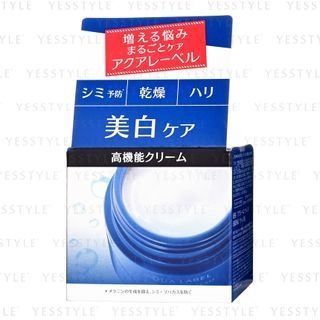
Works for
2 of 2 advertised claims delivered
Evens skin toneTranexamic acid, Alanine + 1 moreStrong evidence
“Featuring distinctive brightening and moisturization benefits, this rich, nourishing cream help prevents sun spots and freckles while promoting fresher, clearer complexions. Comes in a sweet-smelling rose scent.”
This product can help reduce hypepigmentation and even out the skin tone because it contains the following effective ingredients: tranexamic acid
The following ingredient (ingredients) in this product might be helpful, but there is no evidence to confirm that it actually can help even out the skin tone: alanine.
Keep in mind that you would need to apply any topical skincare targetted at hypigmentation consistently for a couple of months to get a result. No topical skincare product can help get rid of hyperpigmentation (including post-acne marks and age spots) instantly.
MoisturizingTriethylhexanoin, Sodium hyaluronate + 13 moreGood evidence
“Featuring distinctive brightening and moisturization benefits, this rich, nourishing cream help prevents sun spots and freckles while promoting fresher, clearer complexions. Comes in a sweet-smelling rose scent.”
This product can help improve hydration of the skin with the two types of ingredients.
The first type is called “humectants”:
these ingredients help attract water.
When humectants are on the surface of the skin, they “pull in” the moisture from the outside environment, or from
within deeper layers of the skin. The following ingredients in this product do the job:
alanine, glutamic acid.
This product also contains ingredients called “occlusives”. They help reduce the speed with which our skin loses moisture to the outside environment. These ingredients also help soften the upper layer of the skin, so it feels less tight and nicer to the touch. The following ingredients in this product do the job: methicone, behenyl alcohol.
Can it cause trouble?
Irritancy3 strong irritants: Alcohol, Phenol + 1 more — patch-test recommendedHigh risk
ComedogenicClean of flagged comedogenic ingredientsNone flagged

User reviews
Be the first — your take helps the next person decide.
Ingredients
Filter by role to see what each ingredient is doing.
Tranexamic acid~29–36%
- Irritation risk
- Low
An amino acid that is effective in reducing hyperpigmentation and evening out the skin tone. It can also help in skin barrier recovery. It is used to treat melasma, especially with injections and when taken orally
More about Tranexamic acidWater~13–15%
Butylene glycol~5.9–7.2%
- Irritation risk
- Low
Used to create a nice product texture and help delivery of other ingredients. Might be somewhat helpful in attracting water to the upper layer of the skin
More about Butylene glycolAlcohol~3.8–4.6%
- Irritation risk
- High
Can be drying and contribute to skin irritation. Used in formulars to dissolve other ingredients, create a thinner product consistency or for its antibacterial properties
More about AlcoholMethicone~2.9–3.6%
- Irritation risk
- Low
A type of silicone that helps soften the upper layer of the skin and reduces the water loss from the skin surface
More about MethiconeGlycerin~2.3–2.8%
- Irritation risk
- Low
One of the best moisturizing ingredients. Naturally present in skin. It attracts water to the upper layer of the skin working as a humectant
More about GlycerinTriethylhexanoin~1.6–2%
- Irritation risk
- Medium
Helps soften the upper layer of the skin
More about TriethylhexanoinDipropylene glycol~1.6–2%
- Irritation risk
- Low
Helps to dissolve other ingredients in a formulation. Slows down the rate of product drying
More about Dipropylene glycolPetrolatum~1.7–2.1%
- Irritation risk
- Low
One of the most effective and the most studied occlusive ingredients that creates a protective layer on top of the skin preventing moisture loss
More about PetrolatumGlyceryl stearate~1.3–1.5%
- Irritation risk
- Low
An emollient that softens the skin and forms a protective layer on its surface. Helps water and oil mix together
More about Glyceryl stearatePolyethylene~1.2–1.5%
Potassium isostearate~0.75–1.15%
Behenyl alcohol~0.8–1.2%
- Irritation risk
- Low
Non-drying alcohol that helps water and oil mix together. Also serves as an emollient
More about Behenyl alcoholBatyl alcohol~0.75–1.1%
- Irritation risk
- Low
Non-drying alcohol. Used to stabilize other ingredients and is an emollient
More about Batyl alcoholAcrylic acid~0.65–0.95%
- Irritation risk
- Low
Edta~0.65–0.95%
Polyethylene~0.9–1.15%
Polypropylene~0.6–0.85%
Dimethyl ether~0.5–0.8%
- Irritation risk
- Low
Sodium hydrosulfite~0.5–0.75%
- Irritation risk
- Low
Sodium metaphosphate~0.45–0.65%
Glutamic acid~0.4–0.65%
- Irritation risk
- Low
An amino-acid that helps attract water to the upper layer of the skin
More about Glutamic acidAlanine~0.4–0.6%
- Irritation risk
- Low
An amino-acid that helps to attract water to the upper layer of the skin and might help to lighten the skin, but solid evidence is lacking
More about AlanineMagnesium ascorbyl phosphate~0.35–0.65%
- Irritation risk
- Medium
A derivative of vitamin C that is more stable, but less bioavailable than the pure form of vitamin C. It does not penetrate the skin well, but has been shown to convert to pure vitamin C once in skin. It can be helpful in stimulating collagen production and lightening the skin tone, but the required concentration is likely to be very high
More about Magnesium ascorbyl phosphateSodium acetylated hyaluronate~0.35–0.65%
- Irritation risk
- Low
A type of hyaluronic acid that works as an excellent moisturizer by attracting water into the upper layer of the skin. Is typically feels less sticky on the skin compared to the usual hyaluronic acid
More about Sodium acetylated hyaluronateSodium hyaluronate~0.35–0.6%
- Irritation risk
- Low
One of the best moisturizing ingredients. Attracts water into the upper layer of the skin
More about Sodium hyaluronateHydrolyzed conchiolin protein~0.35–0.6%
Methionine~0.25–0.45%
- Irritation risk
- Low
Soluble collagen~0.25–0.4%
- Irritation risk
- Low
A typically plant-derived compound that is supposed mimic human collagen. Cannot penetrate the skin barrier so is not particularly useful in skincare products beyond attracting water to the upper layer of the skin
More about Soluble collagenPhenol~0.15–0.3%
- Irritation risk
- High
A harsh exfoliant and preservative. It is banned from using in cosmetics in the EU
More about PhenolAlcohol~0.15–0.25%
- Irritation risk
- High
Can be drying and contribute to skin irritation. Used in formulars to dissolve other ingredients, create a thinner product consistency or for its antibacterial properties
More about AlcoholParfum~0.1–0.15%
- Irritation risk
- High
An aromatic blend of unspecified and possibly irritating ingredients
More about ParfumTitanium dioxide~0.15–0.25%
- Irritation risk
- Low
Works as a UV filter when used in high concentrations. It is photostable and is effective mostly against the UVB light, with some protection in the UVA range. In small concentrations, used for its ability to improve the color of cosmetic products. Is usually well tolerated by the skin
More about Titanium dioxideIngredient list view
Tranexamic acid, Water, Butylene glycol, Alcohol, Methicone, Glycerin, Triethylhexanoin, Dipropylene glycol, Petrolatum, Glyceryl stearate, Polyethylene, Potassium isostearate, Unknown, Behenyl alcohol, Batyl alcohol, Acrylic acid, Unknown, Edta, Polyethylene, Polypropylene, Dimethyl ether, Sodium hydrosulfite, Sodium metaphosphate, Glutamic acid, Alanine, Magnesium ascorbyl phosphate, Sodium acetylated hyaluronate, Sodium hyaluronate, Hydrolyzed conchiolin protein, Unknown, Methionine, Soluble collagen, Phenol, Alcohol, Parfum, Titanium dioxide
Compare prices
Retailers ranked by price — lowest first.

Affiliate links · prices updated regularly
Worth comparing, line by line.
Match % combines shared ingredients, the first five ingredients, shared actives and hero ingredients, irritancy (lower counts in the alternative's favour), texture and body area. Only products in the same routine step are compared.
| ShiseidoAqualabel White Care CreamYOUR PRODUCT | Paula's choiceResist Intensive Repair Cream | Estée LauderRe-Nutriv Ultimate Lift Regenerating Youth Moisturizer Creme Rich | Kose CosmeportCeramiaid Medicated Skin Cream 40g | |
|---|---|---|---|---|
| Match | — | 56% | 56% | 56% |
| Price | $31.63 | $26.40−$5.23 | $350.00+$318.37 | $22.41−$9.22 |
| Shared key ingredients | — | 3 of 11 | 4 of 11 | 3 of 11 |
| Key difference | — | Niacinamide | Linoleic Acid | Phytosphingosine |
| Irritancy | High | Medium | Medium | Low |
| Drying alcohol | Contains drying alcohol | — | — | — |
| View product | Shop | Shop | Shop |

Sources cited in this review
Every concentration estimate and effectiveness label is anchored to one of these 13 studies and safety reviews.
- 1Effect of tranexamic acid on melasma: a clinical trial with histological evaluationonlinelibrary.wiley.com
- 2Tranexamic acid accelerates skin barrier recovery and upregulates occludin in damaged skinonlinelibrary.wiley.com
- 3
- 4Efficacy and possible mechanisms of topical tranexamic acid in melasmaonlinelibrary.wiley.com
- 5
- 6

Affiliate links · As an Amazon Associate, WIMJ earns from qualifying purchases.