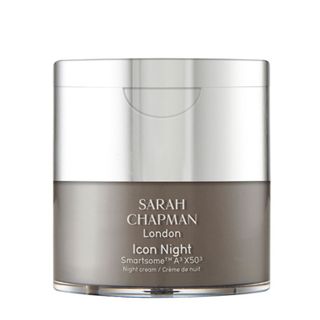
Sarah Chapman Icon Night Smartsome A3 X503 Night Cream
Works for
2 of 2 advertised claims delivered
Anti-aging11 ingredients credited for this claimStrong support
“Vitamin A, potent peptides and de-ageing technologies deliver fast skin smoothing and glow inducing benefits, addressing all signs of premature ageing and dull, fatigued complexions for the ultimate youth boost.”
This product can help reduce and prevent fine lines and wrinkles, improve skin elasticity and firmness because it contains retinal, heptapeptide-15 palmitate, palmitoyl hexapeptide-12.
These ingredients in the product can also be helpful, even though there is less evidence for their effectiveness: copper palmitoyl heptapeptide-14, palmitoyl heptapeptide-18, palmitoyl hexapeptide-52, palmitoyl tetrapeptide-50.
Keep in mind that it typically takes at least 6 weeks to notice any results because the changes that are needed to improve fine lines and elasticity happen in the deeper layers of the skin. No topical anti-aging product can “erase” wrinkles or fully reverse signs of aging.
Moisturizing30 ingredients credited for this claimStrong support
“Always use an SPF moisturiser during the daytime.”
This product can help improve hydration of the skin with the two types of ingredients.
The first type is called “humectants”:
these ingredients help attract water.
When humectants are on the surface of the skin, they “pull in” the moisture from the outside environment, or from
within deeper layers of the skin. The following ingredients in this product do the job:
glycerin, butylene glycol.
This product also contains ingredients called “occlusives”. They help reduce the speed with which our skin loses moisture to the outside environment. These ingredients also help soften the upper layer of the skin, so it feels less tight and nicer to the touch. The following ingredients in this product do the job: caprylic/capric triglyceride, helianthus annuus seed oil.
The following ingredients in this product are especially good for supporting the skin barrier and helping with the hydration level: ceramide ng, copper palmitoyl heptapeptide-14, heptapeptide-15 palmitate, palmitoyl heptapeptide-18, palmitoyl hexapeptide-12, palmitoyl hexapeptide-52, palmitoyl tetrapeptide-50
Evens skin toneNot advertised by the brand · 2 ingredients credited for this claimStrong support
This product can help reduce hypepigmentation and even out the skin tone because it contains the following effective ingredients: retinal.
Keep in mind that you would need to apply any topical skincare targetted at hypigmentation consistently for a couple of months to get a result. No topical skincare product can help get rid of hyperpigmentation (including post-acne marks and age spots) instantly.
Anti-blemishNot advertised by the brand · 3 ingredients credited for this claimStrong support
This product can help reduce breakouts and clogged pores because it contains the following ingredient: retinal. This ingredient is used for treating acne and can have a noticeable effect.
Can it cause trouble?
Irritancy13 strong irritants: Retinal, Retinyl palmitate + 11 more — patch-test recommendedHigh risk
Comedogenic2 ingredients rated 2 or more on the 0–5 pore-clogging scale2 flagged

User reviews
Be the first — your take helps the next person decide.
Ingredients
Filter by role to see what each ingredient is doing.
Water~45–55%
Caprylic/capric triglyceride~5.8–7.1%
- Irritation risk
- Medium
A good mix of fatty acids that forms a protective layer on the skin. Improves the shelf life of products. Derived from coconut and glycerin
More about Caprylic/capric triglycerideCyclopentasiloxane~4.4–5.4%
- Irritation risk
- Low
A silicone that helps improve the product texture and spreadability. Can absorb oil creating a short-term mattifying effect on the skin
More about CyclopentasiloxaneCetyl alcohol~2.6–3.1%
- Irritation risk
- Low
A non-drying alcohol that works to soften the skin and stabilize product formulations helping oil and water mix together
More about Cetyl alcoholGlyceryl stearate~2.4–2.9%
- Irritation risk
- Low
An emollient that softens the skin and forms a protective layer on its surface. Helps water and oil mix together
More about Glyceryl stearateAlpha-glucan oligosaccharide~2–2.5%
- Irritation risk
- Low
Helps attract water to the upper layer of the skin
More about Alpha-glucan oligosaccharideLimnanthes alba seed oil~1.7–2.1%
- Irritation risk
- Low
This oil's cmposition is closest to rapeseed oil. It is a very stable oil and serves as an emoillient
More about Limnanthes alba seed oilButylene glycol~1.4–1.7%
- Irritation risk
- Low
Used to create a nice product texture and help delivery of other ingredients. Might be somewhat helpful in attracting water to the upper layer of the skin
More about Butylene glycolC12-15 alkyl benzoate~1.2–1.4%
- Irritation risk
- Low
Enhances the product texture and makes it more spreadable. Helps reduce water loss from the outer layer of skin. Extands the shelf life by preventing bacteria growth
More about C12-15 alkyl benzoateGlycerin~1–1.2%
- Irritation risk
- Low
One of the best moisturizing ingredients. Naturally present in skin. It attracts water to the upper layer of the skin working as a humectant
More about GlycerinRibose~0.65–0.95%
- Irritation risk
- Low
Retinal~0.5–0.75%
- Irritation risk
- High
One step removed from the biologically active in skin form of vitamin A. Once converted to the retinoic acid in the skin, retinal is proven to be effective against all signs of aging. It improves skin cell turnover, helps fight blemishes and clogged pores, can regulate excess oil production and even skin tone. Concentrations of 0.05% and 0.1% are shown to be effective. It can, however, be irritating
More about RetinalPolymnia sonchifolia root juice~0.45–0.7%
- Irritation risk
- High
A plant extract that helps attract water to the upper layer of the skin and might have some anti-oxidant properties
More about Polymnia sonchifolia root juiceAdansonia digitata seed oil~0.45–0.7%
- Irritation risk
- Medium
Helps soften the upper layer of the skin
More about Adansonia digitata seed oilHydrolyzed verbascum thapsus flower~0.4–0.6%
- Irritation risk
- Low
Passiflora edulis seed oil~0.45–0.65%
- Irritation risk
- High
A good emollient helping to soften the skin. Might have some anti-oxidant properties. Adds a fragrance to the product
More about Passiflora edulis seed oilHydrolyzed pepper fruit extract~0.35–0.6%
- Irritation risk
- Low
Myristoyl tripeptide-31~0.3–0.55%
- Irritation risk
- Low
Palmitoyl hexapeptide-12~0.3–0.5%
- Irritation risk
- Low
A type of peptide. Peptides are excellent moisturizers and might be able support collagen production reducing fine lines and wrinkles
More about Palmitoyl hexapeptide-12Palmitoyl hexapeptide-52~0.25–0.45%
- Irritation risk
- Low
A type of peptide. Peptides are excellent moisturizers and might be able support collagen production reducing fine lines and wrinkles
More about Palmitoyl hexapeptide-52Palmitoyl tetrapeptide-50~0.25–0.45%
Heptapeptide-15 palmitate~0.25–0.45%
- Irritation risk
- Low
A type of peptide. Peptides are excellent moisturizers and might be able support collagen production reducing fine lines and wrinkles
More about Heptapeptide-15 palmitatePalmitoyl heptapeptide-18~0.25–0.45%
Copper palmitoyl heptapeptide-14~0.25–0.45%
- Irritation risk
- Low
The copper palmitoyl heptapeptide-14 is a synthetic peptide developed by ingredient supplier Infinitec, which claims that it can increase collagen production in skin when combined with Heptapeptide-15 Palmitate. The complex was tested in vitro (in a lab) and in a clinical test with 30 volunteers, but the latter wasn't placebo-controlled. The manufacturer reported wrinkle reduction after 28 days of use, but the details of the study aren't publicly available.
More about Copper palmitoyl heptapeptide-14Butyrospermum parkii butter~0.3–0.55%
- Irritation risk
- Low
- Comedogenicity
- 3/5
A great moisturising ingredient that softens the skin and reduces water loss from its upper layer. It also can be helpful in protecting skin from free radicals
More about Butyrospermum parkii butterRetinyl palmitate~0.25–0.45%
- Irritation risk
- High
Three steps removed from the active form of vitamin A - retinoic acid. To have an effect in the skin, it first needs to be converted twice to become the retinoic acid. This means it is less potent than retinol, but could also be less irritating. Once converted to the retinoic acid in the skin, it helps against all signs of aging, improves skin cell turnover and helps fight blemishes and clogged pores. However, in many cosmetic formulations, it is used in a concentration that is too low to have the full effect
More about Retinyl palmitateCeramide ng~0.25–0.5%
- Irritation risk
- Low
A type of lipid similar to ceramides naturally present in skin. Helps to soften the upper layer of the skin and supports the skin barrier function to keep it hydrated. Can help to prevent inflammation in skin
More about Ceramide ngBisabolol~0.2–0.4%
- Irritation risk
- Low
An active component of chamomile plant that historically has been used to calm down irritated skin. A recent study shows that bisabolol indeed can have some anti-inflammatory effect on skin, even though conclusive data is lacking. Bisabolol has a sweet floral scent and can be added to products for its aromatic properties
More about BisabololAllantoin~0.25–0.45%
- Irritation risk
- Low
Helps calm down inflammation in skin and can help reduce itching. Helps to repair the skin barrier and keep skin hydrated
More about AllantoinPeg-10 rapeseed sterol~0.35–0.65%
Rubus chamaemorus seed oil~0.25–0.45%
- Irritation risk
- High
A berry extract that can have some anti-oxidant properties. It helps to preserve product formulations and improve their smell. It can be irritating
More about Rubus chamaemorus seed oilHelianthus annuus seed oil~0.3–0.55%
- Irritation risk
- Low
A great emollient due to its high linoleic acid content. One of the most effective plant oils in helping skin hydration and repairing skin barrier function
More about Helianthus annuus seed oilLactobacillus~0.25–0.45%
- Irritation risk
- Low
A non-living ingredient made by fermentation with the bacteria Lactobacillus. It can help attract water to the upper layer of the skin and might help reduce inflammation
More about LactobacillusLactic acid/glycolic acid copolymer~0.25–0.45%
- Irritation risk
- Low
Cedrus atlantica bark oil~0.25–0.4%
- Irritation risk
- Low
Jasminum officinale flower extract~0.25–0.45%
Pelargonium graveolens flower oil~0.25–0.5%
- Irritation risk
- High
An essential oil. Can be irritating. Can become an allergen with oxidation
More about Pelargonium graveolens flower oilSantalum spicata wood oil~0.25–0.45%
- Irritation risk
- High
Rosa damascena flower oil~0.25–0.45%
- Irritation risk
- High
Used as a fragrance. Can be irritating
More about Rosa damascena flower oilLonicera japonica flower extract~0.25–0.45%
- Irritation risk
- High
A plant extract that might help neutralize free radicals in skin. Can contain volalite oils and be irritating
More about Lonicera japonica flower extractLonicera caprifolium extract~0.25–0.5%
- Irritation risk
- High
Caprylyl glycol~0.3–0.55%
- Irritation risk
- Medium
Helps preserve products and creates a nice product texture
More about Caprylyl glycolAcrylamide/sodium acryloyldimethyltaurate copolymer~0.25–0.5%
- Irritation risk
- Low
Helps water and oil mix together and create gel-like textures
More about Acrylamide/sodium acryloyldimethyltaurate copolymerCyclodextrin~0.25–0.5%
- Irritation risk
- Low
A type of sugar that is used to support delivery of active ingredients and can enhance their penetration into the skin without disrupting the skin's barrier
More about CyclodextrinTribehenin~0.3–0.5%
- Irritation risk
- Low
Used to create a thicker product consistency and soften the upper layer of the skin
More about TribeheninPentylene glycol~0.3–0.55%
- Irritation risk
- Medium
Used to preserve products, dissolve other ingredients and create a nice product texture
More about Pentylene glycolXanthan gum~0.25–0.5%
- Irritation risk
- Low
Used to create a thicker product consistency
More about Xanthan gumPolyvinyl alcohol~0.3–0.55%
Maltodextrin~0.25–0.5%
- Irritation risk
- Low
Used to stabilize the product formulation and can help absorb oil
More about MaltodextrinSteareth-20~0.35–0.65%
Ceteth-20~0.45–0.65%
Isohexadecane~0.4–0.6%
- Irritation risk
- Low
Improves the texture of the product and helps soften the skin. Helps oil and water mix together and can be used as a cleansing agent
More about IsohexadecanePeg-75 stearate~0.25–0.5%
Polysorbate 80~0.3–0.55%
Ammonium acryloyldimethyltaurate/vp copolymer~0.25–0.5%
- Irritation risk
- Low
Increases thickness of a product. Texture enhancer for oil-in-water emulsions
More about Ammonium acryloyldimethyltaurate/vp copolymerEthylhexylglycerin~0.25–0.5%
Sodium gluconate~0.25–0.45%
Phenoxyethanol~0.25–0.5%
- Irritation risk
- Low
A preservative. It helps prevent bacterial growth in cosmetic products
More about PhenoxyethanolParfum~0.25–0.45%
- Irritation risk
- High
An aromatic blend of unspecified and possibly irritating ingredients
More about ParfumCitric acid~0.25–0.45%
- Irritation risk
- Medium
Can work as an exfoliant but is typically used to adjust the product pH
More about Citric acidSorbitan oleate~0.25–0.5%
- Irritation risk
- Medium
- Comedogenicity
- 2/5
Helps oil and water mix together
More about Sorbitan oleateT-butyl alcohol~0.2–0.4%
- Irritation risk
- Medium
Used to dissolve other ingredients and to improve smell of products. It could be irritating
More about T-butyl alcoholSodium benzoate~0.2–0.4%
Potassium sorbate~0.2–0.4%
Glyceryl caprylate~0.25–0.5%
- Irritation risk
- Low
An emollient that can also help water and oil mix together, as well as prevent bacteria growth in products
More about Glyceryl caprylatePhenylpropanol~0.2–0.35%
- Irritation risk
- High
Helps mask the smell of other ingredients and helps preserve the product formulation
More about PhenylpropanolTocopherol~0.2–0.35%
- Irritation risk
- Low
Pure form of vitamin E. Can help moisturise and protect the skin from free radicals. Often used to help stabilise other ingredients or the formula itself
More about TocopherolBenzyl benzoate~0.15–0.25%
- Irritation risk
- High
Fragrance with sweet balsamic smell. Help to preserve products and dissolve other ingredients. Could trigger allergic reactions and be irritating
More about Benzyl benzoateCitronellol~0.15–0.3%
Farnesol~0.15–0.25%
Geraniol~0.1–0.15%
Linalool~0.1–0.15%
Ingredient list view
Water, Caprylic/capric triglyceride, Cyclopentasiloxane, Cetyl alcohol, Glyceryl stearate, Alpha-glucan oligosaccharide, Limnanthes alba seed oil, Butylene glycol, C12-15 alkyl benzoate, Glycerin, Ribose, Retinal, Polymnia sonchifolia root juice, Adansonia digitata seed oil, Hydrolyzed verbascum thapsus flower, Passiflora edulis seed oil, Hydrolyzed pepper fruit extract, Myristoyl tripeptide-31, Palmitoyl hexapeptide-12, Palmitoyl hexapeptide-52, Palmitoyl tetrapeptide-50, Heptapeptide-15 palmitate, Palmitoyl heptapeptide-18, Copper palmitoyl heptapeptide-14, Butyrospermum parkii butter, Retinyl palmitate, Ceramide ng, Bisabolol, Allantoin, Peg-10 rapeseed sterol, Rubus chamaemorus seed oil, Helianthus annuus seed oil, Lactobacillus, Lactic acid/glycolic acid copolymer, Cedrus atlantica bark oil, Jasminum officinale flower extract, Pelargonium graveolens flower oil, Santalum spicata wood oil, Rosa damascena flower oil, Lonicera japonica flower extract, Lonicera caprifolium extract, Caprylyl glycol, Acrylamide/sodium acryloyldimethyltaurate copolymer, Cyclodextrin, Tribehenin, Pentylene glycol, Xanthan gum, Polyvinyl alcohol, Maltodextrin, Steareth-20, Ceteth-20, Isohexadecane, Peg-75 stearate, Polysorbate 80, Ammonium acryloyldimethyltaurate/vp copolymer, Ethylhexylglycerin, Sodium gluconate, Phenoxyethanol, Parfum, Citric acid, Sorbitan oleate, T-butyl alcohol, Sodium benzoate, Potassium sorbate, Glyceryl caprylate, Phenylpropanol, Tocopherol, Benzyl benzoate, Citronellol, Farnesol, Geraniol, Linalool
Compare prices
Retailers ranked by price — lowest first.
Worth comparing, line by line.
Match % combines shared ingredients, the first five ingredients, shared actives and hero ingredients, irritancy (lower counts in the alternative's favour), texture and body area. Only products in the same routine step are compared.
| Sarah ChapmanIcon Night Smartsome A3 X503 Night CreamYOUR PRODUCT | Eau Thermale AveneFace PhysioLift: Smoothing Regenerating Night Balm | AvènePhysiolift Night Smoothing Night Balm | Eczema HoneyConcentrated Cocktail Renewal Cream | |
|---|---|---|---|---|
| Match | — | 67% | 67% | 66% |
| Price | $129.56 | $31.27−$98.29 | $28.00−$101.56 | $19.95−$109.61 |
| Shared key ingredients | — | 3 of 21 | 3 of 21 | 4 of 21 |
| Key difference | — | Ascophyllum Nodosum Extract | Ascophyllum Nodosum Extract | Colloidal Oatmeal |
| Irritancy | High | Medium | Medium | Medium |
| Drying alcohol | — | — | — | — |
| View product | Shop | Shop | Shop |


Product summary
"Sarah Chapman - Icon Night Smartsome A3 X503 Night Cream" has a good moisturizing formula. The formulation is based on a combination of good humectants and emollients. Both are needed to increase the skin hydration level. Copper palmitoyl heptapeptide-14, heptapeptide-15 palmitate, glycerin, butylene glycol and caprylyl glycol in this product (humectants) attract water molecules to the upper layer of the skin (the water comes from the outside air or from the deeper layers of the skin if the air is dry). Emollients in this formulation (ceramide ng, limnanthes alba seed oil, passiflora edulis seed oil, caprylic/capric triglyceride and helianthus annuus seed oil) help to reduce the moisture loss from the skin. They also soften the skin surface and relieve the feeling of dryness and tightness.
Ingredient callouts
- this moisturizer contains an effective form of retinoids (vitamin A): retinal 0.50% - 0.75%. Retinoids are potent multitasking actives. They work to improve and prevent early signs of aging, reduce hyperpigmentation (age spots and post-acne marks), and prevent inflamed blemishes and clogged pores. The downside of retinoids is that they can be irritating. If you are not already using a retinoid in your routine, it is best to start slowly and apply the retinoid product only a few times per week. If your skin tolerates it well, you can gradually increase the frequency to daily. Because of the irritation risk of retinoids, we recommend to have another, retinoid-free moisturizer in your routine to use on the alternative days or when your skin feels dry.
- As a plus, this moisturizer also contains ceramides (ceramide ng 0.25% - 0.50%). Ceramides are a type of lipids that our skin produces itself. They are a building block of the skin's barrier. Ceramides used in skincare are synthetic or extracted from plants. They work well for softening the skin surface and "patch holes" in the skin's barrier.
- We like that this moisturizer contains peptides (palmitoyl tetrapeptide-50 0.25% - 0.45%, palmitoyl hexapeptide-52 0.25% - 0.45%, palmitoyl hexapeptide-12 0.30% - 0.50%, palmitoyl heptapeptide-18 0.25% - 0.45%, heptapeptide-15 palmitate 0.25% - 0.45% and copper palmitoyl heptapeptide-14 0.25% - 0.45%). There are many different kind of peptides and they are naturally present in our skin. They all are a combination of amino-acids. Some of them work as natural anti-biotics, promote wound-healing and production of collagen. The science is still not settled on how effective peptides in skincare are, but it is very likely that they have a benefit. Peptides might help restore the skin barrier and fight the signs of aging. At the very least, peptides work as humectants: they attract water to the upper layer of the skin and improve its hydration.
Irritation risk
There are quite a few common irritants in this product, including ingredients without particular skin benefits. We would not recommend it for sensitive skin. We assess the overall irritancy of this moisturizer to be high. For a detailed overview of all potential irritants: click here
You can see the detailed formula review with the breakdown of all actives in the product and the full ingredient list with estimated concentrations in the tables below.
Price
The product retails for 98.00£ in the United Kingdom.
For a detailed price comparison: click here.
Sources cited in this review
Every concentration estimate and effectiveness label is anchored to one of these 21 studies and safety reviews.
- 1
- 2
- 3
- 4X50 Anti-aging Powder Brochureinfinitec.es
- 5
- 6

Affiliate links · As an Amazon Associate, WIMJ earns from qualifying purchases.