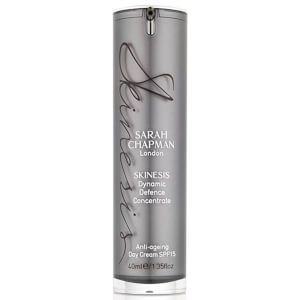
Sarah Chapman Dynamic Defence Concentrate SPF15 Anti-ageing Cream
Works for
2 of 4 advertised claims delivered
Sun protectionSPF 15 · 5 UV filters · Broad spectrumWeak protectionSPF under 30
This product offers broad spectrum sun protection, but it is weak. We recommend to use a broad spectrum sunscreen with at least SPF 30.
Moisturizing19 ingredients credited for this claimStrong support
“Dynamic Defence Concentrate SPF15 Anti-ageing Cream”
This product can help improve hydration of the skin with the two types of ingredients.
The first type is called “humectants”:
these ingredients help attract water.
When humectants are on the surface of the skin, they “pull in” the moisture from the outside environment, or from
within deeper layers of the skin. The following ingredients in this product do the job:
glycerin, sodium pca.
This product also contains ingredients called “occlusives”. They help reduce the speed with which our skin loses moisture to the outside environment. These ingredients also help soften the upper layer of the skin, so it feels less tight and nicer to the touch. The following ingredients in this product do the job: caprylic/capric triglyceride, dimethicone.
The following ingredients in this product are especially good for supporting the skin barrier and helping with the hydration level: palmitoyl tetrapeptide-7, palmitoyl tripeptide-1
Anti-aging7 ingredients credited for this claimModerate support
“Dynamic Defence Concentrate SPF15 Anti-ageing Cream”
This product contains palmitoyl tetrapeptide-7, palmitoyl tripeptide-1. These ingredients might be able to help reduce and prevent fine lines and wrinkles, improve skin elasticity and firmness, but there is not enough evidence that it actually works. The biggest anti-aging effect in this product comes from sun protection. Sun damage is the main factor causing early signs of skin aging. We, however, do not recommend using this product as a sunscreen because the protection it offers is not strong enough).
Evens skin tone3 ingredients credited for this claimLimited support
“Ideal for skin experienced in high potency skincare, this day cream combines a double concentration of actives with a triple skin-brightening complex and cocktail of aromatic oils to plump out deep wrinkles, combat dullness and age spots and firm for a toned, more youthful looking complexion.”
This product contains ingredients () that could help reduce hyperpigmentation (for example, post-acne marks or age spots) in theory, but there is not enough evidence that they actually work.
The biggest effect for evening out skin tone in this product comes from sun protection. Sun damage is the main factor causing age spots, darkening of post-acne marks and other discolorations. This is why sun protection is the best strategy for maintaining an even skin tone. We, however, do not recommend using this product as a sunscreen because the protection it offers is not strong enough).
Anti-oxidationNot advertised by the brand · 7 ingredients credited for this claimStrong support
This product contains antioxidants (ubiquinone) that can help neutralize free radicals in skin. By doing so, they can lessen the damage the skin gets from the UV light (sun).
Can it cause trouble?
Irritancy16 strong irritants: Benzophenone-3, Jasminum officinale flower extract + 14 more — patch-test recommendedHigh risk
Comedogenic2 ingredients rated 2 or more on the 0–5 pore-clogging scale2 flagged


User reviews
Be the first — your take helps the next person decide.
Ingredients
Filter by role to see what each ingredient is doing.
Water~45–55%
Ethylhexyl methoxycinnamate~5.8–7%
- Irritation risk
- High
Octinoxate. When used in higher concentrations, works as a sunscreen protecting the skin from UVB rays. When used in lower concentration, helps to preserve the product formulation. Is shown to be harmful to coral reefs - consider avoiding bathing in coral reef areas when wearing a product with this ingredient. It can be irritating
More about Ethylhexyl methoxycinnamateEthylhexyl salicylate~4.4–5.4%
- Irritation risk
- Low
Octisalate. A UV filter. It offers some protection against the sun rays that cause sunburn (UVB), but does not protect against the most aging sun rays (UVA). It loses its effectiveness quickly when exposed to sunlight. It is an organic, or so called "chemical" sunscreen
More about Ethylhexyl salicylateC12-15 alkyl benzoate~3.2–3.9%
- Irritation risk
- Low
Enhances the product texture and makes it more spreadable. Helps reduce water loss from the outer layer of skin. Extands the shelf life by preventing bacteria growth
More about C12-15 alkyl benzoateBenzophenone-3~3–3.7%
- Irritation risk
- High
Same as oxybenzone. Protects in the UVB and short UVA range. In small concentrations, used to stabilize product formulation. Can be irritating. Is shown to be harmful to coral reefs - consider avoiding bathing in coral reef areas when wearing a product with this ingredient. It can penetrate the skin and get absorbed into bloodstream faster than other popular filters available in the US. The study that produced this finding did not address any potential health effects of the absorption
More about Benzophenone-3Dimethicone~2–2.5%
- Irritation risk
- Low
A silicone that helps to reduce water loss from the surface of the skin. Can temporarily "fill in" lines and wrinkles, absorb oil, and create a nice product finish
More about DimethiconeCaprylic/capric triglyceride~1.7–2.1%
- Irritation risk
- Medium
A good mix of fatty acids that forms a protective layer on the skin. Improves the shelf life of products. Derived from coconut and glycerin
More about Caprylic/capric triglycerideGlycerin~1.5–1.8%
- Irritation risk
- Low
One of the best moisturizing ingredients. Naturally present in skin. It attracts water to the upper layer of the skin working as a humectant
More about GlycerinRumex occidentalis extract~0.95–1.15%
- Irritation risk
- Low
C14-22 alcohols~0.8–1.15%
- Irritation risk
- Low
A non-drying alcohol that helps stabilize product formulations
More about C14-22 alcoholsButyl methoxydibenzoylmethane~1.1–1.3%
- Irritation risk
- Medium
Avobenzone. An organic, or so-called "chemical" UV filter. Protects against both UVA and UVB rays. Needs to be combined with other filters in a formulation to be stable.
More about Butyl methoxydibenzoylmethaneOctocrylene~0.7–1.05%
- Irritation risk
- Medium
A weak sunscreen that protects against the sun rays that cause sunburn (UVB) and is somewhat effective against the UVA rays. It is quite stable and can help stabilize other, more vulnerable, sunscreen ingredients like Avobenzone. It is an organic, or so called "chemical" sunscreen
More about OctocryleneCetyl alcohol~0.5–0.8%
- Irritation risk
- Low
A non-drying alcohol that works to soften the skin and stabilize product formulations helping oil and water mix together
More about Cetyl alcoholCrambe abyssinica seed oil~0.3–0.6%
- Irritation risk
- Medium
Helps soften the upper layer of the skin
More about Crambe abyssinica seed oilGlyceryl stearate~0.45–0.65%
- Irritation risk
- Low
An emollient that softens the skin and forms a protective layer on its surface. Helps water and oil mix together
More about Glyceryl stearatePeg-100 stearate~0.45–0.7%
- Irritation risk
- Low
Helps oil and water mix togehter and creates a nice product texture
More about Peg-100 stearateTetrahexyldecyl ascorbate~0.3–0.6%
- Irritation risk
- Medium
Being a lipid soluble form of vitamin C, it is more stable than ascorbic acid, but still degrades quickly and needs to be stabilized in a formulation with another ingredient. It is claimed to penetrate skin better than pure vitamin C and have the the similar benefits, but solid studies of its effectiveness are lacking. Is likely to require a higher concentration in a product than pure vitamin C to be effective. It might be able to help reduce pore clogging.
More about Tetrahexyldecyl ascorbateArctostaphylos uva ursi leaf extract~0.25–0.5%
- Irritation risk
- Low
Hydroxyethyl acrylate/sodium acryloyldimethyl taurate copolymer~0.25–0.5%
- Irritation risk
- Medium
A gelling agent that thickens the product consistency and leaves the skin with a velvety finish
More about Hydroxyethyl acrylate/sodium acryloyldimethyl taurate copolymerButylene glycol~0.25–0.4%
- Irritation risk
- Low
Used to create a nice product texture and help delivery of other ingredients. Might be somewhat helpful in attracting water to the upper layer of the skin
More about Butylene glycolSqualane~0.25–0.5%
- Irritation risk
- Low
An oil naturally present in skin. Works as an emollient to soften the skin and form a protective layer on its surface without a greasy feeling.
More about SqualaneC12-20 alkyl glucoside~0.25–0.4%
- Irritation risk
- Medium
Helps water and oil mix together
More about C12-20 alkyl glucosidePolysorbate 60~0.2–0.4%
Sodium pca~0.2–0.35%
- Irritation risk
- Low
Naturally present in skin and helps to attract water to its upper layer
More about Sodium pcaLecithin~0.2–0.4%
- Irritation risk
- Low
Used mostly for creating emulsions - helping oil and water mix together. Helps soften the upper layer of the skin
More about LecithinPlankton extract~0.2–0.35%
- Irritation risk
- Medium
- Comedogenicity
- 3/5
Can help attract water to the upper layer of the skin
More about Plankton extractMangifera indica seed butter~0.15–0.3%
- Irritation risk
- Low
Helps to soften the upper layer of the skin and might have some anti-oxidant effect
More about Mangifera indica seed butterButyrospermum parkii butter~0.2–0.4%
- Irritation risk
- Low
- Comedogenicity
- 3/5
A great moisturising ingredient that softens the skin and reduces water loss from its upper layer. It also can be helpful in protecting skin from free radicals
More about Butyrospermum parkii butterNylon-12~0.2–0.4%
Yeast polysaccharides~0.2–0.35%
- Irritation risk
- Low
Phyllanthus emblica fruit extract~0.2–0.35%
- Irritation risk
- Medium
A plant extract that might be helpful in neutralizing free radicals and have a skin lightening effect if used in high enough concentrations
More about Phyllanthus emblica fruit extractPhenoxyethanol~0.2–0.4%
- Irritation risk
- Low
A preservative. It helps prevent bacterial growth in cosmetic products
More about PhenoxyethanolUbiquinone~0.2–0.35%
- Irritation risk
- Low
Coenzyme Q10. It helps neutralize free radicals in skin, improves skin hydration and might be helpful agains fine lines and wrinkles. It can be an allergen
More about UbiquinoneTocopheryl acetate~0.2–0.4%
- Irritation risk
- Medium
A more stable but less bio-available form of vitamin E compared to Tocopherol. Might help moisturize and protect the skin from free radicals, but mostly used in low concentrations to stabilize other ingredients.
More about Tocopheryl acetateCaprylyl glycol~0.25–0.4%
- Irritation risk
- Medium
Helps preserve products and creates a nice product texture
More about Caprylyl glycolEthylhexylglycerin~0.2–0.4%
Hexylene glycol~0.2–0.35%
- Irritation risk
- Medium
Helps create a more spreadable product texture
More about Hexylene glycolCedrus atlantica bark oil~0.15–0.3%
- Irritation risk
- Low
Jasminum officinale flower extract~0.2–0.35%
Teprenone~0.2–0.35%
- Irritation risk
- Low
Parfum~0.2–0.35%
- Irritation risk
- High
An aromatic blend of unspecified and possibly irritating ingredients
More about ParfumTriethanolamine~0.2–0.4%
- Irritation risk
- Medium
Used to adjust pH of the product and can help improve the product's smell
More about TriethanolamineXanthan gum~0.2–0.4%
- Irritation risk
- Low
Used to create a thicker product consistency
More about Xanthan gumIris florentina root extract~0.2–0.35%
- Irritation risk
- Low
Rosa canina flower extract~0.2–0.4%
- Irritation risk
- High
Disodium edta~0.2–0.35%
Diethylhexyl syringylidenemalonate~0.2–0.4%
- Irritation risk
- Medium
Used to stabilize the product formulation
More about Diethylhexyl syringylidenemalonateFusanus spicatus wood oil~0.2–0.4%
- Irritation risk
- Low
Pelargonium graveolens flower oil~0.2–0.4%
- Irritation risk
- High
An essential oil. Can be irritating. Can become an allergen with oxidation
More about Pelargonium graveolens flower oilCarbomer~0.2–0.35%
- Irritation risk
- Low
Helps create a thicker or gel-like product texture. It is not a surfactant but can be used in gentle cleansing formulations
More about CarbomerPolysorbate 20~0.2–0.4%
Rosa damascena flower oil~0.2–0.35%
- Irritation risk
- High
Used as a fragrance. Can be irritating
More about Rosa damascena flower oilPalmitoyl tripeptide-1~0.2–0.4%
- Irritation risk
- Low
A type of peptide. Peptides are excellent moisturizers and might be able support collagen production reducing fine lines and wrinkles
More about Palmitoyl tripeptide-1Palmitoyl tetrapeptide-7~0.2–0.4%
- Irritation risk
- Low
A type of peptide. Peptides are excellent moisturizers and might be able support collagen production reducing fine lines and wrinkles
More about Palmitoyl tetrapeptide-7Retinyl palmitate~0.15–0.3%
- Irritation risk
- High
Three steps removed from the active form of vitamin A - retinoic acid. To have an effect in the skin, it first needs to be converted twice to become the retinoic acid. This means it is less potent than retinol, but could also be less irritating. Once converted to the retinoic acid in the skin, it helps against all signs of aging, improves skin cell turnover and helps fight blemishes and clogged pores. However, in many cosmetic formulations, it is used in a concentration that is too low to have the full effect
More about Retinyl palmitateCitronellol~0.15–0.3%
Geraniol~0.15–0.3%
Linalool~0.15–0.3%
Benzyl benzoate~0.15–0.3%
- Irritation risk
- High
Fragrance with sweet balsamic smell. Help to preserve products and dissolve other ingredients. Could trigger allergic reactions and be irritating
More about Benzyl benzoateFarnesol~0.15–0.25%
Benzyl cinnamate~0.15–0.25%
Benzyl alcohol~0.15–0.25%
- Irritation risk
- High
A preservative. Can be used to mask unpleasant smell. Can be irritating
More about Benzyl alcoholEugenol~0.15–0.25%
Hydroxycitronellal~0.1–0.15%
- Irritation risk
- High
A fragrance. A likely allergen and can be irritating
More about HydroxycitronellalCitral~0.1–0.15%
Ingredient list view
Water, Ethylhexyl methoxycinnamate, Ethylhexyl salicylate, C12-15 alkyl benzoate, Benzophenone-3, Dimethicone, Caprylic/capric triglyceride, Glycerin, Rumex occidentalis extract, C14-22 alcohols, Butyl methoxydibenzoylmethane, Octocrylene, Cetyl alcohol, Crambe abyssinica seed oil, Glyceryl stearate, Peg-100 stearate, Tetrahexyldecyl ascorbate, Arctostaphylos uva ursi leaf extract, Hydroxyethyl acrylate/sodium acryloyldimethyl taurate copolymer, Butylene glycol, Squalane, C12-20 alkyl glucoside, Polysorbate 60, Sodium pca, Lecithin, Plankton extract, Mangifera indica seed butter, Butyrospermum parkii butter, Nylon-12, Yeast polysaccharides, Phyllanthus emblica fruit extract, Phenoxyethanol, Ubiquinone, Tocopheryl acetate, Caprylyl glycol, Ethylhexylglycerin, Hexylene glycol, Cedrus atlantica bark oil, Jasminum officinale flower extract, Teprenone, Parfum, Triethanolamine, Xanthan gum, Iris florentina root extract, Rosa canina flower extract, Disodium edta, Diethylhexyl syringylidenemalonate, Fusanus spicatus wood oil, Pelargonium graveolens flower oil, Carbomer, Polysorbate 20, Rosa damascena flower oil, Palmitoyl tripeptide-1, Palmitoyl tetrapeptide-7, Retinyl palmitate, Citronellol, Geraniol, Linalool, Benzyl benzoate, Farnesol, Benzyl cinnamate, Benzyl alcohol, Eugenol, Hydroxycitronellal, Citral
Compare prices
Retailers ranked by price — lowest first.
.png)

Worth comparing, line by line.
Match % combines shared ingredients, the first five ingredients, shared actives and hero ingredients, irritancy (lower counts in the alternative's favour), texture and body area. Only products in the same routine step are compared.
| Sarah ChapmanDynamic Defence Concentrate SPF15 Anti-ageing CreamYOUR PRODUCT | VENeffectAnti-Aging Moisturizer SPF 15 by Veneffect | ExuvianceAge Reverse Day Repair SPF 30 + Retinol Antiaging Moisturizer | No7Protect & Perfect Intense Advanced Fragrance Free Day Cream SPF 30 | |
|---|---|---|---|---|
| Match | — | 62% | 61% | 60% |
| Price | $84.00 | $45.00−$39.00 | $65.60−$18.40 | $26.99−$57.01 |
| Shared key ingredients | — | 8 of 16 | 7 of 16 | 8 of 16 |
| Key difference | — | Cyclopentasiloxane | Retinol | Acetyl Dipeptide-1 Cetyl Ester |
| Irritancy | High | Medium | Medium | Medium |
| SPF | SPF 15 | SPF 15 | SPF 30 | SPF 30 |
| Drying alcohol | — | — | — | Contains drying alcohol |
| View product | Shop | Shop | Shop |


Product summary
"Sarah Chapman - Dynamic Defence Concentrate SPF15 Anti-ageing Cream" offers broad spectrum protection. It means that it protects from both UVA and UVB rays (you can remember UVB as "burning" sunlight - they cause sunburn. You can remember UVA rays as "aging" - they do not lead to sunburn, but they cause photodamage and contribute to early signs of skin aging and hyperpigmentation). On the negative side, the SPF of this moisturizer is not high enough. We recommend to use a sunscreen with at least SPF 30 daily.
Its formula is also hydrating, so you might not need an additional moistruizer during the day.
Sunscreen filters
This is a so-called "chemical" sunscreen. It means that it uses organic UV filters. They typically offer good sun protection and rarely leave a white cast, but they can be irritating for some people with sensitive skin. Here are the exact UV filters in this sunscreen: oxybenzone 3.00% - 3.70%, avobenzone 1.10% - 1.30%, octinoxate 5.80% - 7.00%, octisalate 4.40% - 5.40% and octocrylene 0.70% - 1.05%.
Irritation risk
There are quite a few common irritants in this product, including ingredients without particular skin benefits. We would not recommend it for sensitive skin. We assess the overall irritancy of this moisturizer to be high. For a detailed overview of all potential irritants: click here
You can see the detailed formula review with the breakdown of all actives in the product and the full ingredient list with estimated concentrations in the tables below.
Price
The product retails for 84.00$ in the United States and from 84.00£ up to 87.00£ in the United Kingdom.
For a detailed price comparison: click here.
Sources cited in this review
Every concentration estimate and effectiveness label is anchored to one of these 18 studies and safety reviews.
- 1
- 2
- 3On Photostability of Oxybenzonecore.ac.uk
- 4
- 5Final Report on the Safety Assessment of Dimethicone Copolyoljournals.sagepub.com
- 6

Affiliate links · As an Amazon Associate, WIMJ earns from qualifying purchases.