Works for
1 of 1 advertised claim delivered
MoisturizingSimmondsia chinensis seed oil, Glycerin + 8 moreGood evidence
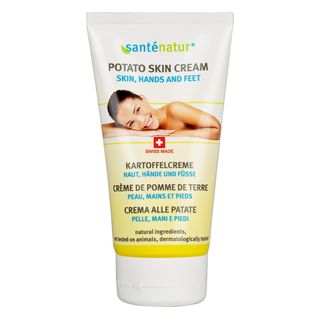
“Santénatur Potato Skin Cream softens, moisturizes, and nurtures your skin with a combination of potato extract from fresh potatoes and beneficial minerals.”
This product can help improve hydration of the skin with the two types of ingredients.
The first type is called “humectants”:
these ingredients help attract water.
When humectants are on the surface of the skin, they “pull in” the moisture from the outside environment, or from
within deeper layers of the skin. The following ingredients in this product do the job:
glycerin.
This product also contains ingredients called “occlusives”. They help reduce the speed with which our skin loses moisture to the outside environment. These ingredients also help soften the upper layer of the skin, so it feels less tight and nicer to the touch. The following ingredients in this product do the job: simmondsia chinensis seed oil, cetearyl alcohol.
Can it cause trouble?
Irritancy9 strong irritants: Alcohol, Boswellia carterii oil + 7 more — patch-test recommendedHigh risk
Comedogenic1 ingredient rated 2 or more on the 0–5 pore-clogging scale1 flagged
User reviews
Be the first — your take helps the next person decide.
Ingredients
Filter by role to see what each ingredient is doing.
Water~40–60%
Cetearyl alcohol~5.4–8.2%
- Irritation risk
- Low
- Comedogenicity
- 2/5
A non-drying alcohol. Works as an emollient. Helps water and oil mix together and creates a nice product texture
More about Cetearyl alcoholDicaprylyl ether~3.9–5.9%
- Irritation risk
- Low
Helps soften the upper layer of the skin while creating a non-greasy feel on the skin. Helps to dissolve other ingredients
More about Dicaprylyl etherGlycerin~2.7–4.1%
- Irritation risk
- Low
One of the best moisturizing ingredients. Naturally present in skin. It attracts water to the upper layer of the skin working as a humectant
More about GlycerinGlyceryl stearate~2.1–3.1%
- Irritation risk
- Low
An emollient that softens the skin and forms a protective layer on its surface. Helps water and oil mix together
More about Glyceryl stearateAlcohol~1.8–2.6%
- Irritation risk
- High
Can be drying and contribute to skin irritation. Used in formulars to dissolve other ingredients, create a thinner product consistency or for its antibacterial properties
More about AlcoholPrunus amygdalus dulcis oil~1.5–2.3%
- Irritation risk
- Low
An emollient that softens the skin
More about Prunus amygdalus dulcis oilSimmondsia chinensis seed oil~1.4–2.1%
- Irritation risk
- Medium
Softens the upper layer of skin and helps restore the healthy skin barrier. Has shown to help calm down inflammation in skin. It is a stable oil, meaning that it retains its properties even when exposed to air.
More about Simmondsia chinensis seed oilSodium levulinate~1–1.6%
Cetearyl glucoside~0.85–1.3%
- Irritation risk
- Medium
Helps water and oil in the product mix well together and improves product texture
More about Cetearyl glucosideCetyl palmitate~0.55–1.3%
- Irritation risk
- Low
An emollient that helps soften the skin and is used to improve product texture and stability
More about Cetyl palmitateCocoglycerides~0.45–1.1%
- Irritation risk
- High
Help soften the upper layer of the skin and make it easier for oil and water mix together. Recently, a rising number of allergic reactions to cocoglycerides and other coconut-derived surfactants has been reported. As there is a significant overlap between frequent irritants and allergens, we flag this ingredient for attention of those with very sensitive, reactive skin
More about CocoglyceridesBoswellia carterii oil~0.35–0.85%
Boswellia carterii gum extract~0.35–0.8%
Citric acid~0.3–0.75%
- Irritation risk
- Medium
Can work as an exfoliant but is typically used to adjust the product pH
More about Citric acidLinalool~0.15–0.65%
Tocopherol~0.15–0.65%
- Irritation risk
- Low
Pure form of vitamin E. Can help moisturise and protect the skin from free radicals. Often used to help stabilise other ingredients or the formula itself
More about TocopherolCaprylic/capric triglyceride~0.2–0.7%
- Irritation risk
- Medium
A good mix of fatty acids that forms a protective layer on the skin. Improves the shelf life of products. Derived from coconut and glycerin
More about Caprylic/capric triglycerideLimonene~0.1–0.45%
- Irritation risk
- High
A common frangrance that can easily irritate skin, especially if exposed to air, light or heat
More about LimoneneParfum~0.1–0.4%
- Irritation risk
- High
An aromatic blend of unspecified and possibly irritating ingredients
More about ParfumAscorbyl palmitate~0.1–0.35%
- Irritation risk
- Medium
Being a lipid soluble form of vitamin C, it is more stable and can penetrate the skin better than L-Ascorbic acid. It is effective in protecting the skin from free radicals, as well as evening the skin tone, but is less effective in stimulating collagen production compared to L-Ascorbic acid.
More about Ascorbyl palmitateFarnesol~0.1–0.3%
Ascorbic acid~0.05–0.25%
- Irritation risk
- High
The most well-researched antioxidant that works in skin. Helps neutralize free radicals supporting collagen production, helping to even out the skin tone and preventing early signs of aging
More about Ascorbic acidCitral~0.05–0.2%
Coumarin~0.05–0.15%
Ingredient list view
Water, Unknown, Cetearyl alcohol, Dicaprylyl ether, Glycerin, Glyceryl stearate, Alcohol, Prunus amygdalus dulcis oil, Simmondsia chinensis seed oil, Sodium levulinate, Cetearyl glucoside, Cetyl palmitate, Cocoglycerides, Unknown, Boswellia carterii oil, Boswellia carterii gum extract, Citric acid, Linalool, Tocopherol, Caprylic/capric triglyceride, Limonene, Parfum, Ascorbyl palmitate, Farnesol, Ascorbic acid, Citral, Coumarin
Compare prices
Retailers ranked by price — lowest first.
.png)
Sources cited in this review
Every concentration estimate and effectiveness label is anchored to one of these 4 studies and safety reviews.
- 1
- 2
- 3Vitamin E in dermatologyncbi.nlm.nih.gov
- 4Vitamin E and Skin Healthlpi.oregonstate.edu

Affiliate links · As an Amazon Associate, WIMJ earns from qualifying purchases.