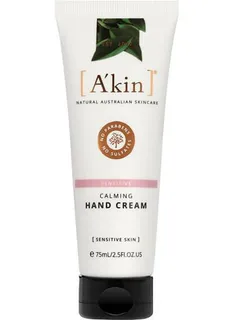
Works for
MoisturizingPanthenol, Cetearyl alcohol + 15 moreWorks well
“This calming natural hand cream moisturises intensively and soothes the most sensitive and allergy-prone skin with a combination of Jojoba and Shea Butter.”
This product can help improve hydration of the skin with the two types of ingredients.
The first type is called “humectants”:
these ingredients help attract water.
When humectants are on the surface of the skin, they “pull in” the moisture from the outside environment, or from
within deeper layers of the skin. The following ingredients in this product do the job:
glycerin, sorbitol.
This product also contains ingredients called “occlusives”. They help reduce the speed with which our skin loses moisture to the outside environment. These ingredients also help soften the upper layer of the skin, so it feels less tight and nicer to the touch. The following ingredients in this product do the job: caprylic/capric triglyceride, simmondsia chinensis seed oil.
The following ingredients in this product are especially good for supporting the skin barrier and helping with the hydration level: panthenol
Can it cause trouble?
Irritancy2 strong irritants: Sodium hydroxymethylglycinate, FarnesolMedium risk
Comedogenic2 ingredients rated 2 or more on the 0–5 pore-clogging scale2 flagged

User reviews
Be the first — your take helps the next person decide.
Ingredients
Filter by role to see what each ingredient is doing.
Water~45–55%
Cetearyl alcohol~5.7–6.9%
- Irritation risk
- Low
- Comedogenicity
- 2/5
A non-drying alcohol. Works as an emollient. Helps water and oil mix together and creates a nice product texture
More about Cetearyl alcoholSodium stearoyl lactylate~4.2–5.1%
- Irritation risk
- Medium
Helps oil and water mix together
More about Sodium stearoyl lactylateGlycerin~3.1–3.8%
- Irritation risk
- Low
One of the best moisturizing ingredients. Naturally present in skin. It attracts water to the upper layer of the skin working as a humectant
More about GlycerinGlyceryl stearate~2.4–2.9%
- Irritation risk
- Low
An emollient that softens the skin and forms a protective layer on its surface. Helps water and oil mix together
More about Glyceryl stearateSorbitol~1.9–2.3%
- Irritation risk
- Low
Helps attract water to the upper layer of the skin and improves the product texture
More about SorbitolPersea gratissima oil~1.7–2.1%
- Irritation risk
- Medium
An emollient that helps soften the skin and could be helpful in repairing its barrier function
More about Persea gratissima oilLecithin~1.4–1.8%
- Irritation risk
- Low
Used mostly for creating emulsions - helping oil and water mix together. Helps soften the upper layer of the skin
More about LecithinSimmondsia chinensis seed oil~1.3–1.6%
- Irritation risk
- Medium
Softens the upper layer of skin and helps restore the healthy skin barrier. Has shown to help calm down inflammation in skin. It is a stable oil, meaning that it retains its properties even when exposed to air.
More about Simmondsia chinensis seed oilPanthenol~0.95–1.2%
- Irritation risk
- Low
Helps attract water to the upper layer of the skin and can help improve skin barrier function
More about PanthenolSqualane~0.75–1.15%
- Irritation risk
- Low
An oil naturally present in skin. Works as an emollient to soften the skin and form a protective layer on its surface without a greasy feeling.
More about SqualaneCaprylic/capric triglyceride~0.65–1%
- Irritation risk
- Medium
A good mix of fatty acids that forms a protective layer on the skin. Improves the shelf life of products. Derived from coconut and glycerin
More about Caprylic/capric triglycerideStearic acid~0.65–1%
- Irritation risk
- Low
Helps oil and water mix together and works as an emollient
More about Stearic acidButyrospermum parkii butter~0.55–0.8%
- Irritation risk
- Low
- Comedogenicity
- 3/5
A great moisturising ingredient that softens the skin and reduces water loss from its upper layer. It also can be helpful in protecting skin from free radicals
More about Butyrospermum parkii butterBehenyl alcohol~0.5–0.8%
- Irritation risk
- Low
Non-drying alcohol that helps water and oil mix together. Also serves as an emollient
More about Behenyl alcoholPhenoxyethanol~0.45–0.7%
- Irritation risk
- Low
A preservative. It helps prevent bacterial growth in cosmetic products
More about PhenoxyethanolSodium isostearoyl lactylate~0.45–0.7%
Macadamia ternifolia seed oil~0.45–0.65%
- Irritation risk
- Medium
Plant oil from nuts that helps soften the upper layer of the skin. Contains a high concentration of oleic acid that can weaken skin's barrier function and increase water-loss while enhancing penetration of other ingredients
More about Macadamia ternifolia seed oilGlyceryl laurate~0.45–0.65%
- Irritation risk
- Medium
Helps water and oil mix together and has an anti-microbial effect helping to preserve product formulations
More about Glyceryl laurateGlyceryl laurate~0.4–0.6%
- Irritation risk
- Medium
Helps water and oil mix together and has an anti-microbial effect helping to preserve product formulations
More about Glyceryl laurateSodium citrate~0.3–0.55%
- Irritation risk
- Medium
Helps to control the skin's pH level. Maintains the skin's natural film of amino-lactic acids and oils. Helps to preserve products
More about Sodium citrateTocopheryl acetate~0.3–0.55%
- Irritation risk
- Medium
A more stable but less bio-available form of vitamin E compared to Tocopherol. Might help moisturize and protect the skin from free radicals, but mostly used in low concentrations to stabilize other ingredients.
More about Tocopheryl acetateXanthan gum~0.25–0.5%
- Irritation risk
- Low
Used to create a thicker product consistency
More about Xanthan gumSodium gluconate~0.25–0.45%
Tocopherol~0.25–0.45%
- Irritation risk
- Low
Pure form of vitamin E. Can help moisturise and protect the skin from free radicals. Often used to help stabilise other ingredients or the formula itself
More about TocopherolPhytosterols~0.3–0.5%
- Irritation risk
- Medium
Lipids that work as an emollient and can be helpful in repairing skin barrier function
More about PhytosterolsChamomilla recutita flower extract~0.2–0.4%
- Irritation risk
- High
Plant extract that can have healing and anti-inflammatory properties. It is a potential allergen and can be irritating
More about Chamomilla recutita flower extractAscorbyl palmitate~0.2–0.35%
- Irritation risk
- Medium
Being a lipid soluble form of vitamin C, it is more stable and can penetrate the skin better than L-Ascorbic acid. It is effective in protecting the skin from free radicals, as well as evening the skin tone, but is less effective in stimulating collagen production compared to L-Ascorbic acid.
More about Ascorbyl palmitateOlea europaea fruit oil~0.2–0.35%
- Irritation risk
- Medium
An emollient that helps soften the skin but is not effective for restoring its barrier function. Might be helpful to calm down inflammation
More about Olea europaea fruit oilFusanus spicatus wood oil~0.15–0.3%
- Irritation risk
- Low
Hydrogenated palm glycerides citrate~0.2–0.35%
- Irritation risk
- Low
Helps soften the upper layer of the skin
More about Hydrogenated palm glycerides citratePhenoxyethanol~0.15–0.25%
- Irritation risk
- Low
A preservative. It helps prevent bacterial growth in cosmetic products
More about PhenoxyethanolSodium hydroxymethylglycinate~0.1–0.2%
Farnesol~0.05–0.1%
Ingredient list view
Water, Cetearyl alcohol, Sodium stearoyl lactylate, Glycerin, Glyceryl stearate, Sorbitol, Persea gratissima oil, Lecithin, Simmondsia chinensis seed oil, Panthenol, Squalane, Caprylic/capric triglyceride, Stearic acid, Butyrospermum parkii butter, Behenyl alcohol, Phenoxyethanol, Sodium isostearoyl lactylate, Macadamia ternifolia seed oil, Glyceryl laurate, Glyceryl laurate, Sodium citrate, Tocopheryl acetate, Xanthan gum, Sodium gluconate, Tocopherol, Phytosterols, Chamomilla recutita flower extract, Ascorbyl palmitate, Olea europaea fruit oil, Fusanus spicatus wood oil, Hydrogenated palm glycerides citrate, Phenoxyethanol, Sodium hydroxymethylglycinate, Farnesol
Compare prices
Retailers ranked by price — lowest first.
Worth comparing, line by line.
Match % combines shared ingredients, the first five ingredients, shared actives and hero ingredients, irritancy (lower counts in the alternative's favour), texture and body area. Only products in the same routine step are compared.
| A'kinCalming Hand Cream for Sensitive SkinYOUR PRODUCT | RoC SkincareDermatologic Enydrial Hand Cream | StriVectinSD™ Hand Cream | Dresdner EssenzRich Hand Cream Sweet Winter Magic | |
|---|---|---|---|---|
| Match | — | 58% | 56% | 56% |
| Price | — | $6.41 | $34.80 | $24.50 |
| Shared key ingredients | — | 3 of 9 | 5 of 9 | 5 of 9 |
| Key difference | — | Copper Gluconate | Linoleic Acid | Sunflower Seed Oil |
| Irritancy | Medium | Low | Medium | Medium |
| Drying alcohol | — | — | — | — |
| View product | Shop | Shop | Shop |


More alternatives: PYUNKANG YUL Skin Barriers Professional Hand CreamElizabeth Grant Intensive Hand & Foot Cream
Sources cited in this review
Every concentration estimate and effectiveness label is anchored to one of these 7 studies and safety reviews.
- 1
- 2Skin moisturizing effects of panthenol-based formulationspdfs.semanticscholar.org
- 3
- 4
- 5Vitamin E in dermatologyncbi.nlm.nih.gov
- 6Vitamin E and Skin Healthlpi.oregonstate.edu

Affiliate links · As an Amazon Associate, WIMJ earns from qualifying purchases.