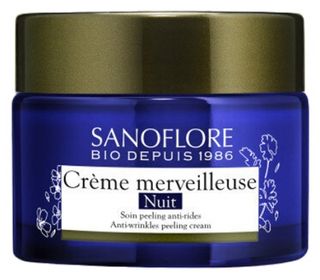
Sanoflore Organic Anti-Wrinkles Peeling Night Cream
Works for
2 of 3 advertised claims delivered
Anti-aging3 ingredients credited for this claimStrong support
“Organic Anti-Wrinkles Peeling Night Cream”
This product can help reduce and prevent fine lines and wrinkles, improve skin elasticity and firmness because it contains adenosine.
Keep in mind that it typically takes at least 6 weeks to notice any results because the changes that are needed to improve fine lines and elasticity happen in the deeper layers of the skin. No topical anti-aging product can “erase” wrinkles or fully reverse signs of aging.
Moisturizing16 ingredients credited for this claimGood support
“Organic Anti-Wrinkles Peeling Night Cream”
This product can help improve hydration of the skin with the two types of ingredients.
The first type is called “humectants”:
these ingredients help attract water.
When humectants are on the surface of the skin, they “pull in” the moisture from the outside environment, or from
within deeper layers of the skin. The following ingredients in this product do the job:
arginine, glycerin.
This product also contains ingredients called “occlusives”. They help reduce the speed with which our skin loses moisture to the outside environment. These ingredients also help soften the upper layer of the skin, so it feels less tight and nicer to the touch. The following ingredients in this product do the job: arginine, caprylic/capric triglyceride.
Exfoliation2 ingredients credited for this claimWeak support
“Sanoflore Organic Anti-Wrinkles Peeling Night Cream 50 ml is an anti-wrinkle peel enriched with in organic pelargonium essential oil, a collagen booster,in natural peptides that activate elasticity,an exfoliating trio of lactic, phytic and citric acids.This cream takes advantage of sleep to repair damage and reconstitute the skin for a new-skin effect.”
This product does not contain effective exfoliating ingredients. It might be able to deliver physical exfoliation, that is scrub off some of the dead cells on the surface of the skin. We do not recommend physical exfoliation, because it is not uniform (some bits of skin can get exfoliated too much while others not at all). It can also traumatize the skin and aggrevate acne and other skin conditions.
Can it cause trouble?
Irritancy10 strong irritants: Parfum, Linalool + 8 more — patch-test recommendedHigh risk
Comedogenic2 ingredients rated 2 or more on the 0–5 pore-clogging scale2 flagged

User reviews
Be the first — your take helps the next person decide.
Ingredients
Filter by role to see what each ingredient is doing.
Water~45–55%
Dicaprylyl carbonate~4.9–6%
- Irritation risk
- Low
Helps products spread more easily and works as an emollient to soften skin
More about Dicaprylyl carbonateSimmondsia chinensis seed oil~4.5–5.5%
- Irritation risk
- Medium
Softens the upper layer of skin and helps restore the healthy skin barrier. Has shown to help calm down inflammation in skin. It is a stable oil, meaning that it retains its properties even when exposed to air.
More about Simmondsia chinensis seed oilCaprylic/capric triglyceride~3.3–4%
- Irritation risk
- Medium
A good mix of fatty acids that forms a protective layer on the skin. Improves the shelf life of products. Derived from coconut and glycerin
More about Caprylic/capric triglycerideGlycerin~2.4–3%
- Irritation risk
- Low
One of the best moisturizing ingredients. Naturally present in skin. It attracts water to the upper layer of the skin working as a humectant
More about GlycerinPropanediol~2–2.4%
- Irritation risk
- Low
Acts as a solvent for other ingredients. Speeds up the absorption of other ingredients into the skin
More about PropanediolGlyceryl stearate citrate~1.7–2.1%
- Irritation risk
- Low
Helps oil and water mix together while softening the upper layer of the skin
More about Glyceryl stearate citrateCetearyl alcohol~1.5–1.9%
- Irritation risk
- Low
- Comedogenicity
- 2/5
A non-drying alcohol. Works as an emollient. Helps water and oil mix together and creates a nice product texture
More about Cetearyl alcoholGlyceryl stearate~1.2–1.5%
- Irritation risk
- Low
An emollient that softens the skin and forms a protective layer on its surface. Helps water and oil mix together
More about Glyceryl stearatePentylene glycol~1–1.3%
- Irritation risk
- Medium
Used to preserve products, dissolve other ingredients and create a nice product texture
More about Pentylene glycolArginine~0.7–1.05%
- Irritation risk
- Low
An amino acid that is naturally present in skin and helps keep it hydrated. When used together with AHAs, it can reduce their irritating effect on the skin
More about ArgininePelargonium graveolens flower/leaf/stem water~0.6–0.85%
- Irritation risk
- Low
Citric acid~0.55–0.8%
- Irritation risk
- Medium
Can work as an exfoliant but is typically used to adjust the product pH
More about Citric acidBenzyl alcohol~0.45–0.7%
- Irritation risk
- High
A preservative. Can be used to mask unpleasant smell. Can be irritating
More about Benzyl alcoholGlyceryl stearate se~0.5–0.7%
- Irritation risk
- Low
- Comedogenicity
- 2/5
Used to stabilize the product formulations and works as an emollient
More about Glyceryl stearate seTocopherol~0.45–0.7%
- Irritation risk
- Low
Pure form of vitamin E. Can help moisturise and protect the skin from free radicals. Often used to help stabilise other ingredients or the formula itself
More about TocopherolParfum~0.45–0.65%
- Irritation risk
- High
An aromatic blend of unspecified and possibly irritating ingredients
More about ParfumXanthan gum~0.45–0.65%
- Irritation risk
- Low
Used to create a thicker product consistency
More about Xanthan gumLactic acid~0.35–0.6%
- Irritation risk
- Medium
An exfoliating and moisturizing alpha-hydroxy acid (AHA). Typically causes less irritation than other AHAs, for example, glycolic acid. At high concentrations (about 15%), lactic acid can help reduce lines and wrinkles. Recent studies show that lactic acid can support the "good" bacteria living on skin's surface (healthy skin microbiome)
More about Lactic acidSalicylic acid~0.3–0.55%
- Irritation risk
- High
Used for skin exfoliation. It has an anti-inflammatory and anti-bacterial effect, helps to unclog pores, prevent blemishes and speed up healing of the existing ones. Sometimes referred to as a BHA (beta-hydroxy acid)
More about Salicylic acidPhytic acid~0.3–0.55%
- Irritation risk
- Medium
An alpha-hydroxy acid (AHA), but is mostly used to stabilize product formulations in cosmetics
More about Phytic acidAdenosine~0.3–0.5%
- Irritation risk
- Low
Might help improve cell turnover and reduce inflammation in skin. One study shows that the ingredients might be able to help reduce dynamic wrinkles (for example, in the corners of the eyes or on the forehead)
More about AdenosineLinalool~0.25–0.45%
Aloe barbadensis leaf juice powder~0.25–0.5%
- Irritation risk
- Medium
Traditionally used to treat sunburns, dermatitis and inflammation, but evidence for its effectiveness is lacking. The extract can contain humectants that help attract water into the skin
More about Aloe barbadensis leaf juice powderLimonene~0.25–0.45%
- Irritation risk
- High
A common frangrance that can easily irritate skin, especially if exposed to air, light or heat
More about LimoneneCitronellol~0.2–0.4%
Pelargonium graveolens flower oil~0.25–0.45%
- Irritation risk
- High
An essential oil. Can be irritating. Can become an allergen with oxidation
More about Pelargonium graveolens flower oilSodium phytate~0.25–0.4%
Helianthus annuus seed oil~0.25–0.45%
- Irritation risk
- Low
A great emollient due to its high linoleic acid content. One of the most effective plant oils in helping skin hydration and repairing skin barrier function
More about Helianthus annuus seed oilGeraniol~0.2–0.35%
Thymus vulgaris flower/leaf oil~0.2–0.35%
- Irritation risk
- High
Citral~0.15–0.25%
Melissa officinalis leaf oil~0.1–0.2%
- Irritation risk
- High
Hydrolyzed linseed extract~0.1–0.2%
- Irritation risk
- Low
Helps soften the upper layer of the skin
More about Hydrolyzed linseed extractAlcohol~0.1–0.15%
- Irritation risk
- High
Can be drying and contribute to skin irritation. Used in formulars to dissolve other ingredients, create a thinner product consistency or for its antibacterial properties
More about AlcoholSodium benzoate~0.1–0.2%
Ingredient list view
Water, Dicaprylyl carbonate, Simmondsia chinensis seed oil, Caprylic/capric triglyceride, Glycerin, Propanediol, Glyceryl stearate citrate, Cetearyl alcohol, Glyceryl stearate, Pentylene glycol, Arginine, Pelargonium graveolens flower/leaf/stem water, Citric acid, Benzyl alcohol, Glyceryl stearate se, Tocopherol, Parfum, Xanthan gum, Lactic acid, Salicylic acid, Phytic acid, Adenosine, Linalool, Aloe barbadensis leaf juice powder, Limonene, Citronellol, Pelargonium graveolens flower oil, Sodium phytate, Helianthus annuus seed oil, Geraniol, Thymus vulgaris flower/leaf oil, Citral, Melissa officinalis leaf oil, Hydrolyzed linseed extract, Alcohol, Sodium benzoate
Compare prices
Retailers ranked by price — lowest first.

Worth comparing, line by line.
Match % combines shared ingredients, the first five ingredients, shared actives and hero ingredients, irritancy (lower counts in the alternative's favour), texture and body area. Only products in the same routine step are compared.
| SanofloreOrganic Anti-Wrinkles Peeling Night CreamYOUR PRODUCT | DECLEORWhite Magnolia Anti-Ageing Rosy Cream | Paula's choiceResist Advanced Smoothing Treatment 10% AHA | LancômeRenergie Multi-Glow Night Cream | |
|---|---|---|---|---|
| Match | — | 85% | 84% | 84% |
| Price | $51.28 | $87.59+$36.31 | $29.60−$21.68 | $103.12+$51.84 |
| Shared key ingredients | — | 7 of 10 | 1 of 10 | 6 of 10 |
| Key difference | — | Isocetyl Stearate | Benzoyl Peroxide | Copernicia Cerifera Wax |
| Irritancy | High | High | Medium | High |
| Drying alcohol | Contains drying alcohol | Contains drying alcohol | — | Contains drying alcohol |
| View product | Shop | Shop | Shop |


Sources cited in this review
Every concentration estimate and effectiveness label is anchored to one of these 18 studies and safety reviews.
- 1
- 2Vitamin E in dermatologyncbi.nlm.nih.gov
- 3Vitamin E and Skin Healthlpi.oregonstate.edu
- 4Epidermal and dermal effects of topical lactic acidncbi.nlm.nih.gov
- 5Dual Effects of Alpha-Hydroxy Acids on the Skinpdfs.semanticscholar.org
- 6Salicylic acid as a peeling agent: a comprehensive reviewncbi.nlm.nih.gov

Affiliate links · As an Amazon Associate, WIMJ earns from qualifying purchases.