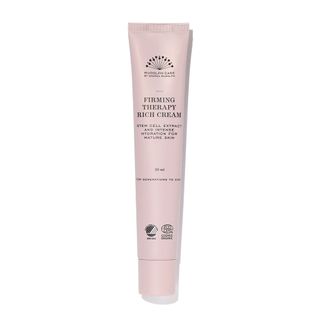
Rudolph Care Firming Therapy Rich Cream Crème Anti-Âge Hydratante
Works for
1 of 2 advertised claims delivered
Moisturizing18 ingredients credited for this claimGood support
“Une crème onctueuse anti-âge et hydratante qui lisse et régénère la peau pour lui redonner souplesse, éclat et fermeté.”
This product can help improve hydration of the skin with the two types of ingredients.
The first type is called “humectants”:
these ingredients help attract water.
When humectants are on the surface of the skin, they “pull in” the moisture from the outside environment, or from
within deeper layers of the skin. The following ingredients in this product do the job:
fructose, glycerin.
This product also contains ingredients called “occlusives”. They help reduce the speed with which our skin loses moisture to the outside environment. These ingredients also help soften the upper layer of the skin, so it feels less tight and nicer to the touch. The following ingredients in this product do the job: butyrospermum parkii butter, helianthus annuus seed oil.
Anti-aging2 ingredients credited for this claimLimited support
“Une crème onctueuse anti-âge et hydratante qui lisse et régénère la peau pour lui redonner souplesse, éclat et fermeté.”
This product does not contain ingredients that are able to reduce fine lines and wrinkles or help with skin elasticity, but it can improve the look of the skin temporarily through moisturization. Well-moisturized skin might also be able to repair the sun damage better.This ingredient - butyrospermum parkii butter - could be helpful for preventing or repairing signs of aging in theory, but there is no evidence that it actually works.
Can it cause trouble?
Irritancy1 strong irritant: ParfumMedium risk
Comedogenic3 ingredients rated 2 or more on the 0–5 pore-clogging scale3 flagged
User reviews
Be the first — your take helps the next person decide.
Ingredients
Filter by role to see what each ingredient is doing.
Aloe barbadensis leaf extract~23–34%
- Irritation risk
- Medium
Traditionally used to treat sunburns, dermatitis and inflammation, but evidence for its effectiveness is lacking. The extract can contain humectants that help attract water into the skin
More about Aloe barbadensis leaf extractCoco-caprylate~5.2–7.7%
- Irritation risk
- Medium
An emollient that softens skin and creates a nice product texture
More about Coco-caprylateSesamum indicum seed oil~5.3–7.9%
- Irritation risk
- Low
A good moisturizing plant oil. Due to the high linoleic acid content, it helps soften the upper layer of the skin, reduce water loss and support skin barrier function
More about Sesamum indicum seed oilOlea europaea fruit oil~4–5.9%
- Irritation risk
- Medium
An emollient that helps soften the skin but is not effective for restoring its barrier function. Might be helpful to calm down inflammation
More about Olea europaea fruit oilWater~2.9–4.3%
Simmondsia chinensis seed oil~2.3–3.5%
- Irritation risk
- Medium
Softens the upper layer of skin and helps restore the healthy skin barrier. Has shown to help calm down inflammation in skin. It is a stable oil, meaning that it retains its properties even when exposed to air.
More about Simmondsia chinensis seed oilPolyglyceryl-2 dipolyhydroxystearate~1.6–2.4%
- Irritation risk
- Low
Helps to soften the upper layer of the skin
More about Polyglyceryl-2 dipolyhydroxystearateHydrogenated vegetable oil~1.4–2%
- Irritation risk
- Low
- Comedogenicity
- 2/5
An oil from a mixture of different vegetables. Helps soften the upper layer of the skin
More about Hydrogenated vegetable oilGlycerin~1.2–1.8%
- Irritation risk
- Low
One of the best moisturizing ingredients. Naturally present in skin. It attracts water to the upper layer of the skin working as a humectant
More about GlycerinButyrospermum parkii butter~1–1.6%
- Irritation risk
- Low
- Comedogenicity
- 3/5
A great moisturising ingredient that softens the skin and reduces water loss from its upper layer. It also can be helpful in protecting skin from free radicals
More about Butyrospermum parkii butterPropanediol~0.6–1.4%
- Irritation risk
- Low
Acts as a solvent for other ingredients. Speeds up the absorption of other ingredients into the skin
More about PropanediolMagnesium sulfate~0.55–1.3%
Euterpe oleracea fruit extract~0.45–1.05%
- Irritation risk
- Medium
A plant extract that can have some anti-oxidant effect in skin
More about Euterpe oleracea fruit extractPolyglyceryl-3 diisostearate~0.45–1%
- Irritation risk
- Medium
- Comedogenicity
- 3/5
Helps oil and water mix together
More about Polyglyceryl-3 diisostearateBrassica oleracea italica seed oil~0.45–1.05%
- Irritation risk
- Medium
A plant seed oil that consists mainly of erucic acid and used to help soften the upper layer of the skin. This fatty acid can enhance penetration of other ingredients into the skin but it is not a good moisturizer on its own
More about Brassica oleracea italica seed oilEuterpe oleracea fruit oil~0.4–0.95%
- Irritation risk
- Medium
A plant oil that might help neutralize free radicals, but evidence of effectiveness in skin is lacking
More about Euterpe oleracea fruit oilHydrogenated castor oil~0.45–1.05%
- Irritation risk
- Medium
A plant oil that can help soften the skin. It might be helpful in calming down inflammation, but solid research is lacking. Is often used in lip products to create the needed product consistency
More about Hydrogenated castor oilAesculus hippocastanum extract~0.4–1%
- Irritation risk
- High
A plant extract. Benefits of topical application are not confirmed
More about Aesculus hippocastanum extractMalus domestica fruit cell culture extract~0.35–0.8%
- Irritation risk
- Low
Leuconostoc/radish root ferment filtrate~0.35–0.75%
- Irritation risk
- Medium
A preservative that comes from radishes fermented by a bacteria. New research suggests that the preservation properties in the ingredient come from an ammonium salt that is not present naturally in radish root but used in its cultivation. Is problematic because the exact amount of the preservative agents is difficult to determine
More about Leuconostoc/radish root ferment filtrateHelianthus annuus seed oil~0.35–0.85%
- Irritation risk
- Low
A great emollient due to its high linoleic acid content. One of the most effective plant oils in helping skin hydration and repairing skin barrier function
More about Helianthus annuus seed oilParfum~0.2–0.8%
- Irritation risk
- High
An aromatic blend of unspecified and possibly irritating ingredients
More about ParfumTocopherol~0.2–0.8%
- Irritation risk
- Low
Pure form of vitamin E. Can help moisturise and protect the skin from free radicals. Often used to help stabilise other ingredients or the formula itself
More about TocopherolFructose~0.2–0.75%
- Irritation risk
- Low
Helps attract water to the upper layer of the skin
More about FructoseSaccharide isomerate~0.2–0.75%
- Irritation risk
- Low
Helps attract water to the upper layer of the skin
More about Saccharide isomerateDistarch phosphate~0.2–0.8%
- Irritation risk
- Low
Hydroxystearic/linolenic/oleic polyglycerides~0.35–0.8%
Xanthan gum~0.2–0.75%
- Irritation risk
- Low
Used to create a thicker product consistency
More about Xanthan gumIsomalt~0.15–0.7%
- Irritation risk
- Low
Helps attract water to the upper layer of the skin
More about IsomaltSodium hyaluronate~0.15–0.65%
- Irritation risk
- Low
One of the best moisturizing ingredients. Attracts water into the upper layer of the skin
More about Sodium hyaluronateSorbic acid~0.15–0.55%
Citric acid~0.15–0.55%
- Irritation risk
- Medium
Can work as an exfoliant but is typically used to adjust the product pH
More about Citric acidSodium benzoate~0.15–0.5%
Sodium citrate~0.1–0.4%
- Irritation risk
- Medium
Helps to control the skin's pH level. Maintains the skin's natural film of amino-lactic acids and oils. Helps to preserve products
More about Sodium citratePotassium sorbate~0.15–0.5%
Ingredient list view
Aloe barbadensis leaf extract, Coco-caprylate, Sesamum indicum seed oil, Olea europaea fruit oil, Water, Simmondsia chinensis seed oil, Polyglyceryl-2 dipolyhydroxystearate, Hydrogenated vegetable oil, Glycerin, Butyrospermum parkii butter, Propanediol, Magnesium sulfate, Euterpe oleracea fruit extract, Polyglyceryl-3 diisostearate, Brassica oleracea italica seed oil, Euterpe oleracea fruit oil, Hydrogenated castor oil, Aesculus hippocastanum extract, Unknown, Unknown, Unknown, Malus domestica fruit cell culture extract, Leuconostoc/radish root ferment filtrate, Helianthus annuus seed oil, Parfum, Tocopherol, Fructose, Saccharide isomerate, Distarch phosphate, Hydroxystearic/linolenic/oleic polyglycerides, Xanthan gum, Isomalt, Sodium hyaluronate, Sorbic acid, Citric acid, Sodium benzoate, Sodium citrate, Potassium sorbate
Compare prices
Retailers ranked by price — lowest first.

Affiliate links · prices updated regularly
Sources cited in this review
Every concentration estimate and effectiveness label is anchored to one of these 22 studies and safety reviews.
- 1
- 2Triglyceride composition of Sesamum indicum seed oilonlinelibrary.wiley.com
- 3
- 4Use of “natural” oils for moisturization: Review of olive, coconut, and sunflower seed oilonlinelibrary.wiley.com
- 5
- 6Safety Assessment of Magnesium Sulfate as Used in Cosmeticsncbi.nlm.nih.gov

Affiliate links · As an Amazon Associate, WIMJ earns from qualifying purchases.