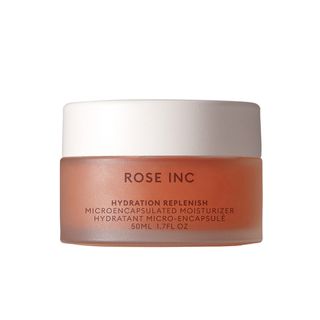
ROSE INC Hydration Replenish Microencapsulated Moisturiser
Works for
2 of 2 advertised claims delivered
Moisturizing14 ingredients credited for this claimStrong support
“Hydration Replenish Microencapsulated Moisturiser”
This product can help improve hydration of the skin with the two types of ingredients.
The first type is called “humectants”:
these ingredients help attract water.
When humectants are on the surface of the skin, they “pull in” the moisture from the outside environment, or from
within deeper layers of the skin. The following ingredients in this product do the job:
betaine, glycerin.
This product also contains ingredients called “occlusives”. They help reduce the speed with which our skin loses moisture to the outside environment. These ingredients also help soften the upper layer of the skin, so it feels less tight and nicer to the touch. The following ingredients in this product do the job: caprylic/capric triglyceride, helianthus annuus seed oil.
The following ingredients in this product are especially good for supporting the skin barrier and helping with the hydration level: niacinamide, palmitoyl tetrapeptide-7
Evens skin tone4 ingredients credited for this claimStrong support
“Key Benefits Delivers intense hydration and powerful actives Promotes a calmer, luminous finish Non-comedogenic, weightless formula Encourages a more even skin tone Intensely hydrating Boosts elasticity Plumps and preps the skin for makeup UK200033466”
This product can help reduce hypepigmentation and even out the skin tone because it contains the following effective ingredients: niacinamide
The following ingredient (ingredients) in this product might be helpful, but there is no evidence to confirm that it actually can help even out the skin tone: chrysin.
Keep in mind that you would need to apply any topical skincare targetted at hypigmentation consistently for a couple of months to get a result. No topical skincare product can help get rid of hyperpigmentation (including post-acne marks and age spots) instantly.
Anti-agingNot advertised by the brand · 7 ingredients credited for this claimStrong support
This product can help reduce and prevent fine lines and wrinkles, improve skin elasticity and firmness because it contains niacinamide.
These ingredients in the product can also be helpful, even though there is less evidence for their effectiveness: palmitoyl tetrapeptide-7.
Keep in mind that it typically takes at least 6 weeks to notice any results because the changes that are needed to improve fine lines and elasticity happen in the deeper layers of the skin. No topical anti-aging product can “erase” wrinkles or fully reverse signs of aging.
Anti-blemishNot advertised by the brand · 2 ingredients credited for this claimStrong support
This product can help reduce breakouts and clogged pores because it contains the following ingredient: niacinamide. This ingredient is used for treating acne and can have a noticeable effect.
Anti-oxidationNot advertised by the brand · 5 ingredients credited for this claimModerate support
This product contains antioxidants (chrysin) that might be able to help neutralize free radicals in skin to lessen the damage it gets from the UV light (sun). There is not enough evidence to confirm their effectiveness in skin though.
Can it cause trouble?
Irritancy7 strong irritants: Rosmarinus officinalis leaf extract, Citrus aurantium bergamia fruit oil + 5 more — patch-test recommendedHigh risk
ComedogenicClean of flagged comedogenic ingredientsNone flagged

User reviews
Be the first — your take helps the next person decide.
Ingredients
Filter by role to see what each ingredient is doing.
Water~40–60%
Propanediol~4.5–6.7%
- Irritation risk
- Low
Acts as a solvent for other ingredients. Speeds up the absorption of other ingredients into the skin
More about PropanediolCaprylic/capric triglyceride~3.7–5.5%
- Irritation risk
- Medium
A good mix of fatty acids that forms a protective layer on the skin. Improves the shelf life of products. Derived from coconut and glycerin
More about Caprylic/capric triglycerideGlycerin~2.7–4%
- Irritation risk
- Low
One of the best moisturizing ingredients. Naturally present in skin. It attracts water to the upper layer of the skin working as a humectant
More about GlycerinBetaine~2.1–3.1%
- Irritation risk
- Low
Helps attract water to the upper layer of the skin and improves the product texture
More about BetainePentylene glycol~1.7–2.6%
- Irritation risk
- Medium
Used to preserve products, dissolve other ingredients and create a nice product texture
More about Pentylene glycolSqualane~1.5–2.3%
- Irritation risk
- Low
An oil naturally present in skin. Works as an emollient to soften the skin and form a protective layer on its surface without a greasy feeling.
More about SqualaneNiacinamide~1.3–1.9%
- Irritation risk
- Low
Is proven to be effective in reducing blemishes, evening out skin tone and helping to improve lines and wrinkles. It helps the skin to repair sun damage, calm down inflammation and keep maintain good levels of moisture. The concentration of about 2% is effective for supporting the skin barrier and evening out the skin tone. Concentration of 4-6% is better for helping with acne and balancing the sebum production
More about NiacinamideLimnanthes alba seed oil~1.1–1.6%
- Irritation risk
- Low
This oil's cmposition is closest to rapeseed oil. It is a very stable oil and serves as an emoillient
More about Limnanthes alba seed oilCoco-caprylate/caprate~0.85–1.3%
- Irritation risk
- Low
Helps to soften the upper layer of the skin without creating a greasy texture
More about Coco-caprylate/caprateCentella asiatica leaf cell extract~0.5–1.2%
- Irritation risk
- Medium
A plant extract that has been shown to be able to reduce inflammation in skin, support restoration of skin barrier function, as well as support collagen production. It can be irritating to sensitive skin. Might be helpful in preventing stretch marks. It could, however, itself be irritating.
More about Centella asiatica leaf cell extractPalmitoyl tetrapeptide-7~0.45–1.05%
- Irritation risk
- Low
A type of peptide. Peptides are excellent moisturizers and might be able support collagen production reducing fine lines and wrinkles
More about Palmitoyl tetrapeptide-7Ascorbyl tetraisopalmitate~0.4–0.9%
- Irritation risk
- Medium
A vitamin C derivative. Studies show that is might be effective in reducing hyperpigmentation, but there are no studies confirming that it is effectively converted into the bioavailable form of Vitamin C in skin. It is not clear how this derivative compares in effectiveness to the topical application of bioavailable form of vitamin C (L-ascorbic acid)
More about Ascorbyl tetraisopalmitateTocopherol~0.35–0.8%
- Irritation risk
- Low
Pure form of vitamin E. Can help moisturise and protect the skin from free radicals. Often used to help stabilise other ingredients or the formula itself
More about TocopherolLactic acid~0.3–0.7%
- Irritation risk
- Medium
An exfoliating and moisturizing alpha-hydroxy acid (AHA). Typically causes less irritation than other AHAs, for example, glycolic acid. At high concentrations (about 15%), lactic acid can help reduce lines and wrinkles. Recent studies show that lactic acid can support the "good" bacteria living on skin's surface (healthy skin microbiome)
More about Lactic acidChrysin~0.3–0.75%
- Irritation risk
- Medium
Might be helpful in reducing fine lines and wrinkles, as well as lightening the skin, but solid evidence is missing. Could somewhat help in reducing the darkness of the under-eye area. Helps to neutralise free radicals in skin
More about ChrysinCastor oil/ipdi copolymer~0.3–0.75%
Helianthus annuus seed oil~0.3–0.7%
- Irritation risk
- Low
A great emollient due to its high linoleic acid content. One of the most effective plant oils in helping skin hydration and repairing skin barrier function
More about Helianthus annuus seed oilRosmarinus officinalis leaf extract~0.15–0.65%
- Irritation risk
- High
Can be helpful in reducing inflammation in skin, including inflamed acne. It can be irritating
More about Rosmarinus officinalis leaf extractSynthetic fluorphlogopite~0.15–0.65%
- Irritation risk
- Low
A mineral that is used as an optical filter (makes the skin looks nicer through light reflection) and to improve the texture of cosmetic products
More about Synthetic fluorphlogopiteAcrylates/c10-30 alkyl acrylate crosspolymer~0.15–0.6%
- Irritation risk
- Medium
Maintains the texture of skincare products. Allows the product to spread evenly. Helps oil and water mix together
More about Acrylates/c10-30 alkyl acrylate crosspolymerTrisodium ethylenediamine disuccinate~0.15–0.55%
- Irritation risk
- Medium
Used to improve stability of the formulation
More about Trisodium ethylenediamine disuccinatePotassium oxide~0.1–0.5%
- Irritation risk
- Low
Ci 77491~0.1–0.45%
- Irritation risk
- Low
A red colorant made of iron oxide. Typically is not irritating
More about Ci 77491Benzyl alcohol~0.1–0.4%
- Irritation risk
- High
A preservative. Can be used to mask unpleasant smell. Can be irritating
More about Benzyl alcoholCitric acid~0.1–0.4%
- Irritation risk
- Medium
Can work as an exfoliant but is typically used to adjust the product pH
More about Citric acidSodium hydroxide~0.1–0.4%
Pelargonium graveolens stem leaf oil~0.1–0.35%
- Irritation risk
- Low
Citrus aurantium bergamia fruit oil~0.05–0.3%
- Irritation risk
- High
A plant oil with a high content of volatile compounds that can irritate the skin and lead to allergic reactions. Can lead to photosensitivity
More about Citrus aurantium bergamia fruit oilCitral~0.05–0.25%
Citronellol~0.05–0.25%
Geraniol~0.05–0.2%
Limonene~0.05–0.15%
- Irritation risk
- High
A common frangrance that can easily irritate skin, especially if exposed to air, light or heat
More about LimoneneLinalool~0.05–0.1%
Ingredient list view
Water, Propanediol, Caprylic/capric triglyceride, Glycerin, Betaine, Pentylene glycol, Squalane, Niacinamide, Limnanthes alba seed oil, Coco-caprylate/caprate, Centella asiatica leaf cell extract, Palmitoyl tetrapeptide-7, Ascorbyl tetraisopalmitate, Tocopherol, Lactic acid, Chrysin, Castor oil/ipdi copolymer, Helianthus annuus seed oil, Rosmarinus officinalis leaf extract, Synthetic fluorphlogopite, Acrylates/c10-30 alkyl acrylate crosspolymer, Trisodium ethylenediamine disuccinate, Unknown, Potassium oxide, Ci 77491, Benzyl alcohol, Citric acid, Sodium hydroxide, Pelargonium graveolens stem leaf oil, Citrus aurantium bergamia fruit oil, Citral, Citronellol, Geraniol, Limonene, Linalool
Compare prices
Retailers ranked by price — lowest first.

Affiliate links · prices updated regularly
Worth comparing, line by line.
Match % combines shared ingredients, the first five ingredients, shared actives and hero ingredients, irritancy (lower counts in the alternative's favour), texture and body area. Only products in the same routine step are compared.
| ROSE INCHydration Replenish Microencapsulated MoisturiserYOUR PRODUCT | SchafMoisturizer | Kester BlackSkin Drench Moisturiser | Vitabrid USWrinkle Cream: Anti-Aging Face Brightening | Vitabrid US | |
|---|---|---|---|---|
| Match | — | 80% | 80% | 79% |
| Price | $20.00 | — | — | $70.00+$50.00 |
| Shared key ingredients | — | 8 of 13 | 6 of 13 | 7 of 13 |
| Key difference | — | Bakuchiol | Palmitoyl Tripeptide-1 | Copper Tripeptide-1 |
| Irritancy | High | Low | Medium | Medium |
| Drying alcohol | — | — | — | — |
| View product | Shop | Shop | Shop |


Product summary
Judging from the ingredient list, "ROSE INC - Hydration Replenish Microencapsulated Moisturiser" works well for improving skin hydration To work well, any moisturizer needs to include a combination of water-binding and emollient ingredients. ROSE INC - Hydration Replenish Microencapsulated Moisturiser ticks this box. Humectants in this product (betaine and glycerin) help to increase the water content in the upper layer of the skin. (These ingredients do so by "capturing" water molecules from the outside air or from within the deeper layers of the skin). Emollients in this formulation (palmitoyl tetrapeptide-7, limnanthes alba seed oil, caprylic/capric triglyceride, helianthus annuus seed oil and squalane) help to reduce the moisture loss from the skin. They also soften the skin surface and relieve the feeling of dryness and tightness.
Ingredient callouts
- We like that this moisturizer contains peptides (palmitoyl tetrapeptide-7 0.45% - 1.05%). There are many different kind of Peptides and they are naturally present in our skin. They all are a combination of aminoacids. Some of them work as natural antibiotics, promote wound-healing and production of collagen. The science is still not settled on how effective Peptides are in skincare, but it is very likely that they have a benefit. Peptides might help restore the skin barrier and fight the signs of aging. At the very least, Peptides work as humectants: they attract water to the upper layer of the skin and improve its hydration.
Irritation risk
There are quite a few common irritants in this product, including ingredients without particular skin benefits. We would not recommend it for sensitive skin. We assess the overall irritancy of this moisturizer to be high. For a detailed overview of all potential irritants: click here
You can see the detailed formula review with the breakdown of all actives in the product and the full ingredient list with estimated concentrations in the tables below.
About the brand
According to Cruelty-Free Kitty "ROSE INC" is cruelty free and so is its parent company.
Price
The product retails from 20.00£ up to 28.50£ in the United Kingdom and for 20.00$ in the United States.
For a detailed price comparison: click here.
Sources cited in this review
Every concentration estimate and effectiveness label is anchored to one of these 28 studies and safety reviews.
- 1
- 2
- 3
- 4Safety Assessment of Alkyl Esters as Used in Cosmeticscir-safety.org
- 5Centella asiatica in Dermatology: An Overviewonlinelibrary.wiley.com
- 6Contact dermatitis due to Madecassolonlinelibrary.wiley.com

Affiliate links · As an Amazon Associate, WIMJ earns from qualifying purchases.