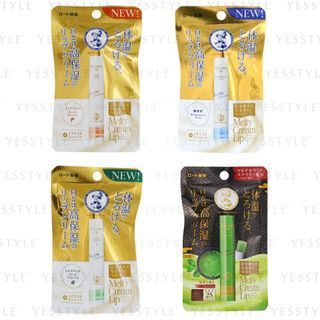
Rohto Mentholatum Melty Cream Lip Balm SPF 25 PA+++ - 4 Types
Works for
1 of 2 advertised claims delivered
Sun protectionSPF 25 · 2 UV filters · Broad spectrumWeak protectionSPF under 30
This product offers broad spectrum sun protection, but it is weak. We recommend to use a broad spectrum sunscreen with at least SPF 30.
MoisturizingCeramide 2, Ceramide 6 ii + 21 moreStrong evidence
“Smooth and melts upon contact with skin, this lip cream contains moisturizing ingredients such as squalene and ceramides for powerful moisture retention.”
This product can help soften the skin and reduce its moisture loss with emollients and occlusives: squalane, cholesterol.
Keep in mind that this product does not contain effective ingredients to attract water to the upper layer of the skin. This is why an additional product with humectants like glycerin or hyaluronic acid can be helpful (apply it before this product for the best results).
The following ingredients in this product are especially good for supporting the skin barrier and helping with the hydration level: ceramide 2, ceramide 3, ceramide 6 ii, paraffinum liquidum, petrolatum
Anti-agingNot advertised by the brand · Epigallocatechin gallate, Butyrospermum parkii butter + 1 moreModerate evidence
This product contains epigallocatechin gallate. This ingredient might be able to help reduce and prevent fine lines and wrinkles, improve skin elasticity and firmness, but there is not enough evidence that it actually works. The biggest anti-aging effect in this product comes from sun protection. Sun damage is the main factor causing early signs of skin aging. We, however, do not recommend using this product as a sunscreen because the protection it offers is not strong enough).
Anti-oxidationNot advertised by the brand · Epigallocatechin gallate, Tocopheryl acetate + 3 moreModerate evidence
This product contains antioxidants (epigallocatechin gallate) that might be able to help neutralize free radicals in skin to lessen the damage it gets from the UV light (sun). There is not enough evidence to confirm their effectiveness in skin though.
Can it cause trouble?
Irritancy1 strong irritant: ParfumMedium risk
Comedogenic1 ingredient rated 2 or more on the 0–5 pore-clogging scale1 flagged
User reviews
Be the first — your take helps the next person decide.
Ingredients
Filter by role to see what each ingredient is doing.
Squalane~25–38%
- Irritation risk
- Low
An oil naturally present in skin. Works as an emollient to soften the skin and form a protective layer on its surface without a greasy feeling.
More about SqualanePetrolatum~5.3–7.9%
- Irritation risk
- Low
One of the most effective and the most studied occlusive ingredients that creates a protective layer on top of the skin preventing moisture loss
More about PetrolatumParaffin~4.6–6.9%
- Irritation risk
- Low
Prevents water loss from the skin surface and thickens the product consistency
More about ParaffinParaffinum liquidum~3.4–5.1%
- Irritation risk
- Low
Mineral oil. One of the most effective and well studied occlusive and emollient moisturizing ingredients. Helps reduce moisture loss in skin and repair skin barrier function
More about Paraffinum liquidumHydrogenated polyisobutene~2.5–3.7%
- Irritation risk
- Low
Used to improve the product consistency and soften the upper layer of the skin
More about Hydrogenated polyisobuteneDiisostearyl malate~2–2.9%
- Irritation risk
- Medium
Helps to soften the upper layer of the skin
More about Diisostearyl malateEthylhexyl methoxycinnamate~1.9–2.9%
- Irritation risk
- High
Octinoxate. When used in higher concentrations, works as a sunscreen protecting the skin from UVB rays. When used in lower concentration, helps to preserve the product formulation. Is shown to be harmful to coral reefs - consider avoiding bathing in coral reef areas when wearing a product with this ingredient. It can be irritating
More about Ethylhexyl methoxycinnamateDipentaerythrityl hexahydroxystearate/hexastearate/hexarosinate~1.3–1.9%
- Irritation risk
- Low
Microcrystalline wax~1.1–1.7%
Butyrospermum parkii butter~0.95–1.4%
- Irritation risk
- Low
- Comedogenicity
- 3/5
A great moisturising ingredient that softens the skin and reduces water loss from its upper layer. It also can be helpful in protecting skin from free radicals
More about Butyrospermum parkii butterPolyglyceryl-2 diisostearate~0.55–1.25%
Phytosteryl macadamiate~0.5–1.2%
- Irritation risk
- Low
Helps soften the upper layer of the skin
More about Phytosteryl macadamiateCeramide 3~0.45–1.1%
- Irritation risk
- Low
A type of lipid similar to ceramides naturally present in skin. Helps to soften the upper layer of the skin and supports the skin barrier function to keep it hydrated. Can help to prevent inflammation in skin
More about Ceramide 3Ceramide 2~0.45–1%
- Irritation risk
- Low
A type of lipid similar to ceramides naturally present in skin. Helps to soften the upper layer of the skin and supports the skin barrier function to keep it hydrated. Can help to prevent inflammation in skin
More about Ceramide 2Ceramide 6 ii~0.4–0.95%
- Irritation risk
- Low
A type of lipid similar to ceramides naturally present in skin. Helps to soften the upper layer of the skin and supports the skin barrier function to keep it hydrated. Can help to prevent inflammation in skin
More about Ceramide 6 iiHoney~0.35–0.8%
- Irritation risk
- Low
Helps attract water to the skin and might have some anti-bacterial properties. Can be an allergen
More about HoneyPersea gratissima oil~0.4–0.95%
- Irritation risk
- Medium
An emollient that helps soften the skin and could be helpful in repairing its barrier function
More about Persea gratissima oilMacadamia ternifolia seed oil~0.4–0.9%
- Irritation risk
- Medium
Plant oil from nuts that helps soften the upper layer of the skin. Contains a high concentration of oleic acid that can weaken skin's barrier function and increase water-loss while enhancing penetration of other ingredients
More about Macadamia ternifolia seed oilOlea europaea fruit oil~0.35–0.8%
- Irritation risk
- Medium
An emollient that helps soften the skin but is not effective for restoring its barrier function. Might be helpful to calm down inflammation
More about Olea europaea fruit oilSimmondsia chinensis seed oil~0.35–0.85%
- Irritation risk
- Medium
Softens the upper layer of skin and helps restore the healthy skin barrier. Has shown to help calm down inflammation in skin. It is a stable oil, meaning that it retains its properties even when exposed to air.
More about Simmondsia chinensis seed oilButyl methoxydibenzoylmethane~0.4–0.95%
- Irritation risk
- Medium
Avobenzone. An organic, or so-called "chemical" UV filter. Protects against both UVA and UVB rays. Needs to be combined with other filters in a formulation to be stable.
More about Butyl methoxydibenzoylmethaneDipropylene glycol~0.15–0.65%
- Irritation risk
- Low
Helps to dissolve other ingredients in a formulation. Slows down the rate of product drying
More about Dipropylene glycolVp/eicosene copolymer~0.2–0.75%
- Irritation risk
- Medium
Used to improve the product adherence to the skin, for example, to pro-long the protective effect of sunscreens. Can be irritating to very sensitive skin
More about Vp/eicosene copolymerPolyglyceryl-4 oleate~0.2–0.7%
- Irritation risk
- Medium
Helps oil and water mix together
More about Polyglyceryl-4 oleateCholesterol~0.3–0.75%
- Irritation risk
- Low
An emollient that is naturally found in skin
More about CholesterolArgania spinosa kernel oil~0.3–0.7%
- Irritation risk
- Medium
An emollient that helps soften the upper layer of the skin. Might have some weak anti-oxidant properties
More about Argania spinosa kernel oilTocopheryl acetate~0.15–0.65%
- Irritation risk
- Medium
A more stable but less bio-available form of vitamin E compared to Tocopherol. Might help moisturize and protect the skin from free radicals, but mostly used in low concentrations to stabilize other ingredients.
More about Tocopheryl acetateSynthetic wax~0.2–0.75%
- Irritation risk
- Low
Used to stabilize product formulations and thicken product consistency
More about Synthetic waxIron oxides~0.15–0.6%
- Irritation risk
- Low
An umbrella term for the following three colorants: CI 77491, CI 77492, CI 77499. They might be able to offer some protection against visible light, but the degree of the protection is not clear
More about Iron oxidesWater~0.15–0.6%
Hydrogenated lecithin~0.15–0.6%
- Irritation risk
- Low
Helps to retain moisture by creating a protective barrier on the skin. Rich in fatty acids. Improves product texture and helps with the penetration of other ingredients.
More about Hydrogenated lecithinGlycine soja sterols~0.2–0.75%
- Irritation risk
- Low
An emollient that helps soften the skin
More about Glycine soja sterolsIsopropyl titanium triisostearate~0.2–0.7%
- Irritation risk
- Medium
Helps water and oil mix together
More about Isopropyl titanium triisostearateButylene glycol~0.1–0.4%
- Irritation risk
- Low
Used to create a nice product texture and help delivery of other ingredients. Might be somewhat helpful in attracting water to the upper layer of the skin
More about Butylene glycolRoyal jelly extract~0.1–0.35%
- Irritation risk
- Medium
A compound secreted by bees. Might be able to attract water to the top layer of the skin. Avoid if sensitive to honey and bee products
More about Royal jelly extractCamellia sinensis leaf extract~0.1–0.35%
- Irritation risk
- Low
Can contain potent anti-oxidant compounds (abbreviated ECG, GCG, EGC, and EGCG) that might help protect the skin from free radicals. Can help calm down inflammation and has some anti-bacterial properties. Unfortunately, these antioxidants are unstable and lose their effectiveness very quickly in products. The concentration of the antioxidant compounds in the extract also tends to be low to be effective in topical formulation
More about Camellia sinensis leaf extractEpigallocatechin gallate~0.05–0.3%
- Irritation risk
- Low
A polyphenol found in tea. This particular compound abbreviated EGCG is the most powerful antioxidant among those extracted from tea (usually green tea). Unfortunately, EGCG is unstable, requires a low pH (below 4) to prevent quick degradation, and does not penetrate the skin very well. This is why the full anti-oxidant effect of EGCG is typically not realized when it is added to topical skincare
More about Epigallocatechin gallateParfum~0.05–0.2%
- Irritation risk
- High
An aromatic blend of unspecified and possibly irritating ingredients
More about ParfumUltramarines~0.05–0.2%
- Irritation risk
- Low
Ci 19140~0.05–0.15%
Ingredient list view
Squalane, Petrolatum, Paraffin, Paraffinum liquidum, Hydrogenated polyisobutene, Diisostearyl malate, Ethylhexyl methoxycinnamate, Dipentaerythrityl hexahydroxystearate/hexastearate/hexarosinate, Microcrystalline wax, Butyrospermum parkii butter, Polyglyceryl-2 diisostearate, Phytosteryl macadamiate, Ceramide 3, Ceramide 2, Ceramide 6 ii, Honey, Persea gratissima oil, Macadamia ternifolia seed oil, Olea europaea fruit oil, Simmondsia chinensis seed oil, Butyl methoxydibenzoylmethane, Dipropylene glycol, Vp/eicosene copolymer, Polyglyceryl-4 oleate, Cholesterol, Argania spinosa kernel oil, Tocopheryl acetate, Synthetic wax, Iron oxides, Water, Hydrogenated lecithin, Glycine soja sterols, Isopropyl titanium triisostearate, Butylene glycol, Royal jelly extract, Camellia sinensis leaf extract, Epigallocatechin gallate, Parfum, Ultramarines, Ci 19140
Compare prices
Retailers ranked by price — lowest first.

Affiliate links · prices updated regularly
Product summary
"Rohto Mentholatum - Melty Cream Lip Balm SPF 25 PA+++ - 4 Types" "is a broad spectrum lip sunscreen meaning that it protects both from UVB rays (" burning "- they cause sunburn) and UVA rays (" aging "- they don't cause sunburn but lead to premature aging and pigmentation issues). However, this lip product does not offer enough sun protection. We recommend to use a sunscreen with at least SPF 30 daily.
Sunscreen filters
This is a so-called" chemical "sunscreen. It means that it uses organic UV filters. They typically offer good sun protection and rarely leave a white cast, but they can be irritating for some people with sensitive skin. These are the sun protection ingredients in this sunscreen: avobenzone 0.40% - 0.95% and octinoxate 1.90% - 2.90%.
Irritation risk
There are some common irritants in this product, including ingredients that do not have benefits for the skin. We assess the overall irritancy of it to be medium. For a detailed overview of all potential irritants: click here
You can see the detailed formula review with the breakdown of all actives in the product and the full ingredient list with estimated concentrations in the tables below.
Price
The product retails for 6.12$ in the United States.
For a detailed price comparison: click here.
Sources cited in this review
Every concentration estimate and effectiveness label is anchored to one of these 12 studies and safety reviews.
- 1A review on the extensive skin benefits of mineral oilncbi.nlm.nih.gov
- 2
- 3Safety Assessment of Phytosterols as Used in Cosmeticscir-safety.org
- 4
- 5
- 6Use of “natural” oils for moisturization: Review of olive, coconut, and sunflower seed oilonlinelibrary.wiley.com

Affiliate links · As an Amazon Associate, WIMJ earns from qualifying purchases.