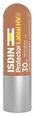
ISDIN Protector Labial HV Lip Balm SPF30
Works for
1 of 2 advertised claims delivered
Sun protectionSPF 30 · 3 UV filters · Broad spectrumWeak protectionLow filter dose
Moisturizing12 ingredients credited for this claimStrong support
“Isdin Protector Labial HV Lip Balm SPF30 4g is a lip balm offering a high sun protection while moisturizing the hypersensitive lips. Dermatologically tested.”
This product can help soften the skin and reduce its moisture loss with emollients and occlusives: cera microcristallina, ricinus communis seed oil.
Keep in mind that this product does not contain effective ingredients to attract water to the upper layer of the skin. This is why an additional product with humectants like glycerin or hyaluronic acid can be helpful (apply it before this product for the best results).
The following ingredients in this product are especially good for supporting the skin barrier and helping with the hydration level: paraffinum liquidum, petrolatum
Can it cause trouble?
Irritancy2 strong irritants: Parfum, Retinyl palmitateMedium risk
Comedogenic4 ingredients rated 2 or more on the 0–5 pore-clogging scale4 flagged
User reviews
Be the first — your take helps the next person decide.
Ingredients
Filter by role to see what each ingredient is doing.
Ricinus communis seed oil~25–37%
- Irritation risk
- Medium
A plant oil that can help soften the skin. It might be helpful in calming down inflammation, but solid research is lacking. Is often used in lip products to create the needed product consistency
More about Ricinus communis seed oilCandelilla cera~5.6–8.3%
- Irritation risk
- Low
Euphorbia cerifera wax~5.1–7.7%
- Irritation risk
- Low
Petrolatum~4–6%
- Irritation risk
- Low
One of the most effective and the most studied occlusive ingredients that creates a protective layer on top of the skin preventing moisture loss
More about PetrolatumCera microcristallina~3.2–4.8%
- Irritation risk
- Low
Helps to soften the upper layer of the skin, reduce water loss from its surface and create a thicker product consistency
More about Cera microcristallinaMicrocrystalline wax~2.3–3.5%
Ethylhexyl methoxycinnamate~2.2–3.3%
- Irritation risk
- High
Octinoxate. When used in higher concentrations, works as a sunscreen protecting the skin from UVB rays. When used in lower concentration, helps to preserve the product formulation. Is shown to be harmful to coral reefs - consider avoiding bathing in coral reef areas when wearing a product with this ingredient. It can be irritating
More about Ethylhexyl methoxycinnamateParaffinum liquidum~1.6–2.4%
- Irritation risk
- Low
Mineral oil. One of the most effective and well studied occlusive and emollient moisturizing ingredients. Helps reduce moisture loss in skin and repair skin barrier function
More about Paraffinum liquidumIsopropyl myristate~1.3–1.9%
- Irritation risk
- Low
- Comedogenicity
- 3/5
An emollient that helps soften the skin. Could be comedogenic
More about Isopropyl myristateOctyldodecanol~1–1.6%
- Irritation risk
- Low
An emollient that helps to soften the skin and create a pleasant product texture and stabilize the formulation
More about OctyldodecanolC12-15 alkyl benzoate~0.9–1.35%
- Irritation risk
- Low
Enhances the product texture and makes it more spreadable. Helps reduce water loss from the outer layer of skin. Extands the shelf life by preventing bacteria growth
More about C12-15 alkyl benzoateTitanium dioxide~1–1.5%
- Irritation risk
- Low
Works as a UV filter when used in high concentrations. It is photostable and is effective mostly against the UVB light, with some protection in the UVA range. In small concentrations, used for its ability to improve the color of cosmetic products. Is usually well tolerated by the skin
More about Titanium dioxideCetyl acetate~0.55–1.3%
- Irritation risk
- Low
- Comedogenicity
- 3/5
Isostearyl neopentanoate~0.5–1.2%
- Irritation risk
- Medium
- Comedogenicity
- 2/5
Used to create a nice product texture and helps soften the upper layer of the skin. Could be comedogenic
More about Isostearyl neopentanoateButyl methoxydibenzoylmethane~0.6–1.35%
- Irritation risk
- Medium
Avobenzone. An organic, or so-called "chemical" UV filter. Protects against both UVA and UVB rays. Needs to be combined with other filters in a formulation to be stable.
More about Butyl methoxydibenzoylmethaneLanolin alcohol~0.5–1.2%
- Irritation risk
- Medium
Helps oil and water mix together. Can be irritating
More about Lanolin alcohol1,2-hexanediol~0.4–0.95%
Alumina~0.45–1%
- Irritation risk
- Low
The same compound that is used safely in dental implants and bone cements. In cosmetics, it is used to improve the consistency of products
More about AluminaParfum~0.2–0.75%
- Irritation risk
- High
An aromatic blend of unspecified and possibly irritating ingredients
More about ParfumRosa canina fruit oil~0.35–0.8%
- Irritation risk
- Medium
A great emollient. Contains vitamin E (tocopherol) which may give it some anti-oxidant properties. Can contain volatile compounds and can be irritating
More about Rosa canina fruit oilCaprylyl glycol~0.3–0.75%
- Irritation risk
- Medium
Helps preserve products and creates a nice product texture
More about Caprylyl glycolAcetylated lanolin alcohol~0.3–0.75%
Lauryl methacrylate/glycol dimethacrylate crosspolymer~0.2–0.8%
- Irritation risk
- Low
Tocopheryl acetate~0.15–0.5%
- Irritation risk
- Medium
A more stable but less bio-available form of vitamin E compared to Tocopherol. Might help moisturize and protect the skin from free radicals, but mostly used in low concentrations to stabilize other ingredients.
More about Tocopheryl acetateRetinyl palmitate~0.1–0.45%
- Irritation risk
- High
Three steps removed from the active form of vitamin A - retinoic acid. To have an effect in the skin, it first needs to be converted twice to become the retinoic acid. This means it is less potent than retinol, but could also be less irritating. Once converted to the retinoic acid in the skin, it helps against all signs of aging, improves skin cell turnover and helps fight blemishes and clogged pores. However, in many cosmetic formulations, it is used in a concentration that is too low to have the full effect
More about Retinyl palmitateSilica~0.2–0.75%
Bht~0.1–0.35%
Tocopherol~0.1–0.35%
- Irritation risk
- Low
Pure form of vitamin E. Can help moisturise and protect the skin from free radicals. Often used to help stabilise other ingredients or the formula itself
More about TocopherolCi 77492~0.05–0.25%
Iron oxides~0.05–0.2%
- Irritation risk
- Low
An umbrella term for the following three colorants: CI 77491, CI 77492, CI 77499. They might be able to offer some protection against visible light, but the degree of the protection is not clear
More about Iron oxidesCi 77491~0.05–0.15%
- Irritation risk
- Low
A red colorant made of iron oxide. Typically is not irritating
More about Ci 77491Ingredient list view
Ricinus communis seed oil, Candelilla cera, Euphorbia cerifera wax, Petrolatum, Cera microcristallina, Microcrystalline wax, Ethylhexyl methoxycinnamate, Paraffinum liquidum, Isopropyl myristate, Octyldodecanol, C12-15 alkyl benzoate, Titanium dioxide, Cetyl acetate, Isostearyl neopentanoate, Butyl methoxydibenzoylmethane, Lanolin alcohol, 1,2-hexanediol, Alumina, Parfum, Rosa canina fruit oil, Caprylyl glycol, Acetylated lanolin alcohol, Lauryl methacrylate/glycol dimethacrylate crosspolymer, Tocopheryl acetate, Retinyl palmitate, Silica, Bht, Tocopherol, Ci 77492, Iron oxides, Ci 77491
Compare prices
Retailers ranked by price — lowest first.
Product summary
"ISDIN - Protector Labial HV Lip Balm SPF30" is using UV filters in a relatively low concentration. Because of this, it might not be able to provide reliable sun protection.
Sunscreen filters
This sunscreen uses so-called "chemical", or organic UV filters (organic simply means that their molecules contain atoms of carbon). These filters typically give good sun protection and rarely leave a white cast, but they can be irritating for sensitive skin. The UV filters in this sunscreen are: avobenzone 0.60% - 1.35% and octinoxate 2.20% - 3.30%.
Irritation risk
There are some common irritants in this product, including ingredients that do not have benefits for the skin. We assess the overall irritancy of this lip product to be medium. For a detailed overview of all potential irritants: click here
You can see the detailed formula review with the breakdown of all actives in the product and the full ingredient list with estimated concentrations in the tables below.
Sources cited in this review
Every concentration estimate and effectiveness label is anchored to one of these 10 studies and safety reviews.
- 1
- 2
- 3
- 4A review on the extensive skin benefits of mineral oilncbi.nlm.nih.gov
- 5
- 6

Affiliate links · As an Amazon Associate, WIMJ earns from qualifying purchases.