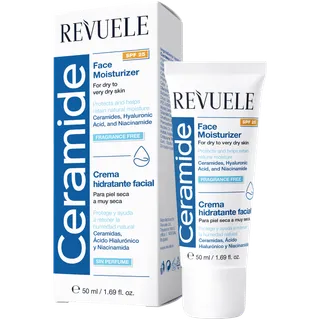
Revuele Ceramide cream SPF25
Works for
Sun protectionSPF 25 · 5 UV filters · Broad spectrumWeak protectionSPF under 30
This product offers broad spectrum sun protection, but it is weak. We recommend to use a broad spectrum sunscreen with at least SPF 30.
This product can be considered "reef safe" because it does not contain the UV filters (oxybenzone and octinoxate) that can be harmful to coral reefs when present in the water in high concentrations.
MoisturizingCetearyl alcohol, Cetyl alcohol + 10 moreWorks
“Tento lehký krém je oblíbeným produktem mnoha lidí trpících různými stupni suchosti pleti. Vyhlazuje a zjemňuje pokožku, zmírňuje nepříjemné pocity a poskytuje dlouhodobou hydrataci.”
This product can help improve hydration of the skin with the two types of ingredients.
The first type is called “humectants”:
these ingredients help attract water.
When humectants are on the surface of the skin, they “pull in” the moisture from the outside environment, or from
within deeper layers of the skin. The following ingredients in this product do the job:
sodium hyaluronate, peg-8.
This product also contains ingredients called “occlusives”. They help reduce the speed with which our skin loses moisture to the outside environment. These ingredients also help soften the upper layer of the skin, so it feels less tight and nicer to the touch. The following ingredients in this product do the job: cocos nucifera oil, dimethicone.
Can it cause trouble?
Irritancy12 flagged ingredientsLow risk
Comedogenic3 ingredients rated 2 or more on the 0–5 pore-clogging scale3 flagged

User reviews
Be the first — your take helps the next person decide.
Ingredients
Filter by role to see what each ingredient is doing.
Water~45–55%
Octocrylene~5.7–7%
- Irritation risk
- Medium
A weak sunscreen that protects against the sun rays that cause sunburn (UVB) and is somewhat effective against the UVA rays. It is quite stable and can help stabilize other, more vulnerable, sunscreen ingredients like Avobenzone. It is an organic, or so called "chemical" sunscreen
More about OctocryleneHomosalate~4.6–5.6%
- Irritation risk
- Medium
A weak sunscreen that offers some protection against the sun rays that cause sunburn (UVB), but does not offer meaningful protection against protect against the most aging sun rays (UVA). It loses its effectiveness quickly when exposed to sunlight. It is an organic, or so called "chemical" sunscreen. When used in low concentrations, helps to stabilize the product formulation
More about HomosalateEthylhexyl salicylate~3.6–4.4%
- Irritation risk
- Low
Octisalate. A UV filter. It offers some protection against the sun rays that cause sunburn (UVB), but does not protect against the most aging sun rays (UVA). It loses its effectiveness quickly when exposed to sunlight. It is an organic, or so called "chemical" sunscreen
More about Ethylhexyl salicylateGlyceryl stearate~2.4–2.9%
- Irritation risk
- Low
An emollient that softens the skin and forms a protective layer on its surface. Helps water and oil mix together
More about Glyceryl stearateCetearyl alcohol~2–2.5%
- Irritation risk
- Low
- Comedogenicity
- 2/5
A non-drying alcohol. Works as an emollient. Helps water and oil mix together and creates a nice product texture
More about Cetearyl alcoholButyl methoxydibenzoylmethane~2.1–2.6%
- Irritation risk
- Medium
Avobenzone. An organic, or so-called "chemical" UV filter. Protects against both UVA and UVB rays. Needs to be combined with other filters in a formulation to be stable.
More about Butyl methoxydibenzoylmethanePotassium cetyl phosphate~1.5–1.8%
- Irritation risk
- Medium
Helps oil and water mix together
More about Potassium cetyl phosphatePropylene glycol~1.2–1.5%
- Irritation risk
- High
Helps oil and water mix together and can enhance the penetration of other ingredients into the skin. It can be irritating
More about Propylene glycolPhenylbenzimidazole sulfonic acid~1.4–1.8%
- Irritation risk
- Medium
Ensulizole. A UV filter that is effective against UVB rays. Does not protect against UVA light. It is photostable and can be used to help stabilize other sunscreen ingredients. It is water-soluble meaning that it can help create lighter sunscreen formulations
More about Phenylbenzimidazole sulfonic acidCetyl alcohol~0.95–1.15%
- Irritation risk
- Low
A non-drying alcohol that works to soften the skin and stabilize product formulations helping oil and water mix together
More about Cetyl alcoholPeg-8~0.65–0.95%
- Irritation risk
- Medium
Used to create a nice product consistency
More about Peg-8Peg-8/smdi copolymer~0.6–0.9%
- Irritation risk
- Low
Palmitoyl myristyl serinate~0.55–0.8%
- Irritation risk
- Low
Sodium polyacrylate~0.55–0.85%
- Irritation risk
- Low
Used to create a gel-like product texture, as well as to stabilize emulsions
More about Sodium polyacrylateDiisopropyl adipate~0.55–0.8%
- Irritation risk
- Low
Helps soften the upper layer of the skin
More about Diisopropyl adipateDimethicone~0.55–0.8%
- Irritation risk
- Low
A silicone that helps to reduce water loss from the surface of the skin. Can temporarily "fill in" lines and wrinkles, absorb oil, and create a nice product finish
More about DimethiconeStearic acid~0.55–0.85%
- Irritation risk
- Low
Helps oil and water mix together and works as an emollient
More about Stearic acidMyristic acid~0.45–0.65%
- Irritation risk
- Medium
- Comedogenicity
- 3/5
Helps oil and water mix together. Could be comedogenic
More about Myristic acidPhenoxyethanol~0.35–0.6%
- Irritation risk
- Low
A preservative. It helps prevent bacterial growth in cosmetic products
More about PhenoxyethanolCocos nucifera oil~0.3–0.5%
- Irritation risk
- Low
- Comedogenicity
- 3/5
An emollient. Found to be as effective as a moisturizer for dry skin as mineral oil. Could be comedogenic
More about Cocos nucifera oilTocopheryl acetate~0.25–0.5%
- Irritation risk
- Medium
A more stable but less bio-available form of vitamin E compared to Tocopherol. Might help moisturize and protect the skin from free radicals, but mostly used in low concentrations to stabilize other ingredients.
More about Tocopheryl acetateTocopherol~0.25–0.45%
- Irritation risk
- Low
Pure form of vitamin E. Can help moisturise and protect the skin from free radicals. Often used to help stabilise other ingredients or the formula itself
More about TocopherolSodium hyaluronate~0.2–0.4%
- Irritation risk
- Low
One of the best moisturizing ingredients. Attracts water into the upper layer of the skin
More about Sodium hyaluronateNiacinamide~0.15–0.3%
- Irritation risk
- Low
Is proven to be effective in reducing blemishes, evening out skin tone and helping to improve lines and wrinkles. It helps the skin to repair sun damage, calm down inflammation and keep maintain good levels of moisture. The concentration of about 2% is effective for supporting the skin barrier and evening out the skin tone. Concentration of 4-6% is better for helping with acne and balancing the sebum production
More about NiacinamideAcrylates/c10-30 alkyl acrylate crosspolymer~0.15–0.3%
- Irritation risk
- Medium
Maintains the texture of skincare products. Allows the product to spread evenly. Helps oil and water mix together
More about Acrylates/c10-30 alkyl acrylate crosspolymerTriethanolamine~0.15–0.25%
- Irritation risk
- Medium
Used to adjust pH of the product and can help improve the product's smell
More about TriethanolamineXanthan gum~0.1–0.2%
- Irritation risk
- Low
Used to create a thicker product consistency
More about Xanthan gumDisodium edta~0.05–0.1%
Octadecyl di-t-butyl-4-hydroxyhydrocinnamate~0.1–0.15%
- Irritation risk
- Low
Ingredient list view
Water, Octocrylene, Homosalate, Ethylhexyl salicylate, Glyceryl stearate, Cetearyl alcohol, Butyl methoxydibenzoylmethane, Potassium cetyl phosphate, Propylene glycol, Phenylbenzimidazole sulfonic acid, Cetyl alcohol, Unknown, Unknown, Unknown, Peg-8, Peg-8/smdi copolymer, Palmitoyl myristyl serinate, Sodium polyacrylate, Unknown, Diisopropyl adipate, Dimethicone, Stearic acid, Myristic acid, Phenoxyethanol, Cocos nucifera oil, Tocopheryl acetate, Tocopherol, Sodium hyaluronate, Niacinamide, Acrylates/c10-30 alkyl acrylate crosspolymer, Triethanolamine, Xanthan gum, Disodium edta, Octadecyl di-t-butyl-4-hydroxyhydrocinnamate
Compare prices
Retailers ranked by price — lowest first.

Worth comparing, line by line.
Match % combines shared ingredients, the first five ingredients, shared actives and hero ingredients, irritancy (lower counts in the alternative's favour), texture and body area. Only products in the same routine step are compared.
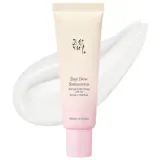
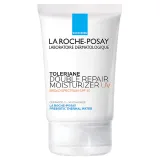
| RevueleCeramide cream SPF25YOUR PRODUCT | Beauty of JoseonDay Dew Sunscreen Lightweight Water-Resistant SPF 50 | OlayTotal Effects Anti-Aging Moisturizer With SPF 30 | La Roche-PosayToleriane Double Repair Face Moisturizer UV Broad Spectrum SPF 30 | |
|---|---|---|---|---|
| Match | — | 92% | 91% | 91% |
| Price | — | $18.00 | $11.00 | $25.99 |
| Shared key ingredients | — | 6 of 10 | 6 of 10 | 6 of 10 |
| Key difference | — | Panthenol | Panthenol | Ceramide Np |
| Irritancy | Low | Low | Low | Low |
| SPF | SPF 25 | SPF 50 | SPF 30 | SPF 30 |
| Drying alcohol | — | — | — | — |
| View product | Shop | Shop | Shop |
More alternatives: Keys Soulcare Daily Moisturizer Broad Spectrum SPF 30CeraVe AM Facial Moisturiser SPF25 - Normal to Dry Skin
Product summary
"Revuele - Ceramide cream SPF25" "is a broad spectrum sunscreen meaning that it protects both from UVB rays (" burning "- they cause sunburn) and UVA rays (" aging "- they don't cause sunburn but lead to premature aging and pigmentation issues). However, this moisturizer does not offer enough sun protection. We recommend to use a sunscreen with at least SPF 30 daily.
Its formula is also hydrating, so you might not need an additional moistruizer during the day.
Sunscreen filters
This sunscreen uses so-called" chemical ", or organic UV filters (organic simply means that their molecules contain atoms of carbon). These filters typically give good sun protection and rarely leave a white cast, but they can be irritating for sensitive skin. The UV filters in this sunscreen are: avobenzone 2.10% - 2.60%, octisalate 3.60% - 4.40%, homosalate 4.60% - 5.60%, octocrylene 5.70% - 6.90% and ensulizole 1.40% - 1.80%.
Irritation risk
This moisturizer contains some common irritants, including those without a benefit for the skin. We assess the overall irritancy of this moisturizer to be medium. For a detailed overview of all potential irritants: click here
You can see the detailed formula review with the breakdown of all actives in the product and the full ingredient list with estimated concentrations in the tables below.
Sources cited in this review
Every concentration estimate and effectiveness label is anchored to one of these 13 studies and safety reviews.
- 1
- 2Surfactants and experimental irritant contact dermatitisncbi.nlm.nih.gov
- 3Propylene Glycolpubmed.ncbi.nlm.nih.gov
- 4Skin-sensitizing and irritant properties of propylene glycolonlinelibrary.wiley.com
- 5
- 6Final Report on the Safety Assessment of Dimethicone Copolyoljournals.sagepub.com

Affiliate links · As an Amazon Associate, WIMJ earns from qualifying purchases.