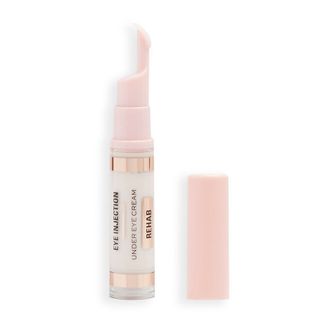
Revolution Makeup Revolution Rehab Eye Injection Under Eye Cream
Works for
0 of 1 advertised claim delivered
Anti-aging3 ingredients credited for this claimWeak support
“WHY YOUR SKIN WILL LOVE IT Packed full of superfood ingredients known to brighten and nourish the sensitive eye area and boost collagen to reduce puffiness 86% of consumers agreed that their eye area looked smoother and more hydrated 82% of consumers agreed that their under eye area looked more awake 72% of consumers agreed that fine lines appeared reduced 72% of consumers would include this product in their routine HOW TO USE After cleansing, apply a small amount of the eye cream to your eye contour and massage using a gentle patting motion.”
Effective ingredients missing or their concentration is too low.
MoisturizingNot advertised by the brand · 17 ingredients credited for this claimGood support
This product can help improve hydration of the skin with the two types of ingredients.
The first type is called “humectants”:
these ingredients help attract water.
When humectants are on the surface of the skin, they “pull in” the moisture from the outside environment, or from
within deeper layers of the skin. The following ingredients in this product do the job:
glycerin, caprylyl glycol.
This product also contains ingredients called “occlusives”. They help reduce the speed with which our skin loses moisture to the outside environment. These ingredients also help soften the upper layer of the skin, so it feels less tight and nicer to the touch. The following ingredients in this product do the job: dimethicone, helianthus annuus seed oil.
Can it cause trouble?
Irritancy1 strong irritant: Sorbitan sesquioleateMedium risk
ComedogenicClean of flagged comedogenic ingredientsNone flagged


User reviews
Be the first — your take helps the next person decide.
Ingredients
Filter by role to see what each ingredient is doing.
Water~45–55%
Isododecane~6.7–8.2%
- Irritation risk
- Low
An emollient that helps soften the skin and can decrease moisture loss. Helps create a nice product texture
More about IsododecaneIsononyl isononanoate~4.3–5.2%
- Irritation risk
- Low
Forms a protective film on the surface of the skin to prevent moisture loss. Gives a velvety feel to products while reducing tackiness
More about Isononyl isononanoatePolymethylsilsesquioxane~3.1–3.8%
- Irritation risk
- Low
A silicone that improves product texture and helps dissolve other ingredients. Can form a non-greasy film on the skin to prevent moisture loss
More about PolymethylsilsesquioxaneDimethicone~2.4–3%
- Irritation risk
- Low
A silicone that helps to reduce water loss from the surface of the skin. Can temporarily "fill in" lines and wrinkles, absorb oil, and create a nice product finish
More about DimethiconeCetyl peg/ppg-10/1 dimethicone~1.9–2.3%
- Irritation risk
- Low
A type of silicone that helps water and oil mix together. Can help to soften upper layer of the skin
More about Cetyl peg/ppg-10/1 dimethiconeHydrogenated castor oil~1.7–2%
- Irritation risk
- Medium
A plant oil that can help soften the skin. It might be helpful in calming down inflammation, but solid research is lacking. Is often used in lip products to create the needed product consistency
More about Hydrogenated castor oilGlycerin~1.5–1.8%
- Irritation risk
- Low
One of the best moisturizing ingredients. Naturally present in skin. It attracts water to the upper layer of the skin working as a humectant
More about GlycerinSorbitan sesquioleate~1.2–1.4%
- Irritation risk
- High
Used to help oil and water mix together. Can be irritating
More about Sorbitan sesquioleateDisteardimonium hectorite~0.95–1.15%
- Irritation risk
- Low
A type of clay that is used to thicken the product consistency
More about Disteardimonium hectoriteSodium chloride~0.7–1.1%
- Irritation risk
- Low
Used to stabilize mixtures of oil and water, and create thicker, gel-like product textures
More about Sodium chloridePhenoxyethanol~0.55–0.85%
- Irritation risk
- Low
A preservative. It helps prevent bacterial growth in cosmetic products
More about PhenoxyethanolPropylene carbonate~0.55–0.8%
- Irritation risk
- Low
Is used to dissolve other ingredients and create nice product texture
More about Propylene carbonateNiacinamide~0.45–0.7%
- Irritation risk
- Low
Is proven to be effective in reducing blemishes, evening out skin tone and helping to improve lines and wrinkles. It helps the skin to repair sun damage, calm down inflammation and keep maintain good levels of moisture. The concentration of about 2% is effective for supporting the skin barrier and evening out the skin tone. Concentration of 4-6% is better for helping with acne and balancing the sebum production
More about NiacinamideCaprylic/capric triglyceride~0.5–0.75%
- Irritation risk
- Medium
A good mix of fatty acids that forms a protective layer on the skin. Improves the shelf life of products. Derived from coconut and glycerin
More about Caprylic/capric triglycerideDimethicone crosspolymer~0.4–0.6%
- Irritation risk
- Low
Used to create a thicker product texture. Helps soften the upper layer of the skin and might be able to prevent moisture loss from its surface
More about Dimethicone crosspolymerTocopheryl acetate~0.4–0.6%
- Irritation risk
- Medium
A more stable but less bio-available form of vitamin E compared to Tocopherol. Might help moisturize and protect the skin from free radicals, but mostly used in low concentrations to stabilize other ingredients.
More about Tocopheryl acetateAscorbyl palmitate~0.3–0.55%
- Irritation risk
- Medium
Being a lipid soluble form of vitamin C, it is more stable and can penetrate the skin better than L-Ascorbic acid. It is effective in protecting the skin from free radicals, as well as evening the skin tone, but is less effective in stimulating collagen production compared to L-Ascorbic acid.
More about Ascorbyl palmitateCaprylyl glycol~0.25–0.5%
- Irritation risk
- Medium
Helps preserve products and creates a nice product texture
More about Caprylyl glycolHelianthus annuus seed oil~0.25–0.5%
- Irritation risk
- Low
A great emollient due to its high linoleic acid content. One of the most effective plant oils in helping skin hydration and repairing skin barrier function
More about Helianthus annuus seed oilVitis vinifera seed oil~0.25–0.45%
- Irritation risk
- Medium
A great emollient that can also have anti-oxidant properties
More about Vitis vinifera seed oilHydrolyzed hibiscus esculentus extract~0.2–0.35%
- Irritation risk
- Medium
A plant extract that might contain a peptide (Myoxinol). It could be helpful in attracting water to the upper layer of the skin and might have some anti-aging effect, but the research is lacking and it is rarely used in a high enough concentration
More about Hydrolyzed hibiscus esculentus extractDextrin~0.2–0.35%
- Irritation risk
- Low
A sugar that is used to stabilize the product formulation. Can help attract water to the upper layer of the skin
More about DextrinAlthaea officinalis root extract~0.15–0.3%
- Irritation risk
- High
A plant extract that can help attract water to the upper layer of the skin and might help to reduce inflammation
More about Althaea officinalis root extractCi 77891~0.1–0.2%
- Irritation risk
- Low
Titanium dioxide~0.15–0.25%
- Irritation risk
- Low
Works as a UV filter when used in high concentrations. It is photostable and is effective mostly against the UVB light, with some protection in the UVA range. In small concentrations, used for its ability to improve the color of cosmetic products. Is usually well tolerated by the skin
More about Titanium dioxideCi 77491~0.1–0.15%
- Irritation risk
- Low
A red colorant made of iron oxide. Typically is not irritating
More about Ci 77491Iron oxides~0.05–0.1%
- Irritation risk
- Low
An umbrella term for the following three colorants: CI 77491, CI 77492, CI 77499. They might be able to offer some protection against visible light, but the degree of the protection is not clear
More about Iron oxidesIngredient list view
Water, Isododecane, Isononyl isononanoate, Polymethylsilsesquioxane, Dimethicone, Cetyl peg/ppg-10/1 dimethicone, Hydrogenated castor oil, Glycerin, Sorbitan sesquioleate, Disteardimonium hectorite, Sodium chloride, Phenoxyethanol, Propylene carbonate, Niacinamide, Caprylic/capric triglyceride, Dimethicone crosspolymer, Tocopheryl acetate, Ascorbyl palmitate, Caprylyl glycol, Helianthus annuus seed oil, Vitis vinifera seed oil, Hydrolyzed hibiscus esculentus extract, Dextrin, Althaea officinalis root extract, Ci 77891, Titanium dioxide, Ci 77491, Iron oxides
Compare prices
Retailers ranked by price — lowest first.

Worth comparing, line by line.
Match % combines shared ingredients, the first five ingredients, shared actives and hero ingredients, irritancy (lower counts in the alternative's favour), texture and body area. Only products in the same routine step are compared.
| RevolutionMakeup Revolution Rehab Eye Injection Under Eye CreamYOUR PRODUCT | La Roche-PosayPigmentclar Anti Dark Circles Eye Cream | CeraVeSkin Renewing Eye Cream | Sun BumHydrating Eye Cream | |
|---|---|---|---|---|
| Match | — | 87% | 86% | 86% |
| Price | $10.56 | $37.68+$27.12 | $15.12+$4.56 | $19.99+$9.43 |
| Shared key ingredients | — | 3 of 9 | 4 of 9 | 3 of 9 |
| Key difference | — | Ascorbyl Glucoside | Palmitoyl Tetrapeptide-7 | Cocos Nucifera Fruit Extract |
| Irritancy | Medium | Low | Low | Low |
| Drying alcohol | — | — | — | — |
| View product | Shop | Shop | Shop |


Sources cited in this review
Every concentration estimate and effectiveness label is anchored to one of these 13 studies and safety reviews.
- 1
- 2Final Report on the Safety Assessment of Dimethicone Copolyoljournals.sagepub.com
- 3
- 4
- 5
- 6

Affiliate links · As an Amazon Associate, WIMJ earns from qualifying purchases.