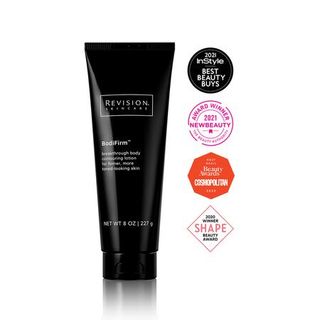
Revision Skincare BodiFirm™ breakthrough body contouring lotion for firmer, more toned-looking skin
Works for
3 of 3 advertised claims delivered
Anti-aging11 ingredients credited for this claimStrong support
“BodiContour™ is a breakthrough, clinically proven body sculpting formula powered by patented iFirm® Technology to visibly firm, tighten, and lift sagging or crepey skin.”
This product can help reduce and prevent fine lines and wrinkles, improve skin elasticity and firmness because it contains palmitoyl hexapeptide-12.
These ingredients in the product can also be helpful, even though there is less evidence for their effectiveness: acetyl tetrapeptide-2, palmitoyl dipeptide-5 diaminobutyroyl hydroxythreonine, palmitoyl tripeptide-38, palmitoyl tripeptide-5.
Keep in mind that it typically takes at least 6 weeks to notice any results because the changes that are needed to improve fine lines and elasticity happen in the deeper layers of the skin. No topical anti-aging product can “erase” wrinkles or fully reverse signs of aging.
Moisturizing26 ingredients credited for this claimStrong support
“With hydrating and microbiome-supporting ingredients, BodiContour™ helps strengthen the skin’s moisture barrier, enhance overall skin health, and promote long-term body rejuvenation.”
This product can help improve hydration of the skin with the two types of ingredients.
The first type is called “humectants”:
these ingredients help attract water.
When humectants are on the surface of the skin, they “pull in” the moisture from the outside environment, or from
within deeper layers of the skin. The following ingredients in this product do the job:
glucosamine hcl, glycerin.
This product also contains ingredients called “occlusives”. They help reduce the speed with which our skin loses moisture to the outside environment. These ingredients also help soften the upper layer of the skin, so it feels less tight and nicer to the touch. The following ingredients in this product do the job: dimethicone, squalane.
The following ingredients in this product are especially good for supporting the skin barrier and helping with the hydration level: acetyl tetrapeptide-2, ceramide ng, isosorbide dicaprylate, palmitoyl dipeptide-5 diaminobutyroyl hydroxythreonine, palmitoyl hexapeptide-12, palmitoyl tripeptide-38, palmitoyl tripeptide-5
Evens skin tone6 ingredients credited for this claimModerate support
“Improves skin tone, texture, and photodamage for healthier-looking skin”
The following ingredient (ingredients) in this product might be helpful, but there is no evidence to confirm that it actually works: glucosamine hcl.
Anti-oxidationNot advertised by the brand · 7 ingredients credited for this claimModerate support
This product contains antioxidants (camellia sinensis leaf extract) that might be able to help neutralize free radicals in skin to lessen the damage it gets from the UV light (sun). There is not enough evidence to confirm their effectiveness in skin though.
Can it cause trouble?
Irritancy3 strong irritants: Helichrysum stoechas extract, Citrus limon peel extract + 1 more — patch-test recommendedHigh risk
Comedogenic3 ingredients rated 2 or more on the 0–5 pore-clogging scale3 flagged
User reviews
Be the first — your take helps the next person decide.
Ingredients
Filter by role to see what each ingredient is doing.
Water~45–55%
Glycerin~4.2–5.2%
- Irritation risk
- Low
One of the best moisturizing ingredients. Naturally present in skin. It attracts water to the upper layer of the skin working as a humectant
More about GlycerinCetearyl alcohol~3.6–4.4%
- Irritation risk
- Low
- Comedogenicity
- 2/5
A non-drying alcohol. Works as an emollient. Helps water and oil mix together and creates a nice product texture
More about Cetearyl alcoholPentylene glycol~3.1–3.7%
- Irritation risk
- Medium
Used to preserve products, dissolve other ingredients and create a nice product texture
More about Pentylene glycolIsosorbide dicaprylate~2.3–2.8%
- Irritation risk
- Low
Helps soften the upper layer of the skin. Early studies suggest that it can help strengthen the skin barrier
More about Isosorbide dicaprylateTricaprylin~1.9–2.3%
- Irritation risk
- Low
An emollient that helps soften the skin. Can increase penetration of other ingredients
More about TricaprylinC12-15 alkyl benzoate~1.6–1.9%
- Irritation risk
- Low
Enhances the product texture and makes it more spreadable. Helps reduce water loss from the outer layer of skin. Extands the shelf life by preventing bacteria growth
More about C12-15 alkyl benzoateLauryl lactate~1.4–1.7%
- Irritation risk
- Low
Dimethicone/vinyl dimethicone crosspolymer~1.1–1.4%
- Irritation risk
- Low
Used to stabilize product formulations and create a nice product texture
More about Dimethicone/vinyl dimethicone crosspolymerSqualane~0.95–1.2%
- Irritation risk
- Low
An oil naturally present in skin. Works as an emollient to soften the skin and form a protective layer on its surface without a greasy feeling.
More about SqualaneMethylsilanol carboxymethyl theophylline alginate~0.6–0.95%
- Irritation risk
- Low
Glucosamine hcl~0.5–0.8%
- Irritation risk
- Low
Might be able to stimulate production of skin's natural moisturizing compounds such as hyaluronic acid. Could be helpful for evening the skin tone.
More about Glucosamine hclPisum sativum extract~0.45–0.7%
- Irritation risk
- Medium
Might be helpful in protecting skin collagen and elastin from breaking down but solid research is lacking
More about Pisum sativum extractCaffeine~0.4–0.65%
- Irritation risk
- Medium
Might be helpful in neutralizing free radicals. Can have a dehydration effect that might somewhat decrease the look of puffy eyes
More about CaffeineBambusa vulgaris leaf/stem extract~0.45–0.65%
- Irritation risk
- Medium
The extract can contain up to 70% of silica. In cosmetics, silica helps absorb oil and creates a thicker product texture
More about Bambusa vulgaris leaf/stem extractRuscus aculeatus root extract~0.35–0.65%
- Irritation risk
- Low
Tetrahexyldecyl ascorbate~0.35–0.65%
- Irritation risk
- Medium
Being a lipid soluble form of vitamin C, it is more stable than ascorbic acid, but still degrades quickly and needs to be stabilized in a formulation with another ingredient. It is claimed to penetrate skin better than pure vitamin C and have the the similar benefits, but solid studies of its effectiveness are lacking. Is likely to require a higher concentration in a product than pure vitamin C to be effective. It might be able to help reduce pore clogging.
More about Tetrahexyldecyl ascorbatePalmitoyl tripeptide-38~0.3–0.55%
- Irritation risk
- Low
A type of peptide. Peptides are excellent moisturizers and might be able support collagen production reducing fine lines and wrinkles
More about Palmitoyl tripeptide-38Helichrysum stoechas extract~0.25–0.5%
- Irritation risk
- High
A plant extract that might have some anti-oxidant properties. Contains an essential oil that can irritate the skin
More about Helichrysum stoechas extractCamellia sinensis leaf extract~0.25–0.5%
- Irritation risk
- Low
Can contain potent anti-oxidant compounds (abbreviated ECG, GCG, EGC, and EGCG) that might help protect the skin from free radicals. Can help calm down inflammation and has some anti-bacterial properties. Unfortunately, these antioxidants are unstable and lose their effectiveness very quickly in products. The concentration of the antioxidant compounds in the extract also tends to be low to be effective in topical formulation
More about Camellia sinensis leaf extractVaccinium vitis-idaea fruit extract~0.25–0.45%
- Irritation risk
- Low
Palmitoyl tripeptide-5~0.2–0.4%
- Irritation risk
- Low
A type of peptide. Peptides are excellent moisturizers and might be able support collagen production reducing fine lines and wrinkles
More about Palmitoyl tripeptide-5Glyceryl caprylate~0.25–0.5%
- Irritation risk
- Low
An emollient that can also help water and oil mix together, as well as prevent bacteria growth in products
More about Glyceryl caprylateCeramide ng~0.25–0.45%
- Irritation risk
- Low
A type of lipid similar to ceramides naturally present in skin. Helps to soften the upper layer of the skin and supports the skin barrier function to keep it hydrated. Can help to prevent inflammation in skin
More about Ceramide ngSolidago virgaurea extract~0.2–0.4%
- Irritation risk
- Low
Astragalus membranaceus root extract~0.25–0.45%
- Irritation risk
- Low
Palmitoyl dipeptide-5 diaminobutyroyl hydroxythreonine~0.2–0.4%
- Irritation risk
- Low
Citrus limon peel extract~0.2–0.35%
Cocos nucifera fruit extract~0.25–0.45%
- Irritation risk
- Low
- Comedogenicity
- 3/5
An emollient. Found to be as effective as a moisturizer for dry skin as mineral oil. Could be comedogenic
More about Cocos nucifera fruit extractPalmitoyl tetrapeptide-72 amide~0.2–0.35%
- Irritation risk
- Low
Methylpropanediol~0.2–0.4%
Steareth-20~0.3–0.55%
Acetyl tetrapeptide-2~0.2–0.4%
- Irritation risk
- Low
A type of peptide. Peptides are excellent moisturizers and might be able support collagen production reducing fine lines and wrinkles
More about Acetyl tetrapeptide-2Palmitoyl hexapeptide-12~0.2–0.4%
- Irritation risk
- Low
A type of peptide. Peptides are excellent moisturizers and might be able support collagen production reducing fine lines and wrinkles
More about Palmitoyl hexapeptide-12Hydrolyzed manihot esculenta tuber extract~0.2–0.4%
- Irritation risk
- Low
Cetyl alcohol~0.25–0.5%
- Irritation risk
- Low
A non-drying alcohol that works to soften the skin and stabilize product formulations helping oil and water mix together
More about Cetyl alcoholMagnesium chloride~0.2–0.4%
Sodium benzoate~0.2–0.4%
Dicetyl phosphate~0.25–0.45%
Steareth-10~0.25–0.45%
- Irritation risk
- Medium
- Comedogenicity
- 3/5
Helps oil and water mix together
More about Steareth-10Ceteth-10 phosphate~0.3–0.55%
Tocopherol~0.2–0.4%
- Irritation risk
- Low
Pure form of vitamin E. Can help moisturise and protect the skin from free radicals. Often used to help stabilise other ingredients or the formula itself
More about TocopherolPeg-10 phytosterol~0.25–0.45%
- Irritation risk
- Medium
Helps oil and water mix together
More about Peg-10 phytosterolDimethicone~0.25–0.5%
- Irritation risk
- Low
A silicone that helps to reduce water loss from the surface of the skin. Can temporarily "fill in" lines and wrinkles, absorb oil, and create a nice product finish
More about DimethiconeLeuconostoc/radish root ferment filtrate~0.2–0.4%
- Irritation risk
- Medium
A preservative that comes from radishes fermented by a bacteria. New research suggests that the preservation properties in the ingredient come from an ammonium salt that is not present naturally in radish root but used in its cultivation. Is problematic because the exact amount of the preservative agents is difficult to determine
More about Leuconostoc/radish root ferment filtrateCaprylyl glycol~0.25–0.45%
- Irritation risk
- Medium
Helps preserve products and creates a nice product texture
More about Caprylyl glycolTribehenin~0.25–0.45%
- Irritation risk
- Low
Used to create a thicker product consistency and soften the upper layer of the skin
More about TribeheninCarbomer~0.2–0.4%
- Irritation risk
- Low
Helps create a thicker or gel-like product texture. It is not a surfactant but can be used in gentle cleansing formulations
More about CarbomerDisodium edta~0.2–0.4%
Hydroxypropyl cyclodextrin~0.25–0.45%
- Irritation risk
- Medium
Used to stabilize product formulations and help soften the upper layer of the skin
More about Hydroxypropyl cyclodextrinXanthan gum~0.25–0.4%
- Irritation risk
- Low
Used to create a thicker product consistency
More about Xanthan gumSilica~0.3–0.55%
Aminomethyl propanol~0.2–0.4%
Propanediol~0.25–0.45%
- Irritation risk
- Low
Acts as a solvent for other ingredients. Speeds up the absorption of other ingredients into the skin
More about PropanediolCitric acid~0.2–0.4%
- Irritation risk
- Medium
Can work as an exfoliant but is typically used to adjust the product pH
More about Citric acidPotassium sorbate~0.25–0.4%
Phenoxyethanol~0.2–0.4%
- Irritation risk
- Low
A preservative. It helps prevent bacterial growth in cosmetic products
More about PhenoxyethanolIsoceteth-10~0.2–0.4%
1,2-hexanediol~0.2–0.4%
Gluconolactone~0.2–0.35%
- Irritation risk
- Medium
A polyhydroxy acid (PHA) that helps shed the dead cells from the skin surface revealing smoother skin. Is believed to be genter than AHAs. It helps attract water to the upper layer of the skin and can stimulate production of skin's own hyaluronic acid resulting in improved hydration levels. It has been shown to be helpful against acne and clogged pores if used consistently (e.g over a period of 12 weeks) in high enough concentration. It can help reduce fine lines and wrinkles and improve skin tone with long-term application. Can help neutralize free radicals
More about GluconolactoneEthylhexylglycerin~0.2–0.35%
Edta~0.2–0.35%
Calcium gluconate~0.2–0.4%
- Irritation risk
- Low
Helps attract water to the upper layer of the skin and helps to improve appearance of the product
More about Calcium gluconateLactic acid~0.15–0.3%
- Irritation risk
- Medium
An exfoliating and moisturizing alpha-hydroxy acid (AHA). Typically causes less irritation than other AHAs, for example, glycolic acid. At high concentrations (about 15%), lactic acid can help reduce lines and wrinkles. Recent studies show that lactic acid can support the "good" bacteria living on skin's surface (healthy skin microbiome)
More about Lactic acidLauryl alcohol~0.2–0.35%
Parfum~0.15–0.25%
- Irritation risk
- High
An aromatic blend of unspecified and possibly irritating ingredients
More about ParfumHexamethylindanopyran~0.1–0.2%
- Irritation risk
- Low
Linalyl acetate~0.1–0.15%
- Irritation risk
- Low
Tetramethyl acetyloctahydronaphthalenes~0.05–0.15%
- Irritation risk
- Low
Ingredient list view
Water, Glycerin, Cetearyl alcohol, Pentylene glycol, Isosorbide dicaprylate, Tricaprylin, C12-15 alkyl benzoate, Lauryl lactate, Dimethicone/vinyl dimethicone crosspolymer, Squalane, Methylsilanol carboxymethyl theophylline alginate, Glucosamine hcl, Pisum sativum extract, Caffeine, Bambusa vulgaris leaf/stem extract, Ruscus aculeatus root extract, Tetrahexyldecyl ascorbate, Palmitoyl tripeptide-38, Helichrysum stoechas extract, Camellia sinensis leaf extract, Vaccinium vitis-idaea fruit extract, Palmitoyl tripeptide-5, Glyceryl caprylate, Unknown, Ceramide ng, Solidago virgaurea extract, Astragalus membranaceus root extract, Palmitoyl dipeptide-5 diaminobutyroyl hydroxythreonine, Citrus limon peel extract, Cocos nucifera fruit extract, Palmitoyl tetrapeptide-72 amide, Methylpropanediol, Steareth-20, Acetyl tetrapeptide-2, Palmitoyl hexapeptide-12, Hydrolyzed manihot esculenta tuber extract, Cetyl alcohol, Magnesium chloride, Sodium benzoate, Dicetyl phosphate, Steareth-10, Ceteth-10 phosphate, Tocopherol, Peg-10 phytosterol, Dimethicone, Leuconostoc/radish root ferment filtrate, Caprylyl glycol, Tribehenin, Carbomer, Disodium edta, Hydroxypropyl cyclodextrin, Xanthan gum, Silica, Aminomethyl propanol, Propanediol, Citric acid, Potassium sorbate, Phenoxyethanol, Isoceteth-10, 1,2-hexanediol, Gluconolactone, Ethylhexylglycerin, Edta, Calcium gluconate, Lactic acid, Lauryl alcohol, Parfum, Hexamethylindanopyran, Linalyl acetate, Tetramethyl acetyloctahydronaphthalenes
Compare prices
Retailers ranked by price — lowest first.

Affiliate links · prices updated regularly
Sources cited in this review
Every concentration estimate and effectiveness label is anchored to one of these 26 studies and safety reviews.
- 1
- 2
- 3Glucosamine: an ingredient with skin and other benefitsncbi.nlm.nih.gov
- 4
- 5
- 6Helichrysum italicum: from traditional use to scientific datancbi.nlm.nih.gov

Affiliate links · As an Amazon Associate, WIMJ earns from qualifying purchases.