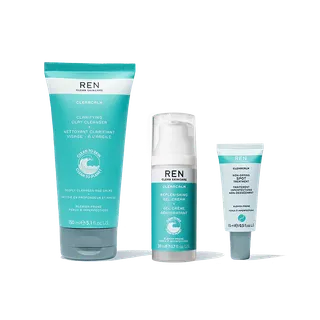
Ren Skincare Spot-Prone Skin Solutions

Ren Skincare Spot-Prone Skin Solutions

Efficacy75/100IrritancyHigh

Works for

Anti-blemish
Salicylic acid, Kaolin + 2 more
Works well
What the product description says
“Clearcalm Clarifying Clay Cleanser Formulated with ingredients known to help prevent blemishes by reducing the causes of blemishes and maskne, your complexion will be left feeling clean without feeling dry or tight.”
Source: Ren Skincare

This product can help reduce breakouts and clogged pores because it contains the following ingredient: salicylic acid. This ingredient is used for treating acne and can have a noticeable effect.

Salicylic acidHeroEffect: HighUsed for skin exfoliation. It has an anti-inflammatory and anti-bacterial effect, helps to unclog pores, prevent blemishes and speed up healing of the existing ones. Sometimes referred to as a BHA (beta-hydroxy acid)~1.2–1.5%
KaolinEffect: LowA type of clay that consists mainly of aluminum silicate. Helps absorb oil and creates a thicker product consistency. Can be used to add a white color~0.25–0.45%
Zinc gluconateEffect: Low, below effective doseTypically used to stabilize the product formulations. It is a salt of a polyhydroxy acid (PHA) and in larger concentrations, can help shed the dead cells from the skin surface revealing smoother skin. It can help attract water to the upper layer of the skin. Might to be helpful against acne and clogged pores. Could be helpful in neutralizing free radicals, but solid research is missing. Due to the zinc content, might help calm down inflammation in skin~0.15–0.25%
Rosmarinus officinalis leaf extractUnder-dosedCan be helpful in reducing inflammation in skin, including inflamed acne. It can be irritating~0.05–0.15%
Moisturizing
Xylitylglucoside, Anhydroxylitol + 22 more
Works
What the product description says
“Clearcalm 3 Replenishing Gel Cream Formulated with bioactives known to even the appearance of skin tone, while providing lightweight moisture for plumper, healthier-looking and calming-feeling skin.”
Source: Ren Skincare

This product can help improve hydration of the skin with the two types of ingredients.

The first type is called “humectants”:
these ingredients help attract water. When humectants are on the surface of the skin, they “pull in” the moisture from the outside environment, or from within deeper layers of the skin. The following ingredients in this product do the job: anhydroxylitol, glycerin.

This product also contains ingredients called “occlusives”. They help reduce the speed with which our skin loses moisture to the outside environment. These ingredients also help soften the upper layer of the skin, so it feels less tight and nicer to the touch. The following ingredients in this product do the job: helianthus annuus seed oil, cocos nucifera fruit extract.

XylitylglucosideKey active· HumectantEffect: HighHelps attract water to the upper layer of the skin and repair the skin barrier function~0.65–0.95%
AnhydroxylitolKey active· HumectantEffect: HighHelps attract water to the upper layer of the skin and repair the skin barrir function~0.45–0.7%
GlycerinKey active· HumectantEffect: HighOne of the best moisturizing ingredients. Naturally present in skin. It attracts water to the upper layer of the skin working as a humectant~0.2–0.35%
Cocos nucifera fruit extractKey active· EmollientEffect: HighAn emollient. Found to be as effective as a moisturizer for dry skin as mineral oil. Could be comedogenic~0.2–0.4%
Cetearyl alcoholKey active· EmollientEffect: MediumA non-drying alcohol. Works as an emollient. Helps water and oil mix together and creates a nice product texture~0.2–0.4%
Helianthus annuus seed oilKey active· Emollient, OcclusiveEffect: HighA great emollient due to its high linoleic acid content. One of the most effective plant oils in helping skin hydration and repairing skin barrier function~0.15–0.3%
Sesamum indicum seed oilKey active· EmollientEffect: HighA good moisturizing plant oil. Due to the high linoleic acid content, it helps soften the upper layer of the skin, reduce water loss and support skin barrier function~0.15–0.3%
GlucoseKey active· HumectantEffect: MediumHelps attract water to the upper layer of the skin. Could be helpful in restoring the skin barrier function~0.15–0.3%
Glucose oxidaseKey activeEffect: HighHelps attract water to the upper layer of the skin~0.1–0.15%
Glycine soja oilKey active· EmollientEffect: HighA good emollient that helps soften the skin and helps repair its barrier function. It can clog pores if used in high concentrations.~0.1–0.2%
Vaccinium macrocarpon seed oilKey active· EmollientEffect: HighA plant oil that can help neutralize free radicals, soften the upper layer of the skin, and support skin's barrier function~0.1–0.2%
LactoperoxidaseKey activeEffect: HighHelps attract water to the upper layer of the skin. In theory, could support healthy skin's microbiome, but evidence of effectiveness in skin is lacking~0.1–0.2%
LactobacillusKey activeEffect: HighA non-living ingredient made by fermentation with the bacteria Lactobacillus. It can help attract water to the upper layer of the skin and might help reduce inflammation~0.1–0.2%
Sodium lactateKey active· HumectantEffect: HighHelps attract water to the upper layer of the skin. Is often used to adjust the pH level of the product~0.1–0.15%
Laminaria ochroleuca extractKey activeEffect: HighHelps attract water to the upper layer of the skin~0.1–0.15%
Chlorella vulgaris extractKey activeEffect: MediumA plant extract that can help to attract water to the upper layer of the skin and might have some anti-oxidant and anti-inflammatory properties~0.1–0.15%
Glyceryl caprylate· EmollientEffect: LowAn emollient that can also help water and oil mix together, as well as prevent bacteria growth in products~0.2–0.35%
Lauryl laurateEffect: LowHelps soften the upper layer of the skin~0.05–0.15%
TocopherolEffect: Low, below effective dosePure form of vitamin E. Can help moisturise and protect the skin from free radicals. Often used to help stabilise other ingredients or the formula itself~0.15–0.3%
Caprylic/capric triglycerideUnder-dosedA good mix of fatty acids that forms a protective layer on the skin. Improves the shelf life of products. Derived from coconut and glycerin~0.2–0.35%
Butyrospermum parkii butterUnder-dosedA great moisturising ingredient that softens the skin and reduces water loss from its upper layer. It also can be helpful in protecting skin from free radicals~0.15–0.25%
Zinc gluconateUnder-dosedTypically used to stabilize the product formulations. It is a salt of a polyhydroxy acid (PHA) and in larger concentrations, can help shed the dead cells from the skin surface revealing smoother skin. It can help attract water to the upper layer of the skin. Might to be helpful against acne and clogged pores. Could be helpful in neutralizing free radicals, but solid research is missing. Due to the zinc content, might help calm down inflammation in skin~0.15–0.25%
Myristyl myristateUnder-dosedAn emollient. Is not recommended for acne-prone skin as it can be comedogenic~0.1–0.2%
Lactic acidUnder-dosedAn exfoliating and moisturizing alpha-hydroxy acid (AHA). Typically causes less irritation than other AHAs, for example, glycolic acid. At high concentrations (about 15%), lactic acid can help reduce lines and wrinkles. Recent studies show that lactic acid can support the "good" bacteria living on skin's surface (healthy skin microbiome)~0.05–0.1%
Evens skin tone
Pinus pinaster bark extract, Salicylic acid + 3 more
Not delivered
What the product description says
“Clearcalm Non-Drying Spot Treatment Proven to work with the microbiome to dramatically reduce spot-causing bacteria tested via an in-vitro study After 12 hours, spots appear reduced in size, complexion looks healthier and skin tone is more even 85% say skin feels calmer and soothed after 4 hours 98% say that makeup does not flake 96% agree that skin has not dried out around the spot proven via a consumer self-evaluation study.”
Source: Ren Skincare

This product might help improve the skin tone through exfoliation. In other words, it helps to speed up the shedding of cells from the upper layer of the skin, and this might help reduce hyperpigmentation.

Pinus pinaster bark extractEffect: LowA plant extract that might help neutralize free radicals and reduce hyperpigmentation, but evidence of effectiveness of topical application is lacking. It can be an INCI name for the trademarked ingredient Pycnogenol (but could also be a different type of this plant's bark extract)~2–2.4%
Salicylic acidEffect: LowUsed for skin exfoliation. It has an anti-inflammatory and anti-bacterial effect, helps to unclog pores, prevent blemishes and speed up healing of the existing ones. Sometimes referred to as a BHA (beta-hydroxy acid)~1.2–1.5%
Glycyrrhiza glabra root extractEffect: LowA plant extract that can help lighten the skin and calm down inflammation. Might be helpful in neutralizing free radicals~0.05–0.15%
Zinc gluconateEffect: Low, below effective doseTypically used to stabilize the product formulations. It is a salt of a polyhydroxy acid (PHA) and in larger concentrations, can help shed the dead cells from the skin surface revealing smoother skin. It can help attract water to the upper layer of the skin. Might to be helpful against acne and clogged pores. Could be helpful in neutralizing free radicals, but solid research is missing. Due to the zinc content, might help calm down inflammation in skin~0.15–0.25%
Lactic acidUnder-dosedAn exfoliating and moisturizing alpha-hydroxy acid (AHA). Typically causes less irritation than other AHAs, for example, glycolic acid. At high concentrations (about 15%), lactic acid can help reduce lines and wrinkles. Recent studies show that lactic acid can support the "good" bacteria living on skin's surface (healthy skin microbiome)~0.05–0.1%
Exfoliation
Side benefit · Salicylic acid, Salix nigra bark extract + 2 more
Works well

This product can help exfoliate the skin. In other words, it helps break down the bonds between dead cells on the surface of the skin and speed up the skin turnover. Skin often appears softer and brighter after exfoliation, but overdoing it can result in disrupted skin barrier. The following ingredient is doing the exfoliating job in this product: salicylic acid.

Salicylic acidKey activeEffect: HighUsed for skin exfoliation. It has an anti-inflammatory and anti-bacterial effect, helps to unclog pores, prevent blemishes and speed up healing of the existing ones. Sometimes referred to as a BHA (beta-hydroxy acid)~1.2–1.5%
Salix nigra bark extractEffect: LowA plant extract that might contain salicylic acid~0.15–0.25%
Zinc gluconateEffect: Low, below effective doseTypically used to stabilize the product formulations. It is a salt of a polyhydroxy acid (PHA) and in larger concentrations, can help shed the dead cells from the skin surface revealing smoother skin. It can help attract water to the upper layer of the skin. Might to be helpful against acne and clogged pores. Could be helpful in neutralizing free radicals, but solid research is missing. Due to the zinc content, might help calm down inflammation in skin~0.15–0.25%
Lactic acidUnder-dosedAn exfoliating and moisturizing alpha-hydroxy acid (AHA). Typically causes less irritation than other AHAs, for example, glycolic acid. At high concentrations (about 15%), lactic acid can help reduce lines and wrinkles. Recent studies show that lactic acid can support the "good" bacteria living on skin's surface (healthy skin microbiome)~0.05–0.1%
Anti-oxidation
Side benefit · Pinus pinaster bark extract, Vaccinium macrocarpon seed oil + 12 more
May help

This product contains antioxidants (pinus pinaster bark extract, vaccinium macrocarpon seed oil) that can help neutralize free radicals in skin to lessen the damage it gets from the UV light (sun). There is some human evidence for this effect in skin, though it is smaller or less consistent than the evidence for the best antioxidants.

Pinus pinaster bark extractKey activeEffect: MediumA plant extract that might help neutralize free radicals and reduce hyperpigmentation, but evidence of effectiveness of topical application is lacking. It can be an INCI name for the trademarked ingredient Pycnogenol (but could also be a different type of this plant's bark extract)~2–2.4%
Vaccinium macrocarpon seed oilKey activeEffect: MediumA plant oil that can help neutralize free radicals, soften the upper layer of the skin, and support skin's barrier function~0.1–0.2%
OryzanolEffect: LowAn anti-oxidant that helps stabilize product formulations. Might help neutralise free radicals in skin~0.15–0.25%
Chlorella vulgaris extractEffect: LowA plant extract that can help to attract water to the upper layer of the skin and might have some anti-oxidant and anti-inflammatory properties~0.1–0.15%
Cassia alata leaf extractEffect: LowMight have some anti-oxidant properties. Can be used as a fragrance. Can be irritating~0.1–0.15%
Calendula officinalis flower extractEffect: LowA plant extract that has some anti-oxidant and anti-bacterial properties. Can be irritating~0.1–0.2%
Pelargonium graveolens flower oilEffect: LowAn essential oil. Can be irritating. Can become an allergen with oxidation~0.1–0.2%
Glycyrrhiza glabra root extractEffect: LowA plant extract that can help lighten the skin and calm down inflammation. Might be helpful in neutralizing free radicals~0.05–0.15%
Zinc gluconateEffect: Low, below effective doseTypically used to stabilize the product formulations. It is a salt of a polyhydroxy acid (PHA) and in larger concentrations, can help shed the dead cells from the skin surface revealing smoother skin. It can help attract water to the upper layer of the skin. Might to be helpful against acne and clogged pores. Could be helpful in neutralizing free radicals, but solid research is missing. Due to the zinc content, might help calm down inflammation in skin~0.15–0.25%
Butyrospermum parkii butterEffect: Low, below effective doseA great moisturising ingredient that softens the skin and reduces water loss from its upper layer. It also can be helpful in protecting skin from free radicals~0.15–0.25%
Anthemis nobilis flower oilEffect: Low, below effective doseAn essential oil that is used as a fragrance and can be irritating. It might have some anti-oxidant effect in skin~0.15–0.25%
BisabololEffect: Low, below effective doseAn active component of chamomile plant that historically has been used to calm down irritated skin. A recent study shows that bisabolol indeed can have some anti-inflammatory effect on skin, even though conclusive data is lacking. Bisabolol has a sweet floral scent and can be added to products for its aromatic properties~0.1–0.2%
Rosmarinus officinalis leaf extractEffect: Low, below effective doseCan be helpful in reducing inflammation in skin, including inflamed acne. It can be irritating~0.05–0.15%
TocopherolUnder-dosedPure form of vitamin E. Can help moisturise and protect the skin from free radicals. Often used to help stabilise other ingredients or the formula itself~0.15–0.3%

Can it cause trouble?

Irritancy
14 strong irritants: Alcohol denat., Santalum album wood oil + 12 more — patch-test recommended
High risk
We flagged 37 ingredients with irritancy potential. Severity depends on your sensitivity threshold; the table lists the worst offenders first.
IngredientFunctionIrritationEst. amount
Alcohol denat.Produces temporary toning effect. Can help dissolve other ingredients or preserve productsHigh~7.2–8.8%est.
Salicylic acidUsed for skin exfoliation. It has an anti-inflammatory and anti-bacterial effect, helps to unclog pores, prevent blemishes and speed up healing of the existing ones. Sometimes referred to as a BHA (beta-hydroxy acid)High~1.2–1.5%est.
Santalum album wood oil—High~0.2–0.35%est.
Thymus vulgaris leaf oil—High~0.1–0.2%est.
FarnesolAdded to create a nice product smell. Can be irritatingHigh~0.05–0.1%est.
Oleyl alcoholUsed as a fragranceHigh~0.1–0.2%est.
Lavandula angustifolia oilAn essential oil. Potential allergen and can be irritating. It has some anti-bacterial propertiesHigh~0.1–0.15%est.
Pelargonium graveolens flower oilAn essential oil. Can be irritating. Can become an allergen with oxidationHigh~0.1–0.2%est.
Salvia officinalis oil—High~0.1–0.15%est.
Anthemis nobilis flower oilAn essential oil that is used as a fragrance and can be irritating. It might have some anti-oxidant effect in skinHigh~0.05–0.1%est.
Sodium hydroxymethylglycinateA preservative. Can be irritatingHigh~0.1–0.2%est.
Rosmarinus officinalis leaf extractCan be helpful in reducing inflammation in skin, including inflamed acne. It can be irritatingHigh~0.05–0.15%est.
CitronellolA fragrance. Can be irritatingHigh~0.1–0.15%est.
GeraniolA fragrance. Can be irritatingHigh~0.1–0.15%est.
LimoneneA common frangrance that can easily irritate skin, especially if exposed to air, light or heatHigh~0.1–0.15%est.
LinaloolA fragrance. Can be irritatingHigh~0.1–0.15%est.
Calendula officinalis flower extractA plant extract that has some anti-oxidant and anti-bacterial properties. Can be irritatingHigh~0.1–0.2%est.
Benzyl alcoholA preservative. Can be used to mask unpleasant smell. Can be irritatingHigh~0.1–0.2%est.
Pinus pinaster bark extractA plant extract that might help neutralize free radicals and reduce hyperpigmentation, but evidence of effectiveness of topical application is lacking. It can be an INCI name for the trademarked ingredient Pycnogenol (but could also be a different type of this plant's bark extract)Medium~2–2.4%est.
Caprylyl/capryl glucosideHelps oil and water mix together. Can be used as a cleansing agentMedium~1.5–1.8%est.
Salix nigra bark extractA plant extract that might contain salicylic acidMedium~1–1.2%est.
Potassium sorbateA preservativeMedium~0.2–0.35%est.
Sodium cocoyl glutamateHelps oil and water mix togetherMedium~0.25–0.5%est.
Citric acidCan work as an exfoliant but is typically used to adjust the product pHMedium~0.15–0.3%est.
Chlorella vulgaris extractA plant extract that can help to attract water to the upper layer of the skin and might have some anti-oxidant and anti-inflammatory propertiesMedium~0.1–0.15%est.
Lactic acidAn exfoliating and moisturizing alpha-hydroxy acid (AHA). Typically causes less irritation than other AHAs, for example, glycolic acid. At high concentrations (about 15%), lactic acid can help reduce lines and wrinkles. Recent studies show that lactic acid can support the "good" bacteria living on skin's surface (healthy skin microbiome)Medium~0.05–0.15%est.
Sodium lactateHelps attract water to the upper layer of the skin. Is often used to adjust the pH level of the productMedium~0.1–0.15%est.
Glycine soja oilA good emollient that helps soften the skin and helps repair its barrier function. It can clog pores if used in high concentrations.Medium~0.1–0.2%est.
Lauryl laurateHelps soften the upper layer of the skinMedium~0.05–0.15%est.
Myristyl myristateAn emollient. Is not recommended for acne-prone skin as it can be comedogenicMedium~0.1–0.2%est.
Cetearyl glucosideHelps water and oil in the product mix well together and improves product textureMedium~0.1–0.2%est.
Caprylic/capric triglycerideA good mix of fatty acids that forms a protective layer on the skin. Improves the shelf life of products. Derived from coconut and glycerinMedium~0.15–0.25%est.
Vaccinium macrocarpon seed oilA plant oil that can help neutralize free radicals, soften the upper layer of the skin, and support skin's barrier functionMedium~0.1–0.2%est.
Cassia alata leaf extractMight have some anti-oxidant properties. Can be used as a fragrance. Can be irritatingMedium~0.1–0.15%est.
Glycyrrhiza glabra root extractA plant extract that can help lighten the skin and calm down inflammation. Might be helpful in neutralizing free radicalsMedium~0.05–0.15%est.
Zinc gluconateTypically used to stabilize the product formulations. It is a salt of a polyhydroxy acid (PHA) and in larger concentrations, can help shed the dead cells from the skin surface revealing smoother skin. It can help attract water to the upper layer of the skin. Might to be helpful against acne and clogged pores. Could be helpful in neutralizing free radicals, but solid research is missing. Due to the zinc content, might help calm down inflammation in skinMedium~0.15–0.25%est.
Dehydroacetic acidA preservativeMedium~0.15–0.25%est.
Comedogenic
9 ingredients rated 2 or more on the 0–5 pore-clogging scale
9 flagged
These ingredients have a comedogenic rating of 2 or more on a 0–5 scale; the table shows each one's rating. In leave-on products they can clog pores in acne-prone skin.
IngredientFunctionRatingEst. amount
Chlorella vulgaris extractA plant extract that can help to attract water to the upper layer of the skin and might have some anti-oxidant and anti-inflammatory properties3/5~0.1–0.15%est.
Oleyl alcoholUsed as a fragrance3/5~0.1–0.2%est.
Butyrospermum parkii butterA great moisturising ingredient that softens the skin and reduces water loss from its upper layer. It also can be helpful in protecting skin from free radicals3/5~0.15–0.25%est.
Myristyl myristateAn emollient. Is not recommended for acne-prone skin as it can be comedogenic3/5~0.1–0.2%est.
Laminaria ochroleuca extractHelps attract water to the upper layer of the skin3/5~0.1–0.15%est.
Cocos nucifera fruit extractAn emollient. Found to be as effective as a moisturizer for dry skin as mineral oil. Could be comedogenic3/5~0.2–0.4%est.
Cetearyl alcoholA non-drying alcohol. Works as an emollient. Helps water and oil mix together and creates a nice product texture2/5~0.15–0.25%est.
Glycine soja oilA good emollient that helps soften the skin and helps repair its barrier function. It can clog pores if used in high concentrations.2/5~0.1–0.2%est.
Cetearyl alcoholA non-drying alcohol. Works as an emollient. Helps water and oil mix together and creates a nice product texture2/5~0.2–0.4%est.
Did this help you decide?

User reviews

Would you recommend?
No community reviews yet.

Be the first — your take helps the next person decide.

Ingredients

Filter by role to see what each ingredient is doing.

Water~45–55%
Formula
Irritation risk
Low

Plain old water

More about Water
Alcohol denat.~7.2–8.8%
Irritant · high
Irritation risk
High

Produces temporary toning effect. Can help dissolve other ingredients or preserve products

More about Alcohol denat.
Glycerin~3.9–4.8%
Key active
Irritation risk
Low
Works for
Moisturizing

One of the best moisturizing ingredients. Naturally present in skin. It attracts water to the upper layer of the skin working as a humectant

More about Glycerin
Xanthan gum~2.1–2.6%
Formula
Irritation risk
Low
Works for
Cleansing

Used to create a thicker product consistency

More about Xanthan gum
Pinus pinaster bark extract~2–2.4%
Key activeIrritant · medium
Irritation risk
Medium
Works for
Anti-oxidationEvens skin tone

A plant extract that might help neutralize free radicals and reduce hyperpigmentation, but evidence of effectiveness of topical application is lacking. It can be an INCI name for the trademarked ingredient Pycnogenol (but could also be a different type of this plant's bark extract)

More about Pinus pinaster bark extract
Salicylic acid~1.2–1.5%
Hero · Anti-blemishIrritant · high
Irritation risk
High
Works for
Anti-inflammatoryExfoliationAnti-blemishAntibacterialEvens skin tone

Used for skin exfoliation. It has an anti-inflammatory and anti-bacterial effect, helps to unclog pores, prevent blemishes and speed up healing of the existing ones. Sometimes referred to as a BHA (beta-hydroxy acid)

More about Salicylic acid
Caprylyl/capryl glucoside~1.5–1.8%
Irritant · medium
Irritation risk
Medium
Works for
Cleansing

Helps oil and water mix together. Can be used as a cleansing agent

More about Caprylyl/capryl glucoside
Salix nigra bark extract~1–1.2%
Irritant · medium
Irritation risk
Medium
Works for
Exfoliation

A plant extract that might contain salicylic acid

More about Salix nigra bark extract
Xylitylglucoside~0.65–0.95%
Key active
Irritation risk
Low
Works for
Moisturizing

Helps attract water to the upper layer of the skin and repair the skin barrier function

More about Xylitylglucoside
Anhydroxylitol~0.45–0.7%
Key active
Irritation risk
Low
Works for
Moisturizing

Helps attract water to the upper layer of the skin and repair the skin barrir function

More about Anhydroxylitol
Sodium benzoate~0.25–0.5%
Formula
Irritation risk
Low

A preservative

More about Sodium benzoate
Xylitol~0.3–0.55%
Formula
Irritation risk
Low

Helps attract water to the upper layer of the skin and repair the skin barrier function

More about Xylitol
Propanediol~0.3–0.55%
Formula
Irritation risk
Low

Acts as a solvent for other ingredients. Speeds up the absorption of other ingredients into the skin

More about Propanediol
Santalum album wood oil~0.2–0.35%
Irritant · high
Potassium sorbate~0.2–0.35%
Irritant · medium
Irritation risk
Medium

A preservative

More about Potassium sorbate
Sodium cocoyl glutamate~0.25–0.5%
Irritant · medium
Irritation risk
Medium
Works for
Cleansing

Helps oil and water mix together

More about Sodium cocoyl glutamate
Glucose~0.2–0.35%
Key active
Irritation risk
Low
Works for
Moisturizing

Helps attract water to the upper layer of the skin. Could be helpful in restoring the skin barrier function

More about Glucose
Citric acid~0.15–0.3%
Irritant · medium
Irritation risk
Medium

Can work as an exfoliant but is typically used to adjust the product pH

More about Citric acid
Glyceryl caprylate~0.2–0.35%
Formula
Irritation risk
Low
Works for
CleansingMoisturizing

An emollient that can also help water and oil mix together, as well as prevent bacteria growth in products

More about Glyceryl caprylate
Polyglyceryl-6 oleate~0.15–0.25%
Formula
Irritation risk
Low
Works for
Cleansing
More about Polyglyceryl-6 oleate
Thymus vulgaris leaf oil~0.1–0.2%
Irritant · high
Chlorella vulgaris extract~0.1–0.15%
Key activeComedogenic 3/5Irritant · medium
Irritation risk
Medium
Comedogenicity
3/5
Works for
MoisturizingAnti-oxidationAnti-inflammatory

A plant extract that can help to attract water to the upper layer of the skin and might have some anti-oxidant and anti-inflammatory properties

More about Chlorella vulgaris extract
Sodium surfactin~0.15–0.3%
Formula
Irritation risk
Low
Works for
Cleansing
More about Sodium surfactin
Lactic acid~0.05–0.15%
Under-dosedIrritant · medium
Irritation risk
Medium
Works for
MoisturizingEvens skin toneExfoliationAnti-aging

An exfoliating and moisturizing alpha-hydroxy acid (AHA). Typically causes less irritation than other AHAs, for example, glycolic acid. At high concentrations (about 15%), lactic acid can help reduce lines and wrinkles. Recent studies show that lactic acid can support the "good" bacteria living on skin's surface (healthy skin microbiome)

More about Lactic acid
Sodium lactate~0.1–0.15%
Key activeIrritant · medium
Irritation risk
Medium
Works for
Moisturizing

Helps attract water to the upper layer of the skin. Is often used to adjust the pH level of the product

More about Sodium lactate
Farnesol~0.05–0.1%
Irritant · high
Irritation risk
High

Added to create a nice product smell. Can be irritating

More about Farnesol
Cream~0.1–0.2%
Formula
Irritation risk
Low
More about Cream
Water~0.1–0.15%
Formula
Irritation risk
Low

Plain old water

More about Water
Cetearyl alcohol~0.15–0.25%
Key activeComedogenic 2/5
Irritation risk
Low
Comedogenicity
2/5
Works for
CleansingMoisturizing

A non-drying alcohol. Works as an emollient. Helps water and oil mix together and creates a nice product texture

More about Cetearyl alcohol
Oleyl alcohol~0.1–0.2%
Comedogenic 3/5Irritant · high
Irritation risk
High
Comedogenicity
3/5

Used as a fragrance

More about Oleyl alcohol
Glycerin~0.1–0.2%
Key active
Irritation risk
Low
Works for
Moisturizing

One of the best moisturizing ingredients. Naturally present in skin. It attracts water to the upper layer of the skin working as a humectant

More about Glycerin
Butyrospermum parkii butter~0.15–0.25%
Under-dosedComedogenic 3/5
Irritation risk
Low
Comedogenicity
3/5
Works for
MoisturizingAnti-oxidationAnti-aging

A great moisturising ingredient that softens the skin and reduces water loss from its upper layer. It also can be helpful in protecting skin from free radicals

More about Butyrospermum parkii butter
Glycine soja oil~0.1–0.2%
Key activeComedogenic 2/5Irritant · medium
Irritation risk
Medium
Comedogenicity
2/5
Works for
Moisturizing

A good emollient that helps soften the skin and helps repair its barrier function. It can clog pores if used in high concentrations.

More about Glycine soja oil
Lauryl laurate~0.05–0.15%
Irritant · medium
Irritation risk
Medium
Works for
Moisturizing

Helps soften the upper layer of the skin

More about Lauryl laurate
Myristyl myristate~0.1–0.2%
Under-dosedComedogenic 3/5Irritant · medium
Irritation risk
Medium
Comedogenicity
3/5
Works for
Moisturizing

An emollient. Is not recommended for acne-prone skin as it can be comedogenic

More about Myristyl myristate
Cetearyl glucoside~0.1–0.2%
Irritant · medium
Irritation risk
Medium
Works for
Cleansing

Helps water and oil in the product mix well together and improves product texture

More about Cetearyl glucoside
Alcohol denat.~0.1–0.2%
Irritant · high
Irritation risk
High

Produces temporary toning effect. Can help dissolve other ingredients or preserve products

More about Alcohol denat.
Oryzanol~0.05–0.15%
Formula
Irritation risk
Low
Works for
Anti-oxidation

An anti-oxidant that helps stabilize product formulations. Might help neutralise free radicals in skin

More about Oryzanol
Caprylic/capric triglyceride~0.15–0.25%
Under-dosedIrritant · medium
Irritation risk
Medium
Works for
Moisturizing

A good mix of fatty acids that forms a protective layer on the skin. Improves the shelf life of products. Derived from coconut and glycerin

More about Caprylic/capric triglyceride
Vaccinium macrocarpon seed oil~0.1–0.2%
Key activeIrritant · medium
Irritation risk
Medium
Works for
MoisturizingAnti-oxidationAnti-inflammatory

A plant oil that can help neutralize free radicals, soften the upper layer of the skin, and support skin's barrier function

More about Vaccinium macrocarpon seed oil
Vaccinium vitis-idaea seed oil~0.1–0.2%
Formula
Carbomer~0.1–0.2%
Formula
Irritation risk
Low
Works for
Cleansing

Helps create a thicker or gel-like product texture. It is not a surfactant but can be used in gentle cleansing formulations

More about Carbomer
Lavandula angustifolia oil~0.1–0.15%
Irritant · high
Irritation risk
High

An essential oil. Potential allergen and can be irritating. It has some anti-bacterial properties

More about Lavandula angustifolia oil
Pelargonium graveolens flower oil~0.1–0.2%
Irritant · high
Irritation risk
High
Works for
Anti-oxidation

An essential oil. Can be irritating. Can become an allergen with oxidation

More about Pelargonium graveolens flower oil
Salvia officinalis oil~0.1–0.15%
Irritant · high
Tocopherol~0.1–0.15%
Under-dosed
Irritation risk
Low
Works for
Anti-oxidationAnti-agingAnti-inflammatoryMoisturizing

Pure form of vitamin E. Can help moisturise and protect the skin from free radicals. Often used to help stabilise other ingredients or the formula itself

More about Tocopherol
Lactic acid~0.05–0.15%
Under-dosedIrritant · medium
Irritation risk
Medium
Works for
ExfoliationMoisturizingEvens skin toneAnti-aging

An exfoliating and moisturizing alpha-hydroxy acid (AHA). Typically causes less irritation than other AHAs, for example, glycolic acid. At high concentrations (about 15%), lactic acid can help reduce lines and wrinkles. Recent studies show that lactic acid can support the "good" bacteria living on skin's surface (healthy skin microbiome)

More about Lactic acid
Anthemis nobilis flower oil~0.05–0.1%
Irritant · high
Irritation risk
High
Works for
Anti-oxidationAnti-inflammatory

An essential oil that is used as a fragrance and can be irritating. It might have some anti-oxidant effect in skin

More about Anthemis nobilis flower oil
Pueraria lobata symbiosome extract~0.1–0.15%
Formula
Cassia alata leaf extract~0.1–0.15%
Irritant · medium
Irritation risk
Medium
Works for
Anti-oxidation

Might have some anti-oxidant properties. Can be used as a fragrance. Can be irritating

More about Cassia alata leaf extract
Phenoxyethanol~0.1–0.2%
Formula
Irritation risk
Low

A preservative. It helps prevent bacterial growth in cosmetic products

More about Phenoxyethanol
Sodium hydroxymethylglycinate~0.1–0.2%
Irritant · high
Irritation risk
High

A preservative. Can be irritating

More about Sodium hydroxymethylglycinate
Glycyrrhiza glabra root extract~0.05–0.15%
Irritant · medium
Irritation risk
Medium
Works for
Anti-oxidationAnti-inflammatoryEvens skin toneReduces rednessAntibacterial

A plant extract that can help lighten the skin and calm down inflammation. Might be helpful in neutralizing free radicals

More about Glycyrrhiza glabra root extract
Laminaria ochroleuca extract~0.1–0.15%
Key activeComedogenic 3/5
Irritation risk
Low
Comedogenicity
3/5
Works for
Moisturizing

Helps attract water to the upper layer of the skin

More about Laminaria ochroleuca extract
Helianthus annuus seed oil~0.1–0.25%
Key active
Irritation risk
Low
Works for
Moisturizing

A great emollient due to its high linoleic acid content. One of the most effective plant oils in helping skin hydration and repairing skin barrier function

More about Helianthus annuus seed oil
Rosmarinus officinalis leaf extract~0.05–0.15%
Under-dosedIrritant · high
Irritation risk
High
Works for
Anti-blemishAnti-oxidationAntibacterial

Can be helpful in reducing inflammation in skin, including inflamed acne. It can be irritating

More about Rosmarinus officinalis leaf extract
Citronellol~0.1–0.15%
Irritant · high
Irritation risk
High

A fragrance. Can be irritating

More about Citronellol
Geraniol~0.1–0.15%
Irritant · high
Irritation risk
High

A fragrance. Can be irritating

More about Geraniol
Limonene~0.1–0.15%
Irritant · high
Irritation risk
High

A common frangrance that can easily irritate skin, especially if exposed to air, light or heat

More about Limonene
Linalool~0.1–0.15%
Irritant · high
Irritation risk
High

A fragrance. Can be irritating

More about Linalool
Clay~0.15–0.25%
Formula
Irritation risk
Low

Can absorb oil. There is no research confirming other benefits for the skin

More about Clay
Water~0.1–0.2%
Formula
Irritation risk
Low

Plain old water

More about Water
Kaolin~0.25–0.45%
Formula
Irritation risk
Low
Works for
MattifyingAnti-blemish

A type of clay that consists mainly of aluminum silicate. Helps absorb oil and creates a thicker product consistency. Can be used to add a white color

More about Kaolin
Cetearyl alcohol~0.2–0.4%
Key activeComedogenic 2/5
Irritation risk
Low
Comedogenicity
2/5
Works for
CleansingMoisturizing

A non-drying alcohol. Works as an emollient. Helps water and oil mix together and creates a nice product texture

More about Cetearyl alcohol
Caprylic/capric triglyceride~0.2–0.35%
Under-dosedIrritant · medium
Irritation risk
Medium
Works for
Moisturizing

A good mix of fatty acids that forms a protective layer on the skin. Improves the shelf life of products. Derived from coconut and glycerin

More about Caprylic/capric triglyceride
Sesamum indicum seed oil~0.15–0.3%
Key active
Irritation risk
Low
Works for
Moisturizing

A good moisturizing plant oil. Due to the high linoleic acid content, it helps soften the upper layer of the skin, reduce water loss and support skin barrier function

More about Sesamum indicum seed oil
Glycerin~0.2–0.35%
Key active
Irritation risk
Low
Works for
Moisturizing

One of the best moisturizing ingredients. Naturally present in skin. It attracts water to the upper layer of the skin working as a humectant

More about Glycerin
Cetearyl glucoside~0.15–0.3%
Irritant · medium
Irritation risk
Medium
Works for
Cleansing

Helps water and oil in the product mix well together and improves product texture

More about Cetearyl glucoside
Helianthus annuus seed oil~0.15–0.3%
Key active
Irritation risk
Low
Works for
Moisturizing

A great emollient due to its high linoleic acid content. One of the most effective plant oils in helping skin hydration and repairing skin barrier function

More about Helianthus annuus seed oil
Salix nigra bark extract~0.15–0.25%
Irritant · medium
Irritation risk
Medium
Works for
Exfoliation

A plant extract that might contain salicylic acid

More about Salix nigra bark extract
Zinc gluconate~0.15–0.25%
Under-dosedIrritant · medium
Irritation risk
Medium
Works for
MoisturizingAnti-inflammatoryAnti-agingEvens skin toneAnti-oxidationExfoliationAnti-blemish

Typically used to stabilize the product formulations. It is a salt of a polyhydroxy acid (PHA) and in larger concentrations, can help shed the dead cells from the skin surface revealing smoother skin. It can help attract water to the upper layer of the skin. Might to be helpful against acne and clogged pores. Could be helpful in neutralizing free radicals, but solid research is missing. Due to the zinc content, might help calm down inflammation in skin

More about Zinc gluconate
Bisabolol~0.1–0.2%
Formula
Irritation risk
Low
Works for
Reduces irritationAnti-inflammatoryAnti-oxidation

An active component of chamomile plant that historically has been used to calm down irritated skin. A recent study shows that bisabolol indeed can have some anti-inflammatory effect on skin, even though conclusive data is lacking. Bisabolol has a sweet floral scent and can be added to products for its aromatic properties

More about Bisabolol
Oryzanol~0.15–0.25%
Formula
Irritation risk
Low
Works for
Anti-oxidation

An anti-oxidant that helps stabilize product formulations. Might help neutralise free radicals in skin

More about Oryzanol
Salvia officinalis oil~0.15–0.25%
Irritant · high
Lavandula angustifolia oil~0.15–0.25%
Irritant · high
Irritation risk
High

An essential oil. Potential allergen and can be irritating. It has some anti-bacterial properties

More about Lavandula angustifolia oil
Calendula officinalis flower extract~0.1–0.2%
Irritant · high
Irritation risk
High
Works for
Anti-oxidation

A plant extract that has some anti-oxidant and anti-bacterial properties. Can be irritating

More about Calendula officinalis flower extract
Leptospermum scoparium branch/leaf oil~0.15–0.25%
Formula
Branch/leaf
Not recognized
Tocopherol~0.15–0.3%
Under-dosed
Irritation risk
Low
Works for
Anti-oxidationAnti-agingMoisturizingAnti-inflammatory

Pure form of vitamin E. Can help moisturise and protect the skin from free radicals. Often used to help stabilise other ingredients or the formula itself

More about Tocopherol
Benzyl alcohol~0.1–0.2%
Irritant · high
Irritation risk
High

A preservative. Can be used to mask unpleasant smell. Can be irritating

More about Benzyl alcohol
Dehydroacetic acid~0.15–0.25%
Irritant · medium
Irritation risk
Medium

A preservative

More about Dehydroacetic acid
Anthemis nobilis flower oil~0.15–0.25%
Irritant · high
Irritation risk
High
Works for
Anti-inflammatoryAnti-oxidation

An essential oil that is used as a fragrance and can be irritating. It might have some anti-oxidant effect in skin

More about Anthemis nobilis flower oil
Xanthan gum~0.15–0.25%
Formula
Irritation risk
Low
Works for
Cleansing

Used to create a thicker product consistency

More about Xanthan gum
Crataegus oxyacantha stem extract~0.15–0.3%
Formula
Cocos nucifera fruit extract~0.2–0.4%
Key activeComedogenic 3/5
Irritation risk
Low
Comedogenicity
3/5
Works for
Moisturizing

An emollient. Found to be as effective as a moisturizer for dry skin as mineral oil. Could be comedogenic

More about Cocos nucifera fruit extract
Glucose~0.15–0.3%
Key active
Irritation risk
Low
Works for
Moisturizing

Helps attract water to the upper layer of the skin. Could be helpful in restoring the skin barrier function

More about Glucose
Lactobacillus~0.1–0.2%
Key active
Irritation risk
Low
Works for
Moisturizing

A non-living ingredient made by fermentation with the bacteria Lactobacillus. It can help attract water to the upper layer of the skin and might help reduce inflammation

More about Lactobacillus
Sodium chloride~0.1–0.2%
Formula
Irritation risk
Low

Used to stabilize mixtures of oil and water, and create thicker, gel-like product textures

More about Sodium chloride
Lactoperoxidase~0.1–0.2%
Key active
Irritation risk
Low
Works for
Moisturizing

Helps attract water to the upper layer of the skin. In theory, could support healthy skin's microbiome, but evidence of effectiveness in skin is lacking

More about Lactoperoxidase
Glucose oxidase~0.1–0.15%
Key active
Irritation risk
Low
Works for
Moisturizing

Helps attract water to the upper layer of the skin

More about Glucose oxidase
Lactic acid~0.05–0.1%
Under-dosedIrritant · medium
Irritation risk
Medium
Works for
Evens skin toneMoisturizingExfoliationAnti-aging

An exfoliating and moisturizing alpha-hydroxy acid (AHA). Typically causes less irritation than other AHAs, for example, glycolic acid. At high concentrations (about 15%), lactic acid can help reduce lines and wrinkles. Recent studies show that lactic acid can support the "good" bacteria living on skin's surface (healthy skin microbiome)

More about Lactic acid
Linalool~0.05%
Irritant · high
Irritation risk
High

A fragrance. Can be irritating

More about Linalool
Ingredient list view

Water, Alcohol denat., Glycerin, Xanthan gum, Pinus pinaster bark extract, Salicylic acid, Caprylyl/capryl glucoside, Salix nigra bark extract, Xylitylglucoside, Anhydroxylitol, Sodium benzoate, Xylitol, Propanediol, Santalum album wood oil, Potassium sorbate, Sodium cocoyl glutamate, Glucose, Citric acid, Glyceryl caprylate, Polyglyceryl-6 oleate, Thymus vulgaris leaf oil, Chlorella vulgaris extract, Sodium surfactin, Lactic acid, Sodium lactate, Farnesol, Cream, Water, Cetearyl alcohol, Oleyl alcohol, Glycerin, Butyrospermum parkii butter, Glycine soja oil, Lauryl laurate, Myristyl myristate, Cetearyl glucoside, Alcohol denat., Oryzanol, Caprylic/capric triglyceride, Vaccinium macrocarpon seed oil, Vaccinium vitis-idaea seed oil, Carbomer, Lavandula angustifolia oil, Pelargonium graveolens flower oil, Salvia officinalis oil, Tocopherol, Lactic acid, Anthemis nobilis flower oil, Pueraria lobata symbiosome extract, Cassia alata leaf extract, Phenoxyethanol, Sodium hydroxymethylglycinate, Glycyrrhiza glabra root extract, Laminaria ochroleuca extract, Helianthus annuus seed oil, Rosmarinus officinalis leaf extract, Citronellol, Geraniol, Limonene, Linalool, Clay, Water, Kaolin, Cetearyl alcohol, Caprylic/capric triglyceride, Sesamum indicum seed oil, Glycerin, Cetearyl glucoside, Helianthus annuus seed oil, Salix nigra bark extract, Zinc gluconate, Bisabolol, Oryzanol, Salvia officinalis oil, Lavandula angustifolia oil, Calendula officinalis flower extract, Leptospermum scoparium branch/leaf oil, Unknown, Tocopherol, Benzyl alcohol, Dehydroacetic acid, Anthemis nobilis flower oil, Xanthan gum, Crataegus oxyacantha stem extract, Cocos nucifera fruit extract, Glucose, Lactobacillus, Sodium chloride, Lactoperoxidase, Glucose oxidase, Lactic acid, Linalool

Compare prices

Retailers ranked by price — lowest first.

🇬🇧 Ren Skincare (UK)
≈ $69.29
Buy

Affiliate links · As an Amazon Associate, WIMJ earns from qualifying purchases.

Worth comparing, line by line.

Match % combines shared ingredients, the first five ingredients, shared actives and hero ingredients, irritancy (lower counts in the alternative's favour), texture and body area. Only products in the same routine step are compared.

Side-by-side comparison of this product against its closest alternatives
Ren SkincareSpot-Prone Skin SolutionsYOUR PRODUCTPlenaireDroplet Lightweight Moisture GelObagiSUPER ANTIOXIDANT SERUMAvataraThe Simple Shield
Match—81%80%80%
Price—$47.00——
Shared key ingredients—3 of 195 of 195 of 19
Key difference—PullulanTetrahexyldecyl AscorbateCeramide Ng
Irritancy High Medium Medium Low
Drying alcohol Contains drying alcohol ———
View product Shop Shop Shop

More alternatives: One Love Organics Botanical A Bio-Retinol Night SerumMelyon Detox Serum - Hyaluronic Acid, Broccoli Extract

Cheaper alternatives? See how this stacks up against similar formulas.
We compare ingredient profiles across our catalog — pick the closest match for your budget.
Open dupe finder

Sources cited in this review

Every concentration estimate and effectiveness label is anchored to one of these 42 studies and safety reviews.

  1. 1
  2. 2
  3. 3
  4. 4
  5. 5
  6. 6
Ren Skincare Spot-Prone Skin Solutions
Ren SkincareSpot-Prone Skin Solutions

Affiliate links · As an Amazon Associate, WIMJ earns from qualifying purchases.

As an Amazon Associate, WIMJ earns from qualifying purchases.