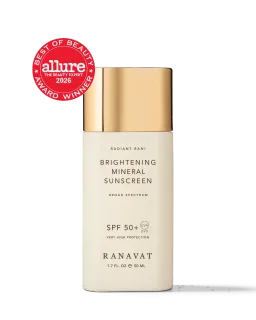
Ranavat Brightening Mineral Sunscreen SPF 50+
Works for
3 of 3 advertised claims delivered
Sun protectionSPF 50 · 2 UV filtersBroad spectrum
This product offers a good level of protection against both UVB and UVA rays.
This sunscreen uses organic (so-called "chemical") sunscreen filters. Organic, or "chemical" filters usually provide reliable sun protection and rarely leave a white cast. Sunscreens with organic filters can sting eyes.
This product can be considered "reef safe" because it does not contain the UV filters (oxybenzone and octinoxate) that can be harmful to coral reefs when present in the water in high concentrations.
Evens skin tone2 ingredients credited for this claimStrong support
“Clinically tested to help reduce dark spots and fine lines*, it provides broad-spectrum sun, blue light, and antioxidant protection with a radiant, luminous finish that leaves skin looking lit from within, with no white cast.”
This product offers broad spectrum sun protection. It means that it can prevent hyperpigmentation and help keep the skin tone even (sun damage is the main factor causing age spots, darkening of post-acne marks and other discolorations).
Anti-aging1 ingredient credited for this claimStrong support
“Clinically tested to help reduce dark spots and fine lines*, it provides broad-spectrum sun, blue light, and antioxidant protection with a radiant, luminous finish that leaves skin looking lit from within, with no white cast.”
This product can help prevent early signs of skin aging because it offers a good level of broad spectrum sun protection. Sun damage is the main cause of premature skin aging, and protecting your skin from the sun is the best anti-aging strategy.
MoisturizingNot advertised by the brand · 17 ingredients credited for this claimGood support
This product can help improve hydration of the skin with the two types of ingredients.
The first type is called “humectants”:
these ingredients help attract water.
When humectants are on the surface of the skin, they “pull in” the moisture from the outside environment, or from
within deeper layers of the skin. The following ingredients in this product do the job:
glycerin, caprylyl glycol.
This product also contains ingredients called “occlusives”. They help reduce the speed with which our skin loses moisture to the outside environment. These ingredients also help soften the upper layer of the skin, so it feels less tight and nicer to the touch. The following ingredients in this product do the job: ricinus communis seed oil, squalane.
Can it cause trouble?
Irritancy9 strong irritants: Rosa damascena flower water, Rosa damascena flower oil + 7 more — patch-test recommendedHigh risk
Comedogenic1 ingredient rated 2 or more on the 0–5 pore-clogging scale1 flagged
User reviews
Be the first — your take helps the next person decide.
Ingredients
Filter by role to see what each ingredient is doing.
Water~45–55%
Coco-caprylate~4.8–5.8%
- Irritation risk
- Medium
An emollient that softens skin and creates a nice product texture
More about Coco-caprylateZinc oxide12.3%
- Irritation risk
- Low
A broad spectrum sunblock (protects from both UVA and UVB rays). Is suitable for most sensitive skins. In small concentrations, can be used as a colorant
More about Zinc oxideEthylhexyl olivate~4.4–5.3%
- Irritation risk
- Low
Helps soften the upper layer of the skin
More about Ethylhexyl olivateButyloctyl salicylate~3.3–4.1%
- Irritation risk
- Medium
A synthetic ester of salicylic acid that is used to help disperse pigments and boost effectiveness of sunscreen ingredients. It is able to absorb UV light (working as an organic, or chemical filter), but is not approved as a sunscreen ingredient on its own
More about Butyloctyl salicylateC13-15 alkane~2.7–3.3%
Glyceryl oleate citrate~2.1–2.6%
- Irritation risk
- Medium
Helps oil and water mix together
More about Glyceryl oleate citrateGlycerin~1.9–2.3%
- Irritation risk
- Low
One of the best moisturizing ingredients. Naturally present in skin. It attracts water to the upper layer of the skin working as a humectant
More about GlycerinEthylhexyl methoxycrylene~1.5–1.8%
- Irritation risk
- Medium
Helps improve stability of sunscreen filters and boost their effectiveness
More about Ethylhexyl methoxycryleneDisteardimonium hectorite~1.3–1.5%
- Irritation risk
- Low
A type of clay that is used to thicken the product consistency
More about Disteardimonium hectoriteRubia cordifolia stem extract~1–1.3%
- Irritation risk
- Low
Crocus sativus flower extract~0.75–1.15%
- Irritation risk
- Low
Buddleja officinalis flower extract~0.95–1.2%
- Irritation risk
- High
A plant flower extract that might help calm down inflammation in skin and neutralize free radicals, but evidence of effectiveness in skin is lacking
More about Buddleja officinalis flower extractRosa damascena flower water~0.6–0.95%
- Irritation risk
- High
Used to add a nice rose smell to the product. Might help attract water to the upper layer of the skin and have some anti-oxidant effect. Can be irritating
More about Rosa damascena flower waterRosa damascena flower oil~0.55–0.85%
- Irritation risk
- High
Used as a fragrance. Can be irritating
More about Rosa damascena flower oilGlycine soja oil~0.6–0.9%
- Irritation risk
- Medium
- Comedogenicity
- 2/5
A good emollient that helps soften the skin and helps repair its barrier function. It can clog pores if used in high concentrations.
More about Glycine soja oilBerberis aristata root extract~0.55–0.85%
- Irritation risk
- Low
Curcuma longa root extract~0.5–0.75%
- Irritation risk
- High
A plant extract that can contain an active compound curcumin, that may have some anti-inflammatory properties when applied to the skin, but solid research is lacking and the typical concentration used in skincare products is too low. Can be an irritant
More about Curcuma longa root extractGlycyrrhiza glabra root extract~0.5–0.7%
- Irritation risk
- Medium
A plant extract that can help lighten the skin and calm down inflammation. Might be helpful in neutralizing free radicals
More about Glycyrrhiza glabra root extractNelumbo nucifera flower extract~0.45–0.65%
Symplocos racemosa bark extract~0.4–0.6%
- Irritation risk
- Low
Brassica juncea seed extract~0.35–0.65%
- Irritation risk
- Low
Cyperus rotundus root extract~0.35–0.6%
- Irritation risk
- Low
Mesua ferrea flower extract~0.3–0.6%
- Irritation risk
- Low
Butea frondosa flower extract~0.3–0.6%
- Irritation risk
- Low
Inula racemosa root extract~0.35–0.6%
- Irritation risk
- Low
Ficus benghalensis bark/bud extract~0.35–0.6%
- Irritation risk
- Low
Cinnamomum tamala leaf extract~0.35–0.6%
- Irritation risk
- Low
Sesamum indicum seed oil~0.4–0.6%
- Irritation risk
- Low
A good moisturizing plant oil. Due to the high linoleic acid content, it helps soften the upper layer of the skin, reduce water loss and support skin barrier function
More about Sesamum indicum seed oilOryza sativa bran oil~0.4–0.6%
- Irritation risk
- Low
Helps soften the upper layer of the skin and might have some anti-oxidant properties
More about Oryza sativa bran oilRicinus communis seed oil~0.4–0.6%
- Irritation risk
- Medium
A plant oil that can help soften the skin. It might be helpful in calming down inflammation, but solid research is lacking. Is often used in lip products to create the needed product consistency
More about Ricinus communis seed oilCaprylic/capric triglyceride~0.45–0.65%
- Irritation risk
- Medium
A good mix of fatty acids that forms a protective layer on the skin. Improves the shelf life of products. Derived from coconut and glycerin
More about Caprylic/capric triglycerideJojoba esters~0.45–0.65%
- Irritation risk
- Medium
An emollient made of jojoba oil. Helps soften the skin and support its barrier function
More about Jojoba estersSqualane~0.45–0.65%
- Irritation risk
- Low
An oil naturally present in skin. Works as an emollient to soften the skin and form a protective layer on its surface without a greasy feeling.
More about SqualaneTocopherol~0.35–0.65%
- Irritation risk
- Low
Pure form of vitamin E. Can help moisturise and protect the skin from free radicals. Often used to help stabilise other ingredients or the formula itself
More about TocopherolBisabolol~0.3–0.55%
- Irritation risk
- Low
An active component of chamomile plant that historically has been used to calm down irritated skin. A recent study shows that bisabolol indeed can have some anti-inflammatory effect on skin, even though conclusive data is lacking. Bisabolol has a sweet floral scent and can be added to products for its aromatic properties
More about BisabololTocopheryl acetate~0.35–0.6%
- Irritation risk
- Medium
A more stable but less bio-available form of vitamin E compared to Tocopherol. Might help moisturize and protect the skin from free radicals, but mostly used in low concentrations to stabilize other ingredients.
More about Tocopheryl acetatePolyglyceryl-3 polyricinoleate~0.4–0.6%
- Irritation risk
- Medium
Helps oil and water mix together
More about Polyglyceryl-3 polyricinoleateCaprylyl glycol~0.4–0.6%
- Irritation risk
- Medium
Helps preserve products and creates a nice product texture
More about Caprylyl glycolTrihydroxystearin~0.3–0.55%
- Irritation risk
- Low
Helps soften the upper layer of the skin and improve the product texture
More about TrihydroxystearinPolyhydroxystearic acid~0.25–0.5%
- Irritation risk
- Medium
Used to create a thicker product consistency and stabilize the formulation
More about Polyhydroxystearic acidPhenoxyethanol~0.25–0.5%
- Irritation risk
- Low
A preservative. It helps prevent bacterial growth in cosmetic products
More about PhenoxyethanolEthylhexylglycerin~0.25–0.5%
Hexylene glycol~0.25–0.45%
- Irritation risk
- Medium
Helps create a more spreadable product texture
More about Hexylene glycolHydroxyphenoxy propionic acid~0.25–0.45%
- Irritation risk
- Medium
Helps reduce hypepigmentation and even out the skin tone
More about Hydroxyphenoxy propionic acidPropylene glycol~0.2–0.4%
- Irritation risk
- High
Helps oil and water mix together and can enhance the penetration of other ingredients into the skin. It can be irritating
More about Propylene glycolGeraniol~0.15–0.3%
Eugenol~0.15–0.3%
Citronellol~0.15–0.3%
Limonene~0.15–0.25%
- Irritation risk
- High
A common frangrance that can easily irritate skin, especially if exposed to air, light or heat
More about LimoneneFarnesol~0.1–0.25%
Geranyl acetate~0.1–0.2%
- Irritation risk
- Low
Linalool~0.15–0.25%
Neral~0.1–0.2%
- Irritation risk
- Low
Ci 77492~0.1–0.15%
Ci 77491~0.05–0.15%
- Irritation risk
- Low
A red colorant made of iron oxide. Typically is not irritating
More about Ci 77491Ingredient list view
Water, Coco-caprylate, Zinc oxide, Ethylhexyl olivate, Butyloctyl salicylate, C13-15 alkane, Glyceryl oleate citrate, Glycerin, Ethylhexyl methoxycrylene, Disteardimonium hectorite, Rubia cordifolia stem extract, Crocus sativus flower extract, Buddleja officinalis flower extract, Rosa damascena flower water, Rosa damascena flower oil, Glycine soja oil, Berberis aristata root extract, Curcuma longa root extract, Glycyrrhiza glabra root extract, Nelumbo nucifera flower extract, Unknown, Symplocos racemosa bark extract, Brassica juncea seed extract, Cyperus rotundus root extract, Mesua ferrea flower extract, Unknown, Butea frondosa flower extract, Unknown, Inula racemosa root extract, Ficus benghalensis bark/bud extract, Cinnamomum tamala leaf extract, Sesamum indicum seed oil, Oryza sativa bran oil, Ricinus communis seed oil, Caprylic/capric triglyceride, Jojoba esters, Squalane, Tocopherol, Bisabolol, Tocopheryl acetate, Polyglyceryl-3 polyricinoleate, Caprylyl glycol, Trihydroxystearin, Polyhydroxystearic acid, Phenoxyethanol, Ethylhexylglycerin, Hexylene glycol, Hydroxyphenoxy propionic acid, Propylene glycol, Geraniol, Eugenol, Citronellol, Limonene, Farnesol, Geranyl acetate, Linalool, Neral, Ci 77492, Ci 77491
Compare prices
Retailers ranked by price — lowest first.

Sources cited in this review
Every concentration estimate and effectiveness label is anchored to one of these 26 studies and safety reviews.
- 1A review of inorganic UV filters zinc oxide and titanium dioxideonlinelibrary.wiley.com
- 2
- 3
- 4
- 5
- 6

Affiliate links · As an Amazon Associate, WIMJ earns from qualifying purchases.