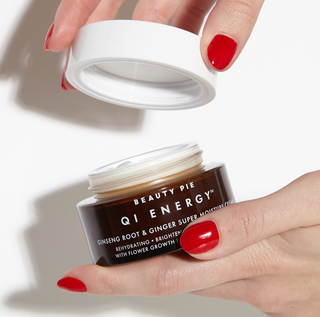
Qi Energy™ Ginseng Root & Ginger Super Moisture Cream
Works for
2 of 2 advertised claims delivered
Moisturizing24 ingredients credited for this claimStrong support
“Ginseng Root & Ginger Super Moisture Cream”
This product can help improve hydration of the skin with the two types of ingredients.
The first type is called “humectants”:
these ingredients help attract water.
When humectants are on the surface of the skin, they “pull in” the moisture from the outside environment, or from
within deeper layers of the skin. The following ingredients in this product do the job:
glycerin, sodium hyaluronate.
This product also contains ingredients called “occlusives”. They help reduce the speed with which our skin loses moisture to the outside environment. These ingredients also help soften the upper layer of the skin, so it feels less tight and nicer to the touch. The following ingredients in this product do the job: dimethicone, squalane.
The following ingredients in this product are especially good for supporting the skin barrier and helping with the hydration level: ceramide ng, palmitoyl hexapeptide-12, phytosphingosine
Anti-aging5 ingredients credited for this claimStrong support
“Our supercharged formulas complement all skin types from high-tech, anti-aging Retinol and brightening vitamin C, to nourishing plant extracts – choose products tailored to your skin’s needs.”
This product can help reduce and prevent fine lines and wrinkles, improve skin elasticity and firmness because it contains palmitoyl hexapeptide-12.
Keep in mind that it typically takes at least 6 weeks to notice any results because the changes that are needed to improve fine lines and elasticity happen in the deeper layers of the skin. No topical anti-aging product can “erase” wrinkles or fully reverse signs of aging.
Can it cause trouble?
Irritancy6 strong irritants: Parfum, Limonene + 4 more — patch-test recommendedHigh risk
ComedogenicClean of flagged comedogenic ingredientsNone flagged


User reviews
Be the first — your take helps the next person decide.
Ingredients
Filter by role to see what each ingredient is doing.
Water~45–55%
Glycerin~4.5–5.5%
- Irritation risk
- Low
One of the best moisturizing ingredients. Naturally present in skin. It attracts water to the upper layer of the skin working as a humectant
More about GlycerinButylene glycol~4–4.8%
- Irritation risk
- Low
Used to create a nice product texture and help delivery of other ingredients. Might be somewhat helpful in attracting water to the upper layer of the skin
More about Butylene glycolIsononyl isononanoate~3.1–3.8%
- Irritation risk
- Low
Forms a protective film on the surface of the skin to prevent moisture loss. Gives a velvety feel to products while reducing tackiness
More about Isononyl isononanoateDimethicone~2.4–2.9%
- Irritation risk
- Low
A silicone that helps to reduce water loss from the surface of the skin. Can temporarily "fill in" lines and wrinkles, absorb oil, and create a nice product finish
More about DimethiconeOctyldodecanol~1.9–2.3%
- Irritation risk
- Low
An emollient that helps to soften the skin and create a pleasant product texture and stabilize the formulation
More about OctyldodecanolDipentaerythrityl hexacaprylate/hexacaprate~1.6–2%
- Irritation risk
- Low
C12-15 alkyl benzoate~1.4–1.8%
- Irritation risk
- Low
Enhances the product texture and makes it more spreadable. Helps reduce water loss from the outer layer of skin. Extands the shelf life by preventing bacteria growth
More about C12-15 alkyl benzoateGlyceryl stearate~1.2–1.5%
- Irritation risk
- Low
An emollient that softens the skin and forms a protective layer on its surface. Helps water and oil mix together
More about Glyceryl stearatePeg-40 stearate~0.95–1.15%
Behenyl alcohol~0.75–1.1%
- Irritation risk
- Low
Non-drying alcohol that helps water and oil mix together. Also serves as an emollient
More about Behenyl alcoholSqualane~0.6–0.95%
- Irritation risk
- Low
An oil naturally present in skin. Works as an emollient to soften the skin and form a protective layer on its surface without a greasy feeling.
More about SqualaneStearic acid~0.6–0.95%
- Irritation risk
- Low
Helps oil and water mix together and works as an emollient
More about Stearic acidTrehalose~0.45–0.7%
- Irritation risk
- Low
A sugar that attracts water to the upper layer of the skin
More about TrehalosePhenoxyethanol~0.45–0.65%
- Irritation risk
- Low
A preservative. It helps prevent bacterial growth in cosmetic products
More about PhenoxyethanolAmmonium acryloyldimethyltaurate/vp copolymer~0.45–0.65%
- Irritation risk
- Low
Increases thickness of a product. Texture enhancer for oil-in-water emulsions
More about Ammonium acryloyldimethyltaurate/vp copolymerPhytosteryl/octyldodecyl lauroyl glutamate~0.45–0.7%
- Irritation risk
- Low
A mix of amino acids and plant-based lipids. Helps to soften the upper layer of the skin and reduce water loss over time
More about Phytosteryl/octyldodecyl lauroyl glutamatePeg-20 methyl glucose sesquistearate~0.4–0.6%
- Irritation risk
- Medium
Helps oil and water mix together
More about Peg-20 methyl glucose sesquistearateTribehenin~0.3–0.6%
- Irritation risk
- Low
Used to create a thicker product consistency and soften the upper layer of the skin
More about TribeheninEthylhexylglycerin~0.3–0.55%
Polyacrylamide~0.3–0.55%
- Irritation risk
- Medium
Used to improve product texture and help oil and water mix together
More about PolyacrylamideSorbitan caprylate~0.25–0.5%
- Irritation risk
- Medium
Helps oil and water mix together
More about Sorbitan caprylateParfum~0.2–0.4%
- Irritation risk
- High
An aromatic blend of unspecified and possibly irritating ingredients
More about ParfumC13-14 isoparaffin~0.3–0.5%
- Irritation risk
- Low
Helps soften the upper layer of the skin, dissolve other ingredients and create a thicker product consistency
More about C13-14 isoparaffinDisodium edta~0.25–0.45%
Acacia senegal gum~0.25–0.5%
- Irritation risk
- Medium
Helps mask the small of other ingredients and improve the product texture
More about Acacia senegal gumSodium hyaluronate~0.25–0.45%
- Irritation risk
- Low
One of the best moisturizing ingredients. Attracts water into the upper layer of the skin
More about Sodium hyaluronateCeramide ng~0.25–0.5%
- Irritation risk
- Low
A type of lipid similar to ceramides naturally present in skin. Helps to soften the upper layer of the skin and supports the skin barrier function to keep it hydrated. Can help to prevent inflammation in skin
More about Ceramide ngCaramel~0.25–0.45%
- Irritation risk
- Low
Laureth-7~0.25–0.5%
Lactic acid~0.25–0.45%
- Irritation risk
- Medium
An exfoliating and moisturizing alpha-hydroxy acid (AHA). Typically causes less irritation than other AHAs, for example, glycolic acid. At high concentrations (about 15%), lactic acid can help reduce lines and wrinkles. Recent studies show that lactic acid can support the "good" bacteria living on skin's surface (healthy skin microbiome)
More about Lactic acidPeg-8~0.25–0.45%
- Irritation risk
- Medium
Used to create a nice product consistency
More about Peg-8Sodium hydroxide~0.25–0.45%
Panax ginseng root extract~0.25–0.5%
- Irritation risk
- High
A plant extract that might have some anti-inflammatory properties, but solid evidence is lacking. It can be irritating
More about Panax ginseng root extractAgar~0.25–0.45%
- Irritation risk
- Medium
Polysaccharide derived from seaweed. Used to create a thicker product consistency and might help attract water to the upper layer of the skin
More about AgarHydrogenated lecithin~0.25–0.5%
- Irritation risk
- Low
Helps to retain moisture by creating a protective barrier on the skin. Rich in fatty acids. Improves product texture and helps with the penetration of other ingredients.
More about Hydrogenated lecithinTocopherol~0.25–0.45%
- Irritation risk
- Low
Pure form of vitamin E. Can help moisturise and protect the skin from free radicals. Often used to help stabilise other ingredients or the formula itself
More about TocopherolLimonene~0.2–0.4%
- Irritation risk
- High
A common frangrance that can easily irritate skin, especially if exposed to air, light or heat
More about LimoneneCanola sterols~0.25–0.5%
- Irritation risk
- Low
Phytosterols~0.3–0.55%
- Irritation risk
- Medium
Lipids that work as an emollient and can be helpful in repairing skin barrier function
More about PhytosterolsLinalool~0.2–0.4%
Alpha-isomethyl ionone~0.2–0.4%
- Irritation risk
- High
A fragrance. Potential allergen and can be irritating
More about Alpha-isomethyl iononeAscorbyl palmitate~0.2–0.4%
- Irritation risk
- Medium
Being a lipid soluble form of vitamin C, it is more stable and can penetrate the skin better than L-Ascorbic acid. It is effective in protecting the skin from free radicals, as well as evening the skin tone, but is less effective in stimulating collagen production compared to L-Ascorbic acid.
More about Ascorbyl palmitateZingiber officinale root extract~0.15–0.3%
- Irritation risk
- High
A plant extract that can contain an irritating essential oil. Might have some anti-oxidant effect, but evidence is lacking
More about Zingiber officinale root extractAlcohol~0.2–0.4%
- Irritation risk
- High
Can be drying and contribute to skin irritation. Used in formulars to dissolve other ingredients, create a thinner product consistency or for its antibacterial properties
More about AlcoholDistearyl lauroyl glutamate~0.25–0.45%
- Irritation risk
- Low
Crocus chrysanthus bulb extract~0.2–0.35%
- Irritation risk
- Low
Palmitoyl hexapeptide-12~0.15–0.3%
- Irritation risk
- Low
A type of peptide. Peptides are excellent moisturizers and might be able support collagen production reducing fine lines and wrinkles
More about Palmitoyl hexapeptide-12Ascorbic acid~0.15–0.25%
- Irritation risk
- High
The most well-researched antioxidant that works in skin. Helps neutralize free radicals supporting collagen production, helping to even out the skin tone and preventing early signs of aging
More about Ascorbic acidCitric acid~0.15–0.25%
- Irritation risk
- Medium
Can work as an exfoliant but is typically used to adjust the product pH
More about Citric acidCi 17200~0.15–0.25%
Phytosphingosine~0.15–0.25%
- Irritation risk
- Low
A type of lipid that is naturally present in skin. It might help in repairing skin barrier function and has anti-bacterial effect
More about PhytosphingosineCi 42090~0.1–0.15%
Ingredient list view
Water, Glycerin, Butylene glycol, Isononyl isononanoate, Dimethicone, Octyldodecanol, Dipentaerythrityl hexacaprylate/hexacaprate, C12-15 alkyl benzoate, Glyceryl stearate, Peg-40 stearate, Behenyl alcohol, Squalane, Stearic acid, Trehalose, Phenoxyethanol, Ammonium acryloyldimethyltaurate/vp copolymer, Phytosteryl/octyldodecyl lauroyl glutamate, Peg-20 methyl glucose sesquistearate, Tribehenin, Ethylhexylglycerin, Polyacrylamide, Sorbitan caprylate, Parfum, C13-14 isoparaffin, Disodium edta, Acacia senegal gum, Sodium hyaluronate, Ceramide ng, Caramel, Laureth-7, Lactic acid, Peg-8, Sodium hydroxide, Panax ginseng root extract, Agar, Hydrogenated lecithin, Tocopherol, Limonene, Canola sterols, Phytosterols, Linalool, Alpha-isomethyl ionone, Ascorbyl palmitate, Zingiber officinale root extract, Alcohol, Distearyl lauroyl glutamate, Crocus chrysanthus bulb extract, Palmitoyl hexapeptide-12, Ascorbic acid, Citric acid, Ci 17200, Phytosphingosine, Ci 42090
Compare prices
Retailers ranked by price — lowest first.

Worth comparing, line by line.
Match % combines shared ingredients, the first five ingredients, shared actives and hero ingredients, irritancy (lower counts in the alternative's favour), texture and body area. Only products in the same routine step are compared.
| Qi Energy™Ginseng Root & Ginger Super Moisture CreamYOUR PRODUCT | BeautyBioThe Quench Quadralipid Skin Recovery Cream | TIRTIRMatcha Calming Cream 50ml | DieuxInstant Angel Skin Restoring Moisturizer | |
|---|---|---|---|---|
| Match | — | 55% | 51% | 50% |
| Price | $17.85 | $170.54+$152.69 | $43.56+$25.71 | $8.98−$8.87 |
| Shared key ingredients | — | 5 of 12 | 5 of 12 | 7 of 12 |
| Key difference | — | Ceramide Ap | Dipeptide-2 | Linoleic Acid |
| Irritancy | High | Medium | Medium | Medium |
| Drying alcohol | Contains drying alcohol | — | — | — |
| View product | Shop | Shop | Shop |


Product summary
"Qi Energy™ - Ginseng Root & Ginger Super Moisture Cream" has a good moisturizing formula. The formulation is based on a combination of good humectants and emollients. Both are needed to increase the skin hydration level. Humectants in this product (glycerin, sodium hyaluronate, trehalose, butylene glycol and peg-8) help to increase the water content in the upper layer of the skin. (These ingredients do so by "capturing" water molecules from the outside air or from within the deeper layers of the skin). Emollients in this formulation (ceramide ng, phytosphingosine, phytosterols, phytosteryl/octyldodecyl lauroyl glutamate and dimethicone) help to reduce the moisture loss from the skin. They also soften the skin surface and relieve the feeling of dryness and tightness.
Ingredient callouts
- This product also contains Vitamin C (Ascorbic Acid). It can be an effective active for anti-aging and evening out the skin tone, but in this moisturizer it is used for stabilizing other ingredients in the formulation. In this concentration (0.15% - 0.25%) it cannot have a noticeable benefit for the skin.
- As a plus, this moisturizer also contains Ceramides (phytosphingosine 0.15% - 0.25% and ceramide ng 0.25% - 0.50%). Ceramides are a type of lipids that our skin produces itself. They are a building block of the skin's barrier. Ceramides used in skincare are synthetic or extracted from plants. They work well for softening the skin surface and "patch holes" in the skin's barrier.
- This moisturizer also contains Peptides (palmitoyl hexapeptide-12 0.15% - 0.30%). Peptides are a very big group of ingredients. They all consist of a different combination of aminoacids. Our skin produces Peptides naturally. Some of them work as natural antibiotics, promote wound-healing and production of collagen. The scientists are still studying how effective the topical application of Peptides is, but it is very likely that they are helpful. Peptides might be able to support skin barrier restoration and even have an anti-aging benefit. At the very least, they certainly help attract water to the skin and support the hydration in this way.
Irritation risk
There are quite a few common irritants in this product, including ingredients without particular skin benefits. We would not recommend it for sensitive skin. We assess the overall irritancy of this moisturizer to be high. For a detailed overview of all potential irritants: click here
You can see the detailed formula review with the breakdown of all actives in the product and the full ingredient list with estimated concentrations in the tables below.
Price
The product retails from 13.50$ up to 15.00$ in the United Kingdom.
For a detailed price comparison: click here.
Sources cited in this review
Every concentration estimate and effectiveness label is anchored to one of these 15 studies and safety reviews.
- 1
- 2
- 3Final Report on the Safety Assessment of Dimethicone Copolyoljournals.sagepub.com
- 4Safety Assessment of Isoparaffins as Used in Cosmeticsjournals.sagepub.com
- 5Hyaluronic acid: A key molecule in skin agingncbi.nlm.nih.gov
- 6

Affiliate links · As an Amazon Associate, WIMJ earns from qualifying purchases.