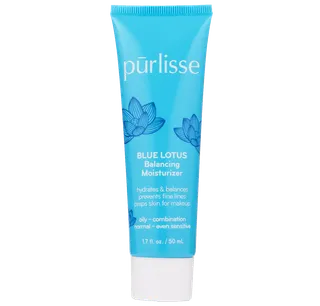
Works for
MoisturizingPalmitoyl oligopeptide, Palmitoyl tetrapeptide-7 + 18 moreWorks well
“Blue Lotus Balancing Moisturizer delivers intensive yet weightless hydration to delicate complexions while instantly restoring skin barrier function and visibly diminishing fine lines.”
This product can help improve hydration of the skin with the two types of ingredients.
The first type is called “humectants”:
these ingredients help attract water.
When humectants are on the surface of the skin, they “pull in” the moisture from the outside environment, or from
within deeper layers of the skin. The following ingredients in this product do the job:
glycerin, sodium hyaluronate.
This product also contains ingredients called “occlusives”. They help reduce the speed with which our skin loses moisture to the outside environment. These ingredients also help soften the upper layer of the skin, so it feels less tight and nicer to the touch. The following ingredients in this product do the job: caprylic/capric triglyceride, dimethicone.
The following ingredients in this product are especially good for supporting the skin barrier and helping with the hydration level: palmitoyl oligopeptide, palmitoyl tetrapeptide-7
Anti-agingPalmitoyl oligopeptide, Palmitoyl tetrapeptide-7 + 2 moreMay help
“Blue Lotus Balancing Moisturizer delivers intensive yet weightless hydration to delicate complexions while instantly restoring skin barrier function and visibly diminishing fine lines.”
This product contains palmitoyl oligopeptide, palmitoyl tetrapeptide-7. These ingredients might be able to help reduce and prevent fine lines and wrinkles, improve skin elasticity and firmness, but there is not enough evidence that it actually works.
Anti-oxidationSide benefit · Camellia sinensis leaf extract, Hydrolyzed soy protein + 4 moreMay help
This product contains antioxidants (camellia sinensis leaf extract) that might be able to help neutralize free radicals in skin to lessen the damage it gets from the UV light (sun). There is not enough evidence to confirm their effectiveness in skin though.
Can it cause trouble?
Irritancy8 strong irritants: Geraniol, Limonene + 6 more — patch-test recommendedHigh risk
Comedogenic1 ingredient rated 2 or more on the 0–5 pore-clogging scale1 flagged

User reviews
Be the first — your take helps the next person decide.
Ingredients
Filter by role to see what each ingredient is doing.
Water~45–55%
Cyclopentasiloxane~6.3–7.6%
- Irritation risk
- Low
A silicone that helps improve the product texture and spreadability. Can absorb oil creating a short-term mattifying effect on the skin
More about CyclopentasiloxaneDimethicone~4.5–5.5%
- Irritation risk
- Low
A silicone that helps to reduce water loss from the surface of the skin. Can temporarily "fill in" lines and wrinkles, absorb oil, and create a nice product finish
More about DimethiconeCetearyl ethylhexanoate~3.2–4%
- Irritation risk
- Low
An emollient that helps soften the skin
More about Cetearyl ethylhexanoateGlycerin~2.5–3%
- Irritation risk
- Low
One of the best moisturizing ingredients. Naturally present in skin. It attracts water to the upper layer of the skin working as a humectant
More about GlycerinDicaprylyl maleate~2–2.5%
- Irritation risk
- Medium
Used to dissolve other ingredients, create a nice product texture and soften the upper layer of the skin. Can be an allergen
More about Dicaprylyl maleateCaprylic/capric triglyceride~1.8–2.2%
- Irritation risk
- Medium
A good mix of fatty acids that forms a protective layer on the skin. Improves the shelf life of products. Derived from coconut and glycerin
More about Caprylic/capric triglycerideStearic acid~1.6–1.9%
- Irritation risk
- Low
Helps oil and water mix together and works as an emollient
More about Stearic acidGlyceryl stearate~1.2–1.5%
- Irritation risk
- Low
An emollient that softens the skin and forms a protective layer on its surface. Helps water and oil mix together
More about Glyceryl stearateCetyl dimethicone~1–1.3%
- Irritation risk
- Low
A type of silicone. Helps soften the upper layer of the skin and creates a nice, light product texture
More about Cetyl dimethiconeCetyl alcohol~0.8–1.2%
- Irritation risk
- Low
A non-drying alcohol that works to soften the skin and stabilize product formulations helping oil and water mix together
More about Cetyl alcoholPeg-100 stearate~0.7–1%
- Irritation risk
- Low
Helps oil and water mix togehter and creates a nice product texture
More about Peg-100 stearatePalmitoyl oligopeptide~0.6–0.95%
- Irritation risk
- Low
A type of peptide. Peptides are excellent moisturizers and might be able support collagen production reducing fine lines and wrinkles
More about Palmitoyl oligopeptidePalmitoyl tetrapeptide-7~0.5–0.8%
- Irritation risk
- Low
A type of peptide. Peptides are excellent moisturizers and might be able support collagen production reducing fine lines and wrinkles
More about Palmitoyl tetrapeptide-7Tocopheryl acetate~0.45–0.7%
- Irritation risk
- Medium
A more stable but less bio-available form of vitamin E compared to Tocopherol. Might help moisturize and protect the skin from free radicals, but mostly used in low concentrations to stabilize other ingredients.
More about Tocopheryl acetateHydrolyzed lupine protein octenylsuccinate~0.45–0.65%
- Irritation risk
- Low
Alaria esculenta extract~0.45–0.65%
- Irritation risk
- Low
Works as a humectant helping to attract water to the upper layer of the skin and might be effective as an anti-oxidant.
More about Alaria esculenta extractHydrolyzed soy protein~0.35–0.65%
- Irritation risk
- Low
Helps attract water to the upper layer of the skin. Might have some anti-aging, anti-oxidant, and skin lightening properties, but solid evidence is missing
More about Hydrolyzed soy proteinCamellia sinensis leaf extract~0.35–0.6%
- Irritation risk
- Low
Can contain potent anti-oxidant compounds (abbreviated ECG, GCG, EGC, and EGCG) that might help protect the skin from free radicals. Can help calm down inflammation and has some anti-bacterial properties. Unfortunately, these antioxidants are unstable and lose their effectiveness very quickly in products. The concentration of the antioxidant compounds in the extract also tends to be low to be effective in topical formulation
More about Camellia sinensis leaf extractDipotassium glycyrrhizate~0.3–0.55%
- Irritation risk
- Low
A salt derived from licorice. Works as an emollient to soften the upper layer of the skin and can help calm down inflammation. Might be helpful for skin lightening
More about Dipotassium glycyrrhizateNymphaea coerulea flower extract~0.3–0.5%
- Irritation risk
- Low
Sodium hyaluronate~0.25–0.5%
- Irritation risk
- Low
One of the best moisturizing ingredients. Attracts water into the upper layer of the skin
More about Sodium hyaluronateButylene glycol~0.25–0.5%
- Irritation risk
- Low
Used to create a nice product texture and help delivery of other ingredients. Might be somewhat helpful in attracting water to the upper layer of the skin
More about Butylene glycolPolysorbate 20~0.3–0.55%
Cetearyl alcohol~0.3–0.55%
- Irritation risk
- Low
- Comedogenicity
- 2/5
A non-drying alcohol. Works as an emollient. Helps water and oil mix together and creates a nice product texture
More about Cetearyl alcoholDicetyl phosphate~0.3–0.5%
Ceteth-10 phosphate~0.35–0.65%
Carbomer~0.25–0.5%
- Irritation risk
- Low
Helps create a thicker or gel-like product texture. It is not a surfactant but can be used in gentle cleansing formulations
More about CarbomerDisodium edta~0.25–0.45%
Aminomethyl propanol~0.25–0.45%
Caprylyl glycol~0.3–0.5%
- Irritation risk
- Medium
Helps preserve products and creates a nice product texture
More about Caprylyl glycolPhenoxyethanol~0.25–0.45%
- Irritation risk
- Low
A preservative. It helps prevent bacterial growth in cosmetic products
More about PhenoxyethanolChlorphenesin~0.16–0.32%
Geraniol~0.2–0.4%
Limonene~0.2–0.35%
- Irritation risk
- High
A common frangrance that can easily irritate skin, especially if exposed to air, light or heat
More about LimoneneCitrus medica peel oil~0.2–0.35%
- Irritation risk
- Low
Citrus aurantium dulcis oil~0.2–0.4%
- Irritation risk
- High
Used as a fragrance. It can be irritating and cause photosensitivity
More about Citrus aurantium dulcis oilCitrus aurantium bergamia fruit oil~0.15–0.3%
- Irritation risk
- High
A plant oil with a high content of volatile compounds that can irritate the skin and lead to allergic reactions. Can lead to photosensitivity
More about Citrus aurantium bergamia fruit oilPelargonium graveolens flower oil~0.2–0.35%
- Irritation risk
- High
An essential oil. Can be irritating. Can become an allergen with oxidation
More about Pelargonium graveolens flower oilCymbopogon martini oil~0.15–0.25%
- Irritation risk
- High
Aromatic plant oil used in cosmetics as a fragrance. A likely irritant
More about Cymbopogon martini oilCitrus aurantifolia oil~0.2–0.4%
- Irritation risk
- High
Juniperus mexicana oil~0.15–0.25%
- Irritation risk
- Low
Tagetes minuta flower oil~0.1–0.15%
- Irritation risk
- Low
Michelia alba flower oil~0.1–0.15%
- Irritation risk
- High
A plant essential oil. Used as a fragrance. Can be irritating
More about Michelia alba flower oilIngredient list view
Water, Cyclopentasiloxane, Dimethicone, Cetearyl ethylhexanoate, Glycerin, Dicaprylyl maleate, Caprylic/capric triglyceride, Stearic acid, Glyceryl stearate, Cetyl dimethicone, Cetyl alcohol, Peg-100 stearate, Palmitoyl oligopeptide, Palmitoyl tetrapeptide-7, Tocopheryl acetate, Hydrolyzed lupine protein octenylsuccinate, Alaria esculenta extract, Hydrolyzed soy protein, Camellia sinensis leaf extract, Dipotassium glycyrrhizate, Nymphaea coerulea flower extract, Sodium hyaluronate, Butylene glycol, Polysorbate 20, Cetearyl alcohol, Dicetyl phosphate, Ceteth-10 phosphate, Carbomer, Disodium edta, Aminomethyl propanol, Caprylyl glycol, Phenoxyethanol, Chlorphenesin, Geraniol, Limonene, Citrus medica peel oil, Citrus aurantium dulcis oil, Citrus aurantium bergamia fruit oil, Pelargonium graveolens flower oil, Cymbopogon martini oil, Citrus aurantifolia oil, Juniperus mexicana oil, Tagetes minuta flower oil, Michelia alba flower oil
Compare prices
Retailers ranked by price — lowest first.

Worth comparing, line by line.
Match % combines shared ingredients, the first five ingredients, shared actives and hero ingredients, irritancy (lower counts in the alternative's favour), texture and body area. Only products in the same routine step are compared.
| PurlisseBlue Lotus Balancing MoisturizerYOUR PRODUCT | MEDI-PEELPeptide 9 Volume Tox Cream Pro | Image skincareThe MAX Stem Cell Creme | Peter Thomas RothPeptide 21 Lift & Firm Moisturizer | |
|---|---|---|---|---|
| Match | — | 62% | 59% | 58% |
| Price | $45.00 | $26.33−$18.67 | $69.77+$24.77 | $56.00+$11.00 |
| Shared key ingredients | — | 7 of 10 | 5 of 10 | 6 of 10 |
| Key difference | — | Acetyl Dipeptide-1 Cetyl Ester | Acetyl Octapeptide-3 | Tripeptide-1 |
| Irritancy | High | Medium | Medium | Medium |
| Drying alcohol | — | — | — | — |
| View product | Shop | Shop | Shop |


More alternatives: Lili Margo Generous Anti-Wrinkle Night CareDerm Institute Anti-Oxidant Hydration Cream
Sources cited in this review
Every concentration estimate and effectiveness label is anchored to one of these 18 studies and safety reviews.
- 1
- 2Final Report on the Safety Assessment of Dimethicone Copolyoljournals.sagepub.com
- 3
- 4Allergic contact dermatitis from medium-chain triglyceridesonlinelibrary.wiley.com
- 5Dicaprylyl maleate--an emerging cosmetic allergenncbi.nlm.nih.gov
- 6Extracts from Glycine max (soybean) induce elastin synthesis and inhibit elastase activityonlinelibrary.wiley.com

Affiliate links · As an Amazon Associate, WIMJ earns from qualifying purchases.