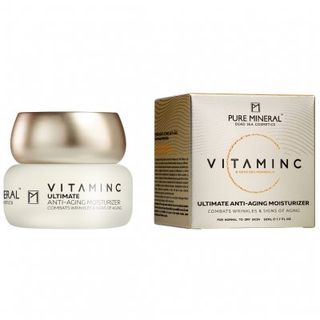
Pure Mineral Vitamin C Ultimate Anti Aging Moisturizer
Works for
1 of 3 advertised claims delivered
Moisturizing16 ingredients credited for this claimGood support
“Vitamin C Ultimate Anti Aging Moisturizer”
This product can help improve hydration of the skin with the two types of ingredients.
The first type is called “humectants”:
these ingredients help attract water.
When humectants are on the surface of the skin, they “pull in” the moisture from the outside environment, or from
within deeper layers of the skin. The following ingredients in this product do the job:
sodium hyaluronate, caprylyl glycol.
This product also contains ingredients called “occlusives”. They help reduce the speed with which our skin loses moisture to the outside environment. These ingredients also help soften the upper layer of the skin, so it feels less tight and nicer to the touch. The following ingredients in this product do the job: caprylic/capric triglyceride, helianthus annuus seed oil.
Evens skin tone3 ingredients credited for this claimWeak support
“dehydration, age spots, sagging, pigmentation and wrinkles, so skin maintains a long-term youthful appearance, firmness, and radiance.”
Effective ingredients missing or their concentration is too low
Anti-aging6 ingredients credited for this claimWeak support
“Vitamin C Ultimate Anti Aging Moisturizer”
Effective ingredients missing or their concentration is too low.
Can it cause trouble?
Irritancy4 strong irritants: Rosa damascena extract, Rosmarinus officinalis leaf extract + 2 more — patch-test recommendedHigh risk
Comedogenic3 ingredients rated 2 or more on the 0–5 pore-clogging scale3 flagged


User reviews
Be the first — your take helps the next person decide.
Ingredients
Filter by role to see what each ingredient is doing.
Water~40–60%
Glyceryl stearate se~3.8–5.8%
- Irritation risk
- Low
- Comedogenicity
- 2/5
Used to stabilize the product formulations and works as an emollient
More about Glyceryl stearate seCetyl alcohol~3.2–4.8%
- Irritation risk
- Low
A non-drying alcohol that works to soften the skin and stabilize product formulations helping oil and water mix together
More about Cetyl alcoholIsopropyl myristate~2.8–4.1%
- Irritation risk
- Low
- Comedogenicity
- 3/5
An emollient that helps soften the skin. Could be comedogenic
More about Isopropyl myristateKaolin~2.2–3.2%
- Irritation risk
- Low
A type of clay that consists mainly of aluminum silicate. Helps absorb oil and creates a thicker product consistency. Can be used to add a white color
More about KaolinCaprylic/capric triglyceride~1.7–2.6%
- Irritation risk
- Medium
A good mix of fatty acids that forms a protective layer on the skin. Improves the shelf life of products. Derived from coconut and glycerin
More about Caprylic/capric triglycerideOlive oil polyglyceryl-6 esters~1.4–2.1%
Persea gratissima oil~1.3–1.9%
- Irritation risk
- Medium
An emollient that helps soften the skin and could be helpful in repairing its barrier function
More about Persea gratissima oilHydrogen~0.95–1.45%
- Irritation risk
- Low
Collagen~0.6–1.35%
- Irritation risk
- Low
Cannot penetrate the skin barrier so is not particularly useful in skincare products
More about CollagenButyrospermum parkii butter~0.5–1.2%
- Irritation risk
- Low
- Comedogenicity
- 3/5
A great moisturising ingredient that softens the skin and reduces water loss from its upper layer. It also can be helpful in protecting skin from free radicals
More about Butyrospermum parkii butterIsopentyldiol~0.4–0.95%
Argon~0.35–0.8%
- Irritation risk
- Low
Rosa damascena extract~0.3–0.7%
- Irritation risk
- High
Oil of a very fragrant pink rose used as fragrance in cosmetics. Extensive research has shown it has mixed benefits. In the pro column, inhaling this flower’s scent seems to have relaxing properties and the plant’s petals contain skin-soothing and antioxidant compounds that can benefit skin. On the flipside, the numerous chemicals that create this rose’s distinctive fragrance pose a risk of causing skin aggravation.
More about Rosa damascena extractCucumis sativus extract~0.2–0.75%
- Irritation risk
- Medium
Sodium hyaluronate~0.2–0.8%
- Irritation risk
- Low
One of the best moisturizing ingredients. Attracts water into the upper layer of the skin
More about Sodium hyaluronateRosmarinus officinalis leaf extract~0.2–0.7%
- Irritation risk
- High
Can be helpful in reducing inflammation in skin, including inflamed acne. It can be irritating
More about Rosmarinus officinalis leaf extractPrunus amygdalus dulcis oil~0.2–0.75%
- Irritation risk
- Low
An emollient that softens the skin
More about Prunus amygdalus dulcis oilCamellia sinensis leaf extract~0.15–0.65%
- Irritation risk
- Low
Can contain potent anti-oxidant compounds (abbreviated ECG, GCG, EGC, and EGCG) that might help protect the skin from free radicals. Can help calm down inflammation and has some anti-bacterial properties. Unfortunately, these antioxidants are unstable and lose their effectiveness very quickly in products. The concentration of the antioxidant compounds in the extract also tends to be low to be effective in topical formulation
More about Camellia sinensis leaf extractCarbomer~0.15–0.6%
- Irritation risk
- Low
Helps create a thicker or gel-like product texture. It is not a surfactant but can be used in gentle cleansing formulations
More about CarbomerHydrogen~0.15–0.55%
- Irritation risk
- Low
Xanthan gum~0.15–0.55%
- Irritation risk
- Low
Used to create a thicker product consistency
More about Xanthan gumPanthenol~0.1–0.5%
- Irritation risk
- Low
Helps attract water to the upper layer of the skin and can help improve skin barrier function
More about PanthenolPotassium sorbate~0.15–0.5%
Ascorbyl tetraisopalmitate~0.15–0.55%
- Irritation risk
- Medium
A vitamin C derivative. Studies show that is might be effective in reducing hyperpigmentation, but there are no studies confirming that it is effectively converted into the bioavailable form of Vitamin C in skin. It is not clear how this derivative compares in effectiveness to the topical application of bioavailable form of vitamin C (L-ascorbic acid)
More about Ascorbyl tetraisopalmitateBenzoic acid~0.15–0.5%
Sorbic acid~0.1–0.5%
Dehydroacetic acid~0.1–0.5%
Caprylyl glycol~0.15–0.55%
- Irritation risk
- Medium
Helps preserve products and creates a nice product texture
More about Caprylyl glycolBenzyl alcohol~0.1–0.4%
- Irritation risk
- High
A preservative. Can be used to mask unpleasant smell. Can be irritating
More about Benzyl alcoholMaris sal~0.1–0.45%
- Irritation risk
- Medium
Used to thicken the product formulation and might help to add minerals to the surface of the skin. It is used in scrubs as a physical exfoliant. Can increase sensitivity to other ingredients if left on the skin or used in high concentration
More about Maris salSea salt~0.1–0.45%
- Irritation risk
- Medium
Used to thicken the product formulation and might help to add minerals to the surface of the skin. It is used in scrubs as a physical exfoliant. Can increase sensitivity to other ingredients if left on the skin or used in high concentration
More about Sea saltTocopherol~0.1–0.45%
- Irritation risk
- Low
Pure form of vitamin E. Can help moisturise and protect the skin from free radicals. Often used to help stabilise other ingredients or the formula itself
More about TocopherolParfum~0.1–0.3%
- Irritation risk
- High
An aromatic blend of unspecified and possibly irritating ingredients
More about ParfumPhospholipids~0.1–0.35%
- Irritation risk
- Low
Emollients that are naturaly present in skin. In addition, they help water and oil mix together in the product
More about PhospholipidsHelianthus annuus seed oil~0.1–0.35%
- Irritation risk
- Low
A great emollient due to its high linoleic acid content. One of the most effective plant oils in helping skin hydration and repairing skin barrier function
More about Helianthus annuus seed oilRetinyl palmitate~0.05–0.15%
- Irritation risk
- High
Three steps removed from the active form of vitamin A - retinoic acid. To have an effect in the skin, it first needs to be converted twice to become the retinoic acid. This means it is less potent than retinol, but could also be less irritating. Once converted to the retinoic acid in the skin, it helps against all signs of aging, improves skin cell turnover and helps fight blemishes and clogged pores. However, in many cosmetic formulations, it is used in a concentration that is too low to have the full effect
More about Retinyl palmitateTitanium dioxide~0.05–0.15%
- Irritation risk
- Low
Works as a UV filter when used in high concentrations. It is photostable and is effective mostly against the UVB light, with some protection in the UVA range. In small concentrations, used for its ability to improve the color of cosmetic products. Is usually well tolerated by the skin
More about Titanium dioxideIngredient list view
Water, Glyceryl stearate se, Cetyl alcohol, Isopropyl myristate, Kaolin, Caprylic/capric triglyceride, Olive oil polyglyceryl-6 esters, Persea gratissima oil, Hydrogen, Collagen, Butyrospermum parkii butter, Isopentyldiol, Argon, Rosa damascena extract, Cucumis sativus extract, Sodium hyaluronate, Rosmarinus officinalis leaf extract, Prunus amygdalus dulcis oil, Camellia sinensis leaf extract, Carbomer, Hydrogen, Unknown, Xanthan gum, Panthenol, Potassium sorbate, Ascorbyl tetraisopalmitate, Benzoic acid, Sorbic acid, Dehydroacetic acid, Caprylyl glycol, Benzyl alcohol, Maris sal, Unknown, Sea salt, Unknown, Tocopherol, Parfum, Phospholipids, Helianthus annuus seed oil, Retinyl palmitate, Titanium dioxide
Compare prices
Retailers ranked by price — lowest first.
Worth comparing, line by line.
Match % combines shared ingredients, the first five ingredients, shared actives and hero ingredients, irritancy (lower counts in the alternative's favour), texture and body area. Only products in the same routine step are compared.
| Pure MineralVitamin C Ultimate Anti Aging MoisturizerYOUR PRODUCT | ManufakturaAnti-Pollution Night Face Cream with Daisy | NovaclearHydro Night Cream - Novaclear | Augustinus BaderDiscovery Size The Cream The Cream | |
|---|---|---|---|---|
| Match | — | 62% | 60% | 59% |
| Price | $125.59 | — | $21.09−$104.50 | $44.82−$80.77 |
| Shared key ingredients | — | 6 of 10 | 5 of 10 | 7 of 10 |
| Key difference | — | Niacinamide | Dimethicone | Retinyl Palmitate |
| Irritancy | High | Medium | Medium | Medium |
| Drying alcohol | — | — | — | Contains drying alcohol |
| View product | Shop | Shop | Shop |


Sources cited in this review
Every concentration estimate and effectiveness label is anchored to one of these 19 studies and safety reviews.
- 1Hyaluronic acid: A key molecule in skin agingncbi.nlm.nih.gov
- 2
- 3Allergic contact dermatitis induced by rosemary leaf extract in a cleansing gelpubmed.ncbi.nlm.nih.gov
- 4
- 5
- 6

Affiliate links · As an Amazon Associate, WIMJ earns from qualifying purchases.