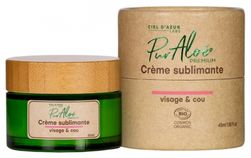
Pur Aloé Premium Enhancing Cream Organic
Works for
1 of 1 advertised claim delivered
Moisturizing18 ingredients credited for this claimGood support
“Premium Enhancing Cream Organic”
This product can help improve hydration of the skin with the two types of ingredients.
The first type is called “humectants”:
these ingredients help attract water.
When humectants are on the surface of the skin, they “pull in” the moisture from the outside environment, or from
within deeper layers of the skin. The following ingredients in this product do the job:
biosaccharide gum-1, glycerin.
This product also contains ingredients called “occlusives”. They help reduce the speed with which our skin loses moisture to the outside environment. These ingredients also help soften the upper layer of the skin, so it feels less tight and nicer to the touch. The following ingredients in this product do the job: caprylic/capric triglyceride, helianthus annuus seed oil.
Anti-agingNot advertised by the brand · 5 ingredients credited for this claimModerate support
This product contains centella asiatica leaf extract. This ingredient might be able to help reduce and prevent fine lines and wrinkles, improve skin elasticity and firmness, but there is not enough evidence that it actually works.
Can it cause trouble?
Irritancy3 strong irritants: Rosa damascena flower water, Parfum + 1 more — patch-test recommendedHigh risk
Comedogenic1 ingredient rated 2 or more on the 0–5 pore-clogging scale1 flagged
User reviews
Be the first — your take helps the next person decide.
Ingredients
Filter by role to see what each ingredient is doing.
Aloe arborescens leaf juice~23–34%
- Irritation risk
- Low
Aloe barbadensis leaf juice~5.3–7.9%
- Irritation risk
- Medium
Traditionally used to treat sunburns, dermatitis and inflammation, but evidence for its effectiveness is lacking. The extract can contain humectants that help attract water into the skin
More about Aloe barbadensis leaf juiceGlycerin~4.2–6.2%
- Irritation risk
- Low
One of the best moisturizing ingredients. Naturally present in skin. It attracts water to the upper layer of the skin working as a humectant
More about GlycerinRosa damascena flower water~3.5–5.2%
- Irritation risk
- High
Used to add a nice rose smell to the product. Might help attract water to the upper layer of the skin and have some anti-oxidant effect. Can be irritating
More about Rosa damascena flower waterCaprylic/capric triglyceride~3–4.6%
- Irritation risk
- Medium
A good mix of fatty acids that forms a protective layer on the skin. Improves the shelf life of products. Derived from coconut and glycerin
More about Caprylic/capric triglycerideWater~1.9–2.9%
Simmondsia chinensis seed oil~1.7–2.6%
- Irritation risk
- Medium
Softens the upper layer of skin and helps restore the healthy skin barrier. Has shown to help calm down inflammation in skin. It is a stable oil, meaning that it retains its properties even when exposed to air.
More about Simmondsia chinensis seed oilPrunus amygdalus dulcis oil~1.3–1.9%
- Irritation risk
- Low
An emollient that softens the skin
More about Prunus amygdalus dulcis oilButylene glycol~1–1.6%
- Irritation risk
- Low
Used to create a nice product texture and help delivery of other ingredients. Might be somewhat helpful in attracting water to the upper layer of the skin
More about Butylene glycolArachidyl alcohol~0.95–1.4%
- Irritation risk
- Low
Used to soften the upper layer of the skin and create a thicker product consistency
More about Arachidyl alcoholCetearyl alcohol~0.9–1.3%
- Irritation risk
- Low
- Comedogenicity
- 2/5
A non-drying alcohol. Works as an emollient. Helps water and oil mix together and creates a nice product texture
More about Cetearyl alcoholStearyl alcohol~0.6–1.35%
- Irritation risk
- Low
An emollient that helps soften the skin
More about Stearyl alcoholCetyl alcohol~0.55–1.25%
- Irritation risk
- Low
A non-drying alcohol that works to soften the skin and stabilize product formulations helping oil and water mix together
More about Cetyl alcoholBenzyl alcohol~0.35–0.85%
- Irritation risk
- High
A preservative. Can be used to mask unpleasant smell. Can be irritating
More about Benzyl alcoholBehenyl alcohol~0.45–1%
- Irritation risk
- Low
Non-drying alcohol that helps water and oil mix together. Also serves as an emollient
More about Behenyl alcoholSodium stearoyl glutamate~0.4–0.95%
- Irritation risk
- Medium
Helps oil and water mix together
More about Sodium stearoyl glutamateCetearyl glucoside~0.35–0.85%
- Irritation risk
- Medium
Helps water and oil in the product mix well together and improves product texture
More about Cetearyl glucosideArachidyl glucoside~0.35–0.75%
Glucose~0.2–0.75%
- Irritation risk
- Low
Helps attract water to the upper layer of the skin. Could be helpful in restoring the skin barrier function
More about GlucoseSodium hyaluronate~0.2–0.7%
- Irritation risk
- Low
One of the best moisturizing ingredients. Attracts water into the upper layer of the skin
More about Sodium hyaluronateCentella asiatica leaf extract~0.15–0.7%
- Irritation risk
- Medium
A plant extract that has been shown to be able to reduce inflammation in skin, support restoration of skin barrier function, as well as support collagen production. It can be irritating to sensitive skin. Might be helpful in preventing stretch marks. It could, however, itself be irritating.
More about Centella asiatica leaf extractRosa canina fruit extract~0.2–0.7%
- Irritation risk
- Medium
A plant extract that might have some anti-oxidant properties, but evidence is lacking
More about Rosa canina fruit extractTocopherol~0.15–0.7%
- Irritation risk
- Low
Pure form of vitamin E. Can help moisturise and protect the skin from free radicals. Often used to help stabilise other ingredients or the formula itself
More about TocopherolHelianthus annuus seed oil~0.2–0.75%
- Irritation risk
- Low
A great emollient due to its high linoleic acid content. One of the most effective plant oils in helping skin hydration and repairing skin barrier function
More about Helianthus annuus seed oilHydrogenated castor oil~0.3–0.75%
- Irritation risk
- Medium
A plant oil that can help soften the skin. It might be helpful in calming down inflammation, but solid research is lacking. Is often used in lip products to create the needed product consistency
More about Hydrogenated castor oilXanthan gum~0.15–0.7%
- Irritation risk
- Low
Used to create a thicker product consistency
More about Xanthan gumAcacia senegal gum~0.3–0.75%
- Irritation risk
- Medium
Helps mask the small of other ingredients and improve the product texture
More about Acacia senegal gumBiosaccharide gum-1~0.15–0.65%
- Irritation risk
- Low
Helps attract water to the upper layer of the skin and is claimed to provide a longer-lasting hydration because of its ability to create a water-binding film on the surface of the skin
More about Biosaccharide gum-1Propanediol~0.15–0.7%
- Irritation risk
- Low
Acts as a solvent for other ingredients. Speeds up the absorption of other ingredients into the skin
More about PropanediolParfum~0.15–0.55%
- Irritation risk
- High
An aromatic blend of unspecified and possibly irritating ingredients
More about ParfumGlyceryl caprylate~0.3–0.7%
- Irritation risk
- Low
An emollient that can also help water and oil mix together, as well as prevent bacteria growth in products
More about Glyceryl caprylateDehydroacetic acid~0.15–0.55%
Ascorbic acid~0.1–0.5%
- Irritation risk
- High
The most well-researched antioxidant that works in skin. Helps neutralize free radicals supporting collagen production, helping to even out the skin tone and preventing early signs of aging
More about Ascorbic acidSodium levulinate~0.1–0.5%
Sodium anisate~0.1–0.45%
Potassium hydroxide~0.1–0.45%
Ingredient list view
Aloe arborescens leaf juice, Aloe barbadensis leaf juice, Glycerin, Rosa damascena flower water, Caprylic/capric triglyceride, Water, Simmondsia chinensis seed oil, Prunus amygdalus dulcis oil, Butylene glycol, Arachidyl alcohol, Cetearyl alcohol, Stearyl alcohol, Cetyl alcohol, Benzyl alcohol, Behenyl alcohol, Sodium stearoyl glutamate, Cetearyl glucoside, Arachidyl glucoside, Glucose, Sodium hyaluronate, Centella asiatica leaf extract, Rosa canina fruit extract, Tocopherol, Helianthus annuus seed oil, Hydrogenated castor oil, Xanthan gum, Acacia senegal gum, Biosaccharide gum-1, Propanediol, Parfum, Glyceryl caprylate, Dehydroacetic acid, Ascorbic acid, Sodium levulinate, Sodium anisate, Potassium hydroxide
Compare prices
Retailers ranked by price — lowest first.

Sources cited in this review
Every concentration estimate and effectiveness label is anchored to one of these 18 studies and safety reviews.
- 1
- 2
- 3
- 4
- 5Hyaluronic acid: A key molecule in skin agingncbi.nlm.nih.gov
- 6

Affiliate links · As an Amazon Associate, WIMJ earns from qualifying purchases.