Works for
Anti-blemishRetinyl palmitate ~0.25–0.4%Under-dosed
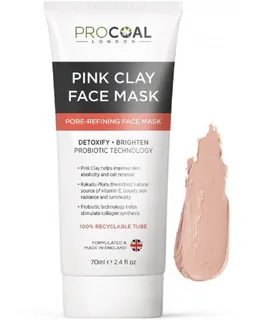
“Pore-refining Pink Clay Face Mask”
Effective ingredients missing or their concentration is too low.
MoisturizingSide benefit · Caprylic/capric triglyceride, Glycerin + 5 moreWorks
This product can help improve hydration of the skin with the two types of ingredients.
The first type is called “humectants”:
these ingredients help attract water.
When humectants are on the surface of the skin, they “pull in” the moisture from the outside environment, or from
within deeper layers of the skin. The following ingredients in this product do the job:
glycerin, glucose.
This product also contains ingredients called “occlusives”. They help reduce the speed with which our skin loses moisture to the outside environment. These ingredients also help soften the upper layer of the skin, so it feels less tight and nicer to the touch. The following ingredients in this product do the job: caprylic/capric triglyceride, cetearyl alcohol.
Can it cause trouble?
Irritancy3 strong irritants: Parfum, Citrus aurantifolia fruit extract + 1 more — patch-test recommendedHigh risk
Comedogenic1 ingredient rated 2 or more on the 0–5 pore-clogging scale1 flagged


User reviews
Be the first — your take helps the next person decide.
Ingredients
Filter by role to see what each ingredient is doing.
Water~45–55%
Bentonite~7–8.5%
Kaolin~4.5–5.5%
- Irritation risk
- Low
A type of clay that consists mainly of aluminum silicate. Helps absorb oil and creates a thicker product consistency. Can be used to add a white color
More about KaolinCaprylic/capric triglyceride~3.3–4%
- Irritation risk
- Medium
A good mix of fatty acids that forms a protective layer on the skin. Improves the shelf life of products. Derived from coconut and glycerin
More about Caprylic/capric triglycerideGlycerin~2.5–3%
- Irritation risk
- Low
One of the best moisturizing ingredients. Naturally present in skin. It attracts water to the upper layer of the skin working as a humectant
More about GlycerinZinc oxide~2.8–3.4%
- Irritation risk
- Low
A broad spectrum sunblock (protects from both UVA and UVB rays). Is suitable for most sensitive skins. In small concentrations, can be used as a colorant
More about Zinc oxideCetearyl alcohol~1.7–2.1%
- Irritation risk
- Low
- Comedogenicity
- 2/5
A non-drying alcohol. Works as an emollient. Helps water and oil mix together and creates a nice product texture
More about Cetearyl alcoholLactobacillus ferment lysate filtrate~1.4–1.7%
- Irritation risk
- Low
Phenoxyethanol~0.5–1%
- Irritation risk
- Low
A preservative. It helps prevent bacterial growth in cosmetic products
More about PhenoxyethanolLactic acid~0.9–1.15%
- Irritation risk
- Medium
An exfoliating and moisturizing alpha-hydroxy acid (AHA). Typically causes less irritation than other AHAs, for example, glycolic acid. At high concentrations (about 15%), lactic acid can help reduce lines and wrinkles. Recent studies show that lactic acid can support the "good" bacteria living on skin's surface (healthy skin microbiome)
More about Lactic acidCetearyl glucoside~0.7–1%
- Irritation risk
- Medium
Helps water and oil in the product mix well together and improves product texture
More about Cetearyl glucosideParfum~0.55–0.8%
- Irritation risk
- High
An aromatic blend of unspecified and possibly irritating ingredients
More about ParfumXanthan gum~0.5–0.8%
- Irritation risk
- Low
Used to create a thicker product consistency
More about Xanthan gumEthylhexylglycerin~0.5–0.75%
Disodium edta~0.4–0.6%
Citrus aurantifolia fruit extract~0.3–0.55%
Camellia sinensis leaf extract~0.3–0.5%
- Irritation risk
- Low
Can contain potent anti-oxidant compounds (abbreviated ECG, GCG, EGC, and EGCG) that might help protect the skin from free radicals. Can help calm down inflammation and has some anti-bacterial properties. Unfortunately, these antioxidants are unstable and lose their effectiveness very quickly in products. The concentration of the antioxidant compounds in the extract also tends to be low to be effective in topical formulation
More about Camellia sinensis leaf extractRetinyl palmitate~0.25–0.4%
- Irritation risk
- High
Three steps removed from the active form of vitamin A - retinoic acid. To have an effect in the skin, it first needs to be converted twice to become the retinoic acid. This means it is less potent than retinol, but could also be less irritating. Once converted to the retinoic acid in the skin, it helps against all signs of aging, improves skin cell turnover and helps fight blemishes and clogged pores. However, in many cosmetic formulations, it is used in a concentration that is too low to have the full effect
More about Retinyl palmitateTocopherol~0.2–0.35%
- Irritation risk
- Low
Pure form of vitamin E. Can help moisturise and protect the skin from free radicals. Often used to help stabilise other ingredients or the formula itself
More about TocopherolTerminalia ferdinandiana fruit extract~0.2–0.35%
- Irritation risk
- Medium
A plant extract that might have some anti-oxidant effect in skin, but evidence is lacking
More about Terminalia ferdinandiana fruit extractLeuconostoc/radish root ferment filtrate~0.15–0.25%
- Irritation risk
- Medium
A preservative that comes from radishes fermented by a bacteria. New research suggests that the preservation properties in the ingredient come from an ammonium salt that is not present naturally in radish root but used in its cultivation. Is problematic because the exact amount of the preservative agents is difficult to determine
More about Leuconostoc/radish root ferment filtratePopulus tremuloides bark extract~0.15–0.25%
- Irritation risk
- Low
Sodium benzoate~0.1–0.2%
Glucose~0.1–0.15%
- Irritation risk
- Low
Helps attract water to the upper layer of the skin. Could be helpful in restoring the skin barrier function
More about GlucoseIngredient list view
Water, Bentonite, Kaolin, Caprylic/capric triglyceride, Glycerin, Zinc oxide, Cetearyl alcohol, Lactobacillus ferment lysate filtrate, Phenoxyethanol, Lactic acid, Cetearyl glucoside, Parfum, Xanthan gum, Ethylhexylglycerin, Disodium edta, Citrus aurantifolia fruit extract, Camellia sinensis leaf extract, Retinyl palmitate, Tocopherol, Terminalia ferdinandiana fruit extract, Leuconostoc/radish root ferment filtrate, Populus tremuloides bark extract, Sodium benzoate, Glucose
Worth comparing, line by line.
Match % combines shared ingredients, the first five ingredients, shared actives and hero ingredients, irritancy (lower counts in the alternative's favour), texture and body area. Only products in the same routine step are compared.
| ProcoalPore-refining Pink Clay Face MaskYOUR PRODUCT | NassifMD DermaceuticalsOvernight Illuminating Masque with Elasta-Derm C | PÜRDowntown Detox Detoxifying Black Lemon Mask | Earth TherapeuticsCalming Pink Clay Facial Sheet Mask | |
|---|---|---|---|---|
| Match | — | 59% | 57% | 56% |
| Price | — | $52.00 | — | $9.00 |
| Shared key ingredients | — | 3 of 8 | 4 of 8 | 3 of 8 |
| Key difference | — | Potassium Azeloyl Diglycinate | Panthenol | Madecassoside |
| Irritancy | High | Medium | High | Medium |
| Drying alcohol | — | — | — | Contains drying alcohol |
| View product | Shop | Shop | Shop |

More alternatives: BIHAKU JOSHI White MaskDr Dennis Gross Vitamin C Lactic Biocellulose Brightening Treatment Mask
Sources cited in this review
Every concentration estimate and effectiveness label is anchored to one of these 12 studies and safety reviews.
- 1
- 2A review of inorganic UV filters zinc oxide and titanium dioxideonlinelibrary.wiley.com
- 3
- 4
- 5
- 6
