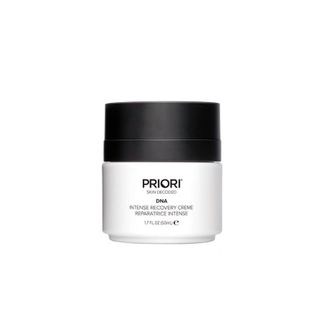
PRIORI Skincare Intense Recovery Creme DNA
Works for
1 of 2 advertised claims delivered
Moisturizing13 ingredients credited for this claimGood support
“Water magnets Glycerin and Hyaluronic Acid provide intense hydration, whilst DNA Repair Enzymes provide essential genetic skin repair and protection from blue and green algae, mustard seed extract and a microbe, for cell repair delivered via liposomes.”
This product can help improve hydration of the skin with the two types of ingredients.
The first type is called “humectants”:
these ingredients help attract water.
When humectants are on the surface of the skin, they “pull in” the moisture from the outside environment, or from
within deeper layers of the skin. The following ingredients in this product do the job:
glycerin, sodium hyaluronate.
This product also contains ingredients called “occlusives”. They help reduce the speed with which our skin loses moisture to the outside environment. These ingredients also help soften the upper layer of the skin, so it feels less tight and nicer to the touch. The following ingredients in this product do the job: dimethicone, cyclopentasiloxane.
Evens skin tone1 ingredient credited for this claimWeak support
“Vitamin C promotes collagen response and minimises pigmentation for a brighter more even skin tone.”
Effective ingredients missing or their concentration is too low
Anti-agingNot advertised by the brand · 3 ingredients credited for this claimModerate support
This product contains arabidopsis thaliana extract. This ingredient might be able to help reduce and prevent fine lines and wrinkles, improve skin elasticity and firmness, but there is not enough evidence that it actually works.
Can it cause trouble?
Irritancy9 flagged ingredientsLow risk
Comedogenic2 ingredients rated 2 or more on the 0–5 pore-clogging scale2 flagged
User reviews
Be the first — your take helps the next person decide.
Ingredients
Filter by role to see what each ingredient is doing.
Water~40–60%
Isopropyl palmitate~5.2–7.7%
- Irritation risk
- Medium
- Comedogenicity
- 3/5
Helps soften the upper layer of the skin and create a thicker product consistency
More about Isopropyl palmitateGlycerin~3.6–5.3%
- Irritation risk
- Low
One of the best moisturizing ingredients. Naturally present in skin. It attracts water to the upper layer of the skin working as a humectant
More about GlycerinButylene glycol~2.7–4.1%
- Irritation risk
- Low
Used to create a nice product texture and help delivery of other ingredients. Might be somewhat helpful in attracting water to the upper layer of the skin
More about Butylene glycolDimethicone~2.2–3.3%
- Irritation risk
- Low
A silicone that helps to reduce water loss from the surface of the skin. Can temporarily "fill in" lines and wrinkles, absorb oil, and create a nice product finish
More about DimethiconeGlyceryl stearate~1.8–2.7%
- Irritation risk
- Low
An emollient that softens the skin and forms a protective layer on its surface. Helps water and oil mix together
More about Glyceryl stearatePolyacrylamide~1.5–2.2%
- Irritation risk
- Medium
Used to improve product texture and help oil and water mix together
More about PolyacrylamideC13-14 isoparaffin~1.3–2%
- Irritation risk
- Low
Helps soften the upper layer of the skin, dissolve other ingredients and create a thicker product consistency
More about C13-14 isoparaffinLaureth-7~1.1–1.6%
Cyclohexasiloxane~0.9–1.35%
- Irritation risk
- Low
A silicone that serves as an emollient. Helps create a nice non-greasy feels
More about CyclohexasiloxaneCyclopentasiloxane~0.55–1.25%
- Irritation risk
- Low
A silicone that helps improve the product texture and spreadability. Can absorb oil creating a short-term mattifying effect on the skin
More about CyclopentasiloxaneBuddleja officinalis flower extract~0.55–1.35%
- Irritation risk
- High
A plant flower extract that might help calm down inflammation in skin and neutralize free radicals, but evidence of effectiveness in skin is lacking
More about Buddleja officinalis flower extractSodium hyaluronate~0.4–0.9%
- Irritation risk
- Low
One of the best moisturizing ingredients. Attracts water into the upper layer of the skin
More about Sodium hyaluronateMicrococcus lysate~0.35–0.85%
- Irritation risk
- Low
Consists of remains of dead bacteria cells. Is likely helpful in attracting water to the upper layer of the skin. Might be helpful in reducing inflammation and neutralizing free radicals in skin. It is claimed to be a "DNA repair enzyme"
More about Micrococcus lysateLecithin~0.35–0.8%
- Irritation risk
- Low
Used mostly for creating emulsions - helping oil and water mix together. Helps soften the upper layer of the skin
More about LecithinPlankton extract~0.15–0.7%
- Irritation risk
- Medium
- Comedogenicity
- 3/5
Can help attract water to the upper layer of the skin
More about Plankton extractMagnesium ascorbyl phosphate~0.15–0.6%
- Irritation risk
- Medium
A derivative of vitamin C that is more stable, but less bioavailable than the pure form of vitamin C. It does not penetrate the skin well, but has been shown to convert to pure vitamin C once in skin. It can be helpful in stimulating collagen production and lightening the skin tone, but the required concentration is likely to be very high
More about Magnesium ascorbyl phosphateTocopherol~0.15–0.55%
- Irritation risk
- Low
Pure form of vitamin E. Can help moisturise and protect the skin from free radicals. Often used to help stabilise other ingredients or the formula itself
More about TocopherolArabidopsis thaliana extract~0.1–0.4%
- Irritation risk
- Medium
Plant extract that might be helpful in repairing sun damage but evidence of effectiveness in skin are lacking
More about Arabidopsis thaliana extractPeg-100 stearate~0.15–0.6%
- Irritation risk
- Low
Helps oil and water mix togehter and creates a nice product texture
More about Peg-100 stearatePhenoxyethanol~0.1–0.35%
- Irritation risk
- Low
A preservative. It helps prevent bacterial growth in cosmetic products
More about PhenoxyethanolAcrylates/c10-30 alkyl acrylate crosspolymer~0.05–0.25%
- Irritation risk
- Medium
Maintains the texture of skincare products. Allows the product to spread evenly. Helps oil and water mix together
More about Acrylates/c10-30 alkyl acrylate crosspolymerEthylhexylglycerin~0.05–0.2%
Xanthan gum~0.05–0.2%
- Irritation risk
- Low
Used to create a thicker product consistency
More about Xanthan gumIngredient list view
Water, Isopropyl palmitate, Glycerin, Butylene glycol, Dimethicone, Glyceryl stearate, Polyacrylamide, C13-14 isoparaffin, Laureth-7, Cyclohexasiloxane, Cyclopentasiloxane, Buddleja officinalis flower extract, Sodium hyaluronate, Micrococcus lysate, Lecithin, Plankton extract, Magnesium ascorbyl phosphate, Tocopherol, Arabidopsis thaliana extract, Peg-100 stearate, Phenoxyethanol, Acrylates/c10-30 alkyl acrylate crosspolymer, Ethylhexylglycerin, Xanthan gum
Compare prices
Retailers ranked by price — lowest first.
Affiliate links · prices updated regularly · As an Amazon Associate, WIMJ earns from qualifying purchases.
Sources cited in this review
Every concentration estimate and effectiveness label is anchored to one of these 15 studies and safety reviews.
- 1Final Report on the Safety Assessment of Isopropyl Isostearatejournals.sagepub.com
- 2
- 3
- 4Final Report on the Safety Assessment of Dimethicone Copolyoljournals.sagepub.com
- 5Safety Assessment of Isoparaffins as Used in Cosmeticsjournals.sagepub.com
- 6

Affiliate links · As an Amazon Associate, WIMJ earns from qualifying purchases.