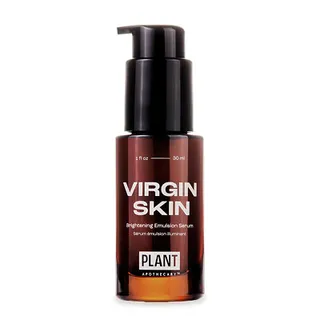
Plant Apothecary Virgin Skin: Brightening Emulsion Serum
Works for
Evens skin toneTetrahexyldecyl ascorbate, Ascorbic acidWorks well
“brightens the skin & combats pigmentation & photo-aging Who it's for.”
This product can help reduce hypepigmentation and even out the skin tone because it contains the following effective ingredients: tetrahexyldecyl ascorbate
Keep in mind that you would need to apply any topical skincare targetted at hypigmentation consistently for a couple of months to get a result. No topical skincare product can help get rid of hyperpigmentation (including post-acne marks and age spots) instantly.
MoisturizingPanthenol, Glycerin + 7 moreWorks well
“a powerful humectant that hydrates the skin, plumping out the appearance of fine lines Jar is made from fully recyclable glass in an electric powered furnace, which is fuelled by green energy.”
This product can help improve hydration of the skin with the two types of ingredients.
The first type is called “humectants”:
these ingredients help attract water.
When humectants are on the surface of the skin, they “pull in” the moisture from the outside environment, or from
within deeper layers of the skin. The following ingredients in this product do the job:
glycerin, sodium hyaluronate.
This product also contains ingredients called “occlusives”. They help reduce the speed with which our skin loses moisture to the outside environment. These ingredients also help soften the upper layer of the skin, so it feels less tight and nicer to the touch. The following ingredients in this product do the job: helianthus annuus seed oil, squalane.
The following ingredients in this product are especially good for supporting the skin barrier and helping with the hydration level: panthenol
Anti-agingTetrahexyldecyl ascorbate, Ascorbic acidWorks well
“brightens the skin & combats pigmentation & photo-aging Who it's for.”
This product can help reduce and prevent fine lines and wrinkles, improve skin elasticity and firmness because it contains tetrahexyldecyl ascorbate.
Keep in mind that it typically takes at least 6 weeks to notice any results because the changes that are needed to improve fine lines and elasticity happen in the deeper layers of the skin. No topical anti-aging product can “erase” wrinkles or fully reverse signs of aging.
Anti-oxidationSide benefit · Tetrahexyldecyl ascorbate, Carthamus tinctorius seed oil + 2 moreWorks well
This product contains antioxidants (tetrahexyldecyl ascorbate) that can help neutralize free radicals in skin. By doing so, they can lessen the damage the skin gets from the UV light (sun).
Can it cause trouble?
Irritancy5 strong irritants: Citrus aurantium dulcis peel oil, Citrus nobilis peel oil + 3 more — patch-test recommendedHigh risk
ComedogenicClean of flagged comedogenic ingredientsNone flagged

User reviews
Be the first — your take helps the next person decide.
Ingredients
Filter by role to see what each ingredient is doing.
Water~45–55%
Tetrahexyldecyl ascorbate~8.3–10.1%
- Irritation risk
- Medium
Being a lipid soluble form of vitamin C, it is more stable than ascorbic acid, but still degrades quickly and needs to be stabilized in a formulation with another ingredient. It is claimed to penetrate skin better than pure vitamin C and have the the similar benefits, but solid studies of its effectiveness are lacking. Is likely to require a higher concentration in a product than pure vitamin C to be effective. It might be able to help reduce pore clogging.
More about Tetrahexyldecyl ascorbateIsoamyl laurate~4.7–5.7%
- Irritation risk
- Medium
Helps stabilize emulsions and create a nice product texture
More about Isoamyl laurateGlycerin~3.4–4.2%
- Irritation risk
- Low
One of the best moisturizing ingredients. Naturally present in skin. It attracts water to the upper layer of the skin working as a humectant
More about GlycerinDicaprylyl ether~2.7–3.3%
- Irritation risk
- Low
Helps soften the upper layer of the skin while creating a non-greasy feel on the skin. Helps to dissolve other ingredients
More about Dicaprylyl etherHydrogenated lecithin~2.2–2.7%
- Irritation risk
- Low
Helps to retain moisture by creating a protective barrier on the skin. Rich in fatty acids. Improves product texture and helps with the penetration of other ingredients.
More about Hydrogenated lecithinBehenyl alcohol~2.1–2.5%
- Irritation risk
- Low
Non-drying alcohol that helps water and oil mix together. Also serves as an emollient
More about Behenyl alcoholHelianthus annuus seed oil~1.8–2.2%
- Irritation risk
- Low
A great emollient due to its high linoleic acid content. One of the most effective plant oils in helping skin hydration and repairing skin barrier function
More about Helianthus annuus seed oilCarthamus tinctorius seed oil~1.4–1.7%
- Irritation risk
- Low
An emollient that helps soften the skin and might help calm down inflammation
More about Carthamus tinctorius seed oilMorus alba leaf extract~1.1–1.4%
- Irritation risk
- Low
Squalane~1–1.3%
- Irritation risk
- Low
An oil naturally present in skin. Works as an emollient to soften the skin and form a protective layer on its surface without a greasy feeling.
More about SqualanePalmitoyl tetrapeptide-10~0.7–1.05%
- Irritation risk
- Low
Phenoxyethanol~0.65–1%
- Irritation risk
- Low
A preservative. It helps prevent bacterial growth in cosmetic products
More about PhenoxyethanolSodium hyaluronate~0.65–0.95%
- Irritation risk
- Low
One of the best moisturizing ingredients. Attracts water into the upper layer of the skin
More about Sodium hyaluronateXanthan gum~0.6–0.9%
- Irritation risk
- Low
Used to create a thicker product consistency
More about Xanthan gumTocopheryl acetate~0.6–0.9%
- Irritation risk
- Medium
A more stable but less bio-available form of vitamin E compared to Tocopherol. Might help moisturize and protect the skin from free radicals, but mostly used in low concentrations to stabilize other ingredients.
More about Tocopheryl acetatePanthenol~0.55–0.85%
- Irritation risk
- Low
Helps attract water to the upper layer of the skin and can help improve skin barrier function
More about PanthenolSodium phytate~0.45–0.7%
Ascorbic acid~0.35–0.65%
- Irritation risk
- High
The most well-researched antioxidant that works in skin. Helps neutralize free radicals supporting collagen production, helping to even out the skin tone and preventing early signs of aging
More about Ascorbic acidCitrus aurantium dulcis peel oil~0.35–0.6%
- Irritation risk
- High
An essentil oil from orange peel. Potential allergen and can be irritating
More about Citrus aurantium dulcis peel oilCitrus nobilis peel oil~0.3–0.55%
- Irritation risk
- High
A plant oil with high content of volatile compounds that, especially when exposed to air, can cause allergic reactions and irritate the skin
More about Citrus nobilis peel oilCitrus paradisi peel oil~0.2–0.4%
Caprylic/capric triglyceride~0.3–0.5%
- Irritation risk
- Medium
A good mix of fatty acids that forms a protective layer on the skin. Improves the shelf life of products. Derived from coconut and glycerin
More about Caprylic/capric triglycerideCitric acid~0.15–0.3%
- Irritation risk
- Medium
Can work as an exfoliant but is typically used to adjust the product pH
More about Citric acidEthylhexylglycerin~0.15–0.3%
Limonene~0.1–0.2%
- Irritation risk
- High
A common frangrance that can easily irritate skin, especially if exposed to air, light or heat
More about LimoneneAlcohol~0.1–0.2%
- Irritation risk
- High
Can be drying and contribute to skin irritation. Used in formulars to dissolve other ingredients, create a thinner product consistency or for its antibacterial properties
More about AlcoholIngredient list view
Water, Tetrahexyldecyl ascorbate, Isoamyl laurate, Glycerin, Dicaprylyl ether, Hydrogenated lecithin, Behenyl alcohol, Helianthus annuus seed oil, Carthamus tinctorius seed oil, Morus alba leaf extract, Squalane, Palmitoyl tetrapeptide-10, Phenoxyethanol, Sodium hyaluronate, Xanthan gum, Tocopheryl acetate, Panthenol, Sodium phytate, Ascorbic acid, Citrus aurantium dulcis peel oil, Citrus nobilis peel oil, Citrus paradisi peel oil, Caprylic/capric triglyceride, Citric acid, Ethylhexylglycerin, Limonene, Alcohol
Compare prices
Retailers ranked by price — lowest first.
Worth comparing, line by line.
Match % combines shared ingredients, the first five ingredients, shared actives and hero ingredients, irritancy (lower counts in the alternative's favour), texture and body area. Only products in the same routine step are compared.
| Plant ApothecaryVirgin Skin: Brightening Emulsion SerumYOUR PRODUCT | Jack BlackBrightening Booster Vitamin C Serum | Image skincareIMAGE MD restoring youth repair serum | KYLIE SKINVitamin C Serum | |
|---|---|---|---|---|
| Match | — | 64% | 62% | 61% |
| Price | — | $38.25 | $112.00 | $35.80 |
| Shared key ingredients | — | 5 of 8 | 6 of 8 | 4 of 8 |
| Key difference | — | Dimethicone | Glycolic Acid | Ferulic Acid |
| Irritancy | High | Medium | High | Low |
| Drying alcohol | Contains drying alcohol | — | — | — |
| View product | Shop | Shop | Shop |


More alternatives: Retrouvé Voyage Nutrient Face SerumDr. Barbara Sturm The Good C Vitamin C Serum
Sources cited in this review
Every concentration estimate and effectiveness label is anchored to one of these 14 studies and safety reviews.
- 1
- 2
- 3
- 4
- 5
- 6Effect of topically applied lipids on surfactant-irritated skinonlinelibrary.wiley.com

Affiliate links · As an Amazon Associate, WIMJ earns from qualifying purchases.