Works for
CleansingDecyl glucoside, Cetearyl alcohol + 5 moreCleanses gently
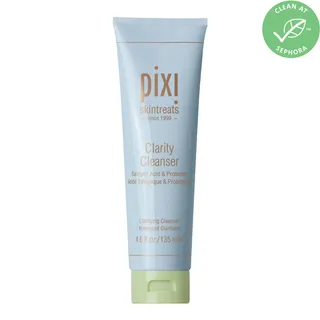
“Skintreats Clarity Cleanser”
This product works by removing dirt and oil from the surface of the skin. It uses a combination of mild cleansing agents (cetearyl alcohol, cocamidopropyl betaine, decyl glucoside, glyceryl stearate, peg-100 stearate, polysorbate 20, xanthan gum) and should be able to cleanse the skin gently. Still keep in mind that any cleansing can disrupt the skin barrier, and most people do not need to cleanse their skin more than once per day.
Even though this formulation is mild, the following cleansing agents could trigger an irritation or allergy for some people: cocamidopropyl betaine, decyl glucoside
ExfoliationGlycolic acid, Allantoin + 4 moreWorks well
“Salicylic, lactic and glycolic acid help refresh and exfoliate while probiotics balance and preserve.”
This product can help exfoliate the skin. In other words, it helps break down the bonds between dead cells on the surface of the skin and speed up the skin turnover. Skin often appears softer and brighter after exfoliation, but overdoing it can result in disrupted skin barrier. The following ingredient is doing the exfoliating job in this product: glycolic acid.
Anti-blemishGlycolic acid, Allantoin + 6 moreNot delivered
“This clear complexion cleanser hydrates while it gently and effectively purifying pores, visibly minimising breakouts.”
This product contains ingredients (glycolic acid) that could help reduce blemishes and clogged pores in theory, but there is not enough evidence that they actually work.
Can it cause trouble?
Irritancy6 strong irritants: Citrus aurantium amara leaf/twig extract, Lavandula angustifolia flower/leaf/stem extract + 4 more — patch-test recommendedHigh risk
Comedogenic2 ingredients rated 2 or more on the 0–5 pore-clogging scale2 flagged

User reviews
Be the first — your take helps the next person decide.
Ingredients
Filter by role to see what each ingredient is doing.
Water~45–55%
Glycerin~4.3–5.3%
- Irritation risk
- Low
One of the best moisturizing ingredients. Naturally present in skin. It attracts water to the upper layer of the skin working as a humectant
More about GlycerinCetearyl alcohol~3.5–4.3%
- Irritation risk
- Low
- Comedogenicity
- 2/5
A non-drying alcohol. Works as an emollient. Helps water and oil mix together and creates a nice product texture
More about Cetearyl alcoholDecyl glucoside~3.7–4.6%
- Irritation risk
- High
Helps oil and water mix together. Can be irritating
More about Decyl glucosideCocamidopropyl betaine~3.1–3.8%
- Irritation risk
- High
Helps water and oil mix together. Used as a cleansing ingredient. Could be an allergen
More about Cocamidopropyl betainePolysorbate 20~1.9–2.3%
Aloe barbadensis leaf juice~1.6–1.9%
- Irritation risk
- Medium
Traditionally used to treat sunburns, dermatitis and inflammation, but evidence for its effectiveness is lacking. The extract can contain humectants that help attract water into the skin
More about Aloe barbadensis leaf juiceCocos nucifera oil~1.4–1.8%
- Irritation risk
- Low
- Comedogenicity
- 3/5
An emollient. Found to be as effective as a moisturizer for dry skin as mineral oil. Could be comedogenic
More about Cocos nucifera oilAllantoin~1–1.3%
- Irritation risk
- Low
Helps calm down inflammation in skin and can help reduce itching. Helps to repair the skin barrier and keep skin hydrated
More about AllantoinTocopheryl acetate~0.95–1.15%
- Irritation risk
- Medium
A more stable but less bio-available form of vitamin E compared to Tocopherol. Might help moisturize and protect the skin from free radicals, but mostly used in low concentrations to stabilize other ingredients.
More about Tocopheryl acetateCitrus aurantium amara leaf/twig extract~0.65–1%
- Irritation risk
- High
Lavandula angustifolia flower/leaf/stem extract~0.55–0.8%
Glycolic acid~0.5–0.75%
- Irritation risk
- High
An alpha-hydroxy acid (AHA) that helps to remove the dead skin cells on the surface of the skin reveling a more even, smoother complexation. It is also able to stimulate collagen production with long-term use. Could help to reduce pore congestion. It can be irritating to the skin. Apply sunscreen daily if using products with glycolic acid
More about Glycolic acidLactic acid~0.45–0.65%
- Irritation risk
- Medium
An exfoliating and moisturizing alpha-hydroxy acid (AHA). Typically causes less irritation than other AHAs, for example, glycolic acid. At high concentrations (about 15%), lactic acid can help reduce lines and wrinkles. Recent studies show that lactic acid can support the "good" bacteria living on skin's surface (healthy skin microbiome)
More about Lactic acidCentella asiatica extract~0.5–0.7%
- Irritation risk
- Medium
A plant extract that has been shown to be able to reduce inflammation in skin, support restoration of skin barrier function, as well as support collagen production. Contains active compounds called centelloids: asiaticoside, madecasosside, asiatic acid and madecassic acid. Might be helpful in preventing stretch marks. It can be itself be irritating though.
More about Centella asiatica extractGlycyrrhiza glabra root extract~0.35–0.65%
- Irritation risk
- Medium
A plant extract that can help lighten the skin and calm down inflammation. Might be helpful in neutralizing free radicals
More about Glycyrrhiza glabra root extractSaccharum officinarum extract~0.35–0.6%
- Irritation risk
- Low
Sugar extract that helps attract water to the upper layer of the skin
More about Saccharum officinarum extractSalix alba bark extract~0.3–0.55%
- Irritation risk
- High
A plant extract that can help neutralize free radicals in skin. It contains a compound salicin that can theoretically be converted into salicylic acid that, in turn, helps reduce inflammation in skin, but the evidence of effectiveness in skin is lacking and the extract is usually not used in a concentration that would enable an exfoliating effect
More about Salix alba bark extractSodium hyaluronate~0.3–0.55%
- Irritation risk
- Low
One of the best moisturizing ingredients. Attracts water into the upper layer of the skin
More about Sodium hyaluronateCitrus aurantium bergamia fruit extract~0.25–0.5%
- Irritation risk
- High
Citrus aurantium dulcis peel extract~0.2–0.4%
Panthenol~0.25–0.45%
- Irritation risk
- Low
Helps attract water to the upper layer of the skin and can help improve skin barrier function
More about PanthenolLactobacillus ferment lysate filtrate~0.2–0.4%
- Irritation risk
- Low
Bromelain~0.2–0.4%
- Irritation risk
- Low
Papain~0.2–0.4%
- Irritation risk
- High
An enzyme extracted from papaya fruit. Can have an exfoliating effect on the skin. Can be irritating
More about PapainCitrus aurantium amara flower extract~0.2–0.4%
- Irritation risk
- High
Used as a fragrance for its citrus smell. Can be irritating
More about Citrus aurantium amara flower extractCoriandrum sativum fruit/leaf extract~0.25–0.45%
- Irritation risk
- Low
Rosmarinus officinalis leaf extract~0.2–0.4%
- Irritation risk
- High
Can be helpful in reducing inflammation in skin, including inflamed acne. It can be irritating
More about Rosmarinus officinalis leaf extractStyrax tonkinensis resin extract~0.2–0.35%
- Irritation risk
- Low
Ascorbic acid~0.2–0.4%
- Irritation risk
- High
The most well-researched antioxidant that works in skin. Helps neutralize free radicals supporting collagen production, helping to even out the skin tone and preventing early signs of aging
More about Ascorbic acidSalicylic acid~0.2–0.4%
- Irritation risk
- High
Used for skin exfoliation. It has an anti-inflammatory and anti-bacterial effect, helps to unclog pores, prevent blemishes and speed up healing of the existing ones. Sometimes referred to as a BHA (beta-hydroxy acid)
More about Salicylic acidLeuconostoc/radish root ferment filtrate~0.25–0.4%
- Irritation risk
- Medium
A preservative that comes from radishes fermented by a bacteria. New research suggests that the preservation properties in the ingredient come from an ammonium salt that is not present naturally in radish root but used in its cultivation. Is problematic because the exact amount of the preservative agents is difficult to determine
More about Leuconostoc/radish root ferment filtratePopulus tremuloides bark extract~0.2–0.4%
- Irritation risk
- Low
Sodium polyacrylate~0.25–0.45%
- Irritation risk
- Low
Used to create a gel-like product texture, as well as to stabilize emulsions
More about Sodium polyacrylateSodium chloride~0.25–0.45%
- Irritation risk
- Low
Used to stabilize mixtures of oil and water, and create thicker, gel-like product textures
More about Sodium chlorideBentonite~0.25–0.45%
Glyceryl stearate~0.25–0.5%
- Irritation risk
- Low
An emollient that softens the skin and forms a protective layer on its surface. Helps water and oil mix together
More about Glyceryl stearatePeg-100 stearate~0.3–0.55%
- Irritation risk
- Low
Helps oil and water mix togehter and creates a nice product texture
More about Peg-100 stearateCaprylic/capric triglyceride~0.25–0.45%
- Irritation risk
- Medium
A good mix of fatty acids that forms a protective layer on the skin. Improves the shelf life of products. Derived from coconut and glycerin
More about Caprylic/capric triglycerideEthylhexylglycerin~0.15–0.3%
Xanthan gum~0.15–0.3%
- Irritation risk
- Low
Used to create a thicker product consistency
More about Xanthan gumMaltodextrin~0.15–0.3%
- Irritation risk
- Low
Used to stabilize the product formulation and can help absorb oil
More about MaltodextrinPhenoxyethanol~0.15–0.3%
- Irritation risk
- Low
A preservative. It helps prevent bacterial growth in cosmetic products
More about PhenoxyethanolIron oxides~0.1–0.2%
- Irritation risk
- Low
An umbrella term for the following three colorants: CI 77491, CI 77492, CI 77499. They might be able to offer some protection against visible light, but the degree of the protection is not clear
More about Iron oxidesUltramarines~0.1–0.15%
- Irritation risk
- Low
Ingredient list view
Water, Glycerin, Cetearyl alcohol, Decyl glucoside, Cocamidopropyl betaine, Polysorbate 20, Aloe barbadensis leaf juice, Cocos nucifera oil, Allantoin, Tocopheryl acetate, Citrus aurantium amara leaf/twig extract, Lavandula angustifolia flower/leaf/stem extract, Glycolic acid, Lactic acid, Centella asiatica extract, Glycyrrhiza glabra root extract, Saccharum officinarum extract, Salix alba bark extract, Sodium hyaluronate, Citrus aurantium bergamia fruit extract, Citrus aurantium dulcis peel extract, Panthenol, Lactobacillus ferment lysate filtrate, Bromelain, Papain, Citrus aurantium amara flower extract, Coriandrum sativum fruit/leaf extract, Rosmarinus officinalis leaf extract, Styrax tonkinensis resin extract, Ascorbic acid, Salicylic acid, Leuconostoc/radish root ferment filtrate, Populus tremuloides bark extract, Sodium polyacrylate, Sodium chloride, Bentonite, Glyceryl stearate, Peg-100 stearate, Caprylic/capric triglyceride, Ethylhexylglycerin, Xanthan gum, Maltodextrin, Phenoxyethanol, Iron oxides, Ultramarines
Compare prices
Retailers ranked by price — lowest first.

Worth comparing, line by line.
Match % combines shared ingredients, the first five ingredients, shared actives and hero ingredients, irritancy (lower counts in the alternative's favour), texture and body area. Only products in the same routine step are compared.
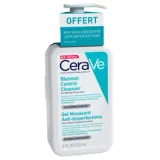
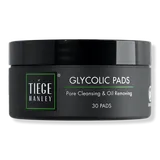
| PixiSkintreats Clarity CleanserYOUR PRODUCT | CeraVeGel Moussant Anti-Imperfections | PurifideBlackhead Control 2% SA Deep Exfoliating Cleanser | Tiege HanleyGLYCOLIC PADS Pore Cleansing & Oil Removing | |
|---|---|---|---|---|
| Match | — | 80% | 78% | 77% |
| Price | — | — | — | $18.00 |
| Shared key ingredients | — | 7 of 20 | 9 of 20 | 6 of 20 |
| Key difference | — | Niacinamide | Linoleic Acid | Oatmeal Extract |
| Irritancy | High | Low | Medium | Medium |
| Drying alcohol | — | — | — | Contains drying alcohol |
| View product | Shop | Shop | Shop |

More alternatives: Dope Skin Co AHA/BHA Exfoliating CleanserClinique Clarifying Do-Over Peel
Sources cited in this review
Every concentration estimate and effectiveness label is anchored to one of these 28 studies and safety reviews.
- 1
- 2
- 3
- 4
- 5Glycolic acid peel therapy – a current reviewncbi.nlm.nih.gov
- 6

Affiliate links · As an Amazon Associate, WIMJ earns from qualifying purchases.