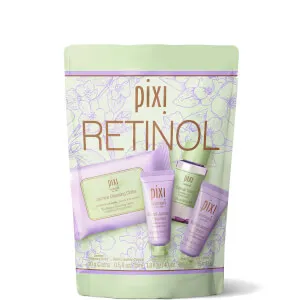
Works for
CleansingGlyceryl stearate, Palmitic acid + 16 moreCleanses gently
“Inside the handy travel-sized bag, youll find Jasmine Cleansing Cloths (10 x cloths), a Retinol Jasmine Cleanser (15ml), a Retinol Tonic (40ml) and a Retinol Jasmine Lotion (15ml).”
This product works by removing dirt and oil from the surface of the skin. It uses a combination of mild cleansing agents (caprylyl/capryl glucoside, carbomer, cetearyl alcohol, cetearyl olivate, glyceryl arachidonate, glyceryl linoleate, glyceryl stearate, hydrogenated lecithin, palmitic acid, peg-40 hydrogenated castor oil, polyglyceryl-4 caprate, polysorbate 20, polysorbate 60, sorbitan isostearate, sorbitan olivate, sorbitan stearate, xanthan gum) and should be able to cleanse the skin gently. Still keep in mind that any cleansing can disrupt the skin barrier, and most people do not need to cleanse their skin more than once per day.
Anti-blemishRetinol, Retinyl palmitate + 2 moreWorks well
“Then the Retinol Jasmine Cleanser will hydrate, keep blemishes at bay and keep skin supple.”
This product can help reduce breakouts and clogged pores because it contains the following ingredient: retinol. This ingredient is used for treating acne and can have a noticeable effect.
The following ingredient (ingredients) in this product might be helpful, but there is no evidence to confirm that it actually works: retinyl palmitate
ExfoliationSide benefit · Retinol, Retinyl palmitateWorks well
This product can help exfoliate the skin. In other words, it helps break down the bonds between dead cells on the surface of the skin and speed up the skin turnover. Skin often appears softer and brighter after exfoliation, but overdoing it can result in disrupted skin barrier. The following ingredient is doing the exfoliating job in this product: retinol.
Can it cause trouble?
Irritancy8 strong irritants: Retinol, Retinyl palmitate + 6 more — patch-test recommendedHigh risk
Comedogenic5 ingredients rated 2 or more on the 0–5 pore-clogging scale5 flagged

User reviews
Be the first — your take helps the next person decide.
Ingredients
Filter by role to see what each ingredient is doing.
Retinol~28–34%
- Irritation risk
- High
Two steps removed from the active form of vitamin A - retinoic acid. Once converted to the retinoic acid in the skin, retinol is proven to be effective against all signs of aging. It improves skin cell turnover, helps fight blemishes and clogged pores, can regulate excess oil production and even skin tone. It can, however, be quite irritating
More about RetinolJasminum sambac flower extract~4.8–5.8%
- Irritation risk
- Low
Water~5.3–6.5%
Ethylhexyl palmitate~4.2–5.1%
- Irritation risk
- Low
- Comedogenicity
- 3/5
An emollient that helps soften the skin and create a nice product texture
More about Ethylhexyl palmitateCetyl ethylhexanoate~3.3–4.1%
- Irritation risk
- Medium
An emollient that helps soften the skin and creates a thicker product texture
More about Cetyl ethylhexanoateMethylpropanediol~2.4–3%
Glycerin~2–2.4%
- Irritation risk
- Low
One of the best moisturizing ingredients. Naturally present in skin. It attracts water to the upper layer of the skin working as a humectant
More about Glycerin1,2-hexanediol~0.8–1.2%
Cetearyl alcohol~1.5–1.8%
- Irritation risk
- Low
- Comedogenicity
- 2/5
A non-drying alcohol. Works as an emollient. Helps water and oil mix together and creates a nice product texture
More about Cetearyl alcoholPolysorbate 60~1.1–1.3%
Glyceryl stearate~1–1.2%
- Irritation risk
- Low
An emollient that softens the skin and forms a protective layer on its surface. Helps water and oil mix together
More about Glyceryl stearatePalmitic acid~0.8–1.2%
- Irritation risk
- Low
An emollient that is naturally present in skin and helps soften it
More about Palmitic acidHydroxyethyl acrylate/sodium acryloyldimethyl taurate copolymer~0.65–1%
- Irritation risk
- Medium
A gelling agent that thickens the product consistency and leaves the skin with a velvety finish
More about Hydroxyethyl acrylate/sodium acryloyldimethyl taurate copolymerRetinyl palmitate~0.6–0.9%
- Irritation risk
- High
Three steps removed from the active form of vitamin A - retinoic acid. To have an effect in the skin, it first needs to be converted twice to become the retinoic acid. This means it is less potent than retinol, but could also be less irritating. Once converted to the retinoic acid in the skin, it helps against all signs of aging, improves skin cell turnover and helps fight blemishes and clogged pores. However, in many cosmetic formulations, it is used in a concentration that is too low to have the full effect
More about Retinyl palmitateArachis hypogaea oil~0.6–0.9%
- Irritation risk
- Low
Helianthus annuus seed oil~0.65–1%
- Irritation risk
- Low
A great emollient due to its high linoleic acid content. One of the most effective plant oils in helping skin hydration and repairing skin barrier function
More about Helianthus annuus seed oilJasminum officinale oil~0.5–0.75%
- Irritation risk
- Low
Rubus fruticosus fruit extract~0.5–0.75%
- Irritation risk
- Medium
A plant extract that might help neutralize free radicals in skin
More about Rubus fruticosus fruit extractBuddleja davidii extract~0.5–0.75%
- Irritation risk
- Low
Thymus vulgaris extract~0.45–0.65%
- Irritation risk
- High
Ceramide 3~0.5–0.8%
- Irritation risk
- Low
A type of lipid similar to ceramides naturally present in skin. Helps to soften the upper layer of the skin and supports the skin barrier function to keep it hydrated. Can help to prevent inflammation in skin
More about Ceramide 3Tocopherol~0.45–0.65%
- Irritation risk
- Low
Pure form of vitamin E. Can help moisturise and protect the skin from free radicals. Often used to help stabilise other ingredients or the formula itself
More about TocopherolCarbomer~0.4–0.6%
- Irritation risk
- Low
Helps create a thicker or gel-like product texture. It is not a surfactant but can be used in gentle cleansing formulations
More about CarbomerCaprylic/capric triglyceride~0.5–0.75%
- Irritation risk
- Medium
A good mix of fatty acids that forms a protective layer on the skin. Improves the shelf life of products. Derived from coconut and glycerin
More about Caprylic/capric triglycerideSorbitan stearate~0.4–0.65%
Cetearyl olivate~0.4–0.65%
Sorbitan olivate~0.4–0.65%
Sodium magnesium silicate~0.4–0.6%
- Irritation risk
- Low
Behenyl alcohol~0.5–0.75%
- Irritation risk
- Low
Non-drying alcohol that helps water and oil mix together. Also serves as an emollient
More about Behenyl alcoholDipropylene glycol~0.35–0.6%
- Irritation risk
- Low
Helps to dissolve other ingredients in a formulation. Slows down the rate of product drying
More about Dipropylene glycolPotassium hydroxide~0.4–0.6%
Hydrogenated lecithin~0.4–0.65%
- Irritation risk
- Low
Helps to retain moisture by creating a protective barrier on the skin. Rich in fatty acids. Improves product texture and helps with the penetration of other ingredients.
More about Hydrogenated lecithinEthylhexylglycerin~0.4–0.6%
Disodium edta~0.35–0.65%
Retinol~0.35–0.65%
- Irritation risk
- High
Two steps removed from the active form of vitamin A - retinoic acid. Once converted to the retinoic acid in the skin, retinol is proven to be effective against all signs of aging. It improves skin cell turnover, helps fight blemishes and clogged pores, can regulate excess oil production and even skin tone. It can, however, be quite irritating
More about RetinolWater~0.4–0.6%
Rosmarinus officinalis leaf water~0.4–0.6%
- Irritation risk
- Low
Glycerin~0.45–0.65%
- Irritation risk
- Low
One of the best moisturizing ingredients. Naturally present in skin. It attracts water to the upper layer of the skin working as a humectant
More about GlycerinPropanediol~0.4–0.65%
- Irritation risk
- Low
Acts as a solvent for other ingredients. Speeds up the absorption of other ingredients into the skin
More about PropanediolMethyl gluceth-20~0.35–0.65%
- Irritation risk
- Low
Helps attract water to the upper layer of the skin and soften it
More about Methyl gluceth-20Peg-8~0.4–0.6%
- Irritation risk
- Medium
Used to create a nice product consistency
More about Peg-8Panthenol~0.35–0.65%
- Irritation risk
- Low
Helps attract water to the upper layer of the skin and can help improve skin barrier function
More about PanthenolMagnesium ascorbyl phosphate~0.4–0.6%
- Irritation risk
- Medium
A derivative of vitamin C that is more stable, but less bioavailable than the pure form of vitamin C. It does not penetrate the skin well, but has been shown to convert to pure vitamin C once in skin. It can be helpful in stimulating collagen production and lightening the skin tone, but the required concentration is likely to be very high
More about Magnesium ascorbyl phosphateSodium hyaluronate~0.35–0.65%
- Irritation risk
- Low
One of the best moisturizing ingredients. Attracts water into the upper layer of the skin
More about Sodium hyaluronateLecithin~0.5–0.75%
- Irritation risk
- Low
Used mostly for creating emulsions - helping oil and water mix together. Helps soften the upper layer of the skin
More about LecithinOenothera biennis flower extract~0.4–0.6%
Hibiscus rosa-sinensis flower extract~0.35–0.65%
- Irritation risk
- High
Sodium acrylates copolymer~0.55–0.85%
- Irritation risk
- Medium
Used to create a thicker product consistency
More about Sodium acrylates copolymerPalmitoyl tripeptide-37~0.4–0.6%
Hydroxypropyl cyclodextrin~0.5–0.7%
- Irritation risk
- Medium
Used to stabilize product formulations and help soften the upper layer of the skin
More about Hydroxypropyl cyclodextrinRetinol~0.35–0.65%
- Irritation risk
- High
Two steps removed from the active form of vitamin A - retinoic acid. Once converted to the retinoic acid in the skin, retinol is proven to be effective against all signs of aging. It improves skin cell turnover, helps fight blemishes and clogged pores, can regulate excess oil production and even skin tone. It can, however, be quite irritating
More about RetinolPhenoxyethanol~0.4–0.6%
- Irritation risk
- Low
A preservative. It helps prevent bacterial growth in cosmetic products
More about PhenoxyethanolCaprylic/capric triglyceride~0.5–0.75%
- Irritation risk
- Medium
A good mix of fatty acids that forms a protective layer on the skin. Improves the shelf life of products. Derived from coconut and glycerin
More about Caprylic/capric triglycerideJasminum officinale flower/leaf extract~0.3–0.6%
Lavandula angustifolia flower/leaf/stem extract~0.4–0.6%
Eugenia caryophyllus flower extract~0.45–0.65%
- Irritation risk
- High
A plant extract that is used as a fragrance. Can be irritating
More about Eugenia caryophyllus flower extractVitis vinifera fruit extract~0.35–0.65%
- Irritation risk
- Medium
A plant extract that helps attract water to the upper layer of the skin. It might be helpful in neutralizing free radicals in skin, but is less potent than the extract from the seeds
More about Vitis vinifera fruit extractSodium citrate~0.35–0.65%
- Irritation risk
- Medium
Helps to control the skin's pH level. Maintains the skin's natural film of amino-lactic acids and oils. Helps to preserve products
More about Sodium citratePeg-40 hydrogenated castor oil~0.45–0.65%
- Irritation risk
- Medium
Helps oil and water mix together
More about Peg-40 hydrogenated castor oilDisodium edta~0.35–0.65%
Citric acid~0.35–0.65%
- Irritation risk
- Medium
Can work as an exfoliant but is typically used to adjust the product pH
More about Citric acidPolysorbate 20~0.45–0.65%
Ethylhexylglycerin~0.4–0.6%
Retinol~0.35–0.65%
- Irritation risk
- High
Two steps removed from the active form of vitamin A - retinoic acid. Once converted to the retinoic acid in the skin, retinol is proven to be effective against all signs of aging. It improves skin cell turnover, helps fight blemishes and clogged pores, can regulate excess oil production and even skin tone. It can, however, be quite irritating
More about RetinolJasminum sambac flower extract~0.35–0.6%
- Irritation risk
- Low
Water~0.4–0.6%
Glycerin~0.45–0.65%
- Irritation risk
- Low
One of the best moisturizing ingredients. Naturally present in skin. It attracts water to the upper layer of the skin working as a humectant
More about GlycerinCaprylic/capric triglyceride~0.5–0.75%
- Irritation risk
- Medium
A good mix of fatty acids that forms a protective layer on the skin. Improves the shelf life of products. Derived from coconut and glycerin
More about Caprylic/capric triglyceride1,2-hexanediol~0.35–0.65%
Cetearyl alcohol~0.55–0.8%
- Irritation risk
- Low
- Comedogenicity
- 2/5
A non-drying alcohol. Works as an emollient. Helps water and oil mix together and creates a nice product texture
More about Cetearyl alcoholDicaprylyl carbonate~0.5–0.75%
- Irritation risk
- Low
Helps products spread more easily and works as an emollient to soften skin
More about Dicaprylyl carbonateRetinyl palmitate~0.4–0.65%
- Irritation risk
- High
Three steps removed from the active form of vitamin A - retinoic acid. To have an effect in the skin, it first needs to be converted twice to become the retinoic acid. This means it is less potent than retinol, but could also be less irritating. Once converted to the retinoic acid in the skin, it helps against all signs of aging, improves skin cell turnover and helps fight blemishes and clogged pores. However, in many cosmetic formulations, it is used in a concentration that is too low to have the full effect
More about Retinyl palmitateJasminum officinale oil~0.35–0.65%
- Irritation risk
- Low
Sodium hyaluronate~0.45–0.65%
- Irritation risk
- Low
One of the best moisturizing ingredients. Attracts water into the upper layer of the skin
More about Sodium hyaluronateCeramide 3~0.5–0.8%
- Irritation risk
- Low
A type of lipid similar to ceramides naturally present in skin. Helps to soften the upper layer of the skin and supports the skin barrier function to keep it hydrated. Can help to prevent inflammation in skin
More about Ceramide 3Copper tripeptide-1~0.45–0.65%
- Irritation risk
- Low
A naturally occurring peptide. One of the most studied peptides in dermatology. It is sometimes abbreviated GHK-Cu. Belongs to the class of carrier peptides. It stimulates both synthesis and breakdown of collagen in skin. It is released in skin wounds and inflammation to support healing. It accelerates wound-healing of the skin and can stimulate hair growth. There are preliminary studies that confirm that copper tripeptide can help support collagen production reducing fine lines and wrinkles and decrease inflammation in skin.
More about Copper tripeptide-1Rubus fruticosus fruit extract~0.45–0.65%
- Irritation risk
- Medium
A plant extract that might help neutralize free radicals in skin
More about Rubus fruticosus fruit extractCetearyl olivate~0.45–0.7%
Sorbitan olivate~0.45–0.7%
Trehalose~0.45–0.65%
- Irritation risk
- Low
A sugar that attracts water to the upper layer of the skin
More about TrehaloseButyrospermum parkii butter~0.55–0.8%
- Irritation risk
- Low
- Comedogenicity
- 3/5
A great moisturising ingredient that softens the skin and reduces water loss from its upper layer. It also can be helpful in protecting skin from free radicals
More about Butyrospermum parkii butterTocopherol~0.45–0.65%
- Irritation risk
- Low
Pure form of vitamin E. Can help moisturise and protect the skin from free radicals. Often used to help stabilise other ingredients or the formula itself
More about TocopherolSodium ascorbyl phosphate~0.45–0.65%
- Irritation risk
- Medium
A stable derivative of vitamin C. It is oil-soluble which means it is more likely to penetrate the skin compared to the pure form of vitamin C (which is water-soluble), but it is less bio-available and is way less effective in stimulating collagen and reducing wrinkles compared to the pure form of vitamin C (L-ascorbic acid) and its other derivatives (for example, magnesium ascorbyl phosphate). At the same time, this vitamin C derivative has been shown in studies to be effective in reducing acne, blemishes and clogged pores. It is less irritating then the pure form of vitamin C
More about Sodium ascorbyl phosphateThymus vulgaris extract~0.4–0.6%
- Irritation risk
- High
Arginine~0.4–0.65%
- Irritation risk
- Low
An amino acid that is naturally present in skin and helps keep it hydrated. When used together with AHAs, it can reduce their irritating effect on the skin
More about ArginineTocopheryl acetate~0.45–0.7%
- Irritation risk
- Medium
A more stable but less bio-available form of vitamin E compared to Tocopherol. Might help moisturize and protect the skin from free radicals, but mostly used in low concentrations to stabilize other ingredients.
More about Tocopheryl acetateHelianthus annuus seed oil~0.5–0.75%
- Irritation risk
- Low
A great emollient due to its high linoleic acid content. One of the most effective plant oils in helping skin hydration and repairing skin barrier function
More about Helianthus annuus seed oilPanthenol~0.45–0.65%
- Irritation risk
- Low
Helps attract water to the upper layer of the skin and can help improve skin barrier function
More about PanthenolBiotin~0.45–0.65%
- Irritation risk
- Low
Might have some moisturising properties. Is not effective when applied topically beyond some moisturizing effect
More about BiotinBuddleja davidii extract~0.45–0.65%
- Irritation risk
- Low
Hydroxyethyl acrylate/sodium acryloyldimethyl taurate copolymer~0.45–0.65%
- Irritation risk
- Medium
A gelling agent that thickens the product consistency and leaves the skin with a velvety finish
More about Hydroxyethyl acrylate/sodium acryloyldimethyl taurate copolymerHydrogenated soybean oil~0.5–0.75%
- Irritation risk
- Low
- Comedogenicity
- 2/5
Glyceryl arachidonate~0.55–0.8%
- Irritation risk
- Medium
Helps water and oil mix together
More about Glyceryl arachidonateGlyceryl linoleate~0.55–0.8%
- Irritation risk
- Medium
Helps oil and water mix together
More about Glyceryl linoleatePolyglyceryl-10 stearate~0.45–0.65%
- Irritation risk
- Medium
Helps water and oil mix together and softens the upper layer of the skin
More about Polyglyceryl-10 stearateCitric acid~0.45–0.65%
- Irritation risk
- Medium
Can work as an exfoliant but is typically used to adjust the product pH
More about Citric acidSorbitan isostearate~0.45–0.7%
- Irritation risk
- Low
Helps oil and water mix together
More about Sorbitan isostearateDipropylene glycol~0.4–0.65%
- Irritation risk
- Low
Helps to dissolve other ingredients in a formulation. Slows down the rate of product drying
More about Dipropylene glycolPolysorbate 60~0.45–0.7%
Carbomer~0.45–0.65%
- Irritation risk
- Low
Helps create a thicker or gel-like product texture. It is not a surfactant but can be used in gentle cleansing formulations
More about CarbomerXanthan gum~0.45–0.65%
- Irritation risk
- Low
Used to create a thicker product consistency
More about Xanthan gumArachis hypogaea oil~0.45–0.65%
- Irritation risk
- Low
Disodium edta~0.45–0.65%
Jasminum sambac flower extract~0.25–0.5%
- Irritation risk
- Low
Water~0.3–0.55%
Glycerin~0.35–0.6%
- Irritation risk
- Low
One of the best moisturizing ingredients. Naturally present in skin. It attracts water to the upper layer of the skin working as a humectant
More about GlycerinAloe barbadensis leaf juice~0.3–0.55%
- Irritation risk
- Medium
Traditionally used to treat sunburns, dermatitis and inflammation, but evidence for its effectiveness is lacking. The extract can contain humectants that help attract water into the skin
More about Aloe barbadensis leaf juiceChamomilla recutita flower extract~0.3–0.55%
- Irritation risk
- High
Plant extract that can have healing and anti-inflammatory properties. It is a potential allergen and can be irritating
More about Chamomilla recutita flower extractJasminum sambac flower extract~0.25–0.45%
- Irritation risk
- Low
Polyglyceryl-4 caprate~0.25–0.5%
Sodium benzoate~0.2–0.4%
Citric acid~0.2–0.4%
- Irritation risk
- Medium
Can work as an exfoliant but is typically used to adjust the product pH
More about Citric acidCaprylyl/capryl glucoside~0.25–0.5%
- Irritation risk
- Medium
Helps oil and water mix together. Can be used as a cleansing agent
More about Caprylyl/capryl glucosidePolysorbate 20~0.2–0.4%
Caprylyl glycol~0.25–0.5%
- Irritation risk
- Medium
Helps preserve products and creates a nice product texture
More about Caprylyl glycolDisodium edta~0.15–0.3%
Sodium citrate~0.1–0.15%
- Irritation risk
- Medium
Helps to control the skin's pH level. Maintains the skin's natural film of amino-lactic acids and oils. Helps to preserve products
More about Sodium citratePhenoxyethanol~0.15–0.3%
- Irritation risk
- Low
A preservative. It helps prevent bacterial growth in cosmetic products
More about PhenoxyethanolIngredient list view
Retinol, Jasminum sambac flower extract, Water, Ethylhexyl palmitate, Cetyl ethylhexanoate, Methylpropanediol, Glycerin, 1,2-hexanediol, Cetearyl alcohol, Polysorbate 60, Glyceryl stearate, Palmitic acid, Hydroxyethyl acrylate/sodium acryloyldimethyl taurate copolymer, Retinyl palmitate, Arachis hypogaea oil, Helianthus annuus seed oil, Jasminum officinale oil, Rubus fruticosus fruit extract, Buddleja davidii extract, Thymus vulgaris extract, Ceramide 3, Tocopherol, Carbomer, Caprylic/capric triglyceride, Sorbitan stearate, Cetearyl olivate, Sorbitan olivate, Sodium magnesium silicate, Behenyl alcohol, Dipropylene glycol, Potassium hydroxide, Hydrogenated lecithin, Ethylhexylglycerin, Disodium edta, Retinol, Water, Rosmarinus officinalis leaf water, Glycerin, Propanediol, Methyl gluceth-20, Peg-8, Panthenol, Magnesium ascorbyl phosphate, Sodium hyaluronate, Lecithin, Oenothera biennis flower extract, Hibiscus rosa-sinensis flower extract, Sodium acrylates copolymer, Palmitoyl tripeptide-37, Hydroxypropyl cyclodextrin, Retinol, Phenoxyethanol, Caprylic/capric triglyceride, Jasminum officinale flower/leaf extract, Lavandula angustifolia flower/leaf/stem extract, Eugenia caryophyllus flower extract, Vitis vinifera fruit extract, Sodium citrate, Peg-40 hydrogenated castor oil, Disodium edta, Citric acid, Polysorbate 20, Ethylhexylglycerin, Retinol, Jasminum sambac flower extract, Water, Glycerin, Caprylic/capric triglyceride, 1,2-hexanediol, Cetearyl alcohol, Dicaprylyl carbonate, Retinyl palmitate, Jasminum officinale oil, Sodium hyaluronate, Ceramide 3, Copper tripeptide-1, Rubus fruticosus fruit extract, Cetearyl olivate, Sorbitan olivate, Trehalose, Butyrospermum parkii butter, Tocopherol, Sodium ascorbyl phosphate, Thymus vulgaris extract, Arginine, Tocopheryl acetate, Helianthus annuus seed oil, Panthenol, Biotin, Buddleja davidii extract, Hydroxyethyl acrylate/sodium acryloyldimethyl taurate copolymer, Hydrogenated soybean oil, Glyceryl arachidonate, Glyceryl linoleate, Polyglyceryl-10 stearate, Citric acid, Sorbitan isostearate, Dipropylene glycol, Polysorbate 60, Carbomer, Xanthan gum, Arachis hypogaea oil, Disodium edta, Jasminum sambac flower extract, Water, Glycerin, Aloe barbadensis leaf juice, Chamomilla recutita flower extract, Jasminum sambac flower extract, Polyglyceryl-4 caprate, Sodium benzoate, Citric acid, Caprylyl/capryl glucoside, Polysorbate 20, Caprylyl glycol, Disodium edta, Sodium citrate, Phenoxyethanol
Compare prices
Retailers ranked by price — lowest first.
Worth comparing, line by line.
Match % combines shared ingredients, the first five ingredients, shared actives and hero ingredients, irritancy (lower counts in the alternative's favour), texture and body area. Only products in the same routine step are compared.
| PixiRetinol Beauty In A BagYOUR PRODUCT | YEOUTHVitamin C Facial Cleanser Day/Night Cream | REVOLUTION SKINCARERetinol Smoothing Cream Cleanser | Derma EVitamin C Daily Brightening Cleanser | |
|---|---|---|---|---|
| Match | — | 57% | 56% | 55% |
| Price | — | $41.90 | — | $13.56 |
| Shared key ingredients | — | 9 of 32 | 6 of 32 | 4 of 32 |
| Key difference | — | Sodium Ascorbyl Phosphate | Prunus Amygdalus Dulcis Seed | Niacinamide |
| Irritancy | High | Medium | Medium | Medium |
| Drying alcohol | — | — | Contains drying alcohol | — |
| View product | Shop | Shop | Shop |


More alternatives: MALIN + GOETZ retinol correcting serumCleaning Supply Retinol 24 + Peptide Face Wash, Smoothing, Sulfate-Free
Sources cited in this review
Every concentration estimate and effectiveness label is anchored to one of these 33 studies and safety reviews.
- 1
- 2Improvement of naturally aged skin with vitamin A (retinol)ncbi.nlm.nih.gov
- 3
- 4
- 5
- 6

Affiliate links · As an Amazon Associate, WIMJ earns from qualifying purchases.