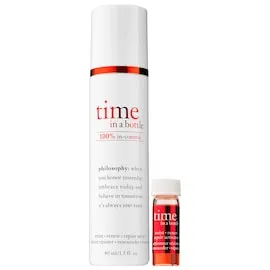
Philosophy Time In A Bottle 100% In-Control

Philosophy Time In A Bottle 100% In-Control

Efficacy50/100IrritancyHigh

Works for

Anti-aging
Adenosine, Magnesium aluminum silicate + 6 more
Works well
What the product description says
“This serum that repairs visible damage, activates skin's natural age-resisting , and protects against environmental aggressors.”
Source: Sephora

This product can help reduce and prevent fine lines and wrinkles, improve skin elasticity and firmness because it contains adenosine.

Keep in mind that it typically takes at least 6 weeks to notice any results because the changes that are needed to improve fine lines and elasticity happen in the deeper layers of the skin. No topical anti-aging product can “erase” wrinkles or fully reverse signs of aging.

AdenosineKey activeEffect: HighMight help improve cell turnover and reduce inflammation in skin. One study shows that the ingredients might be able to help reduce dynamic wrinkles (for example, in the corners of the eyes or on the forehead)~0.25–0.5%
Magnesium aluminum silicateEffect: LowMight be helpful in restoring skin barrier function and, when combined with zinc carbonate and malonic acid, reducing fine lines and wrinkles by stimulating elastin production. Also helps stabilize the product formulation~0.25–0.5%
TocopherolEffect: Low, below effective dosePure form of vitamin E. Can help moisturise and protect the skin from free radicals. Often used to help stabilise other ingredients or the formula itself~0.3–0.5%
Camellia sinensis leaf extractEffect: Low, below effective doseCan contain potent anti-oxidant compounds (abbreviated ECG, GCG, EGC, and EGCG) that might help protect the skin from free radicals. Can help calm down inflammation and has some anti-bacterial properties. Unfortunately, these antioxidants are unstable and lose their effectiveness very quickly in products. The concentration of the antioxidant compounds in the extract also tends to be low to be effective in topical formulation~0.3–0.5%
Ascorbyl palmitateEffect: Low, below effective doseBeing a lipid soluble form of vitamin C, it is more stable and can penetrate the skin better than L-Ascorbic acid. It is effective in protecting the skin from free radicals, as well as evening the skin tone, but is less effective in stimulating collagen production compared to L-Ascorbic acid.~0.25–0.5%
Ascorbic acidUnder-dosedThe most well-researched antioxidant that works in skin. Helps neutralize free radicals supporting collagen production, helping to even out the skin tone and preventing early signs of aging~0.25–0.4%
Lactic acidUnder-dosedAn exfoliating and moisturizing alpha-hydroxy acid (AHA). Typically causes less irritation than other AHAs, for example, glycolic acid. At high concentrations (about 15%), lactic acid can help reduce lines and wrinkles. Recent studies show that lactic acid can support the "good" bacteria living on skin's surface (healthy skin microbiome)~0.25–0.4%
Retinyl palmitateUnder-dosedThree steps removed from the active form of vitamin A - retinoic acid. To have an effect in the skin, it first needs to be converted twice to become the retinoic acid. This means it is less potent than retinol, but could also be less irritating. Once converted to the retinoic acid in the skin, it helps against all signs of aging, improves skin cell turnover and helps fight blemishes and clogged pores. However, in many cosmetic formulations, it is used in a concentration that is too low to have the full effect~0.15–0.25%
Evens skin tone
Ascorbic acid ~0.25–0.4%, below the ~4% it needs + 2 more
Under-dosed
What the product description says
“Uneven skin tone If you want to know more.”
Source: Sephora

Effective ingredients missing or their concentration is too low

Bifida ferment lysateEffect: Low, below effective doseConsists of remains of dead yeast bacteria cells. Helps to hydrate the skin and reduce irritation. Might has some anti-oxidant effect~0.45–0.65%
Camellia sinensis leaf extractEffect: Low, below effective doseCan contain potent anti-oxidant compounds (abbreviated ECG, GCG, EGC, and EGCG) that might help protect the skin from free radicals. Can help calm down inflammation and has some anti-bacterial properties. Unfortunately, these antioxidants are unstable and lose their effectiveness very quickly in products. The concentration of the antioxidant compounds in the extract also tends to be low to be effective in topical formulation~0.3–0.5%
Ascorbic acidUnder-dosedThe most well-researched antioxidant that works in skin. Helps neutralize free radicals supporting collagen production, helping to even out the skin tone and preventing early signs of aging~0.25–0.4%
Lactic acidUnder-dosedAn exfoliating and moisturizing alpha-hydroxy acid (AHA). Typically causes less irritation than other AHAs, for example, glycolic acid. At high concentrations (about 15%), lactic acid can help reduce lines and wrinkles. Recent studies show that lactic acid can support the "good" bacteria living on skin's surface (healthy skin microbiome)~0.25–0.4%
Retinyl palmitateUnder-dosedThree steps removed from the active form of vitamin A - retinoic acid. To have an effect in the skin, it first needs to be converted twice to become the retinoic acid. This means it is less potent than retinol, but could also be less irritating. Once converted to the retinoic acid in the skin, it helps against all signs of aging, improves skin cell turnover and helps fight blemishes and clogged pores. However, in many cosmetic formulations, it is used in a concentration that is too low to have the full effect~0.15–0.25%
Moisturizing
Side benefit · Dimethicone, Cyclopentasiloxane + 18 more
Works

This product can help improve hydration of the skin with the two types of ingredients.

The first type is called “humectants”:
these ingredients help attract water. When humectants are on the surface of the skin, they “pull in” the moisture from the outside environment, or from within deeper layers of the skin. The following ingredients in this product do the job: glycerin, bis-peg-18 methyl ether dimethyl silane.

This product also contains ingredients called “occlusives”. They help reduce the speed with which our skin loses moisture to the outside environment. These ingredients also help soften the upper layer of the skin, so it feels less tight and nicer to the touch. The following ingredients in this product do the job: dimethicone, dimethiconol.

DimethiconeKey active· Emollient, OcclusiveEffect: HighA silicone that helps to reduce water loss from the surface of the skin. Can temporarily "fill in" lines and wrinkles, absorb oil, and create a nice product finish~5.3–6.5%
CyclopentasiloxaneKey active· EmollientEffect: MediumA silicone that helps improve the product texture and spreadability. Can absorb oil creating a short-term mattifying effect on the skin~3.2–3.9%
GlycerinKey active· HumectantEffect: HighOne of the best moisturizing ingredients. Naturally present in skin. It attracts water to the upper layer of the skin working as a humectant~1.5–1.8%
DimethiconolKey active· Emollient, OcclusiveEffect: HighA silicone that makes products more spreadable and keeps skin smooth. Helps to add gloss to skin and may visually fill in fine lines/wrinkles for short time~1.2–1.5%
SqualaneKey active· Emollient, OcclusiveEffect: HighAn oil naturally present in skin. Works as an emollient to soften the skin and form a protective layer on its surface without a greasy feeling.~0.35–0.65%
Bacillus fermentKey activeEffect: HighA product of bacterial fermentation. Can help attract water to the upper layer of the skin~0.25–0.5%
AdenosineKey activeEffect: MediumMight help improve cell turnover and reduce inflammation in skin. One study shows that the ingredients might be able to help reduce dynamic wrinkles (for example, in the corners of the eyes or on the forehead)~0.25–0.5%
Hydrolyzed vegetable proteinKey activeEffect: Medium~0.25–0.5%
Plankton extractKey activeEffect: MediumCan help attract water to the upper layer of the skin~0.2–0.4%
Micrococcus lysateKey activeEffect: HighConsists of remains of dead bacteria cells. Is likely helpful in attracting water to the upper layer of the skin. Might be helpful in reducing inflammation and neutralizing free radicals in skin. It is claimed to be a "DNA repair enzyme"~0.15–0.3%
Bis-peg-18 methyl ether dimethyl silane· Humectant, EmollientEffect: LowA type of silicone that helps soften the upper layer of the skin and create a nice product texture~4.2–5.2%
Peg-8· HumectantEffect: LowUsed to create a nice product consistency~2.4–2.9%
Butylene glycol· HumectantEffect: LowUsed to create a nice product texture and help delivery of other ingredients. Might be somewhat helpful in attracting water to the upper layer of the skin~1.7–2%
Caprylyl glycol· Humectant, EmollientEffect: LowHelps preserve products and creates a nice product texture~0.45–0.7%
LecithinEffect: Low, below effective doseUsed mostly for creating emulsions - helping oil and water mix together. Helps soften the upper layer of the skin~0.3–0.55%
TocopherolEffect: Low, below effective dosePure form of vitamin E. Can help moisturise and protect the skin from free radicals. Often used to help stabilise other ingredients or the formula itself~0.3–0.5%
Camellia sinensis leaf extractEffect: Low, below effective doseCan contain potent anti-oxidant compounds (abbreviated ECG, GCG, EGC, and EGCG) that might help protect the skin from free radicals. Can help calm down inflammation and has some anti-bacterial properties. Unfortunately, these antioxidants are unstable and lose their effectiveness very quickly in products. The concentration of the antioxidant compounds in the extract also tends to be low to be effective in topical formulation~0.3–0.5%
Bifida ferment lysateUnder-dosedConsists of remains of dead yeast bacteria cells. Helps to hydrate the skin and reduce irritation. Might has some anti-oxidant effect~0.45–0.65%
Caprylic/capric triglycerideUnder-dosedA good mix of fatty acids that forms a protective layer on the skin. Improves the shelf life of products. Derived from coconut and glycerin~0.3–0.6%
Lactic acidUnder-dosedAn exfoliating and moisturizing alpha-hydroxy acid (AHA). Typically causes less irritation than other AHAs, for example, glycolic acid. At high concentrations (about 15%), lactic acid can help reduce lines and wrinkles. Recent studies show that lactic acid can support the "good" bacteria living on skin's surface (healthy skin microbiome)~0.25–0.4%

Can it cause trouble?

Irritancy
8 strong irritants: Alcohol denat., Benzophenone-4 + 6 more — patch-test recommended
High risk
We flagged 27 ingredients with irritancy potential. Severity depends on your sensitivity threshold; the table lists the worst offenders first.
IngredientFunctionIrritationEst. amount
Alcohol denat.Produces temporary toning effect. Can help dissolve other ingredients or preserve productsHigh~1.9–2.4%est.
Benzophenone-4Sulisobenzone. A UV filter. Is typically used to improve the product stability under exposure to UV light. It is effective against both UVA and UVB rays. It can be used is larger concentrations as a sun protection ingredient for the skin, but can be irritatingHigh~0.7–1.05%est.
Propylene glycolHelps oil and water mix together and can enhance the penetration of other ingredients into the skin. It can be irritatingHigh~0.35–0.6%est.
ParfumAn aromatic blend of unspecified and possibly irritating ingredientsHigh~0.25–0.45%est.
Physalis pubescens fruit juice—High~0.3–0.5%est.
AlcoholCan be drying and contribute to skin irritation. Used in formulars to dissolve other ingredients, create a thinner product consistency or for its antibacterial propertiesHigh~0.25–0.5%est.
Punica granatum fruit extractA fruit extract that is used to add a fragrance to the product. It might have some antioxidant propertiesHigh~0.25–0.45%est.
LinaloolA fragrance. Can be irritatingHigh~0.25–0.45%est.
Ascorbic acidThe most well-researched antioxidant that works in skin. Helps neutralize free radicals supporting collagen production, helping to even out the skin tone and preventing early signs of agingHigh~0.25–0.4%est.
Retinyl palmitateThree steps removed from the active form of vitamin A - retinoic acid. To have an effect in the skin, it first needs to be converted twice to become the retinoic acid. This means it is less potent than retinol, but could also be less irritating. Once converted to the retinoic acid in the skin, it helps against all signs of aging, improves skin cell turnover and helps fight blemishes and clogged pores. However, in many cosmetic formulations, it is used in a concentration that is too low to have the full effectHigh~0.15–0.25%est.
Peg-8Used to create a nice product consistencyMedium~2.4–2.9%est.
PtfeUsed to create a nice product finishMedium~0.45–0.65%est.
Caprylyl glycolHelps preserve products and creates a nice product textureMedium~0.45–0.7%est.
1,2-hexanediolA preservativeMedium~0.4–0.65%est.
Hydroxyethyl acrylate/sodium acryloyldimethyl taurate copolymerA gelling agent that thickens the product consistency and leaves the skin with a velvety finishMedium~0.3–0.6%est.
Plantago lanceolata leaf extractA plant extract that might have anti-oxidant propertiesMedium~0.3–0.55%est.
Disodium edtaStabilizes the product formulationMedium~0.25–0.5%est.
Caprylic/capric triglycerideA good mix of fatty acids that forms a protective layer on the skin. Improves the shelf life of products. Derived from coconut and glycerinMedium~0.3–0.6%est.
Polysorbate 60Helps oil and water mix togetherMedium~0.3–0.55%est.
Acrylates/c10-30 alkyl acrylate crosspolymerMaintains the texture of skincare products. Allows the product to spread evenly. Helps oil and water mix togetherMedium~0.3–0.55%est.
Citric acidCan work as an exfoliant but is typically used to adjust the product pHMedium~0.25–0.5%est.
BhtA preservativeMedium~0.25–0.5%est.
Ascorbyl palmitateBeing a lipid soluble form of vitamin C, it is more stable and can penetrate the skin better than L-Ascorbic acid. It is effective in protecting the skin from free radicals, as well as evening the skin tone, but is less effective in stimulating collagen production compared to L-Ascorbic acid.Medium~0.25–0.5%est.
Lactic acidAn exfoliating and moisturizing alpha-hydroxy acid (AHA). Typically causes less irritation than other AHAs, for example, glycolic acid. At high concentrations (about 15%), lactic acid can help reduce lines and wrinkles. Recent studies show that lactic acid can support the "good" bacteria living on skin's surface (healthy skin microbiome)Medium~0.25–0.4%est.
Plankton extractCan help attract water to the upper layer of the skinMedium~0.2–0.4%est.
Sorbic acidA preservativeMedium~0.1–0.2%est.
Comedogenic
1 ingredient rated 2 or more on the 0–5 pore-clogging scale
1 flagged
These ingredients have a comedogenic rating of 2 or more on a 0–5 scale; the table shows each one's rating. In leave-on products they can clog pores in acne-prone skin.
IngredientFunctionRatingEst. amount
Plankton extractCan help attract water to the upper layer of the skin3/5~0.2–0.4%est.

User reviews

Would you recommend?
No community reviews yet.

Be the first — your take helps the next person decide.

Ingredients

Filter by role to see what each ingredient is doing.

Water~45–55%
Formula
Irritation risk
Low

Plain old water

More about Water
Dimethicone~5.3–6.5%
Key active
Irritation risk
Low
Works for
MoisturizingMattifying

A silicone that helps to reduce water loss from the surface of the skin. Can temporarily "fill in" lines and wrinkles, absorb oil, and create a nice product finish

More about Dimethicone
Bis-peg-18 methyl ether dimethyl silane~4.2–5.2%
Formula
Irritation risk
Low
Works for
CleansingMoisturizing

A type of silicone that helps soften the upper layer of the skin and create a nice product texture

More about Bis-peg-18 methyl ether dimethyl silane
Cyclopentasiloxane~3.2–3.9%
Key active
Irritation risk
Low
Works for
MoisturizingMattifying

A silicone that helps improve the product texture and spreadability. Can absorb oil creating a short-term mattifying effect on the skin

More about Cyclopentasiloxane
Peg-8~2.4–2.9%
Irritant · medium
Irritation risk
Medium
Works for
Moisturizing

Used to create a nice product consistency

More about Peg-8
Alcohol denat.~1.9–2.4%
Irritant · high
Irritation risk
High

Produces temporary toning effect. Can help dissolve other ingredients or preserve products

More about Alcohol denat.
Butylene glycol~1.7–2%
Formula
Irritation risk
Low
Works for
Moisturizing

Used to create a nice product texture and help delivery of other ingredients. Might be somewhat helpful in attracting water to the upper layer of the skin

More about Butylene glycol
Glycerin~1.5–1.8%
Key active
Irritation risk
Low
Works for
Moisturizing

One of the best moisturizing ingredients. Naturally present in skin. It attracts water to the upper layer of the skin working as a humectant

More about Glycerin
Dimethiconol~1.2–1.5%
Key active
Irritation risk
Low
Works for
Moisturizing

A silicone that makes products more spreadable and keeps skin smooth. Helps to add gloss to skin and may visually fill in fine lines/wrinkles for short time

More about Dimethiconol
Polyethylene~1.2–1.4%
Formula
Irritation risk
Low

Used to thicken the product's texture

More about Polyethylene
Xanthan gum~0.65–1%
Formula
Irritation risk
Low
Works for
Cleansing

Used to create a thicker product consistency

More about Xanthan gum
Phenoxyethanol~0.55–0.8%
Formula
Irritation risk
Low

A preservative. It helps prevent bacterial growth in cosmetic products

More about Phenoxyethanol
Benzophenone-4~0.7–1.05%
Irritant · high
Irritation risk
High
Works for
Sun protection

Sulisobenzone. A UV filter. Is typically used to improve the product stability under exposure to UV light. It is effective against both UVA and UVB rays. It can be used is larger concentrations as a sun protection ingredient for the skin, but can be irritating

More about Benzophenone-4
Bifida ferment lysate~0.45–0.65%
Under-dosed
Irritation risk
Low
Works for
MoisturizingAnti-oxidationEvens skin tone

Consists of remains of dead yeast bacteria cells. Helps to hydrate the skin and reduce irritation. Might has some anti-oxidant effect

More about Bifida ferment lysate
Ptfe~0.45–0.65%
Irritant · medium
Irritation risk
Medium

Used to create a nice product finish

More about Ptfe
Caprylyl glycol~0.45–0.7%
Irritant · medium
Irritation risk
Medium
Works for
Moisturizing

Helps preserve products and creates a nice product texture

More about Caprylyl glycol
1,2-hexanediol~0.4–0.65%
Irritant · medium
Irritation risk
Medium

A preservative

More about 1,2-hexanediol
Propylene glycol~0.35–0.6%
Irritant · high
Irritation risk
High
Works for
Moisturizing

Helps oil and water mix together and can enhance the penetration of other ingredients into the skin. It can be irritating

More about Propylene glycol
Hydroxyethyl acrylate/sodium acryloyldimethyl taurate copolymer~0.3–0.6%
Irritant · medium
Irritation risk
Medium

A gelling agent that thickens the product consistency and leaves the skin with a velvety finish

More about Hydroxyethyl acrylate/sodium acryloyldimethyl taurate copolymer
Squalane~0.35–0.65%
Key active
Irritation risk
Low
Works for
Moisturizing

An oil naturally present in skin. Works as an emollient to soften the skin and form a protective layer on its surface without a greasy feeling.

More about Squalane
Plantago lanceolata leaf extract~0.3–0.55%
Irritant · medium
Irritation risk
Medium
Works for
Anti-inflammatoryAnti-oxidation

A plant extract that might have anti-oxidant properties

More about Plantago lanceolata leaf extract
Disodium edta~0.25–0.5%
Irritant · medium
Irritation risk
Medium

Stabilizes the product formulation

More about Disodium edta
Caprylic/capric triglyceride~0.3–0.6%
Under-dosedIrritant · medium
Irritation risk
Medium
Works for
Moisturizing

A good mix of fatty acids that forms a protective layer on the skin. Improves the shelf life of products. Derived from coconut and glycerin

More about Caprylic/capric triglyceride
Parfum~0.25–0.45%
Irritant · high
Irritation risk
High

An aromatic blend of unspecified and possibly irritating ingredients

More about Parfum
Silica dimethyl silylate~0.3–0.55%
Formula
Irritation risk
Low

Used to create a thicker product consistency

More about Silica dimethyl silylate
Sodium hydroxide~0.25–0.5%
Formula
Irritation risk
Low

Used to adjust the product's pH

More about Sodium hydroxide
Adenosine~0.25–0.5%
Key active
Irritation risk
Low
Works for
Anti-agingMoisturizingAnti-oxidation

Might help improve cell turnover and reduce inflammation in skin. One study shows that the ingredients might be able to help reduce dynamic wrinkles (for example, in the corners of the eyes or on the forehead)

More about Adenosine
Physalis pubescens fruit juice~0.3–0.5%
Irritant · high
Lecithin~0.3–0.55%
Formula
Irritation risk
Low
Works for
CleansingMoisturizing

Used mostly for creating emulsions - helping oil and water mix together. Helps soften the upper layer of the skin

More about Lecithin
Polysorbate 60~0.3–0.55%
Irritant · medium
Irritation risk
Medium
Works for
Cleansing

Helps oil and water mix together

More about Polysorbate 60
Alcohol~0.25–0.5%
Irritant · high
Irritation risk
High
Works for
Antibacterial

Can be drying and contribute to skin irritation. Used in formulars to dissolve other ingredients, create a thinner product consistency or for its antibacterial properties

More about Alcohol
Tocopherol~0.3–0.5%
Formula
Irritation risk
Low
Works for
Anti-oxidationAnti-inflammatoryAnti-agingMoisturizing

Pure form of vitamin E. Can help moisturise and protect the skin from free radicals. Often used to help stabilise other ingredients or the formula itself

More about Tocopherol
Acrylates/c10-30 alkyl acrylate crosspolymer~0.3–0.55%
Irritant · medium
Irritation risk
Medium

Maintains the texture of skincare products. Allows the product to spread evenly. Helps oil and water mix together

More about Acrylates/c10-30 alkyl acrylate crosspolymer
Silica~0.45–0.65%
Formula
Irritation risk
Low

Used to absorb oil and can temporarily mattify skin

More about Silica
Hydrolyzed soy flour~0.25–0.5%
Formula
Citric acid~0.25–0.5%
Irritant · medium
Irritation risk
Medium

Can work as an exfoliant but is typically used to adjust the product pH

More about Citric acid
Sodium phosphate~0.25–0.5%
Formula
Irritation risk
Low

Helps stabilize the product formulation

More about Sodium phosphate
Bht~0.25–0.5%
Irritant · medium
Irritation risk
Medium

A preservative

More about Bht
Sodium chloride~0.3–0.55%
Formula
Irritation risk
Low

Used to stabilize mixtures of oil and water, and create thicker, gel-like product textures

More about Sodium chloride
Ascorbyl palmitate~0.25–0.5%
Irritant · medium
Irritation risk
Medium
Works for
Anti-agingAnti-oxidation

Being a lipid soluble form of vitamin C, it is more stable and can penetrate the skin better than L-Ascorbic acid. It is effective in protecting the skin from free radicals, as well as evening the skin tone, but is less effective in stimulating collagen production compared to L-Ascorbic acid.

More about Ascorbyl palmitate
Camellia sinensis leaf extract~0.3–0.5%
Formula
Irritation risk
Low
Works for
AntibacterialAnti-oxidationAnti-agingMoisturizingEvens skin toneAnti-blemish

Can contain potent anti-oxidant compounds (abbreviated ECG, GCG, EGC, and EGCG) that might help protect the skin from free radicals. Can help calm down inflammation and has some anti-bacterial properties. Unfortunately, these antioxidants are unstable and lose their effectiveness very quickly in products. The concentration of the antioxidant compounds in the extract also tends to be low to be effective in topical formulation

More about Camellia sinensis leaf extract
Coffea arabica seed extract~0.25–0.5%
Formula
Irritation risk
Low
Works for
Anti-oxidation

Might be helpful in neutralizing free radicals in skin

More about Coffea arabica seed extract
Pongamia pinnata seed extract~0.25–0.5%
Formula
Punica granatum fruit extract~0.25–0.45%
Irritant · high
Irritation risk
High
Works for
Anti-oxidation

A fruit extract that is used to add a fragrance to the product. It might have some antioxidant properties

More about Punica granatum fruit extract
Bacillus ferment~0.25–0.5%
Key active
Irritation risk
Low
Works for
Moisturizing

A product of bacterial fermentation. Can help attract water to the upper layer of the skin

More about Bacillus ferment
Linalool~0.25–0.45%
Irritant · high
Irritation risk
High

A fragrance. Can be irritating

More about Linalool
Sodium benzoate~0.25–0.5%
Formula
Irritation risk
Low

A preservative

More about Sodium benzoate
Angelica archangelica root extract~0.25–0.45%
Formula
Citrus aurantium amara peel extract~0.25–0.5%
Irritant · high
Maltodextrin~0.3–0.5%
Formula
Irritation risk
Low
Works for
Mattifying

Used to stabilize the product formulation and can help absorb oil

More about Maltodextrin
Hydrolyzed vegetable protein~0.25–0.5%
Key active
Irritation risk
Low
Works for
Moisturizing
More about Hydrolyzed vegetable protein
Trisodium edta~0.25–0.45%
Formula
Irritation risk
Low

Helps preserve product formulations

More about Trisodium edta
Magnesium aluminum silicate~0.25–0.5%
Formula
Irritation risk
Low
Works for
Anti-aging

Might be helpful in restoring skin barrier function and, when combined with zinc carbonate and malonic acid, reducing fine lines and wrinkles by stimulating elastin production. Also helps stabilize the product formulation

More about Magnesium aluminum silicate
Acetic acid~0.25–0.45%
Formula
Irritation risk
Low
More about Acetic acid
Potassium chloride~0.25–0.5%
Formula
Potassium phosphate~0.25–0.45%
Formula
Irritation risk
Low

Helps regulate the pH of the formulation

More about Potassium phosphate
Ascorbic acid~0.25–0.4%
Under-dosedIrritant · high
Irritation risk
High
Works for
Anti-agingEvens skin toneAnti-oxidation

The most well-researched antioxidant that works in skin. Helps neutralize free radicals supporting collagen production, helping to even out the skin tone and preventing early signs of aging

More about Ascorbic acid
Lactic acid~0.25–0.4%
Under-dosedIrritant · medium
Irritation risk
Medium
Works for
Evens skin toneExfoliationMoisturizingAnti-aging

An exfoliating and moisturizing alpha-hydroxy acid (AHA). Typically causes less irritation than other AHAs, for example, glycolic acid. At high concentrations (about 15%), lactic acid can help reduce lines and wrinkles. Recent studies show that lactic acid can support the "good" bacteria living on skin's surface (healthy skin microbiome)

More about Lactic acid
Sclerotium gum~0.2–0.4%
Formula
Irritation risk
Low

Used to create gel-like formulas and stabilize emulsions

More about Sclerotium gum
Plankton extract~0.2–0.4%
Key activeComedogenic 3/5Irritant · medium
Irritation risk
Medium
Comedogenicity
3/5
Works for
Moisturizing

Can help attract water to the upper layer of the skin

More about Plankton extract
Micrococcus lysate~0.15–0.3%
Key active
Irritation risk
Low
Works for
MoisturizingAnti-inflammatoryAnti-oxidation

Consists of remains of dead bacteria cells. Is likely helpful in attracting water to the upper layer of the skin. Might be helpful in reducing inflammation and neutralizing free radicals in skin. It is claimed to be a "DNA repair enzyme"

More about Micrococcus lysate
Sorbic acid~0.1–0.2%
Irritant · medium
Irritation risk
Medium

A preservative

More about Sorbic acid
Retinyl palmitate~0.15–0.25%
Under-dosedIrritant · high
Irritation risk
High
Works for
Anti-agingEvens skin toneAnti-blemishExfoliation

Three steps removed from the active form of vitamin A - retinoic acid. To have an effect in the skin, it first needs to be converted twice to become the retinoic acid. This means it is less potent than retinol, but could also be less irritating. Once converted to the retinoic acid in the skin, it helps against all signs of aging, improves skin cell turnover and helps fight blemishes and clogged pores. However, in many cosmetic formulations, it is used in a concentration that is too low to have the full effect

More about Retinyl palmitate
Titanium dioxide~0.15–0.3%
Formula
Irritation risk
Low
Works for
Sun protection

Works as a UV filter when used in high concentrations. It is photostable and is effective mostly against the UVB light, with some protection in the UVA range. In small concentrations, used for its ability to improve the color of cosmetic products. Is usually well tolerated by the skin

More about Titanium dioxide
Ci 77891~0.1–0.15%
Formula
Irritation risk
Low
More about Ci 77891
Mica~0.1–0.2%
Formula
Irritation risk
Low

Creates an illusion of smoother and more radiant skin tone. Adds shimmer to the skin by reflecting light

More about Mica
Ingredient list view

Water, Dimethicone, Bis-peg-18 methyl ether dimethyl silane, Cyclopentasiloxane, Peg-8, Alcohol denat., Butylene glycol, Glycerin, Dimethiconol, Polyethylene, Xanthan gum, Phenoxyethanol, Benzophenone-4, Bifida ferment lysate, Ptfe, Caprylyl glycol, 1,2-hexanediol, Propylene glycol, Hydroxyethyl acrylate/sodium acryloyldimethyl taurate copolymer, Squalane, Plantago lanceolata leaf extract, Disodium edta, Caprylic/capric triglyceride, Parfum, Silica dimethyl silylate, Sodium hydroxide, Adenosine, Physalis pubescens fruit juice, Lecithin, Polysorbate 60, Alcohol, Tocopherol, Acrylates/c10-30 alkyl acrylate crosspolymer, Silica, Hydrolyzed soy flour, Citric acid, Sodium phosphate, Bht, Sodium chloride, Ascorbyl palmitate, Camellia sinensis leaf extract, Coffea arabica seed extract, Pongamia pinnata seed extract, Punica granatum fruit extract, Bacillus ferment, Linalool, Sodium benzoate, Angelica archangelica root extract, Citrus aurantium amara peel extract, Maltodextrin, Hydrolyzed vegetable protein, Trisodium edta, Magnesium aluminum silicate, Acetic acid, Potassium chloride, Potassium phosphate, Ascorbic acid, Lactic acid, Sclerotium gum, Plankton extract, Micrococcus lysate, Sorbic acid, Retinyl palmitate, Titanium dioxide, Ci 77891, Mica

Compare prices

Retailers ranked by price — lowest first.

🇦🇺 Amazon Australia (AU)
Price unavailable Out of stock
Check

Affiliate links · As an Amazon Associate, WIMJ earns from qualifying purchases.

Worth comparing, line by line.

Match % combines shared ingredients, the first five ingredients, shared actives and hero ingredients, irritancy (lower counts in the alternative's favour), texture and body area. Only products in the same routine step are compared.

Side-by-side comparison of this product against its closest alternatives
PhilosophyTime In A Bottle 100% In-ControlYOUR PRODUCTUriageAge Protect Multi-Action Intensive SerumDr Dennis GrossAdvanced Retinol + Ferulic Texture Renewal Serum PacketteLancaster365 Skin Repair Youth Renewal Serum
Match—54%53%51%
Price—$43.29$67.15$59.65
Shared key ingredients—7 of 165 of 168 of 16
Key difference—Kappaphycus Alvarezii ExtractSalicylic AcidPunica Granatum Extract
Irritancy High Medium Medium High
Drying alcohol Contains drying alcohol —— Contains drying alcohol
View product Shop Shop Shop

More alternatives: Paula's choice Resist Ultra-Light Super Antioxidant Concentrate SerumTONYMOLY Retinol Red Callus Synergy Ampoule

Cheaper alternatives? Browse formulas in the same category.
We compare ingredient profiles across our catalog — pick the closest match for your budget.
Open dupe finder

Sources cited in this review

Every concentration estimate and effectiveness label is anchored to one of these 20 studies and safety reviews.

  1. 1
  2. 2
  3. 3
  4. 4
  5. 5
  6. 6
Philosophy Time In A Bottle 100% In-Control
PhilosophyTime In A Bottle 100% In-Control

Affiliate links · As an Amazon Associate, WIMJ earns from qualifying purchases.

As an Amazon Associate, WIMJ earns from qualifying purchases.