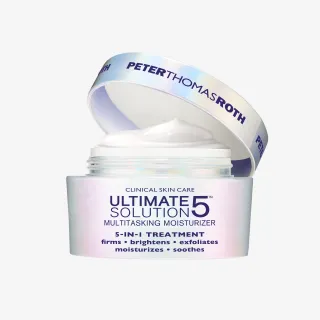
Peter Thomas Roth Ultimate Solution 5 Multitasking Moisturizer
Works for
4 of 4 advertised claims delivered
MoisturizingPanthenol, Acetyl hexapeptide-8 + 22 moreStrong evidence
“5. Moisturizes: Hyaluronic Acid, Collagen, Ceramide NP, Avocado Oil and Coconut Oil hydrate and plump the look of skin with moisture.”
This product can help improve hydration of the skin with the two types of ingredients.
The first type is called “humectants”:
these ingredients help attract water.
When humectants are on the surface of the skin, they “pull in” the moisture from the outside environment, or from
within deeper layers of the skin. The following ingredients in this product do the job:
glycerin, sodium hyaluronate.
This product also contains ingredients called “occlusives”. They help reduce the speed with which our skin loses moisture to the outside environment. These ingredients also help soften the upper layer of the skin, so it feels less tight and nicer to the touch. The following ingredients in this product do the job: butyrospermum parkii butter, caprylic/capric triglyceride.
The following ingredients in this product are especially good for supporting the skin barrier and helping with the hydration level: acetyl hexapeptide-8, ceramide np, palmitoyl tetrapeptide-7, palmitoyl tripeptide-1, palmitoyl tripeptide-5, panthenol
Evens skin toneGlycolic acid, Salicylic acid + 2 moreStrong evidence
“2. Brightens: A potent combination of Vitamin C, Lactic Acid and Maleic Acid helps brighten the look of dark spots and reduce the appearance of uneven tone.”
This product can help reduce hypepigmentation and even out the skin tone because it contains the following effective ingredients: glycolic acid, salicylic acid
Keep in mind that you would need to apply any topical skincare targetted at hypigmentation consistently for a couple of months to get a result. No topical skincare product can help get rid of hyperpigmentation (including post-acne marks and age spots) instantly.
Anti-agingGlycolic acid, Centella asiatica extract + 8 moreStrong evidence
“1. Firms: Cutting-edge Firma-CELL™ Peptide Complex treats the signs of aging, visibly helping to improve the look of firmness, fine lines and wrinkles.”
This product can help reduce and prevent fine lines and wrinkles, improve skin elasticity and firmness because it contains glycolic acid.
These ingredients in the product can also be helpful, even though there is less evidence for their effectiveness: acetyl hexapeptide-8, centella asiatica extract, palmitoyl tetrapeptide-7, palmitoyl tripeptide-1, palmitoyl tripeptide-5, vitis vinifera seed extract.
Keep in mind that it typically takes at least 6 weeks to notice any results because the changes that are needed to improve fine lines and elasticity happen in the deeper layers of the skin. No topical anti-aging product can “erase” wrinkles or fully reverse signs of aging.
ExfoliationGlycolic acid, Salicylic acid + 2 moreStrong evidence
“3. Exfoliates: Glycolic, Salicylic and Tartaric Acids chemically exfoliate to help improve the look of uneven texture, enlarged pores and dullness.”
This product can help exfoliate the skin. In other words, it helps break down the bonds between dead cells on the surface of the skin and speed up the skin turnover. Skin often appears softer and brighter after exfoliation, but overdoing it can result in disrupted skin barrier. The following ingredient is doing the exfoliating job in this product: glycolic acid, salicylic acid.
Anti-blemishNot advertised by the brand · Salicylic acid, Glycolic acid + 2 moreStrong evidence
This product can help reduce breakouts and clogged pores because it contains the following ingredient: salicylic acid. This ingredient is used for treating acne and can have a noticeable effect.
The following ingredient (ingredients) in this product might be helpful, but there is no evidence to confirm that it actually works: glycolic acid
Anti-oxidationNot advertised by the brand · Vitis vinifera seed extract, Tartaric acid + 8 moreStrong evidence
This product contains antioxidants (vitis vinifera seed extract) that can help neutralize free radicals in skin. By doing so, they can lessen the damage the skin gets from the UV light (sun).
The following ingredients - camellia sinensis leaf extract, centella asiatica extract, tartaric acid also can have an antioxidant effect, but there is less evidence to confirm their effectiveness in skin.
Can it cause trouble?
Irritancy1 strong irritant: Echinacea angustifolia extractMedium risk
Comedogenic4 ingredients rated 2 or more on the 0–5 pore-clogging scale4 flagged


User reviews
Be the first — your take helps the next person decide.
Ingredients
Filter by role to see what each ingredient is doing.
Water~45–55%
Glycerin~4.4–5.4%
- Irritation risk
- Low
One of the best moisturizing ingredients. Naturally present in skin. It attracts water to the upper layer of the skin working as a humectant
More about GlycerinCaprylic/capric triglyceride~4.3–5.2%
- Irritation risk
- Medium
A good mix of fatty acids that forms a protective layer on the skin. Improves the shelf life of products. Derived from coconut and glycerin
More about Caprylic/capric triglycerideCocos nucifera oil~3.1–3.8%
- Irritation risk
- Low
- Comedogenicity
- 3/5
An emollient. Found to be as effective as a moisturizer for dry skin as mineral oil. Could be comedogenic
More about Cocos nucifera oilGlycolic acid~2.3–2.9%
- Irritation risk
- High
An alpha-hydroxy acid (AHA) that helps to remove the dead skin cells on the surface of the skin reveling a more even, smoother complexation. It is also able to stimulate collagen production with long-term use. Could help to reduce pore congestion. It can be irritating to the skin. Apply sunscreen daily if using products with glycolic acid
More about Glycolic acidButyrospermum parkii butter~2–2.5%
- Irritation risk
- Low
- Comedogenicity
- 3/5
A great moisturising ingredient that softens the skin and reduces water loss from its upper layer. It also can be helpful in protecting skin from free radicals
More about Butyrospermum parkii butterButylene glycol~1.6–2%
- Irritation risk
- Low
Used to create a nice product texture and help delivery of other ingredients. Might be somewhat helpful in attracting water to the upper layer of the skin
More about Butylene glycolSodium hydroxide~1.5–1.8%
Cetearyl olivate~1.2–1.5%
Cetearyl alcohol~1.1–1.3%
- Irritation risk
- Low
- Comedogenicity
- 2/5
A non-drying alcohol. Works as an emollient. Helps water and oil mix together and creates a nice product texture
More about Cetearyl alcoholSodium acryloyldimethyltaurate/vp crosspolymer~0.7–1.05%
- Irritation risk
- Medium
Used to stabilize the product formulations
More about Sodium acryloyldimethyltaurate/vp crosspolymerCetyl alcohol~0.7–1.05%
- Irritation risk
- Low
A non-drying alcohol that works to soften the skin and stabilize product formulations helping oil and water mix together
More about Cetyl alcoholGlyceryl stearate~0.6–0.9%
- Irritation risk
- Low
An emollient that softens the skin and forms a protective layer on its surface. Helps water and oil mix together
More about Glyceryl stearateSorbitan olivate~0.5–0.75%
Tocopheryl acetate~0.45–0.7%
- Irritation risk
- Medium
A more stable but less bio-available form of vitamin E compared to Tocopherol. Might help moisturize and protect the skin from free radicals, but mostly used in low concentrations to stabilize other ingredients.
More about Tocopheryl acetatePalmitoyl tripeptide-5~0.45–0.65%
- Irritation risk
- Low
A type of peptide. Peptides are excellent moisturizers and might be able support collagen production reducing fine lines and wrinkles
More about Palmitoyl tripeptide-5Palmitoyl tripeptide-1~0.5–0.7%
- Irritation risk
- Low
A type of peptide. Peptides are excellent moisturizers and might be able support collagen production reducing fine lines and wrinkles
More about Palmitoyl tripeptide-1Palmitoyl tetrapeptide-7~0.45–0.65%
- Irritation risk
- Low
A type of peptide. Peptides are excellent moisturizers and might be able support collagen production reducing fine lines and wrinkles
More about Palmitoyl tetrapeptide-7Acetyl hexapeptide-8~0.3–0.6%
- Irritation risk
- Low
A type of peptide. Peptides are excellent moisturizers and might be able support collagen production reducing fine lines and wrinkles
More about Acetyl hexapeptide-8Ceramide np~0.35–0.65%
- Irritation risk
- Low
A type of lipid similar to ceramides naturally present in skin. Helps to soften the upper layer of the skin and supports the skin barrier function to keep it hydrated. Can help to prevent inflammation in skin
More about Ceramide npSodium hyaluronate~0.3–0.55%
- Irritation risk
- Low
One of the best moisturizing ingredients. Attracts water into the upper layer of the skin
More about Sodium hyaluronateLactic acid~0.3–0.5%
- Irritation risk
- Medium
An exfoliating and moisturizing alpha-hydroxy acid (AHA). Typically causes less irritation than other AHAs, for example, glycolic acid. At high concentrations (about 15%), lactic acid can help reduce lines and wrinkles. Recent studies show that lactic acid can support the "good" bacteria living on skin's surface (healthy skin microbiome)
More about Lactic acidSalicylic acid~0.25–0.5%
- Irritation risk
- High
Used for skin exfoliation. It has an anti-inflammatory and anti-bacterial effect, helps to unclog pores, prevent blemishes and speed up healing of the existing ones. Sometimes referred to as a BHA (beta-hydroxy acid)
More about Salicylic acidMaleic acid~0.3–0.5%
- Irritation risk
- Low
Tartaric acid~0.25–0.5%
- Irritation risk
- Medium
An AHA (alpha-hydroxy acid). It oxidizes quickly which makes it less effective in skincare formulations. It can support skin's barrier and moisture levels
More about Tartaric acidAscorbyl methylsilanol pectinate~0.25–0.5%
- Irritation risk
- Medium
A stable derivative of pectin and vitamin C. It might help neutralize free radicals in skin, but evidence of effectiveness is lacking. Helps create a thicker product consistency and stabilize the product formulation
More about Ascorbyl methylsilanol pectinateCentella asiatica extract~0.3–0.55%
- Irritation risk
- Medium
A plant extract that has been shown to be able to reduce inflammation in skin, support restoration of skin barrier function, as well as support collagen production. Contains active compounds called centelloids: asiaticoside, madecasosside, asiatic acid and madecassic acid. Might be helpful in preventing stretch marks. It can be itself be irritating though.
More about Centella asiatica extractCamellia sinensis leaf extract~0.3–0.55%
- Irritation risk
- Low
Can contain potent anti-oxidant compounds (abbreviated ECG, GCG, EGC, and EGCG) that might help protect the skin from free radicals. Can help calm down inflammation and has some anti-bacterial properties. Unfortunately, these antioxidants are unstable and lose their effectiveness very quickly in products. The concentration of the antioxidant compounds in the extract also tends to be low to be effective in topical formulation
More about Camellia sinensis leaf extractVitis vinifera seed extract~0.3–0.55%
- Irritation risk
- Low
A plant extract that contains resveratrol and other anti-oxidant compounds that can help neutralize free radicals, reduce inflammation in skin and even out its tone. Can be also used to stabilize the product formulation
More about Vitis vinifera seed extractEchinacea angustifolia extract~0.25–0.45%
- Irritation risk
- High
Plant extract that might contain antioxidants, have antibacterial effect and help reduce inflammation, but solid evidence is lacking. Can be irritating
More about Echinacea angustifolia extractMacrocystis pyrifera extract~0.25–0.5%
- Irritation risk
- Low
- Comedogenicity
- 3/5
Hydrolyzed vegetable protein~0.25–0.5%
Viola tricolor extract~0.25–0.5%
- Irritation risk
- Medium
A plant extract that might have an anti-inflammatory effect in skin
More about Viola tricolor extractFoeniculum vulgare seed extract~0.25–0.5%
- Irritation risk
- Low
Persea gratissima oil~0.3–0.6%
- Irritation risk
- Medium
An emollient that helps soften the skin and could be helpful in repairing its barrier function
More about Persea gratissima oilPanthenol~0.25–0.5%
- Irritation risk
- Low
Helps attract water to the upper layer of the skin and can help improve skin barrier function
More about PanthenolCholesterol~0.3–0.6%
- Irritation risk
- Low
An emollient that is naturally found in skin
More about CholesterolBisabolol~0.25–0.4%
- Irritation risk
- Low
An active component of chamomile plant that historically has been used to calm down irritated skin. A recent study shows that bisabolol indeed can have some anti-inflammatory effect on skin, even though conclusive data is lacking. Bisabolol has a sweet floral scent and can be added to products for its aromatic properties
More about BisabololSodium phytate~0.25–0.5%
Sodium lactate~0.25–0.5%
- Irritation risk
- Medium
Helps attract water to the upper layer of the skin. Is often used to adjust the pH level of the product
More about Sodium lactateLeuconostoc/radish root ferment filtrate~0.25–0.45%
- Irritation risk
- Medium
A preservative that comes from radishes fermented by a bacteria. New research suggests that the preservation properties in the ingredient come from an ammonium salt that is not present naturally in radish root but used in its cultivation. Is problematic because the exact amount of the preservative agents is difficult to determine
More about Leuconostoc/radish root ferment filtratePotassium cetyl phosphate~0.3–0.5%
- Irritation risk
- Medium
Helps oil and water mix together
More about Potassium cetyl phosphateCetearyl glucoside~0.25–0.5%
- Irritation risk
- Medium
Helps water and oil in the product mix well together and improves product texture
More about Cetearyl glucosideSodium benzoate~0.25–0.45%
Potassium sorbate~0.25–0.45%
Sorbitan isostearate~0.2–0.4%
- Irritation risk
- Low
Helps oil and water mix together
More about Sorbitan isostearateEthylhexylglycerin~0.2–0.35%
Hydroxyethyl acrylate/sodium acryloyldimethyl taurate copolymer~0.15–0.3%
- Irritation risk
- Medium
A gelling agent that thickens the product consistency and leaves the skin with a velvety finish
More about Hydroxyethyl acrylate/sodium acryloyldimethyl taurate copolymerCarbomer~0.15–0.3%
- Irritation risk
- Low
Helps create a thicker or gel-like product texture. It is not a surfactant but can be used in gentle cleansing formulations
More about CarbomerMethylpropanediol~0.15–0.3%
Polysorbate 60~0.15–0.3%
Polysorbate 20~0.1–0.2%
Phenoxyethanol~0.15–0.25%
- Irritation risk
- Low
A preservative. It helps prevent bacterial growth in cosmetic products
More about PhenoxyethanolIngredient list view
Water, Glycerin, Caprylic/capric triglyceride, Cocos nucifera oil, Glycolic acid, Butyrospermum parkii butter, Butylene glycol, Sodium hydroxide, Cetearyl olivate, Cetearyl alcohol, Sodium acryloyldimethyltaurate/vp crosspolymer, Cetyl alcohol, Glyceryl stearate, Sorbitan olivate, Tocopheryl acetate, Palmitoyl tripeptide-5, Palmitoyl tripeptide-1, Palmitoyl tetrapeptide-7, Acetyl hexapeptide-8, Ceramide np, Sodium hyaluronate, Lactic acid, Salicylic acid, Maleic acid, Tartaric acid, Ascorbyl methylsilanol pectinate, Centella asiatica extract, Camellia sinensis leaf extract, Vitis vinifera seed extract, Echinacea angustifolia extract, Macrocystis pyrifera extract, Hydrolyzed vegetable protein, Viola tricolor extract, Foeniculum vulgare seed extract, Persea gratissima oil, Panthenol, Cholesterol, Bisabolol, Sodium phytate, Sodium lactate, Leuconostoc/radish root ferment filtrate, Potassium cetyl phosphate, Cetearyl glucoside, Sodium benzoate, Potassium sorbate, Sorbitan isostearate, Ethylhexylglycerin, Hydroxyethyl acrylate/sodium acryloyldimethyl taurate copolymer, Carbomer, Methylpropanediol, Polysorbate 60, Polysorbate 20, Phenoxyethanol
Compare prices
Retailers ranked by price — lowest first.

Affiliate links · prices updated regularly
Worth comparing, line by line.
Match % combines shared ingredients, the first five ingredients, shared actives and hero ingredients, irritancy (lower counts in the alternative's favour), texture and body area. Only products in the same routine step are compared.
| Peter Thomas RothUltimate Solution 5 Multitasking MoisturizerYOUR PRODUCT | CeraVeBlemish Control Gel | Grahams NaturalKP Smoothing Cream | YEOUTHHyaluronic Acid Cream with Vitamin C E, Ferulic Acid, Tripeptide 31 Shea Butter | |
|---|---|---|---|---|
| Match | — | 72% | 71% | 70% |
| Price | $65.00 | $13.76−$51.24 | $23.99−$41.01 | $31.99−$33.01 |
| Shared key ingredients | — | 7 of 22 | 6 of 22 | 4 of 22 |
| Key difference | — | Niacinamide | Niacinamide | Ferulic Acid |
| Irritancy | Medium | Low | Low | Low |
| Drying alcohol | — | — | — | — |
| View product | Shop | Shop | Shop |

Sources cited in this review
Every concentration estimate and effectiveness label is anchored to one of these 34 studies and safety reviews.
- 1
- 2
- 3Glycolic acid peel therapy – a current reviewncbi.nlm.nih.gov
- 4
- 5
- 6

Affiliate links · As an Amazon Associate, WIMJ earns from qualifying purchases.