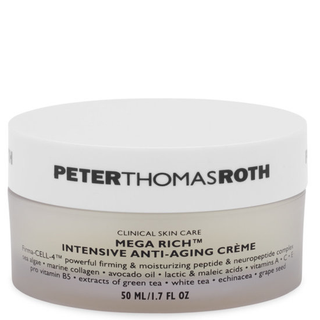
Peter Thomas Roth Mega-Rich Intensive Anti-Aging Cellular Creme
Works for
3 of 3 advertised claims delivered
Moisturizing32 ingredients credited for this claimStrong support
“Delivering intense hydration, Peter Thomas Roth Mega Rich Intensive Anti-Ageing Cellular Cream uses collagen and elastin to help tone, smooth and lift skin, reducing the appearance of fine lines and the severity of deep wrinkles.”
This product can help improve hydration of the skin with the two types of ingredients.
The first type is called “humectants”:
these ingredients help attract water.
When humectants are on the surface of the skin, they “pull in” the moisture from the outside environment, or from
within deeper layers of the skin. The following ingredients in this product do the job:
algae extract, glycerin.
This product also contains ingredients called “occlusives”. They help reduce the speed with which our skin loses moisture to the outside environment. These ingredients also help soften the upper layer of the skin, so it feels less tight and nicer to the touch. The following ingredients in this product do the job: dimethicone, algae extract.
The following ingredients in this product are especially good for supporting the skin barrier and helping with the hydration level: acetyl hexapeptide-8, linoleic acid, palmitoyl oligopeptide, palmitoyl tetrapeptide-7, palmitoyl tripeptide-5, panthenol
Evens skin tone3 ingredients credited for this claimModerate support
“The complex helps to improve the look of skin firmness, tone, smoothness, clarity, fine lines, and deep wrinkles.”
The following ingredient (ingredients) in this product might be helpful, but there is no evidence to confirm that it actually works: retinyl palmitate.
Anti-aging12 ingredients credited for this claimModerate support
“Mega-Rich Intensive Anti-Aging Cellular Creme”
This product contains acetyl hexapeptide-8, centella asiatica extract, palmitoyl oligopeptide, palmitoyl tetrapeptide-7, palmitoyl tripeptide-5, retinyl palmitate, vitis vinifera seed extract. These ingredients might be able to help reduce and prevent fine lines and wrinkles, improve skin elasticity and firmness, but there is not enough evidence that it actually works.
Anti-oxidationNot advertised by the brand · 15 ingredients credited for this claimStrong support
This product contains antioxidants (superoxide dismutase, vitis vinifera seed extract) that can help neutralize free radicals in skin. By doing so, they can lessen the damage the skin gets from the UV light (sun).
The following ingredients - camellia sinensis leaf extract, centella asiatica extract, ginkgo biloba leaf extract, tartaric acid, tocopheryl linoleate also can have an antioxidant effect, but there is less evidence to confirm their effectiveness in skin.
Can it cause trouble?
Irritancy4 strong irritants: Zingiber officinale root extract, Citrus limon peel extract + 2 more — patch-test recommendedHigh risk
Comedogenic2 ingredients rated 2 or more on the 0–5 pore-clogging scale2 flagged
User reviews
Be the first — your take helps the next person decide.
Ingredients
Filter by role to see what each ingredient is doing.
Water~45–55%
Glycerin~4.8–5.9%
- Irritation risk
- Low
One of the best moisturizing ingredients. Naturally present in skin. It attracts water to the upper layer of the skin working as a humectant
More about GlycerinAcetyl hexapeptide-8~4–4.9%
- Irritation risk
- Low
A type of peptide. Peptides are excellent moisturizers and might be able support collagen production reducing fine lines and wrinkles
More about Acetyl hexapeptide-8C12-15 alkyl benzoate~3.1–3.8%
- Irritation risk
- Low
Enhances the product texture and makes it more spreadable. Helps reduce water loss from the outer layer of skin. Extands the shelf life by preventing bacteria growth
More about C12-15 alkyl benzoateGlyceryl stearate~2.3–2.8%
- Irritation risk
- Low
An emollient that softens the skin and forms a protective layer on its surface. Helps water and oil mix together
More about Glyceryl stearateIsocetyl stearate~1.9–2.4%
- Irritation risk
- Low
An emollient that helps soften the skin
More about Isocetyl stearatePanthenol~1.5–1.9%
- Irritation risk
- Low
Helps attract water to the upper layer of the skin and can help improve skin barrier function
More about PanthenolCetyl alcohol~1.5–1.9%
- Irritation risk
- Low
A non-drying alcohol that works to soften the skin and stabilize product formulations helping oil and water mix together
More about Cetyl alcoholPersea gratissima oil~1.3–1.6%
- Irritation risk
- Medium
An emollient that helps soften the skin and could be helpful in repairing its barrier function
More about Persea gratissima oilPeg-100 stearate~1.2–1.4%
- Irritation risk
- Low
Helps oil and water mix togehter and creates a nice product texture
More about Peg-100 stearateTocopheryl acetate~0.7–1.1%
- Irritation risk
- Medium
A more stable but less bio-available form of vitamin E compared to Tocopherol. Might help moisturize and protect the skin from free radicals, but mostly used in low concentrations to stabilize other ingredients.
More about Tocopheryl acetatePropylene glycol stearate~0.6–0.85%
Palmitoyl tripeptide-5~0.55–0.8%
- Irritation risk
- Low
A type of peptide. Peptides are excellent moisturizers and might be able support collagen production reducing fine lines and wrinkles
More about Palmitoyl tripeptide-5Palmitoyl tetrapeptide-7~0.55–0.8%
- Irritation risk
- Low
A type of peptide. Peptides are excellent moisturizers and might be able support collagen production reducing fine lines and wrinkles
More about Palmitoyl tetrapeptide-7Palmitoyl oligopeptide~0.65–0.95%
- Irritation risk
- Low
A type of peptide. Peptides are excellent moisturizers and might be able support collagen production reducing fine lines and wrinkles
More about Palmitoyl oligopeptideZingiber officinale root extract~0.45–0.65%
- Irritation risk
- High
A plant extract that can contain an irritating essential oil. Might have some anti-oxidant effect, but evidence is lacking
More about Zingiber officinale root extractCitrus limon peel extract~0.4–0.65%
Echinacea purpurea extract~0.35–0.6%
- Irritation risk
- High
Plant extract that might have some anti-oxidant properties. Can be irritating
More about Echinacea purpurea extractCentella asiatica extract~0.45–0.65%
- Irritation risk
- Medium
A plant extract that has been shown to be able to reduce inflammation in skin, support restoration of skin barrier function, as well as support collagen production. Contains active compounds called centelloids: asiaticoside, madecasosside, asiatic acid and madecassic acid. Might be helpful in preventing stretch marks. It can be itself be irritating though.
More about Centella asiatica extractGinkgo biloba leaf extract~0.3–0.55%
- Irritation risk
- High
A plant extract that might help neutralize free radicals and reduce inflammation in skin. It can be irritating
More about Ginkgo biloba leaf extractVitis vinifera seed extract~0.3–0.6%
- Irritation risk
- Low
A plant extract that contains resveratrol and other anti-oxidant compounds that can help neutralize free radicals, reduce inflammation in skin and even out its tone. Can be also used to stabilize the product formulation
More about Vitis vinifera seed extractCamellia sinensis leaf extract~0.3–0.55%
- Irritation risk
- Low
Can contain potent anti-oxidant compounds (abbreviated ECG, GCG, EGC, and EGCG) that might help protect the skin from free radicals. Can help calm down inflammation and has some anti-bacterial properties. Unfortunately, these antioxidants are unstable and lose their effectiveness very quickly in products. The concentration of the antioxidant compounds in the extract also tends to be low to be effective in topical formulation
More about Camellia sinensis leaf extractFoeniculum vulgare fruit extract~0.25–0.5%
- Irritation risk
- Low
Viola tricolor extract~0.25–0.5%
- Irritation risk
- Medium
A plant extract that might have an anti-inflammatory effect in skin
More about Viola tricolor extractAlgae extract~0.35–0.6%
- Irritation risk
- Low
- Comedogenicity
- 3/5
Plant extract that helps the skin to attract water and make it more smooth for touch. Also shows promise of anti-aging properties, but research is not extensive yet
More about Algae extractRetinyl palmitate~0.25–0.5%
- Irritation risk
- High
Three steps removed from the active form of vitamin A - retinoic acid. To have an effect in the skin, it first needs to be converted twice to become the retinoic acid. This means it is less potent than retinol, but could also be less irritating. Once converted to the retinoic acid in the skin, it helps against all signs of aging, improves skin cell turnover and helps fight blemishes and clogged pores. However, in many cosmetic formulations, it is used in a concentration that is too low to have the full effect
More about Retinyl palmitateRosa canina seed extract~0.3–0.55%
- Irritation risk
- Low
Ascorbyl palmitate~0.25–0.5%
- Irritation risk
- Medium
Being a lipid soluble form of vitamin C, it is more stable and can penetrate the skin better than L-Ascorbic acid. It is effective in protecting the skin from free radicals, as well as evening the skin tone, but is less effective in stimulating collagen production compared to L-Ascorbic acid.
More about Ascorbyl palmitateAscorbyl methylsilanol pectinate~0.25–0.5%
- Irritation risk
- Medium
A stable derivative of pectin and vitamin C. It might help neutralize free radicals in skin, but evidence of effectiveness is lacking. Helps create a thicker product consistency and stabilize the product formulation
More about Ascorbyl methylsilanol pectinateTocopheryl linoleate~0.25–0.5%
- Irritation risk
- Medium
A relative of vitamin E (Tocopherol). It can have an anti-oxidant effect in skin and/or to stabilize the product fromulation. It could be irritating but most of the reported allergy and irritation cases appeared in one geographic location (Switzerland) in 1992, and might be due to the quality issues in manufacturing of a particular batch of the ingredient
More about Tocopheryl linoleateWheat amino acids~0.2–0.4%
- Irritation risk
- Low
Sodium pca~0.25–0.5%
- Irritation risk
- Low
Naturally present in skin and helps to attract water to its upper layer
More about Sodium pcaSodium ascorbyl phosphate~0.3–0.5%
- Irritation risk
- Medium
A stable derivative of vitamin C. It is oil-soluble which means it is more likely to penetrate the skin compared to the pure form of vitamin C (which is water-soluble), but it is less bio-available and is way less effective in stimulating collagen and reducing wrinkles compared to the pure form of vitamin C (L-ascorbic acid) and its other derivatives (for example, magnesium ascorbyl phosphate). At the same time, this vitamin C derivative has been shown in studies to be effective in reducing acne, blemishes and clogged pores. It is less irritating then the pure form of vitamin C
More about Sodium ascorbyl phosphatePhospholipids~0.25–0.5%
- Irritation risk
- Low
Emollients that are naturaly present in skin. In addition, they help water and oil mix together in the product
More about PhospholipidsHydrolyzed elastin~0.3–0.55%
- Irritation risk
- Low
Maleic acid~0.25–0.5%
- Irritation risk
- Low
Lactic acid~0.25–0.5%
- Irritation risk
- Medium
An exfoliating and moisturizing alpha-hydroxy acid (AHA). Typically causes less irritation than other AHAs, for example, glycolic acid. At high concentrations (about 15%), lactic acid can help reduce lines and wrinkles. Recent studies show that lactic acid can support the "good" bacteria living on skin's surface (healthy skin microbiome)
More about Lactic acidTartaric acid~0.25–0.5%
- Irritation risk
- Medium
An AHA (alpha-hydroxy acid). It oxidizes quickly which makes it less effective in skincare formulations. It can support skin's barrier and moisture levels
More about Tartaric acidSoluble collagen~0.3–0.5%
- Irritation risk
- Low
A typically plant-derived compound that is supposed mimic human collagen. Cannot penetrate the skin barrier so is not particularly useful in skincare products beyond attracting water to the upper layer of the skin
More about Soluble collagenBisabolol~0.25–0.4%
- Irritation risk
- Low
An active component of chamomile plant that historically has been used to calm down irritated skin. A recent study shows that bisabolol indeed can have some anti-inflammatory effect on skin, even though conclusive data is lacking. Bisabolol has a sweet floral scent and can be added to products for its aromatic properties
More about BisabololPolysorbate 20~0.3–0.55%
Carbomer~0.25–0.5%
- Irritation risk
- Low
Helps create a thicker or gel-like product texture. It is not a surfactant but can be used in gentle cleansing formulations
More about CarbomerSodium hyaluronate~0.25–0.5%
- Irritation risk
- Low
One of the best moisturizing ingredients. Attracts water into the upper layer of the skin
More about Sodium hyaluronatePropylene glycol~0.25–0.45%
- Irritation risk
- High
Helps oil and water mix together and can enhance the penetration of other ingredients into the skin. It can be irritating
More about Propylene glycolCaprylic/capric triglyceride~0.3–0.6%
- Irritation risk
- Medium
A good mix of fatty acids that forms a protective layer on the skin. Improves the shelf life of products. Derived from coconut and glycerin
More about Caprylic/capric triglycerideButylene glycol~0.25–0.45%
- Irritation risk
- Low
Used to create a nice product texture and help delivery of other ingredients. Might be somewhat helpful in attracting water to the upper layer of the skin
More about Butylene glycolStearoxytrimethylsilane~0.3–0.5%
Stearyl alcohol~0.3–0.55%
- Irritation risk
- Low
An emollient that helps soften the skin
More about Stearyl alcoholLanolin oil~0.3–0.5%
- Irritation risk
- Low
Sebum of wool-bearing animals (most commonly sheep). Helps soften the upper layer of the skin and reduce the skin water loss. In rare cases could be an allergen. Not suitable for vegans
More about Lanolin oilLanolin alcohol~0.3–0.55%
- Irritation risk
- Medium
Helps oil and water mix together. Can be irritating
More about Lanolin alcoholDimethicone~0.25–0.5%
- Irritation risk
- Low
A silicone that helps to reduce water loss from the surface of the skin. Can temporarily "fill in" lines and wrinkles, absorb oil, and create a nice product finish
More about DimethiconeHistidine hcl~0.2–0.35%
- Irritation risk
- Low
A salt of an amino-acid that helps attract water to the upper layer of the skin. Might be helpful in restoring the skin barrier function
More about Histidine hclSuperoxide dismutase~0.2–0.35%
- Irritation risk
- Low
An antioxidant enzyme that is naturally present in skin. It can help support skin barrier function and reduce inflammation in skin. It is used in topical medications for inflammatory skin conditions including atopic dermatitis (eczema) and psoriasis. There are three types of natural Superoxide Dismutase in human skin. The compound used in topical treatments and cosmetics are mimics of typically one of these natural variants
More about Superoxide dismutaseOleic acid~0.2–0.35%
- Irritation risk
- Medium
Helps soften the upper layer of the skin. At the same time, it can weaken the skin's barrier enhancing penetration of other ingredients and increasing the risk of skin dryness
More about Oleic acidLinoleic acid~0.4–0.6%
- Irritation risk
- Low
An excellent emollient. Helps soften the skin, restore its barrier function, and can help to calm down inflammation. It can be helpful to prevent blemishes and clogged pores
More about Linoleic acidDiazolidinyl urea~0.15–0.25%
- Irritation risk
- High
A preservative. Works by releasing formaldehyde. Can be irritating
More about Diazolidinyl ureaMethylparaben~0.1–0.25%
Propylparaben~0.1–0.2%
Ingredient list view
Water, Glycerin, Acetyl hexapeptide-8, C12-15 alkyl benzoate, Glyceryl stearate, Isocetyl stearate, Panthenol, Cetyl alcohol, Persea gratissima oil, Peg-100 stearate, Tocopheryl acetate, Propylene glycol stearate, Palmitoyl tripeptide-5, Palmitoyl tetrapeptide-7, Palmitoyl oligopeptide, Zingiber officinale root extract, Citrus limon peel extract, Echinacea purpurea extract, Centella asiatica extract, Ginkgo biloba leaf extract, Vitis vinifera seed extract, Camellia sinensis leaf extract, Foeniculum vulgare fruit extract, Viola tricolor extract, Algae extract, Retinyl palmitate, Rosa canina seed extract, Ascorbyl palmitate, Ascorbyl methylsilanol pectinate, Tocopheryl linoleate, Wheat amino acids, Sodium pca, Sodium ascorbyl phosphate, Phospholipids, Hydrolyzed elastin, Maleic acid, Lactic acid, Tartaric acid, Soluble collagen, Bisabolol, Polysorbate 20, Carbomer, Sodium hyaluronate, Propylene glycol, Caprylic/capric triglyceride, Butylene glycol, Stearoxytrimethylsilane, Stearyl alcohol, Lanolin oil, Lanolin alcohol, Dimethicone, Histidine hcl, Superoxide dismutase, Oleic acid, Linoleic acid, Diazolidinyl urea, Methylparaben, Propylparaben
Compare prices
Retailers ranked by price — lowest first.

Product summary
Based on the ingredient list, "Peter Thomas Roth - Mega-Rich Intensive Anti-Aging Cellular Creme" can work well for skin moisturization. The formulation is based on a combination of good humectants and emollients. Both are needed to increase the skin hydration level. Glycerin, sodium hyaluronate, sodium pca, soluble collagen and butylene glycol in this product (humectants) attract water molecules to the upper layer of the skin (the water comes from the outside air or from the deeper layers of the skin if the air is dry). Ceramide 3, beeswax, caprylic/capric triglyceride, dimethicone and squalane in this product help decrease the water evoporation from the skin, so that it stays hydrated for longer. These ingredients also soften the skin and take away the feeling of tightness and dryness.
Ingredient callouts
- This product also contains Vitamin C (Ascorbic Acid). It can be an effective active for anti-aging and evening out the skin tone, but in this moisturizer it is used for stabilizing other ingredients in the formulation. In this concentration (0.30% - 0.55%) it cannot have a noticeable benefit for the skin.
- This moisturizer includes a form of Retinoids (vitamin A) - retinyl palmitate 0.30% - 0.60%, but this type of vitamin A is not very effective. It could in theory help with fine lines and wrinkles, but the effect is most likely minimal.
- As a plus, this moisturizer also contains Ceramides (ceramide 3 0.30% - 0.60%). Ceramides are a type of lipids that our skin produces itself. They are a building block of the skin's barrier. Ceramides used in skincare are synthetic or extracted from plants. They work well for softening the skin surface and "patch holes" in the skin's barrier.
- This moisturizer also contains Peptides (palmitoyl oligopeptide 0.55% - 0.85%). Peptides are a very big group of ingredients. They all consist of a different combination of aminoacids. Our skin produces Peptides naturally. Some of them work as natural antibiotics, promote wound-healing and production of collagen. The scientists are still studying how effective the topical application of Peptides is, but it is very likely that they are helpful. Peptides might be able to support skin barrier restoration and even have an anti-aging benefit. At the very least, they certainly help attract water to the skin and support the hydration in this way.
Irritation risk
This formulation includes some common irritants, including ingredients that do not provide a benefit for the skin. We assess the overall irritancy of this moisturizer to be medium. For a detailed overview of all potential irritants: click here
You can see the detailed formula review with the breakdown of all actives in the product and the full ingredient list with estimated concentrations in the tables below.
Price
The product retails from 65.00$ up to 85.00$ in the United States, for 89.99A$ in Australia, from 45.00£ up to 81.60£ in the United Kingdom and from 81.90CA$ up to 107.10CA$ in Canada.
For a detailed price comparison: click here.
Sources cited in this review
Every concentration estimate and effectiveness label is anchored to one of these 55 studies and safety reviews.
- 1
- 2Skin moisturizing effects of panthenol-based formulationspdfs.semanticscholar.org
- 3
- 4
- 5
- 6

Affiliate links · As an Amazon Associate, WIMJ earns from qualifying purchases.