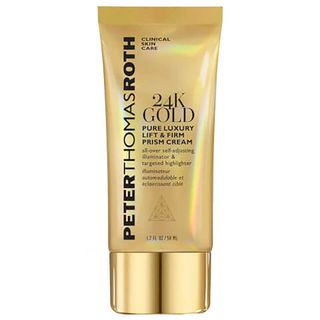
Peter Thomas Roth 24K Gold Prism Cream
Works for
1 of 2 advertised claims delivered
Moisturizing16 ingredients credited for this claimGood support
“Enriched with 24K gold, colloidal gold, and intelligent shade-sensing sphere technology, the formula uses optical diffusers to scatter light and diminish the appearance of imperfections, plus advanced hydrators to help to prevent water loss to provide immediate and long-term hydration to create a fresh, dewy finish.Cruelty free Read more”
This product can help improve hydration of the skin with the two types of ingredients.
The first type is called “humectants”:
these ingredients help attract water.
When humectants are on the surface of the skin, they “pull in” the moisture from the outside environment, or from
within deeper layers of the skin. The following ingredients in this product do the job:
glycerin, hyaluronic acid.
This product also contains ingredients called “occlusives”. They help reduce the speed with which our skin loses moisture to the outside environment. These ingredients also help soften the upper layer of the skin, so it feels less tight and nicer to the touch. The following ingredients in this product do the job: dimethicone, simmondsia chinensis seed oil.
Evens skin toneNo ingredient credited for this claimNo support
“Three shade-sensing spheres are combined to provide a full spectrum of radiance and are self-adjusting to complement every skin tone.”
Effective ingredients missing or their concentration is too low
Can it cause trouble?
Irritancy1 strong irritant: Hamamelis virginiana waterMedium risk
Comedogenic1 ingredient rated 2 or more on the 0–5 pore-clogging scale1 flagged
User reviews
Be the first — your take helps the next person decide.
Ingredients
Filter by role to see what each ingredient is doing.
Gold~22–33%
Hyaluronic acid~4.1–6.1%
- Irritation risk
- Low
One of the best moisturizing ingredients. Attracts water into the upper layer of the skin. Naturally present in skin. Typically has large molecule size unless advertised otherwise on the product label. Helps support skin's barrier function and may help to reduce inflammation
More about Hyaluronic acidAloe barbadensis extract~4.4–6.6%
- Irritation risk
- Medium
Traditionally used to treat sunburns, dermatitis and inflammation, but evidence for its effectiveness is lacking. The extract can contain humectants that help attract water into the skin
More about Aloe barbadensis extractSimmondsia chinensis seed oil~3.8–5.8%
- Irritation risk
- Medium
Softens the upper layer of skin and helps restore the healthy skin barrier. Has shown to help calm down inflammation in skin. It is a stable oil, meaning that it retains its properties even when exposed to air.
More about Simmondsia chinensis seed oilPersea gratissima oil~2.8–4.2%
- Irritation risk
- Medium
An emollient that helps soften the skin and could be helpful in repairing its barrier function
More about Persea gratissima oilWater~2–2.9%
Glycerin~1.6–2.4%
- Irritation risk
- Low
One of the best moisturizing ingredients. Naturally present in skin. It attracts water to the upper layer of the skin working as a humectant
More about GlycerinMica~1.4–2.1%
- Irritation risk
- Low
Creates an illusion of smoother and more radiant skin tone. Adds shimmer to the skin by reflecting light
More about MicaHydrogenated polyisobutene~1.3–1.9%
- Irritation risk
- Low
Used to improve the product consistency and soften the upper layer of the skin
More about Hydrogenated polyisobuteneHomosalate~1.3–1.9%
- Irritation risk
- Medium
A weak sunscreen that offers some protection against the sun rays that cause sunburn (UVB), but does not offer meaningful protection against protect against the most aging sun rays (UVA). It loses its effectiveness quickly when exposed to sunlight. It is an organic, or so called "chemical" sunscreen. When used in low concentrations, helps to stabilize the product formulation
More about HomosalatePropanediol~0.55–1.25%
- Irritation risk
- Low
Acts as a solvent for other ingredients. Speeds up the absorption of other ingredients into the skin
More about PropanediolEthylhexyl methoxycinnamate~0.85–1.25%
- Irritation risk
- High
Octinoxate. When used in higher concentrations, works as a sunscreen protecting the skin from UVB rays. When used in lower concentration, helps to preserve the product formulation. Is shown to be harmful to coral reefs - consider avoiding bathing in coral reef areas when wearing a product with this ingredient. It can be irritating
More about Ethylhexyl methoxycinnamateOctyldodecanol~0.45–1.05%
- Irritation risk
- Low
An emollient that helps to soften the skin and create a pleasant product texture and stabilize the formulation
More about OctyldodecanolTrilaureth-4 phosphate~0.4–0.9%
- Irritation risk
- Medium
Helps oil and water mix together
More about Trilaureth-4 phosphateGlyceryl stearate~0.4–0.95%
- Irritation risk
- Low
An emollient that softens the skin and forms a protective layer on its surface. Helps water and oil mix together
More about Glyceryl stearateJojoba esters~0.4–0.95%
- Irritation risk
- Medium
An emollient made of jojoba oil. Helps soften the skin and support its barrier function
More about Jojoba estersCetyl alcohol~0.4–0.95%
- Irritation risk
- Low
A non-drying alcohol that works to soften the skin and stabilize product formulations helping oil and water mix together
More about Cetyl alcoholCeteareth-12~0.3–0.75%
Ceteareth-20~0.4–0.9%
- Irritation risk
- Medium
- Comedogenicity
- 2/5
Helps oil and water mix together. Has some emollient properties
More about Ceteareth-20Colloidal gold~0.2–0.75%
- Irritation risk
- Low
Sodium hyaluronate~0.15–0.7%
- Irritation risk
- Low
One of the best moisturizing ingredients. Attracts water into the upper layer of the skin
More about Sodium hyaluronateTocopherol~0.3–0.75%
- Irritation risk
- Low
Pure form of vitamin E. Can help moisturise and protect the skin from free radicals. Often used to help stabilise other ingredients or the formula itself
More about TocopherolAloe barbadensis leaf juice~0.15–0.65%
- Irritation risk
- Medium
Traditionally used to treat sunburns, dermatitis and inflammation, but evidence for its effectiveness is lacking. The extract can contain humectants that help attract water into the skin
More about Aloe barbadensis leaf juiceBht~0.2–0.8%
Persea gratissima oil~0.3–0.75%
- Irritation risk
- Medium
An emollient that helps soften the skin and could be helpful in repairing its barrier function
More about Persea gratissima oilDimethicone~0.3–0.75%
- Irritation risk
- Low
A silicone that helps to reduce water loss from the surface of the skin. Can temporarily "fill in" lines and wrinkles, absorb oil, and create a nice product finish
More about DimethiconePentaerythrityl tetraethylhexanoate~0.3–0.75%
- Irritation risk
- Low
Used to create a nice product consistency while softening the upper layer of the skin
More about Pentaerythrityl tetraethylhexanoateHamamelis virginiana water~0.15–0.55%
- Irritation risk
- High
A plant extract that can help calm down inflammation in skin. Can, however, itself be irritating
More about Hamamelis virginiana waterCarbomer~0.15–0.65%
- Irritation risk
- Low
Helps create a thicker or gel-like product texture. It is not a surfactant but can be used in gentle cleansing formulations
More about CarbomerCitric acid~0.15–0.65%
- Irritation risk
- Medium
Can work as an exfoliant but is typically used to adjust the product pH
More about Citric acidBoron nitride~0.2–0.7%
- Irritation risk
- Low
Helps to absord oil and evenly disperse other ingredients (for example, pigment) in product formulation
More about Boron nitrideHdi/trimethylol hexyllactone crosspolymer~0.15–0.65%
- Irritation risk
- Low
Used to create a silky product texture and add volume to products
More about Hdi/trimethylol hexyllactone crosspolymerTin oxide~0.35–0.8%
- Irritation risk
- Low
A colorant that can add a pearl-like appearance to the formulation
More about Tin oxideSilica dimethyl silylate~0.3–0.7%
Triethanolamine~0.15–0.7%
- Irritation risk
- Medium
Used to adjust pH of the product and can help improve the product's smell
More about TriethanolamineSilica~0.35–0.8%
Polyester-1~0.4–0.9%
- Irritation risk
- Low
Benzoic acid~0.25–0.5%
Pentylene glycol~0.35–0.85%
- Irritation risk
- Medium
Used to preserve products, dissolve other ingredients and create a nice product texture
More about Pentylene glycolPotassium sorbate~0.3–0.6%
Sodium benzoate~0.25–0.5%
Phenoxyethanol~0.15–0.55%
- Irritation risk
- Low
A preservative. It helps prevent bacterial growth in cosmetic products
More about PhenoxyethanolGold~0.1–0.45%
Ci 77480~0.1–0.4%
- Irritation risk
- Low
Titanium dioxide~0.15–0.7%
- Irritation risk
- Low
Works as a UV filter when used in high concentrations. It is photostable and is effective mostly against the UVB light, with some protection in the UVA range. In small concentrations, used for its ability to improve the color of cosmetic products. Is usually well tolerated by the skin
More about Titanium dioxideCi 77891~0.1–0.35%
- Irritation risk
- Low
Ci 75470~0.05–0.25%
Iron oxides~0.05–0.25%
- Irritation risk
- Low
An umbrella term for the following three colorants: CI 77491, CI 77492, CI 77499. They might be able to offer some protection against visible light, but the degree of the protection is not clear
More about Iron oxidesIngredient list view
Gold, Hyaluronic acid, Aloe barbadensis extract, Simmondsia chinensis seed oil, Persea gratissima oil, Unknown, Water, Glycerin, Mica, Hydrogenated polyisobutene, Homosalate, Propanediol, Ethylhexyl methoxycinnamate, Octyldodecanol, Trilaureth-4 phosphate, Glyceryl stearate, Jojoba esters, Cetyl alcohol, Ceteareth-12, Ceteareth-20, Colloidal gold, Sodium hyaluronate, Tocopherol, Aloe barbadensis leaf juice, Bht, Persea gratissima oil, Dimethicone, Pentaerythrityl tetraethylhexanoate, Hamamelis virginiana water, Carbomer, Citric acid, Boron nitride, Hdi/trimethylol hexyllactone crosspolymer, Tin oxide, Silica dimethyl silylate, Triethanolamine, Silica, Polyester-1, Benzoic acid, Pentylene glycol, Potassium sorbate, Sodium benzoate, Phenoxyethanol, Gold, Ci 77480, Titanium dioxide, Ci 77891, Ci 75470, Iron oxides
Compare prices
Retailers ranked by price — lowest first.


Sources cited in this review
Every concentration estimate and effectiveness label is anchored to one of these 15 studies and safety reviews.
- 1Efficacy of a New Topical Nano-hyaluronic Acid in Humansncbi.nlm.nih.gov
- 2Physiochemical properties and application of hyaluronic acid: a systematic reviewonlinelibrary.wiley.com
- 3
- 4
- 5
- 6Hyaluronic acid: A key molecule in skin agingncbi.nlm.nih.gov

Affiliate links · As an Amazon Associate, WIMJ earns from qualifying purchases.