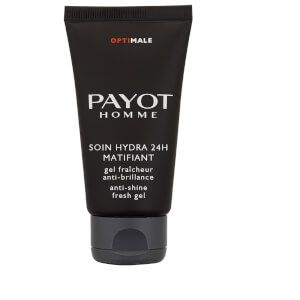
Payot Men Soin Hydra 24H Matifiant Anti-Shine Fresh Gel
Works for
1 of 1 advertised claim delivered
Moisturizing13 ingredients credited for this claimGood support
“Men Soin Hydra 24H Matifiant Anti-Shine Fresh Gel”
This product can help improve hydration of the skin with the two types of ingredients.
The first type is called “humectants”:
these ingredients help attract water.
When humectants are on the surface of the skin, they “pull in” the moisture from the outside environment, or from
within deeper layers of the skin. The following ingredients in this product do the job:
diglycerin, glycerin.
This product also contains ingredients called “occlusives”. They help reduce the speed with which our skin loses moisture to the outside environment. These ingredients also help soften the upper layer of the skin, so it feels less tight and nicer to the touch. The following ingredients in this product do the job: dimethicone, cetyl alcohol.
Can it cause trouble?
Irritancy8 strong irritants: Alcohol, Parfum + 6 more — patch-test recommendedHigh risk
ComedogenicClean of flagged comedogenic ingredientsNone flagged
User reviews
Be the first — your take helps the next person decide.
Ingredients
Filter by role to see what each ingredient is doing.
Water~40–60%
Alcohol~6.3–9.5%
- Irritation risk
- High
Can be drying and contribute to skin irritation. Used in formulars to dissolve other ingredients, create a thinner product consistency or for its antibacterial properties
More about AlcoholGlycerin~3.4–5%
- Irritation risk
- Low
One of the best moisturizing ingredients. Naturally present in skin. It attracts water to the upper layer of the skin working as a humectant
More about GlycerinDiglycerin~2.5–3.7%
- Irritation risk
- Low
Helps attract water to the upper layer of the skin
More about DiglycerinButylene glycol~1.8–2.7%
- Irritation risk
- Low
Used to create a nice product texture and help delivery of other ingredients. Might be somewhat helpful in attracting water to the upper layer of the skin
More about Butylene glycolTapioca starch~1.4–2.1%
Cetearyl isononanoate~1.2–1.8%
- Irritation risk
- Low
An emollient that softens the skin and helps prevent moisture loss.
More about Cetearyl isononanoateDimethicone~1.1–1.6%
- Irritation risk
- Low
A silicone that helps to reduce water loss from the surface of the skin. Can temporarily "fill in" lines and wrinkles, absorb oil, and create a nice product finish
More about DimethiconeIsodecyl neopentanoate~0.85–1.25%
- Irritation risk
- Low
An emollient that helps soften the skin. It also forms a protective on its surface to reduce water loss.
More about Isodecyl neopentanoateNylon-12~0.6–1.35%
Polymethyl methacrylate~0.4–0.95%
- Irritation risk
- Low
Is used to enhance product texture and can help to optically mask skin imperfections
More about Polymethyl methacrylatePtfe~0.35–0.8%
Sodium polyacrylate~0.3–0.75%
- Irritation risk
- Low
Used to create a gel-like product texture, as well as to stabilize emulsions
More about Sodium polyacrylateOlea europaea leaf extract~0.15–0.6%
- Irritation risk
- Medium
A plant extract that might have some anti-oxidant and anti-inflammatory properties but evidence for effectiveness in skin is missing
More about Olea europaea leaf extractMagnesium pca~0.15–0.55%
- Irritation risk
- Low
Helps attract water to the upper layer of the skin
More about Magnesium pcaMalachite extract~0.15–0.6%
- Irritation risk
- Low
A mineral that is claimed to be able to support collagen product in skin, but evidence of effectiveness is missing
More about Malachite extractSodium pca~0.15–0.55%
- Irritation risk
- Low
Naturally present in skin and helps to attract water to its upper layer
More about Sodium pcaManganese pca~0.1–0.45%
- Irritation risk
- Low
Helps attract water to the upper layer of the skin. Often used as a part of an ingredient complex Physiogenyl together with Sodium PCA, Magnesium PCA and Zinc PCA. The manufacturer claims that it does more than attracting water, but there is no evidence or studies supporting this claim
More about Manganese pcaZinc pca~0.1–0.5%
- Irritation risk
- Low
A compound that combines zinc with a hydrating ingredient PCA. Might to be helpful against acne and clogged pores. Can help calm down inflammation in skin. Could be helpful in reducing the formation of free radicals in skin. Might help to reduce fine lines in wrinkles, but solid evidence is missing
More about Zinc pcaLauryl glucoside~0.15–0.55%
Polyglyceryl-2 dipolyhydroxystearate~0.1–0.3%
- Irritation risk
- Low
Helps to soften the upper layer of the skin
More about Polyglyceryl-2 dipolyhydroxystearateSorbitan isostearate~0.1–0.35%
- Irritation risk
- Low
Helps oil and water mix together
More about Sorbitan isostearateAscorbyl tetraisopalmitate~0.05–0.3%
- Irritation risk
- Medium
A vitamin C derivative. Studies show that is might be effective in reducing hyperpigmentation, but there are no studies confirming that it is effectively converted into the bioavailable form of Vitamin C in skin. It is not clear how this derivative compares in effectiveness to the topical application of bioavailable form of vitamin C (L-ascorbic acid)
More about Ascorbyl tetraisopalmitatePolysorbate 20~0.1–0.3%
Polymethylsilsesquioxane~0.05–0.3%
- Irritation risk
- Low
A silicone that improves product texture and helps dissolve other ingredients. Can form a non-greasy film on the skin to prevent moisture loss
More about PolymethylsilsesquioxanePolyisobutene~0.1–0.3%
Polyacrylate-13~0.05–0.3%
- Irritation risk
- Low
Used to create a thicker product consistency and stabilize the product formulation
More about Polyacrylate-13Cetyl alcohol~0.1–0.3%
- Irritation risk
- Low
A non-drying alcohol that works to soften the skin and stabilize product formulations helping oil and water mix together
More about Cetyl alcoholIron oxides~0.05–0.25%
- Irritation risk
- Low
An umbrella term for the following three colorants: CI 77491, CI 77492, CI 77499. They might be able to offer some protection against visible light, but the degree of the protection is not clear
More about Iron oxidesCitric acid~0.05–0.25%
- Irritation risk
- Medium
Can work as an exfoliant but is typically used to adjust the product pH
More about Citric acidO-cymen-5-ol~0.05–0.1%
Potassium sorbate~0.05–0.3%
Phenoxyethanol~0.1–0.3%
- Irritation risk
- Low
A preservative. It helps prevent bacterial growth in cosmetic products
More about PhenoxyethanolSorbic acid~0.05–0.3%
Sodium benzoate~0.05–0.25%
Parfum~0.05–0.2%
- Irritation risk
- High
An aromatic blend of unspecified and possibly irritating ingredients
More about ParfumHexyl cinnamal~0.05–0.2%
Linalool~0.05–0.2%
Benzyl salicylate~0.05–0.15%
Limonene~0.05–0.15%
- Irritation risk
- High
A common frangrance that can easily irritate skin, especially if exposed to air, light or heat
More about LimoneneCoumarin~0.01–0.05%
Butylphenyl methylpropional~0.01–0.05%
- Irritation risk
- High
A fragrance. Can trigger allergic reactions and be irritating
More about Butylphenyl methylpropionalIngredient list view
Water, Alcohol, Glycerin, Diglycerin, Butylene glycol, Tapioca starch, Cetearyl isononanoate, Dimethicone, Isodecyl neopentanoate, Nylon-12, Polymethyl methacrylate, Ptfe, Sodium polyacrylate, Olea europaea leaf extract, Magnesium pca, Malachite extract, Sodium pca, Manganese pca, Zinc pca, Lauryl glucoside, Polyglyceryl-2 dipolyhydroxystearate, Sorbitan isostearate, Ascorbyl tetraisopalmitate, Polysorbate 20, Polymethylsilsesquioxane, Polyisobutene, Polyacrylate-13, Cetyl alcohol, Iron oxides, Citric acid, O-cymen-5-ol, Potassium sorbate, Phenoxyethanol, Sorbic acid, Sodium benzoate, Parfum, Hexyl cinnamal, Linalool, Benzyl salicylate, Limonene, Coumarin, Butylphenyl methylpropional
Compare prices
Retailers ranked by price — lowest first.

.png)
Sources cited in this review
Every concentration estimate and effectiveness label is anchored to one of these 15 studies and safety reviews.
- 1
- 2
- 3Final Report on the Safety Assessment of Dimethicone Copolyoljournals.sagepub.com
- 4Safety Assessment of Fluoropolymers as Used in Cosmeticscir-safety.org
- 5
- 6

Affiliate links · As an Amazon Associate, WIMJ earns from qualifying purchases.