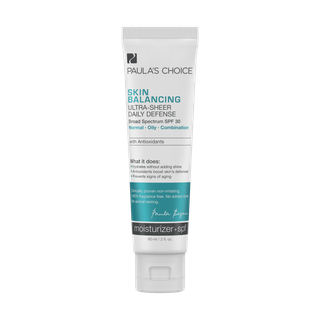
Paula's choice Ultra-Sheer Daily Defense Broad Spectrum SPF 30
Works for
3 of 3 advertised claims delivered
Sun protectionSPF 30 · 5 UV filtersBroad spectrum
This product offers a good level of protection against both UVB and UVA rays.
This sunscreen uses organic (so-called "chemical") sunscreen filters. Organic, or "chemical" filters usually provide reliable sun protection and rarely leave a white cast. Sunscreens with organic filters can sting eyes.
Evens skin tone1 ingredient credited for this claimStrong support
“SKIN BALANCING Ultra-Sheer Daily Defense SPF 30 feels wonderfully light, but its broad-spectrum, oil-absorbing formula gives skin a nourishing supply of antioxidants to diminish the appearance of wrinkles and uneven skin tone and to smooth away dryness for younger-looking skin!”
This product offers broad spectrum sun protection. It means that it can prevent hyperpigmentation and help keep the skin tone even (sun damage is the main factor causing age spots, darkening of post-acne marks and other discolorations).
Anti-aging4 ingredients credited for this claimStrong support
“SKIN BALANCING Ultra-Sheer Daily Defense SPF 30 feels wonderfully light, but its broad-spectrum, oil-absorbing formula gives skin a nourishing supply of antioxidants to diminish the appearance of wrinkles and uneven skin tone and to smooth away dryness for younger-looking skin!”
This product can help reduce and prevent fine lines and wrinkles, improve skin elasticity and firmness because it contains adenosine.
Keep in mind that it typically takes at least 6 weeks to notice any results because the changes that are needed to improve fine lines and elasticity happen in the deeper layers of the skin. No topical anti-aging product can “erase” wrinkles or fully reverse signs of aging.
This product can also help prevent early signs of skin aging because it offers a good level of broad spectrum sun protection. Sun damage is the main cause of premature skin aging, and protecting your skin from the sun is the best anti-aging strategy.
MoisturizingNot advertised by the brand · 10 ingredients credited for this claimStrong support
This product can help improve hydration of the skin with the two types of ingredients.
The first type is called “humectants”:
these ingredients help attract water.
When humectants are on the surface of the skin, they “pull in” the moisture from the outside environment, or from
within deeper layers of the skin. The following ingredients in this product do the job:
panthenol, butylene glycol.
This product also contains ingredients called “occlusives”. They help reduce the speed with which our skin loses moisture to the outside environment. These ingredients also help soften the upper layer of the skin, so it feels less tight and nicer to the touch. The following ingredients in this product do the job: cetyl dimethicone.
The following ingredients in this product are especially good for supporting the skin barrier and helping with the hydration level: panthenol
Anti-oxidationNot advertised by the brand · 11 ingredients credited for this claimStrong support
This product contains antioxidants (superoxide dismutase) that can help neutralize free radicals in skin. By doing so, they can lessen the damage the skin gets from the UV light (sun).
The following ingredients - camellia sinensis extract, camellia sinensis leaf extract, ginkgo biloba leaf extract also can have an antioxidant effect, but there is less evidence to confirm their effectiveness in skin.
Can it cause trouble?
Irritancy1 strong irritant: Benzophenone-3Medium risk
ComedogenicClean of flagged comedogenic ingredientsNone flagged
User reviews
Be the first — your take helps the next person decide.
Ingredients
Filter by role to see what each ingredient is doing.
Butyl methoxydibenzoylmethane3%
- Irritation risk
- Medium
Avobenzone. An organic, or so-called "chemical" UV filter. Protects against both UVA and UVB rays. Needs to be combined with other filters in a formulation to be stable.
More about Butyl methoxydibenzoylmethaneHomosalate7%
- Irritation risk
- Medium
A weak sunscreen that offers some protection against the sun rays that cause sunburn (UVB), but does not offer meaningful protection against protect against the most aging sun rays (UVA). It loses its effectiveness quickly when exposed to sunlight. It is an organic, or so called "chemical" sunscreen. When used in low concentrations, helps to stabilize the product formulation
More about HomosalateOctocrylene2%
- Irritation risk
- Medium
A weak sunscreen that protects against the sun rays that cause sunburn (UVB) and is somewhat effective against the UVA rays. It is quite stable and can help stabilize other, more vulnerable, sunscreen ingredients like Avobenzone. It is an organic, or so called "chemical" sunscreen
More about OctocryleneBenzophenone-34%
- Irritation risk
- High
Same as oxybenzone. Protects in the UVB and short UVA range. In small concentrations, used to stabilize product formulation. Can be irritating. Is shown to be harmful to coral reefs - consider avoiding bathing in coral reef areas when wearing a product with this ingredient. It can penetrate the skin and get absorbed into bloodstream faster than other popular filters available in the US. The study that produced this finding did not address any potential health effects of the absorption
More about Benzophenone-3Water~45–55%
Butylene glycol~6–7.3%
- Irritation risk
- Low
Used to create a nice product texture and help delivery of other ingredients. Might be somewhat helpful in attracting water to the upper layer of the skin
More about Butylene glycolSilica~5.4–6.6%
Aluminum starch octenylsuccinate~4–4.9%
- Irritation risk
- Medium
Used to thicken the product's consistency
More about Aluminum starch octenylsuccinateCetyl dimethicone~3.2–3.9%
- Irritation risk
- Low
A type of silicone. Helps soften the upper layer of the skin and creates a nice, light product texture
More about Cetyl dimethiconeCamellia sinensis leaf extract~2.2–2.6%
- Irritation risk
- Low
Can contain potent anti-oxidant compounds (abbreviated ECG, GCG, EGC, and EGCG) that might help protect the skin from free radicals. Can help calm down inflammation and has some anti-bacterial properties. Unfortunately, these antioxidants are unstable and lose their effectiveness very quickly in products. The concentration of the antioxidant compounds in the extract also tends to be low to be effective in topical formulation
More about Camellia sinensis leaf extractCamellia sinensis extract~1.7–2.1%
- Irritation risk
- Low
Tea extract. Might be helpful in neutralizing free radicals in skin
More about Camellia sinensis extractAloe barbadensis leaf juice powder~1.4–1.7%
- Irritation risk
- Medium
Traditionally used to treat sunburns, dermatitis and inflammation, but evidence for its effectiveness is lacking. The extract can contain humectants that help attract water into the skin
More about Aloe barbadensis leaf juice powderAscorbyl palmitate~1.2–1.4%
- Irritation risk
- Medium
Being a lipid soluble form of vitamin C, it is more stable and can penetrate the skin better than L-Ascorbic acid. It is effective in protecting the skin from free radicals, as well as evening the skin tone, but is less effective in stimulating collagen production compared to L-Ascorbic acid.
More about Ascorbyl palmitatePhospholipids~1–1.2%
- Irritation risk
- Low
Emollients that are naturaly present in skin. In addition, they help water and oil mix together in the product
More about PhospholipidsSuperoxide dismutase~0.7–1.05%
- Irritation risk
- Low
An antioxidant enzyme that is naturally present in skin. It can help support skin barrier function and reduce inflammation in skin. It is used in topical medications for inflammatory skin conditions including atopic dermatitis (eczema) and psoriasis. There are three types of natural Superoxide Dismutase in human skin. The compound used in topical treatments and cosmetics are mimics of typically one of these natural variants
More about Superoxide dismutaseAdenosine~0.6–0.9%
- Irritation risk
- Low
Might help improve cell turnover and reduce inflammation in skin. One study shows that the ingredients might be able to help reduce dynamic wrinkles (for example, in the corners of the eyes or on the forehead)
More about AdenosineTocopherol~0.55–0.8%
- Irritation risk
- Low
Pure form of vitamin E. Can help moisturise and protect the skin from free radicals. Often used to help stabilise other ingredients or the formula itself
More about TocopherolBisabolol~0.45–0.7%
- Irritation risk
- Low
An active component of chamomile plant that historically has been used to calm down irritated skin. A recent study shows that bisabolol indeed can have some anti-inflammatory effect on skin, even though conclusive data is lacking. Bisabolol has a sweet floral scent and can be added to products for its aromatic properties
More about BisabololBoerhavia diffusa root extract~0.45–0.7%
- Irritation risk
- Medium
A plant extract that might help reduce inflammation and neutralize free radicals
More about Boerhavia diffusa root extractColloidal oatmeal~0.65–1%
- Irritation risk
- Low
Helps to restore skin barrier function, soften the upper layer of the skin and calm down inflammation
More about Colloidal oatmealPanthenol~0.45–0.65%
- Irritation risk
- Low
Helps attract water to the upper layer of the skin and can help improve skin barrier function
More about PanthenolGinkgo biloba leaf extract~0.4–0.6%
- Irritation risk
- High
A plant extract that might help neutralize free radicals and reduce inflammation in skin. It can be irritating
More about Ginkgo biloba leaf extractSalix alba bark extract~0.3–0.6%
- Irritation risk
- High
A plant extract that can help neutralize free radicals in skin. It contains a compound salicin that can theoretically be converted into salicylic acid that, in turn, helps reduce inflammation in skin, but the evidence of effectiveness in skin is lacking and the extract is usually not used in a concentration that would enable an exfoliating effect
More about Salix alba bark extractAcrylates/c10-30 alkyl acrylate crosspolymer~0.45–0.65%
- Irritation risk
- Medium
Maintains the texture of skincare products. Allows the product to spread evenly. Helps oil and water mix together
More about Acrylates/c10-30 alkyl acrylate crosspolymerTitanium dioxide~0.35–0.6%
- Irritation risk
- Low
Works as a UV filter when used in high concentrations. It is photostable and is effective mostly against the UVB light, with some protection in the UVA range. In small concentrations, used for its ability to improve the color of cosmetic products. Is usually well tolerated by the skin
More about Titanium dioxideSodium hydroxide~0.3–0.6%
Steareth-21~0.4–0.65%
Steareth-2~0.3–0.55%
Polysorbate 20~0.3–0.55%
Disodium edta~0.25–0.45%
Phenoxyethanol~0.2–0.4%
- Irritation risk
- Low
A preservative. It helps prevent bacterial growth in cosmetic products
More about PhenoxyethanolSorbic acid~0.2–0.35%
Ingredient list view
Butyl methoxydibenzoylmethane, Homosalate, Octocrylene, Benzophenone-3, Water, Butylene glycol, Silica, Aluminum starch octenylsuccinate, Cetyl dimethicone, Camellia sinensis leaf extract, Camellia sinensis extract, Aloe barbadensis leaf juice powder, Ascorbyl palmitate, Phospholipids, Superoxide dismutase, Adenosine, Tocopherol, Bisabolol, Boerhavia diffusa root extract, Colloidal oatmeal, Panthenol, Ginkgo biloba leaf extract, Salix alba bark extract, Acrylates/c10-30 alkyl acrylate crosspolymer, Titanium dioxide, Sodium hydroxide, Steareth-21, Steareth-2, Polysorbate 20, Disodium edta, Phenoxyethanol, Sorbic acid
Compare prices
Retailers ranked by price — lowest first.

Affiliate links · prices updated regularly
Product summary
We assess that "Paula's choice - Ultra-Sheer Daily Defense Broad Spectrum SPF 30" can provide reliable sun protection based on the ingredient list. It can protect from both UVA and UVB rays. This is great news because not all sunscreens with SPF ratings give UVA protection. (UVA rays do not cause sunburn, but still damage our skin and lead to early aging).
Its formula is also hydrating, so you might not need an additional moistruizer during the day. Like all broad-spectrum sunscreens, this product has an anti-aging benefit.
Sunscreen filters
This is a "mixed" sunscreen in the sense that it uses both mineral and organic (so-called "chemical") sun filters. Here are the organic filters this product uses: oxybenzone, avobenzone, homosalate and octocrylene. As for the mineral filters, this sunscreen uses titanium dioxide.
Irritation risk
There are actives in this product that can be irritating. We assess the overall irritancy of this product to be medium. For a detailed overview of all potential irritants: click here
You can see the detailed formula review with the breakdown of all actives in the product and the full ingredient list with estimated concentrations in the tables below.
Price
The product retails for 33.00$ in the United States.
For a detailed price comparison: click here.
Sources cited in this review
Every concentration estimate and effectiveness label is anchored to one of these 25 studies and safety reviews.
- 1
- 2
- 3
- 4On Photostability of Oxybenzonecore.ac.uk
- 5
- 6

Affiliate links · As an Amazon Associate, WIMJ earns from qualifying purchases.